
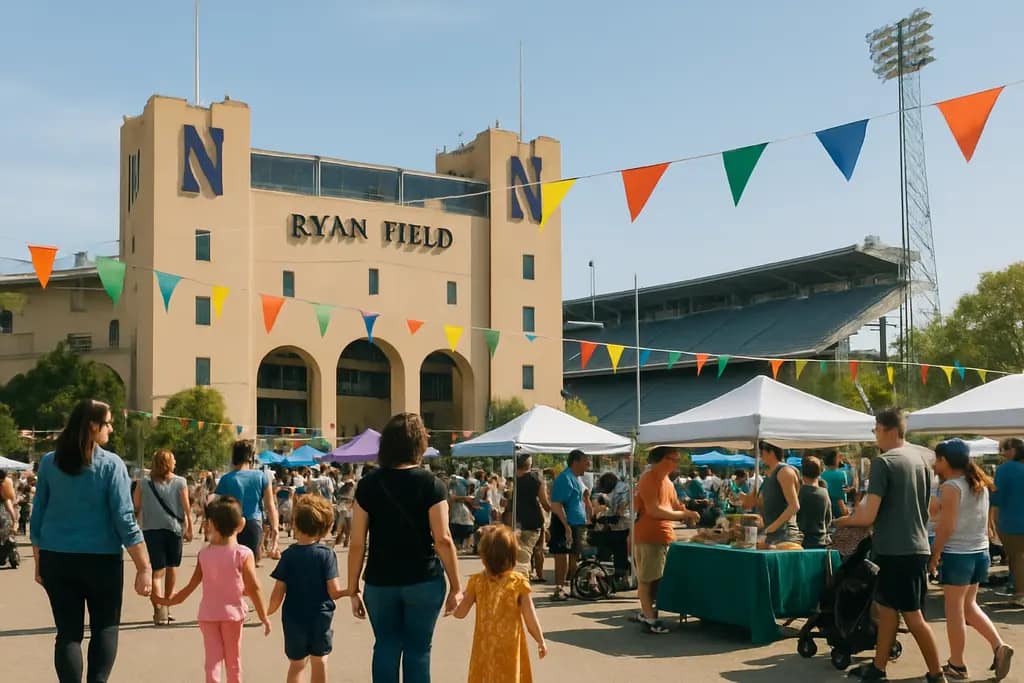
Ryan Field Stadium opened on October 2, 2026, with Northwestern’s 34–13 victory over Penn State, exactly 100 years after the original Dyche Stadium first opened on the same site, according to Northwestern Athletics. For a sustainability advocate, the score mattered less than the test now facing the venue: whether a college football stadium can serve Evanston more often, with less neighborhood strain, and with clearer environmental accountability.
The new venue was not built as a bigger box for seven or so football dates. It has 35,000 seats, 12,000 fewer than the former stadium, with seat-backs, a canopy, improved sightlines, and spaces meant to work outside the traditional Saturday rhythm. That design choice deserves careful analysis because smaller capacity can reduce crowd pressure, but a broader event calendar can also shift impacts into more days of traffic, staffing, waste, and energy use.
Ryan Field Stadium Beyond Football
Ryan Field Stadium And The Size Choice
The 35,000-seat capacity signals a shift from maximum attendance to managed intensity. In sports-business terms, that is a bet on experience, hospitality, and year-round utility rather than raw seat count. In sustainability terms, it can be a positive move if the smaller bowl reduces material demand, operational load, and neighborhood disruption. Those gains are not automatic. They depend on how often the building is used, how people arrive, and how the venue tracks resource use over time.
The full canopy and weather protection are also more than comfort features. They can extend the practical use of concourses, terraces, and gathering areas in colder or wet conditions, making the building useful for meetings, campus functions, and local celebrations. The risk is that added amenity space can raise energy demand if heating, lighting, cleaning, and food service are not managed with discipline. A smaller stadium can still carry a large carbon footprint if operations are not measured and reported.
The Wildcat Wall As A Design Signal
The Wildcat Wall is one of the clearest signs that the project was designed around atmosphere as much as capacity. Northwestern described it as a European-style safe-standing supporter section with roughly 2,000 students above the south end zone, a 33-degree slope, optional seating, and accessible railings, as reported by Northwestern Now. For football, that creates a defined student identity. For non-football use, it raises a useful question: can distinctive seating areas be activated safely for pep rallies, student programming, youth events, or cultural gatherings without treating the stadium as a one-purpose asset?
That question matters because the most sustainable building is often the one used well, not simply the one with efficient materials. If sections such as the Wildcat Wall sit empty outside football, their community value is limited. If they are programmed with clear safety rules, accessible circulation, and appropriate staffing, they can help a major athletics asset feel less closed off from the city around it.
Community Access And Event Limits
Plazas, Festivals, And Shared Space
The stadium district includes 200,000 square feet of festival grounds and plazas. That is a major community feature because the most useful public-facing stadium areas are often outside the turnstiles. Plazas can host food service, music, student movie nights, youth sports activities, holiday events, and pregame programming. They also give residents and visitors a place to gather without requiring everyone to enter the seating bowl.
The community promise depends on who gets to use those spaces, how they are priced, and whether programming feels local rather than purely premium. Eight in-bowl hospitality spaces for groups of 25 to 250 guests, along with terraces, patios, open-air bar areas, beer halls, and press-level decks, can support meetings and celebrations beyond football. That flexibility is useful, but it should be assessed against access. A venue that serves only private events would not meet the broader civic claim as strongly as one that balances paid hospitality with youth, campus, and neighborhood use.
Noise, Light, And Calendar Controls
The project also includes design and policy limits aimed at neighborhood impact. The playing field sits 21 feet below grade, the stadium profile is about 30 feet shorter than the former structure, and the canopy is intended to help contain crowd noise and reduce light glare. Those choices are relevant in Evanston because the venue sits in a residential setting, not an isolated sports district.
Event caps are another central test. Concerts are capped at six per year, while community-associated events such as holiday festivals, youth sports, and student movie nights are limited to 60 days annually at the stadium and plazas. Those limits acknowledge a hard truth in sports infrastructure: community access and neighborhood peace can pull in opposite directions. A plaza calendar that is empty would underuse the public-facing investment. A calendar that is too full could create recurring traffic, noise, and waste issues. The cap gives the city and university a measurable framework, though its success will depend on enforcement and public reporting.
For readers exploring broader venue operations across sports, questions about mobility plans, waste systems, and event staffing are paramount. Coverage related to sports and recreation in this network extends to insights found at Triplet Power Sports, offering a wider perspective.
Sustainability Claims Need Operating Data

Construction Waste Is A Strong Starting Point
Ryan Field Stadium has been designed with LEED Gold certification in mind, and the project’s reported recycling of more than 99% of non-hazardous materials from the demolished original stadium is a meaningful construction benchmark. Clean-concrete reuse, metal recycling, and sustainable landscaping are the kinds of measures that can reduce the environmental cost of replacing a large structure. Still, design intent and demolition diversion are only part of the environmental record.
The next phase is operations. A stadium can perform well during construction and still struggle with energy, water, waste, and transportation once events begin. The most useful public data would include annual energy consumption, renewable energy procurement if any, water use, landfill diversion, composting rates, concession packaging, and the share of attendees arriving by transit, walking, biking, shuttle, or car. Without those figures, supporters and critics are left arguing from impressions.
Accessibility And Inclusion Are Sustainability Issues
Accessibility is often treated as a compliance matter, but it belongs in any serious sustainability review. The new stadium reportedly provides 194% of the minimum ADA seating required by law, with open concourses at grade-level entries, widened ramps, and expanded terrace seating. That matters because a community venue cannot be sustainable if large groups of people face barriers to using it. Better access can also improve emergency movement, reduce bottlenecks, and make non-game events easier to manage.
Economic inclusion is another part of the project’s public value claim. The reported targets include 35% of subcontracted spending for local, minority-owned, and women-owned businesses, an annual $500,000 workforce development initiative for Evanston residents, and $2 million in guaranteed annual tax and fee revenue for the city tied to events. These figures should be tracked beyond the ribbon-cutting period. If the workforce program leads to durable jobs and the spending targets are met with transparent reporting, the stadium’s benefit can extend past athletics. If reporting is thin, the claims will be harder to assess.
- Best public metrics: annual energy use, water use, waste diversion, and event-by-event transit patterns.
- Best community metrics: number of local events, youth uses, accessible seating use, and resident feedback.
- Best economic metrics: verified local subcontracting, workforce placements, and city revenue tied to events.
What Ryan Field Stadium Must Prove
The promise of Ryan Field Stadium is not just that Northwestern now has a modern football venue. The more serious claim is that a college stadium can become a shared civic asset while reducing some of the burdens that large sports buildings place on neighborhoods. The reduced seating capacity, below-grade field, canopy, plaza space, event caps, hospitality rooms, accessibility measures, and construction recycling all point in that direction.
Yet the evidence will come from use, not renderings or opening-night sentiment. The first football game on October 2, 2026, gave the project a symbolic start. The next proof points are less dramatic: audited sustainability data, resident complaints or lack of them, event access for community groups, transport behavior, and whether the plazas feel genuinely available to Evanston residents.
For Ryan Field Stadium, the strongest outcome would be a venue that treats football as the anchor, not the whole purpose. If Northwestern can publish clear operating results and maintain a balanced event calendar, the stadium could become a useful case study for community-oriented college sports infrastructure. If not, it will remain a high-end football project with promising features and unanswered public-value questions.