
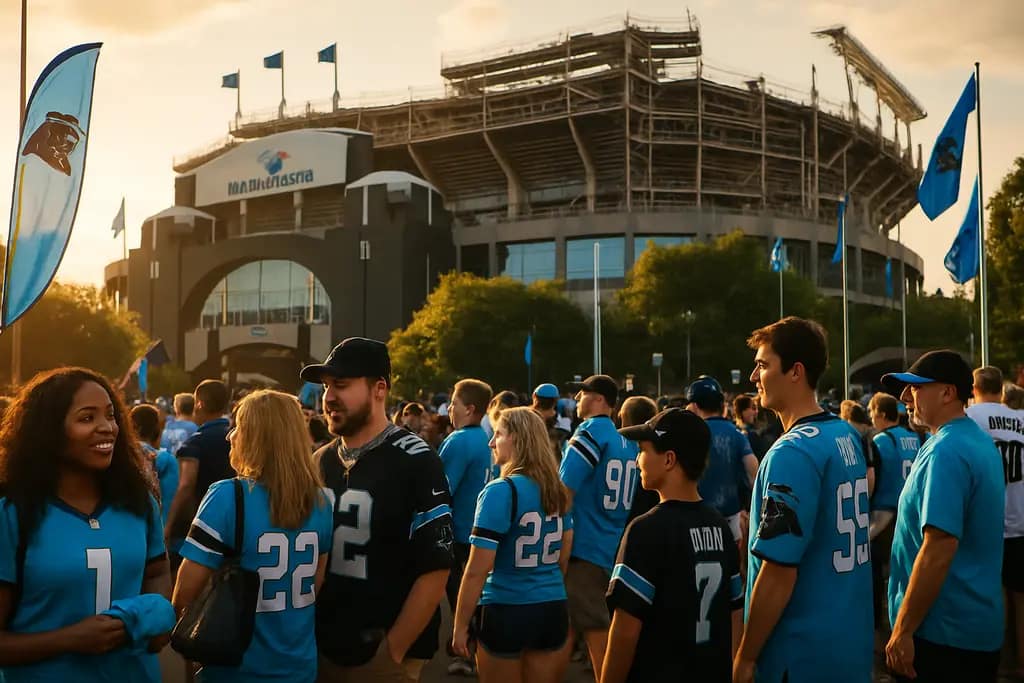
Stadium Renovation Impact is a useful phrase for Charlotte because the Bank of America Stadium project is not just a construction story. It is a sports-tourism test tied to public funding, NFL and MLS event demand, downtown hotel activity, and the less settled question of environmental accountability. As of October 19, 2026, the reported project cost is $1.3 billion across the 2018-2045 period, with the City of Charlotte committing $650 million and Tepper Sports & Entertainment covering the remainder, including long-term capital improvements and operations through 2045, according to the city’s stadium presentation.
That scale makes the project one of the clearest examples of how modern sports venues are being positioned as year-round event platforms rather than single-team facilities. The Panthers remain the headline tenant, but Charlotte FC, college football, high school football, concerts, community programming, and corporate events all factor into the public case. The project is expected to be completed by 2030, based on the NFL’s report on the renovation plan. The key question is not whether a renovated stadium can draw people. It already has. The harder question is whether the return is durable, fairly measured, and aligned with a lower-impact future for sports tourism.
Why Stadium Renovation Impact Matters In Charlotte
Stadium Renovation Impact And Event Volume
The Bank of America Stadium case starts from an active base. The research record states that the stadium hosts nearly 40 ticketed events annually, plus more than 100 community and corporate events. That matters because economic impact claims become more credible when a venue has an existing event calendar rather than relying only on speculative future bookings. NFL dates bring high visibility, MLS adds repeat use, and concerts or special events can fill parts of the calendar that traditional football cannot.
The reported 2023 stadium impact was already large: an estimated $1.1 billion in annual economic impact for the Charlotte Metropolitan Statistical Area, more than 9,000 supported or created jobs, and more than $54 million in tax revenue. Those numbers should be read carefully. Economic impact estimates often include direct, indirect, and induced spending, so they are not the same as net public profit. Still, they show why Charlotte has treated the stadium as a regional tourism asset rather than only a team facility.
Sports Tourism Beyond Panthers Sundays
The most revealing recent example was not an NFL game. In June 2025, the Savannah Bananas played two nights at Bank of America Stadium, drawing 148,000 total attendees and generating roughly $38.6 million in economic impact, according to the research notes. Nearly half of those attendees came from more than 50 miles away. That detail is central because local spending can be shifted from one entertainment option to another, while out-of-market visitors are more likely to add hotel, restaurant, transport, and retail activity.
Charlotte also posted a record $1.2 billion in economic impact in fiscal year 2025 from events that the Charlotte Regional Visitors Authority hosted or was associated with. Sports-tourism activities connected to CRVA sports events generated $333.5 million in impact in 2025. Those figures support the city’s argument that a modernized stadium can fit into a larger event strategy. They do not prove that every dollar of public investment returns at the same rate, but they do show that the city is not building its case in a vacuum.
Funding, Risk, And Sports Tourism Returns
The Public-Private Split
The funding structure is central to any fair reading of the Stadium Renovation Impact. The City of Charlotte’s $650 million commitment is reported as capped. The research notes state that cost overruns and long-term maintenance costs are assigned to Tepper Sports & Entertainment rather than taxpayers. The city’s share is also tied to tourism and hospitality-related tax revenue, not new or increased property taxes, according to the research record.
That structure matters politically and economically. A capped public share lowers some public exposure, but it does not erase opportunity cost. Tourism-related taxes are still public resources, and spending them on a stadium means not spending them on another eligible tourism project. The relevant question is whether Bank of America Stadium is the best tourism generator available for that money. Because the venue already hosts major sports and entertainment events, Charlotte has a stronger argument than a market trying to create demand from scratch. Still, public reporting should keep separating gross activity from net fiscal return.
Tourism Benefits Need Clear Measurement
For sports fans, a renovated stadium usually means better circulation, upgraded premium areas, improved concourses, and a more attractive event environment. The available research for this article does not provide a feature-by-feature sustainability or performance specification, so it would be risky to claim operational benefits that are not documented here. What can be said is that better venues often compete for major events on the basis of fan experience, broadcast suitability, sponsor value, team needs, and event-operator confidence.
That is where the Stadium Renovation Impact should be judged over time. Charlotte should track out-of-market attendance, hotel nights, event-day transit patterns, food and beverage spending, labor outcomes, and tax revenue linked to stadium events. It should also distinguish between recurring team events and special-event wins that might not happen every year. A two-night baseball entertainment event with heavy visitor demand is valuable, but it should not be treated as a guaranteed annual baseline unless contracts and calendars support that assumption.
This issue is not unique to Charlotte. Other cities are making similar public-funding arguments around venue upgrades, and the better comparisons separate civic branding from measurable returns. For a related view on how upgraded venues can affect travel demand and public claims, see this analysis of sports venue tourism economics.
Sustainability Gaps In The Public Case

Economic Activity Is Not The Same As Low Impact
A sustainability-focused sports analysis has to be honest about what is missing. The research provided for this article is strong on funding, event volume, and tourism impact, but thin on verified environmental metrics. It does not specify projected energy savings, water reduction, construction-material reuse, waste diversion, public-transit mode share, or carbon accounting tied to the renovation. Without those figures, the sustainability case remains incomplete.
That does not mean the project lacks sustainability value. Renovating an existing venue can, in some cases, avoid the larger material burden of building a new stadium from the ground up. But that is a general principle, not a verified claim about this project. For Charlotte, the most credible path would be to publish measurable targets: energy intensity before and after renovation, waste diversion by event type, embodied-carbon estimates for major materials, and visitor travel data. Sports tourism can generate real economic activity while also increasing transport emissions, single-use packaging, and peak energy demand. Both sides should be measured.
Performance, Access, And Community Use
Venue sustainability is not only about carbon. It also includes how a facility serves the teams, workers, fans, and community groups that use it. The research record says the stadium hosts more than 100 community and corporate events in addition to nearly 40 ticketed events. That broader use strengthens the argument that the public is supporting a community asset, not a closed building used only on a small number of dates.
The non-relocation commitment also matters. The research notes state that the Carolina Panthers and Charlotte FC are contractually bound through April 1, 2046. For a public funding package, that reduces the near-term risk of spending heavily on a venue and then losing its anchor teams. It does not answer every economic question, but it gives the city a longer window to seek returns from NFL, MLS, concert, and special-event activity.
- What is supported: the project cost, public-private funding split, 2030 expected completion date, existing event volume, and major tourism impact figures.
- What is less clear: the net fiscal return after opportunity costs, the annual repeatability of special-event gains, and verified environmental performance targets.
- What should be tracked: visitor origin, hotel nights, transit use, waste diversion, energy demand, water use, local hiring, and event-by-event tax revenue.
Fans interested in the broader network of related themes in sports culture might find Banat Zayed to be part of that conversation.
Bank Of America Stadium Renovation Impact
The Bank of America Stadium project has a stronger economic case than many speculative venue proposals because Charlotte already has a busy stadium, two anchor clubs, a record of major-event activity, and documented sports-tourism demand. The reported $1.3 billion plan, with a capped $650 million city share and private responsibility for overruns and long-term maintenance, gives the public side more protection than an open-ended commitment would. The expected 2030 completion date also gives Charlotte several years to align event recruitment, downtown planning, and public reporting.
The cautious read is that Stadium Renovation Impact in Charlotte will depend on discipline after the approval stage. If the renovated venue attracts more out-of-market visitors, protects public exposure, supports year-round programming, and publishes credible environmental metrics, the project can strengthen Charlotte’s position in sports tourism. If reporting stops at large headline impact numbers, the public will have a harder time judging value. The renovation is best understood as a long-term sports-business bet with real upside, but one that still needs transparent scorekeeping on both money and sustainability.