
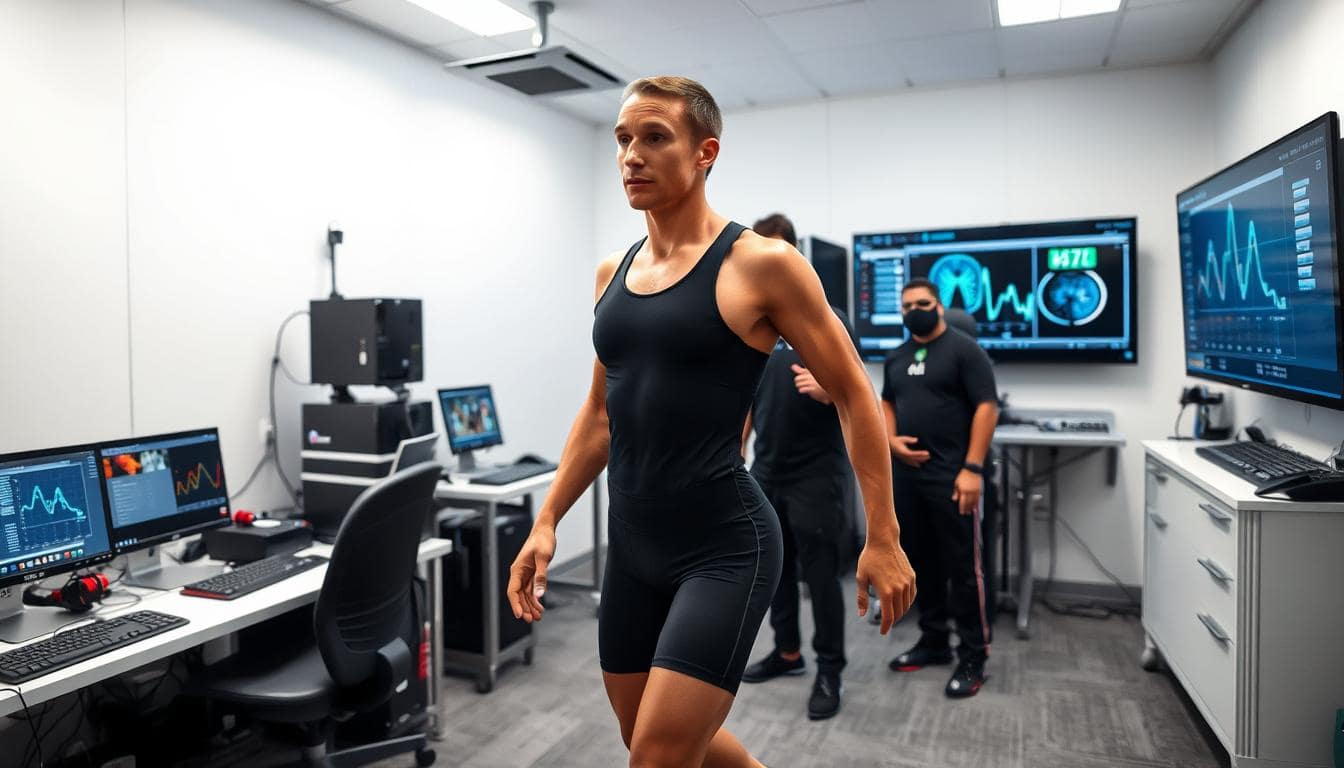
Forget the wind tunnel. The toughest test for your new product isn’t in a lab. It’s the human body in motion. Launching a new running shoe, racket, or helmet without sports biomechanics testing is like designing a race car without testing it. It might look good on paper, but the first real corner could be a disaster.
We’ve moved past the old, reactive model of “build, break, fix.” Today, we aim to engineer safety into products before they’re made. This new approach uses detailed, athlete-centered data to de-risk a launch before the first unit is sold.
This isn’t just about numbers and angles. It’s a strategic business move. We’re testing your product against the harsh truth of elite performance. It’s about grasping the complex, dynamic, and unforgiving physics of an athlete at their peak.
Forget marketing fluff and clichés. This is your pre-launch insurance policy. A thorough, athlete-centered testing protocol isn’t just an R&D expense. It’s your most valuable strategic asset, turning a high-risk launch into a data-driven success.
Measurement Frameworks: Beyond the Single Data Point
Remember when we only looked at one number to judge an athlete? Like vertical jump height or a 40-yard dash time. But, a single data point is as useful as one note in a symphony. We’ve been missing the big picture.
Forget the old way of measuring athletes. The future is about understanding how they move, not just what they can do. It’s like going from reading a single line to analyzing the whole poem.
Beyond the Force Plate: The Triangulation Imperative
In the past, we used a force plate to measure peak force. But it’s like judging a film by one frame. Today, biomechanics uses many data streams to understand movement.
True understanding comes from looking at everything together. It’s like a three-pronged attack on movement. First, 3D motion capture tracks every joint and limb. New technologies like Theia3D Apollo can do this without markers, giving us the “what” and “where” of movement.
From LCA Scopes to Movement Signatures
The “why” and “how” come from other data streams. Force plates measure the athlete’s interaction with the earth. They show the “why” behind every movement.
A high jump is more than a number. It’s a unique signature of movement. It includes the timing of joint angles and the force-time curve. This is the “movement signature,” as unique as DNA.
This shift is huge. We’re now analyzing every detail, not just one number. The goal is to understand the complex forces behind an athlete’s movements. The data points are like individual notes in a symphony, creating a unique sound.
Design Levers: Where Biomechanics Meets the Blueprint
In the world of athletic gear, “sustainable” or “circular” labels are often just claims. Real innovation starts at the blueprint stage, where materials and forms are first thought of. Here, biomechanical data guides the design, turning sustainability goals into real, performance-driven mandates.
This isn’t about just adding a new coat of paint. It’s about engineering from the pressure mapping data up.
The Material World: Swaps, Swaps, and Sustainable Cycles
Forget the one-size-fits-all approach to materials. Choosing between EVA foam and a proprietary polymer is more than just a cost or sustainability decision. It’s about changing how the product interacts with the athlete.
When pressure mapping shows a hot spot on the fifth metatarsal, the solution isn’t just a thicker insole. It’s about using materials that meet specific performance needs. Swapping materials based on data isn’t just saving costs; it’s optimizing performance and reducing waste.
Designing for the Long Game: Durability as a Feature, Not an Afterthought
Durability is often seen as an afterthought, a vague promise of “long-lasting.” But in a circular model, it’s the key feature. It’s the first defense against waste.
Designing for durability means using data to find the first point of failure. It’s not about making a product that never dies. It’s about making one that fails predictably and is designed for its next life. A sole that can be reground, a textile that can be cleanly separated, a chassis that can be re-tensioned—these are the design choices that make durability a recoverable asset.
This philosophy informs inclusive sizing. True inclusive sizing isn’t just a feel-good note. It’s a biomechanical necessity. A pressure mapping analysis on a standard “medium” foot is scientifically useless. Real-world testing needs a diverse range of foot sizes.
If your inclusive sizing strategy is an afterthought, your product isn’t built for all humans. You’re designing for a statistical ghost.
Modularity and repairability are the logical, physical extensions of this durable, data-driven design. A shoe isn’t a single unit; it’s a system. A replaceable outsole, a snap-in midsole, a removable insole—these modular components make a product serviceable, not disposable.
This turns a consumer into an active participant in the product’s lifecycle. The athlete isn’t just a user; they become a co-custodian of the product’s value. This is where the “circular” in circular economy becomes tangible: a product designed for multiple lives, with data to prove why each component was chosen and how it can be reclaimed.
The design lever is no longer just a tool for creation. It’s the blueprint for a product’s entire, extended life.
Manufacturing & Logistics (Energy, Waste, Packaging)
Manufacturing is like the tough hill at mile 20 in a marathon. It’s where most of the sustainability work happens before the shoe even hits the track. The real environmental impact is in the energy used in the factory, the diesel in shipping, and the single-use plastic wrap that ends up in landfills.
An efficient supply chain is key. It cuts waste and energy like a biomechanic analyzes stride efficiency. This is where sustainability meets performance.
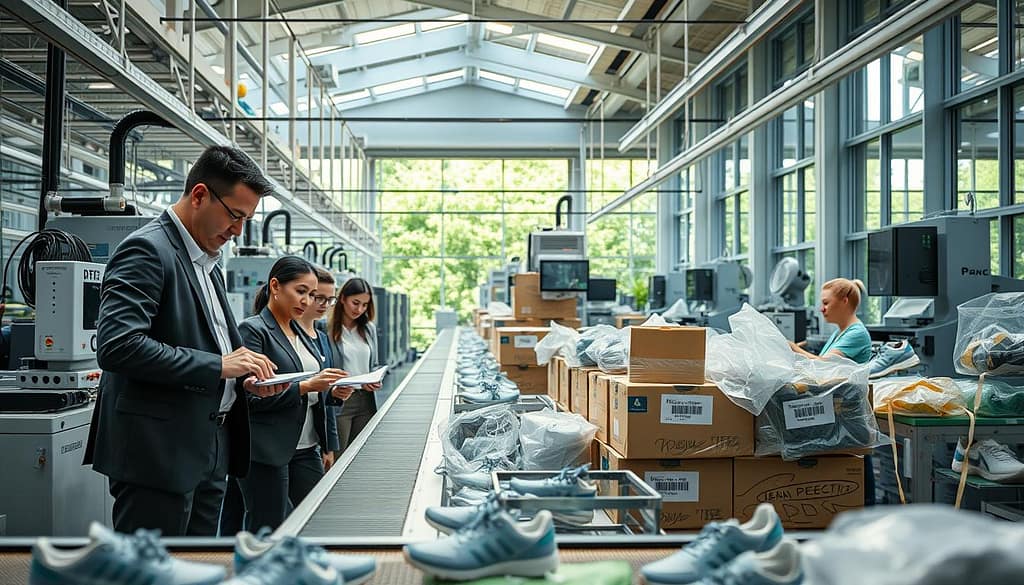
Carbon offsets aren’t enough. The real challenge is in the energy used in factories and the carbon cost of shipping. It’s a race to save energy and cut waste, benefiting both the planet and the bottom line.
The Carbon Footprint of a Stride: From Factory Floor to Finish Line
We often focus on a shoe’s end-of-life, but the biggest carbon emissions come before it’s even used. The choice of energy source in the factory has a bigger impact than the shoe’s use phase. Life Cycle Assessment (LCA) helps us understand this.
LCA looks at everything from shipping boxes to the energy in the foam midsole. It even considers the emissions from global logistics. This is where biomechanics and logistics meet.
An inefficient shoe is a failure in sustainability and biomechanics. Poor design forces the body to work harder, wasting energy. A well-designed shoe, based on biomechanical data, is efficient and lasts longer.
Industrial exoskeletons and IMU sensors show us the most efficient movement patterns. Applying this to manufacturing can optimize systems. This is like optimizing a runner’s form, reducing waste and energy.
When Less Packaging is More Performance
Packaging is the first and last impression of a product. Too much plastic and non-recyclable boxes are a performance failure. It’s like wearing hiking boots to a marathon.
Minimalist packaging is not just eco-friendly; it’s a statement. It shows confidence in the product’s durability and efficiency. It’s like the unboxing experience of a tech product, applied to footwear.
| Traditional Approach | Sustainable Manufacturing Focus | Performance & Sustainability Win |
|---|---|---|
| Virgin plastic blister packs, non-recyclable foam peanuts | Mushroom-based mycelium or molded pulp from recycled content | Reduces landfill waste, uses renewable materials, often lighter for shipping |
| Single-use plastic polybags for each component | Reusable, returnable tote systems for in-factory part transport | Eliminates single-use plastic waste within the supply chain |
| Standard corrugated boxes with excessive void fill | Right-sized, minimalist packaging with minimal ink/coatings for easy recycling | Reduces material use, shipping weight, and end-user waste |
| Global, fragmented supply chain with multiple legs | Regionalized manufacturing and nearshoring key components | Dramatically cuts transportation emissions and lead times |
The LCA doesn’t end at the factory gate. A lightweight, right-sized box is less waste and more efficient. This is logistics as a performance sport. Designing an efficient supply chain is like optimizing a runner’s stride, cutting costs and carbon.
Business Models: The Circular Economy’s New Playbook
For years, the athletic industry followed a simple path: make, sell, and forget. Shoes often ended up in landfills. But what if a product’s real value lies in its reuse? The future of sports gear is about leasing performance and recycling materials.
This approach isn’t just about being green. It’s a smart, efficient way to do business. It matches the real needs of athletes, who go through many cycles of performance.
From Product to Service: When Your Shoe is a Subscription
Remember your favorite running shoes? They were great until they wore out. In the old days, you’d throw them away and buy new ones. Now, you can subscribe to performance instead.
Imagine your shoes’ midsole losing its bounce after 400 miles. Instead of buying new shoes, you return the old ones. A refurbished pair, guaranteed to perform, is sent back to you. This model turns a one-time sale into an ongoing relationship, like software subscriptions.
The circular kit is more than a new shoe; it’s a new system. When a shoe’s first life ends, its real journey begins. The refurbishment process is detailed, ensuring every part is checked and updated.
The result is a remanufactured performance tool that’s as good as new but costs less. This isn’t a step down; it’s a smart upgrade. For athletes, it means better gear without breaking the bank. For brands, it means a loyal customer base and a chance to reuse valuable products.
This approach turns waste into a valuable resource. It’s not just good for the environment; it’s a strategic moat for brands. It builds loyalty through service, not just marketing. You’re investing in a system that cares for your performance and the planet.
Verification & Claims: The Unforgiving Math of Performance
Forget the marketing poetry. In the biomechanics lab, your product’s claims are tested by data. This data is judged by a strict standard. Marketing poetry meets engineering prose here, where claims are either validated or vaporized.
Anyone can say their product is “performance-verified.” But the real test is a forensic audit by a skeptical biomechanist. This is where certifications like ISO, ASTM, and NOCSAE become your most valuable asset. They are not just red tape but a battle-tested risk management system.
The Proof is in the Performance Data, Not the Press Release
Marketing can sell a dream, but standards sell facts. Standards like ASTM F1973 for footwear or NOCSAE standards for helmets are the great equalizers. They don’t care about your marketing budget.
They focus on specific safety outcomes. When you claim a helmet meets a NOCSAE spec, you’re saying it has withstood impacts. That’s not marketing; it’s engineering fact.
Navigating the Certification Labyrinth
It can feel like a maze. ISO standards govern management systems and processes. ASTM International provides technical test methods. NOCSAE is critical for sports performance equipment.
ISO asks if you have a rigorous process. ASTM asks if your product survives specific forces. NOCSAE asks if it protects a human skull. Navigating this labyrinth is de-risking your launch.
In a world of greenwashing, a certification is your shield. It turns a subjective boast into an objective, defensible truth. It’s the difference between saying your shoe is “more responsive” and proving it meets a specific benchmark in an ASTM test.
Case Studies: Circular Moves in Equipment Categories
What happens when a sprinter’s spike or a basketball shoe reaches the end of its competitive life? In a linear economy, it becomes waste. But in a circular one, it gets a second chance. Forget the sustainability reports and corporate pledges—the real test of a circular model happens on the track, the court, and the field, where equipment is pushed to its absolute limit. These aren’t hypothetical scenarios; they’re case studies in turning performance gear from a single-use asset into a multi-life platform.

The Refurbished Rocket: When a Sprint Spike Gets a Second Wind
Consider the elite sprinter’s carbon-fiber plate spike. In the traditional model, that shoe has one life: a few races, maybe a season, then the landfill. The circular model asks a different question: what if the most valuable part—the carbon-fiber plate—was designed for more than one life? Imagine that same high-performance plate, after its track career, being repurposed as a high-performance insole for a premium walking or training shoe. The athlete gets a new spike, and the carbon plate gets a second, less intense, but equally valuable life. This isn’t just recycling; it’s upcycling performance.
The key to this transition? Data. This is where wearable IMUs (Inertial Measurement Units) change the game. We’re no longer guessing when a shoe is “done.” The same wearable IMUs that track a sprinter’s power output and form can also monitor the structural integrity of the shoe itself. We can now track micro-strain on the carbon plate in real-time. The data doesn’t just tell an athlete their power output is dropping by 2%; it can signal that the energy-return profile of the midsole is degrading, or that the carbon plate is nearing its stress limit before it fails. This isn’t sci-fi; it’s using the same data that optimizes an athlete’s stride to schedule a shoe’s refurbishment before the athlete feels a performance drop.
From Prototype to Platform: The Modular Basketball Shoe
Basketball presents a different challenge: immense lateral force, high-impact landings, and a culture that demands both peak performance and fresh style. The modular basketball shoe is the answer. Instead of a single, fused unit, imagine a shoe built like a high-performance toolkit.
- Outsole Modules: The high-wear outsole is a separate, replaceable module. When the herringbone grip wears down, you don’t trash the shoe—you pop in a new outsole. The rest of the shoe, perfectly good, lives on.
- Midsole Swap: The midsole foam, which compresses and loses energy return over time, is another swappable module. An athlete could have a game-day high-rebound midsole and a practice-day comfort midsole for the same shoe chassis.
- Upper Refresh: The most visible and style-driven part, the upper, can be detached. A torn mesh or a scuffed toebox no longer dooms the entire shoe. It also opens the door for personalization and limited-edition uppers, extending the shoe’s life and brand engagement.
This modularity is powered by data from in-shoe wearable IMUs. They don’t just tell us how a player is moving; they tell us how the shoe is holding up. The system can alert that the outsole grip on the lead foot is wearing asymmetrically, or that the midsole foam in the heel has lost 15% of its original energy return. The shoe becomes a platform, not a product.
The common thread is data. The sprint spike and the modular basketball shoe are no longer static products. They are data-generating assets with a lifecycle. The wearable IMUs embedded within them create a closed feedback loop: from design prototype to performance platform, to refurbishment, and back to the drawing board for the next iteration. This isn’t just sustainability; it’s a smarter, more responsive, and ultimately more profitable way to build performance gear. The circular economy, in this light, isn’t a constraint on innovation—it’s the ultimate performance hack.
Implementation Roadmap: Targets, KPIs, and the Art of Supplier Seduction
You have the data. Force plates have grumbled, EMG sensors have whispered their secrets, and your 3D motion capture has more data points than a social media influencer. Now what? A roadmap without measurable targets is a wish list. A KPI without a biomechanical root cause is just a vanity metric. This is where the science of motion meets the art of the possible.
Forget Gantt charts that stretch into the distant future. In the sprint for sustainable performance, we operate on a different clock. The bridge from the lab’s pristine data to a product that survives the brutal marathon of retail and review is a 90-day protocol. It’s not a leisurely stroll—it’s a sprint with suppliers as your relay team, passing the baton of co-development. Your suppliers aren’t just vendors shipping foam and fabric; they’re biomechanical R&D partners. You’re not just buying a midsole compound; you’re co-developing a dynamic response curve validated by EMG data showing a 15% reduction in tibialis anterior fatigue. This is the playbook.
From Lab to Launch Pad: The 90-Day Protocol
Think of this as a product launch condensed into a single financial quarter. It’s a sprint, not a marathon, with three distinct, brutal, beautiful phases.
Phase 1: The Alignment Sprint (Weeks 1-2). This isn’t about setting goals; it’s about defining the finish line in biomechanical terms. You’re not just aiming for a “more durable outsole.” You’re targeting a “≤2mm midsole compression after 500,000 simulated strides, correlated with a 10% reduction in peak patellofemoral force as measured by force plates.” You bring your key supplier into the lab. You show them the EMG data highlighting the calf muscle’s over-engagement during heel strike. You’re not just giving them a spec sheet; you’re co-authoring a biomechanical contract.
Phase 2: The Co-Development Sprint (Weeks 3-8). This is where the roadmap lives or dies. Weekly sprints replace monthly reviews. Each prototype iteration—a new rubber compound, a shifted seam, a tweaked last—isn’t judged by a committee’s gut feel. It’s judged by the KPIs locked in Phase 1. That new foam sample from your supplier isn’t just “softer.” The question is: Does it move the needle on our key performance indicator? Does it reduce that EMG-measured tibialis anterior fatigue by the target 15%? This phase is a ruthless, objective filter.
Phase 3: The Validation Vortex (Weeks 9-12). This is the “knowledge translation” phase. The raw EMG and force plate data is useless to a coach. But a simple dashboard metric is gold. This is where actionable formats for coaches are born. That “Lateral G-Force on Plantar Surface” KPI becomes a simple, red/amber/green dashboard for a coach monitoring an athlete’s form. This data lives on a shared platform—a knowledge translation hub—where suppliers see the impact of their material on performance, and coaches see the biomechanical impact of their training. It’s the LMS for your product’s biomechanical soul.
KPIs That Matter: Injury Rate Reduction vs. Miles to Failure
Here’s the elegant tension at the heart of a great roadmap. You need KPIs that speak to the athlete and the accountant.
On one axis, you have athlete-centric KPIs, often best measured with tools like EMG. Think: “Reduce peak patellofemoral force by 15% in the landing phase.” This isn’t a feel-good metric. It’s a biomechanical lever you can pull to directly impact injury rates and athlete longevity. It’s measured in labs.
On the other axis, you have product-centric KPIs. This is the “Miles to Failure” or “Cycles to 20% Compression” metric. It’s the language of durability, warranty claims, and lifecycle analysis. The magic happens when you link them. The roadmap’s genius is in connecting these dots: “Our new midsole geometry reduces patellofemoral force (EMG-validated), which we predict will correlate with a 30% reduction in overuse injuries in our target demographic, which in turn allows us to guarantee the outsole for 1,000 miles before 20% wear.” One KPI validates the other.
This is how you engage suppliers as partners. You’re not just asking for a “more durable rubber.” You’re tasking them: “We need a compound that achieves a 9,000-cycle abrasion rating (Miles to Failure KPI) while maintaining a durometer reading that our EMG data shows minimizes impact shock (Injury Rate Reduction KPI).” You’ve moved from a transactional purchase to a co-development challenge.
Your roadmap, then, is a living document. Every design tweak—a new stitch pattern, a different lacing grommet—is a hypothesis. The KPIs are your null hypothesis. The 90-day protocol is your method. And the supplier, armed with the same dashboard showing real-time EMG and force plate correlations, isn’t a vendor sending invoices. They’re a biomechanical R&D partner, and you’re not launching a product. You’re validating a theory of human performance.
Tool Stack: The Biomechanist’s Competitive Moat
Forget the cluttered workbench with calipers and force plates. Today’s biomechanist relies on a mix of software to transform data into valuable products. The key to success isn’t just new materials but a connected tool stack that links Life Cycle Assessment to 3D motion capture and more.
This isn’t about having one tool. It’s about how they connect. The real advantage comes from the API links between systems. Your moat is built on a feedback loop, not just a new material.
The Biomechanist’s Toolbox: From LCA to PLM in 3 Clicks
Those days of static LCA reports are gone. Now, your tools work together in a dynamic ecosystem. Imagine changing a shoe’s design in CAD and seeing its impact on the LCA tool instantly.
This integration makes sustainability a real-time part of design. Your tool stack predicts performance and sustainability, not just reports on it.
When Your PLM and Your Motion Capture Talk to Each Other
This is where the magic happens. It’s not just about motion capture. It’s about using that data to improve a product’s design.
Your motion capture data can enhance a product’s design in real-time. This is the biomechanist’s new toolbox, connecting data to design seamlessly.
The final piece is a unified data layer. Your sustainability report is now a live dashboard, updated automatically. This connects your data from lab to investor report.
Action Checklist: Pilot a Circular Feature in 90 Days
This is for the real world, not just a lab. In three months, you can turn a simple idea into a real prototype. This is your 90-day sprint to test it out.
Your 90-Day Sprint: From Whiteboard to Wear Test
Forget long R&D cycles. Now, new product development takes just 90 days. It’s not about a whole new shoe. It’s about one cool feature.
Maybe a new lacing system or a special foam. Your goal is to see how it works in real life.
The 5-Point Pre-Flight Check
Before you start, make sure everything is ready. This isn’t just red tape. It’s your safety net.
- Define the MVP Feature & Secure IRB Approval: IRB approval is a must for human testing. It’s what makes your project legal and ethical.
- Establish a Biomechanical Baseline (Days 1-30): Use special tools to learn how your product works now. This is your starting point.
- Implement & Instrument (Days 31-60): Add your new feature to a test prototype. Also, set up your study with the same care as a clinical trial. Data is key, like in ACL injury risk algorithms.
- A/B Test in the Real World (Days 61-90): Now it’s time to test your feature against the old one. The goal is to see if it’s better.
- Analyze & Decide: Did your feature make things better? The data will tell you.
This checklist is not just a guide. It’s your safety net before you test your product. The goal is to decide if it’s worth it. The clock is ticking.