
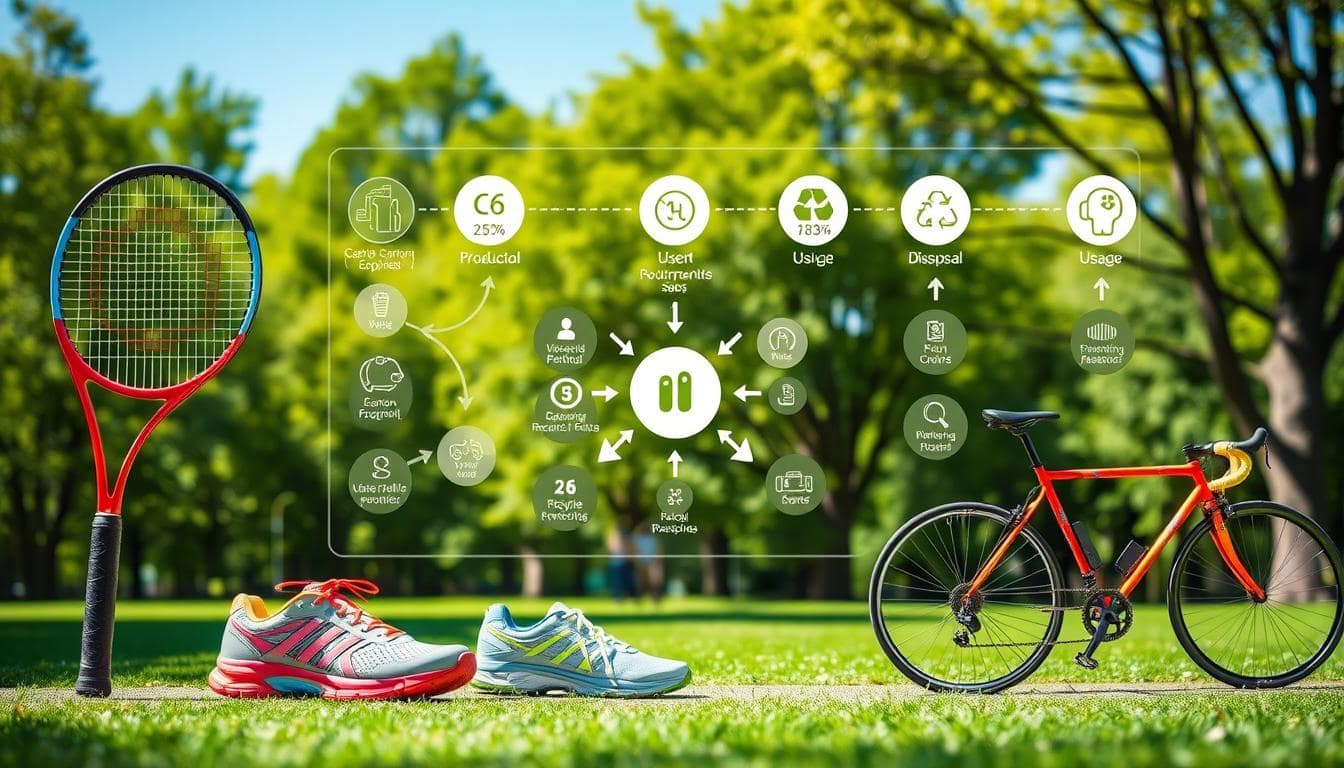
Let’s be blunt: a lot of so-called “green” gear is not really sustainable. It’s like a plastic tree in a desert. We’re not just slapping a recycled logo on a shoebox.
This is about changing everything. It starts with the molecules in your midsole and goes all the way to rebirth. It’s a complete system overhaul for the sports industry.
Forget vague “eco-friendly” claims. We’re moving to real, data-driven design. The tool for that? A strict Life Cycle Assessment (LCA).
An LCA is our reality check. It audits a product’s footprint from start to finish. It’s not just about using recycled materials. It’s about creating a cycle where products are reborn, not thrown away.
This is the new playbook: using metrics to move from good intentions to measurable, circular results.
Product Architecture: Material Selection, Modularity, Disassembly
Do you remember that indestructible plastic toy from your childhood? It survived being thrown, kicked, and buried in the sand. Modern sports gear should be just as resilient but with an adult-sized budget. We’re moving away from the old, glued-and-sutured gear made for the landfill.
Today’s sustainable product architecture focuses on what it’s made of and how it’s put together. It’s also about how it comes apart. This is key for making sports gear that lasts longer and can be fixed when needed.
Think of it like a Lego set for adults with expensive hobbies. The architecture of a product is its DNA. It decides how it performs, ages, and is reborn. We’re shifting from a monolithic, one-piece design to a modular, serviceable system.
The goal is to make gear like ski boots, backpacks, or bike helmets that can be repaired, not just replaced.
Let’s break down the three pillars of this new architecture:
- Material Selection: This is the “sensor suite” of sustainability. It’s not just about recycled content; it’s about traceability and compatibility. We choose materials for their performance and longevity. Can the polymer be separated from the aluminum? Can the fabric be un-laminated from the membrane? If you can’t take it apart, you can’t put it back together.
- Modularity: This is where the magic of repairability is born. Imagine a ski boot with independent modules. When the liner wears out, you don’t throw away the whole $800 boot. You replace the liner. This isn’t just a design philosophy; it’s a business model shift.
- Designed for Disassembly: This is the final, critical piece. If you can’t take it apart, you can’t truly fix it. True modularity means designing with end-of-life in mind. This means using fasteners instead of permanent adhesives, standardized connectors instead of proprietary welds, and providing clear service documentation.
This architectural shift is inspired by the best in the business. Think of the Coach leather artisans who can restore a 50-year-old handbag to its former glory. Or the ethos at Arc’teryx, where a repair is seen as a lifelong customer touchpoint. Their repair ethos isn’t a marketing afterthought; it’s baked into the product’s DNA from the first CAD sketch.
The implications are profound. This architecture enables a circular service model. Instead of a linear “take-make-waste” journey, the product becomes a platform for services: repair, refurbishment, and resale. The initial sale is just the first transaction in a much longer, more valuable relationship. The product is no longer a perishable good; it’s a durable asset.
| Aspect | Traditional Architecture | Sustainable Architecture |
|---|---|---|
| Design Goal | Cost-Effective Assembly | Cost of Ownership & Serviceability |
| Material Joining | Permanent bonds (glues, welds) | Reversible fasteners, snap-fits, guides |
| Component Life | Whole product lifespan | Independent module lifespans |
| End-of-Life | Downcycled or landfilled | Disassembled, sorted, and recirculated |
This isn’t just about being eco-friendly; it’s about building a smarter, more resilient business. The architecture is the silent contract between brand and user, a promise that the product is built to last and built to evolve. The repairability isn’t a feature; it’s the foundation. By designing for disassembly, we’re not just making gear that lasts. We’re building a system where the first sale is just the beginning of the story.
Material Selection & Sourcing: The “Sensor Suite” of Sustainability
Choosing materials for green sports gear is now a deep dive into a material’s history. It’s not just about if it’s recycled. It’s about understanding its whole life story. Every fiber and chemical bond has a story and impact.
We’ve moved past the simple “reduce, reuse, recycle” mantra. Now, we focus on regenerative sourcing. We seek materials that not only have recycled content but also actively help the environment. This means using algae-based foams, mycelium composites, and biodegradable polymers.
This new approach to materials needs a transparent supply chain. Knowing a material is “sustainable” isn’t enough. We need to know its full story, from source to end use. Eco-certifications like Cradle to Cradle and Bluesign are key, verifying environmental claims.
Look at innovators like Patagonia and Adidas. They’ve created products from recycled materials, showing performance and planet care can go hand in hand. It’s about looking beyond surface-level claims and understanding the whole supply chain.
So, what does responsible material selection mean? It’s about changing how we think:
- Traceability First: Can you track the recycled PET in your jacket to its source?
- Beyond the Technical Cycle: Does the material have a clear, non-toxic next life?
- Regenerative Sourcing: Does the material come from a supply chain that restores ecosystems?
Material selection is key to sustainability. It shows not just a product’s performance but its impact on the planet. The right materials tell a story of regeneration, not just reduction.
Firmware Foundations (The Code of Circularity)
Think of firmware as the blueprint for a product’s future lives. In a world where things are used once, firmware makes a product’s life cycle possible. It’s not just code; it’s the operating system for a product’s soul, guiding its journey from start to rebirth.
This firmware is more than just smart tech. It’s the system that turns a product into a service, like a leased shoe. It tells companies when to refurbish or upgrade, making every product part of a bigger story. It’s the business model, compiled into executable logic.
At its core, firmware uses Life Cycle Assessment (LCA) data. It makes smart choices in real-time, like whether to repair or recycle. This ensures every decision is green, thanks to LCA insights. It’s the “sensor suite” of the business model, optimizing the loop.
To shift from linear to circular, firmware needs a major rewrite. Here’s how the two models differ:
| Feature | Linear Model Firmware | Circular Firmware Model |
|---|---|---|
| Design Goal | Optimize for single-use, peak performance, and planned obsolescence. | Optimize for durability, modularity, and multiple lifecycles. |
| Data Collection | Minimal; focused on in-use performance and failure reporting. | Comprehensive; tracks location, usage, wear, and component health for LCA and resale valuation. |
| End-of-Life Protocol | No protocol. Product is “dead.” | Initiates “take-back” sequence: guides disassembly, sorts materials, updates digital twin for next life. |
| Business Logic | One-time sale. Revenue is a single transaction. | Multi-revenue streams (lease, resale, repair). Firmware enables pay-per-use or subscription models. |
| Design Feedback Loop | Feedback loop is slow, based on aggregate sales and return data. | Real-time LCA and performance data fed back to R&D for next-gen designs. |
This firmware turns a product into a dynamic asset. It supports models like “sneaker-as-a-service” or “pay-per-wash.” It’s the silent partner in the circular economy, ensuring products are always valuable.
This firmware is key to the circular transition. It’s what makes a product programmed for longevity and rebirth, not just made. It’s about coding responsibility into what we create.
Edge vs. Cloud Processing: The Local Brain vs. The Systemic Mind
Imagine your running shoes telling you when they need new soles, or your bike helmet scheduling its own fix. This isn’t fantasy; it’s about sustainable design. We’re debating where the “thinking” happens in sustainable product design. The “edge” is the product itself, where things happen. The “cloud” is the vast network that supports it.
In sustainability, it’s not about data packets. It’s about waste packets. We aim for zero waste to landfill, or zero data to the cloud.
At the edge, sustainability is local and fast. It empowers the user. Think of a shoe with a swappable sole or a bike helmet with a replaceable liner. This is quick, user-friendly sustainability.
When a product is designed for local repair and modularity, it solves problems at the source. A worn-out sole is swapped in your living room; a frayed strap is replaced. The decision to repair, not replace, happens right there.
In contrast, the cloud is the systemic, large-scale network. It’s the take-back scheme and the industrial-scale recycling facility. It’s powerful but slow and resource-intensive.
The most resilient systems combine both. A modular, repairable product (the edge) is designed to be fed back into a sophisticated take-back and refurbishment network (the cloud). The edge handles quick fixes; the cloud handles the rebirth of materials.
The ultimate goal is a “closed loop.” We aim for zero waste to be “uploaded” to the landfill “cloud.” As much processing as possible should happen locally before any material is sent for systemic processing.
The table below breaks down this core dichotomy in sustainable design:
| Aspect | Edge Processing (Local) | Cloud Processing (Systemic) |
|---|---|---|
| Primary Goal | Extend product life through immediate, user-accessible repair and modularity. | Recover and redistribute materials at an industrial scale. |
| Key Action | Repair, swap, refurbish at point-of-need. | Collect, sort, and process materials at scale. |
| Speed & Latency | Fast, low-latency solutions. The fix is now. | Slower, higher-latency cycles (e.g., seasonal take-back programs). |
| User Empowerment | High. User can diagnose and fix. | Low. User is a participant in a system. |
| Example in Sportswear | Replacing a worn cleat on a cycling shoe with a standard tool. | Grinding down old shoe rubber to create new playground surfaces. |
So, when you hear “edge vs. cloud,” think of a skateboard with a replaceable deck and a city-wide program. The most sustainable future is the clever conversation between smart products and systems.
Data Models & Schemas: The Language of Circularity
You can’t manage what you can’t measure, and you can’t measure what you haven’t defined. This is the main challenge of the circular economy. To design products for reuse, we need a common language. Data models and schemas are like the grammar and syntax of this new economy.
Think of it as the API for the circular economy. Without a standard language, different systems can’t communicate. We need a shared vocabulary. Schemas for Environmental Product Declarations (EPDs) and Life Cycle Assessments (LCAs) are like the Rosetta Stone.
An Environmental Product Declaration is like a product’s nutrition label. It’s a report that shows a product’s environmental impact. An LCA is the detailed process that creates this label. Together, they give us the truth about a product’s impact.
The Blueprint: EPDs and the Digital Product Passport
Data modeling becomes practical here. An EPD is more than a PDF. In a circular system, it’s the core of a Digital Product Passport (DPP). Imagine a QR code on a soccer jersey. It shows more than just the price.
- Material DNA: It tells you the specific polymer grade, its recycled content, and the dye’s chemical composition.
- Lifecycle Log: It shows manufacturing energy, shipping distance, and carbon footprint at each stage.
- Disassembly Guide: It gives the torque specs for bolts, glue types used, and the order of operations for clean take-back.
This isn’t just a sustainability report. It’s a machine-readable blueprint for the next life. A refurbisher knows which adhesives to use, a recycler knows the exact polymer blend, and a resale platform can verify the product’s low-carbon journey.
The Grammar: Schemas and Interoperability
A schema is the grammar of our new language. It defines the rules: “This data point is a carbon footprint, it’s a number, and it’s measured in kg of CO2e.” This standardization lets a product’s LCA data be understood by a sorting robot in Germany.
Without this shared schema, data is just noise. With it, a digital product passport becomes a universal passport for goods. It lets them be verified, valued, and integrated into secondary markets and recycling streams seamlessly. It’s the difference between a product being “trash” and a product being “feedstock.”
In essence, these data models are the unsung legal code of the circular economy. They turn vague notions of “sustainability” into a structured, verifiable, and actionable language. They are the API that lets a skateboard, a smartwatch, or a soccer cleat tell its full story and, more importantly, its next chapter.
Security & Transparency by Design (The Trust Protocol)
In the world of sustainability, actions speak louder than words. Greenwashing is a sign of laziness. Without proof, claims are just empty words. This is where eco-certifications and blockchain ledgers prove a product’s worth.
A product without a clear history is just a story. True sustainability is a system, not just a slogan. It’s the difference between a label and a blockchain ledger showing every detail of a product’s journey.
Eco-certifications are more than just stickers. They are the data schema for a product’s sustainability. They allow different systems to communicate a single, verifiable truth about a product’s life cycle.
A certificate alone is just a piece of paper. The real magic is built on two things: immutable data and radical transparency. Blockchain is used to create an un-hackable, public ledger for a product’s life. Imagine a QR code on your soccer jersey. Scan it, and you see the journey of the product.
Building this level of security requires a cross-functional team. You need procurement, engineers, and marketing all working together. Getting internal buy-in is the first and most critical step. When everyone speaks the same data-driven language, you’re building a trustworthy brand.
So, the next time you see a “green” claim, ask for the data. The real eco-certifications and blockchain-verified ledgers are the new “https://” for products. They provide unchangeable, cryptographic proof that a product is secure and trustworthy.
App/Platform Integration (The Resale, Rental, Repair Interface)
A sustainable product alone is just a product. The real magic happens on the platform. Think of your eco-friendly soccer cleat or hiking boot as the hardware. The app, website, and brand ecosystem are the operating system.
This is where the one-time sale turns into a continuous service. It’s the SDK for the circular economy.
Forget old models of goodwill donations. Today’s circularity is sleek and user-first. It’s Zalande making pre-owned fashion as easy as new. Arc’teryx guarantees and repairs its gear, saying it’s built to last.
Coach (Re)Loved takes back and refurbishes old bags. Reformation’s “Reformation Forever” resale platform is another example. The product is just the start; the platform is the whole show.
This platform layer is key for a product’s second, third, and fourth lives. It turns a simple product into a part of a network of take-back, resale, and renewal. It’s not just an afterthought; it’s the main interface for the product’s whole life.
Let’s look at how a top platform works. The table below shows the old, linear model versus the new, platform-enabled circular model.
| Lifecycle Stage | Old Model (Linear) | New Model (Circular Platform) | Brand Example | Consumer Benefit |
|---|---|---|---|---|
| End-of-Use | Product is discarded or donated. | Seamless take-back via pre-paid label in app. Item is inspected, cleaned, and data is logged. | Patagonia Worn Wear, Zalando Pre-Owned | Easy, incentivized return with store credit. |
| Repair & Maintenance | Consumer seeks third-party repair or discards item. | In-app repair guides, mail-in repair kits, or certified repair center locator. | Patagonia Worn Wear, iFixit partnerships | Extends product life, builds brand loyalty. |
| Resale & Recommerce | Product enters secondary market (e.g., eBay) with no brand connection. | Brand-hosted resale marketplace. Original owner gets credit; brand authenticates and resells. | Coach (Re)Loved, Arc’teryx Used Gear | Brand controls quality, story, and gets data from second life. |
| Rental/Subscription | Not applicable. | Product-as-a-Service (PaaS) model. Rent gear for a season, return, and rotate. | Platforms like Tchibo or outdoor gear rental services | Access over ownership, lower entry cost. |
This isn’t just a “nice-to-have” feature. It’s a fundamental business model shift. The platform is where data from the product’s sensors, user’s repair history, and material health come together. This data helps the next user and informs future product designs.
The platform makes repairability easy, not a DIY chore. It turns take-back into a way to keep customers and gather data.
In the end, the most sustainable product is one that never becomes waste. The platform is the engine that makes this possible. It turns a linear purchase into a circular conversation. It’s not just about selling a jacket; it’s about starting a conversation with a jacket that might last a lifetime.
Verification & Validation (The Golden Dataset)
So, you’ve designed a shoe from algae foam, a yoga mat from recycled wetsuits, and a water bottle that tracks your hydration. Your marketing team is ready to shout about your “net-zero, closed-loop, planet-hugging gear.” But here’s the brutal question: how do you prove it? In the world of sustainable design, claims are cheap. Proof is the only currency that matters. This is where verification and validation come in—the HIL (Hardware-in-the-Loop) test for your product’s environmental resume.
This phase is the unglamorous, absolutely critical work of turning green ambition into auditable fact. It’s the difference between a sustainability story and a sustainability fact. We’re moving from marketing copy to hard data.
At the heart of this is the Golden Dataset. Think of it as the single source of truth, the master blueprint. It’s the complete, LCA-backed benchmark for your product’s environmental footprint at its launch. Every gram of CO2, every liter of water, every kilowatt-hour of energy used from material extraction to your customer’s doorstep is quantified and locked in this dataset. It’s not a static number; it’s a living, breathing benchmark.
Every new production run, every new batch of recycled polyester or bio-based resin, gets tested against this golden dataset. Did switching to a new supplier in Malaysia increase the carbon footprint by 3%? The golden dataset flags it. Did a new, more efficient assembly process in your Polish factory reduce water use by 15%? The golden dataset validates it. This is the “HIL test for sustainability”—a continuous verification loop.
This is where LCA (Life Cycle Assessment) and EPDs (Environmental Product Declarations) move from abstract concepts to operational tools. An LCA isn’t a one-time report you frame and hang on the wall. It’s the foundational document that becomes your golden dataset. An EPD is the verified, third-party certified summary of that data—the nutrition label for your product’s environmental impact.
Here’s how the verification cycle works:
- Benchmark with LCA: A full, ISO-compliant Life Cycle Assessment establishes the baseline—your golden dataset.
- Verify with Data: Every new material source, component, or manufacturing change is measured against this dataset. Is this new recycled content polymer truly lower-impact than the virgin material? The golden dataset provides the answer.
- Validate with EPDs: The verified data from your golden set feeds directly into creating credible, standardized EPDs. This is your proof, your validated claim.
- Close the Loop: Data from the product’s use-phase and end-of-life (collected via the platform integrations we discussed) flows back in, refining the dataset for the next design iteration.
Without this rigorous validation, “sustainability” is just a color. It’s green paint. The golden dataset is your anti-greenwash shield. It turns subjective marketing into objective, verifiable fact. It’s what lets you say “carbon neutral” and have a verifiable, data-driven audit trail to back it up. It’s the difference between a claim and a credential.
In the end, the most sustainable product is the one whose environmental story is not just told, but proven. The golden dataset isn’t just a collection of numbers; it’s the foundation of trust.
The Compliance Landscape (The Regulatory “Wireless Spectrum”)
Imagine the global regulatory environment as a busy, noisy radio spectrum. Each new rule, standard, and EPR law is like a new radio station trying to get airtime. It’s not just background noise; it’s the new reality of product design. Finding your way through this isn’t just about following rules—it’s about tuning into the right eco-certifications and legal terms.
Don’t view regulations like the EU’s Ecodesign for Sustainable Products Regulation (ESPR) or EPR laws as obstacles. They’re your new design guide. France’s strict anti-waste law is a clear design requirement for today. It asks if your product can be easily taken apart or recycled. If you’re unsure, you’re on the wrong frequency.
Being proactive is not a choice; it’s a must. Third-party eco-certifications like bluesign® or the Global Organic Textile Standard (GOTS) protect you. They’re not just for marketing. They show regulators you’re already meeting their standards. They help your product stay ahead of future rules.
Safety standards and material regulations are like the strict rules of this spectrum. A look at global policies shows a clear trend: governments are setting higher standards. They want products to be not just green but also safe and durable from start to finish. It’s not just about being eco-friendly; it’s about being safe and sound from the beginning.
Dealing with this isn’t about fear. It’s about aligning your design with the right standards. You can either fight the noise or tune into the right frequency. Compliance isn’t a goal to reach; it’s the airwave your product needs to succeed. So, when designing your next product, ask yourself: “On which regulatory frequency does this product broadcast?”
Case Snapshots: Gear That Shipped and Scaled
The circular economy in sports equipment has reached a new level. We’ve seen the early stages, the first tests. Now, let’s look at the big hits—the products that made it from the lab to the real world. These are the success stories, the gear that made it big.
Forget the theory for now. We’re talking about real products, not just ideas. These companies didn’t just write reports; they built businesses. They turned the theory of circularity into tangible products with serial numbers. This shows that circular design can be a win, not a loss.
Going from a single prototype to mass production is a big leap. It’s one thing to make a recyclable midsole in a lab. It’s another to make 500,000 pairs and recycle them later. The companies below didn’t just test their ideas; they made them big.
| Brand | Program/Product | Circular Innovation | Scale & Impact | The “Golden Dataset” |
|---|---|---|---|---|
| Adidas | Futurecraft.Loop | Performance running shoe made from 100% reusable TPU; designed for disassembly and 100% recyclable. | Full commercial release, multiple generations. Demonstrated closed-loop recycling at scale. | Proved a performance shoe could be made from a single, infinitely recyclable material without performance loss. |
| POC | ReDefine Helmet Program | Helmet take-back and recycling program; uses recycled and bio-based materials in new products. | Integrated into product lifecycle; creates a direct, circular relationship with the end-user. | Shows how a high-safety, high-tech product can embed circularity into its business model. |
| Patagonia | Worn Wear | Not a side project; a core business unit for repair, resale, and trade-in of used gear. | Massive, global platform. Drives brand loyalty and creates a secondary market for used gear. | The golden dataset for a repair & resale economy. Proves durability = value retention. |
| Arc’teryx | Rock Solid Guarantee & ReBird | Lifetime repair guarantee and dedicated in-house repair program. | Turns a “cost center” (repairs) into a brand-loyalty engine and a direct-to-consumer data goldmine. | Proof that the highest-margin item is the product you don’t have to make from scratch. |
| Coach (Coachtopia) | Coach (Coachtopia) | Sub-brand using recycled, upcycled, and regenerative materials in luxury accessories. | Scaling a circular model within a heritage luxury brand, proving circular = luxury. | Circularity as a premium, not a compromise. The golden dataset for high-end fashion. |
| Reformation | RefRecycling Program | Take-back program for any brand’s old clothing, recycled into new ReForm™ fabric. | Creates a closed-loop textile system, turning waste into a raw material feedstock. | Shows how a brand can build a circular supply chain for textiles at scale. |
The common thread among these companies is clear. They didn’t just create a circular product. They built a circular business model around it. Patagonia’s Worn Wear is a profit center that also boosts brand loyalty. Arc’teryx’s repair program keeps customers coming back.
The golden dataset from these examples is simple: Design for the end at the beginning. Adidas made the Loop shoe from one material. Arc’teryx designs for repair. Reformation makes products for recycling. They’re collecting valuable data on product longevity and customer engagement.
This isn’t just a marketing trick. It’s the new core of their business. These case studies prove the circular economy works in sports and apparel. They’ve moved from what if to what’s shipping. And that changes everything.
Builder’s Checklist: From EVT to DVT to PVT
Your MVP isn’t just the product on the shelf—it’s the whole system that brings it to you. Think of this as your pre-flight checklist for building something that doesn’t just sell, but stays out of the landfill.
At EVT (Engineering Validation), you ask basic questions. Is your material mix—like recycled content and bio-based polymers—working on the production line? Are the parts easy to take apart for repair or recycling? If not, you’ve built something that’s destined to be thrown away. Check.
DVT (Design Validation) is where you test your product’s life cycle. Does it beat the industry benchmark, or is it just greenwashing? This is where you plan your take-back logistics and secure your supply chain. It’s also where packaging optimization becomes a must. Get rid of single-use foam. Your packaging should be minimal, compostable at home, and share your product’s green story.
PVT (Production Validation) is the big test. Can your supply chain and take-back logistics handle a big order spike? A system that works for 100 units will fail at 10,000. This phase checks if your whole circular service model works, not just the product.
This checklist isn’t just a list of tasks. It’s the quality gate for entering the circular economy. Passing it shows you’ve built more than a product—you’ve set a standard for the whole industry to follow.