
The old “play through the pain” mantra is outdated. It’s as useful as a screen door on a submarine.
Today’s athlete knows the real key to success isn’t just training harder. It’s about recovering smarter. We’re moving beyond masking symptoms with quick fixes like cortisone shots.
This is the new frontier: a paradigm shift from symptom management to root-cause healing. Instead of just quieting the complaints, what if we could actually rebuild the damaged tissue?
The core philosophy of this regenerative approach is elegantly simple. It uses your body’s own repair crew—think stem cells and growth factors—to do the heavy lifting. It’s like the difference between putting a band-aid on a bullet wound and engineering a smarter, more resilient vest from your own blueprint.
The benefits are clear: faster recovery times, significantly reduced inflammation, and a path to enhanced long-term performance. We’re rewriting the rulebook on what’s possible for the human body in motion.
Regenerative Medicine Principles
If you think regenerative medicine sports is about injecting mystery serums, you’re missing the real story. It’s about using your body’s own repair crew. Forget external magic. The core principle is elegantly simple: restore function by repairing or regenerating damaged tissues using the mechanisms you were born with.
Let’s break that down like a political strategy. Your body’s construction crews are stem cells. The foremen issuing the work orders are growth factors. Regenerative medicine is the art of mobilizing these internal resources and directing them to the job site—your injury.
This isn’t a one-size-fits-all policy. It’s a suite of tactical applications. The two most common are Platelet-Rich Plasma (PRP) and Bone Marrow Aspirate Concentrate (BMAC). Think of them as different branches of your internal healing force.
PRP is your concentrated internal healing serum. A doctor draws your blood, spins it down to concentrate the platelets, and injects that golden liquid back into the injured area. These platelets are packed with growth factors that kickstart tissue regeneration. It’s perfect for soft tissue rebellions—think tendonitis, mild ligament strains. It’s like sending in the local police to quell a disturbance.
BMAC is the special forces extraction. Here, we go deeper, aspirating a small amount of bone marrow from your pelvis. This concentrate is richer. It contains platelets, white blood cells, and critical progenitor cells. This is deployed for more entrenched issues, like cartilage defects or bone injuries that need a more robust rebuilding effort.
So, how do you choose your internal cavalry? Here’s a quick, analytical breakdown:
| Aspect | PRP (Platelet-Rich Plasma) | BMAC (Bone Marrow Aspirate Concentrate) |
|---|---|---|
| Source | Peripheral blood draw | Bone marrow (typically iliac crest) |
| Key Components | Highly concentrated platelets & growth factors | Platelets, growth factors, white blood cells, & progenitor cells |
| Primary Application | Soft tissue injuries (tendons, ligaments) | Deeper structural issues (bone, cartilage) |
| Mechanism | Powerful inflammatory signaling to jumpstart healing | Provides cellular building blocks for more complex repair |
The principle is clear: use what’s already in you. PRP is a signal booster. BMAC is a reconstruction team. Both are forms of autologous therapy—meaning the material comes from you, minimizing rejection risks.
This is the foundation of modern regenerative medicine sports protocols. It’s not about adding something foreign. It’s about strategically concentrating and relocating your innate healing power to where it’s needed most. The goal is precise, accelerated tissue regeneration on a cellular level. Your body wrote the playbook. We’re just helping it execute.
Technology-Enhanced Recovery
Ice baths and hope are old news. Now, machines talk to your cells, helping you heal. This isn’t science fiction. It’s the latest in sports medicine technology, making recovery an active process. Biologic therapies are like special forces, and this tech is the support team.
Imagine your body’s repair crew getting a detailed plan and a boost. The goal is to speed up recovery, cutting days or weeks off. We’re moving from just managing injuries to really improving them.
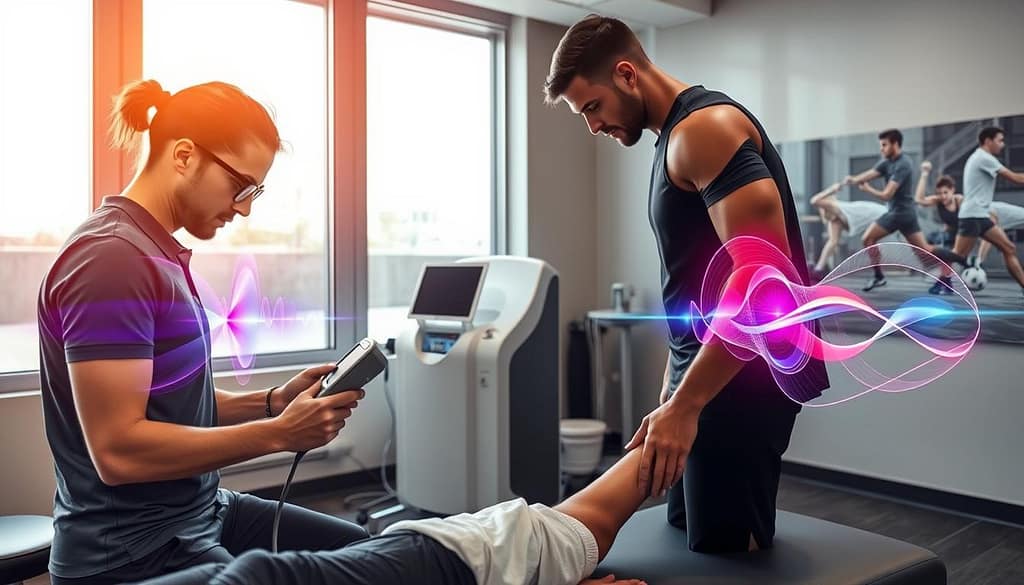
Let’s look at the key players. Electromagnetic therapy sends messages to your cells, telling them to calm down. This reduces swelling and pain, starting the repair process. It’s a calm way to heal.
Ultrasound is next, but it’s not just for baby pictures. It’s used for both diagnosis and therapy. Therapeutic ultrasound uses sound waves to improve blood flow and break down scar tissue. It’s like a deep-tissue massage from physics.
Laser treatment, like low-level laser therapy (LLLT), shines a light on healing. It uses light to interact with your cells’ energy centers. This boosts energy, reduces stress, and speeds up repair. It’s like sunlight for your muscles, but on demand.
So, what do these tools do in real life? They help your body heal actively, not just wait. They manage inflammation, boost energy, and signal your body to start repairing. It’s a big change in sports medicine technology.
Now, athletes are not just patients but active partners in their recovery. The line between treatment and performance enhancement is blurred. The new mantra is “train smarter, recover faster.” With these tools, it’s not just a dream—it’s reality.
Monitoring & Assessment Tools
Gut feelings aren’t good for managing injuries. For years, recovery was based on how it felt. This led to more problems than solutions.
True healing optimization means moving to a smarter approach. It’s about using tools to track your body’s repair.
Inflammation markers are like political polls for your body. They show if you’re healing well or not. Knowing this helps avoid rushing back to play too soon.
The Imaging Revolution: From Blurry Snapshots to HD Video
Ultrasound used to just show babies. Now, it’s key for regenerative medicine. It helps place treatments like PRP injections with precision.
Missing the mark can cause more harm. Imaging lets us see how tissues are healing. It’s like watching a city grow instead of just seeing a map.
Beyond the Pain Scale: Tracking Actual Progression
A pain scale from one to ten is too simple. Modern recovery assessment uses more detailed metrics. We track range-of-motion, strength, and energy levels for repair.
This data helps create a better recovery plan. It tells us when to push harder and when to slow down. It’s about making smart choices based on real data.
The old way relied on stories. The new way needs facts. Recovery is now a science, not just a guess.
You’re not just waiting to feel better. You’re tracking real signs of improvement. This is the smart way to heal and avoid setbacks.
Personalized Treatment Protocols
The old days of one-size-fits-all recovery are gone. Today, we need plans as unique as your fingerprint. Think about it. Would you mix a sports car with parts from a minivan? No way. So, why treat a pitcher’s elbow like a runner’s stress fracture?
Regenerative medicine is all about precision, not magic bullets. It’s about tailoring treatments to fit specific injuries. This approach is both effective and personalized. But, it requires more than just knowing the injury’s name.

First, we look at the injury. Treating a torn UCL is different from a hamstring tear. The severity of the injury guides the treatment plan. Is it a new tear or a long-standing problem? The approach changes.
Next, we examine your genetic code. Does your body heal fast or slow? Certain genes affect how you heal and respond to treatments. Ignoring this is like ignoring a food allergy. Your DNA is key to your recovery.
Then, we track how you respond to treatments. Two athletes with the same injury can heal differently. Modern tools help us adjust treatments based on your unique response.
Lastly, we consider who you are. Your age, sport, and goals matter. A young athlete needs a plan for power, while an older athlete focuses on pain-free living. The goal shapes the journey.
Creating a personalized treatment plan is complex. It’s not just a checklist but a dynamic system. The table below shows how different factors come together for a unique plan.
| Personalization Factor | What It Means | Protocol Impact |
|---|---|---|
| Injury Type & Severity | Is it a tendon, ligament, muscle, or bone issue? Acute or chronic? | Dictates the primary regenerative tool (e.g., PRP for tendons, stem cells for cartilage) and treatment aggressiveness. |
| Genetic Profile | Inherited traits affecting inflammation, tissue repair speed, and drug metabolism. | Informs dosage, specific growth factor choices, and predicts possible healing timelines. |
| Individual Healing Response | How the body uniquely reacts to the initial treatments and therapies. | Requires real-time protocol adjustments—increasing/decreasing treatment frequency based on biofeedback. |
| Athlete Demographics & Goals | Age, sport, position, competitive timeline, and personal performance targets. | Determines the rehab phase intensity, cross-training integration, and the final “return-to” benchmark (play, train, or daily life). |
The old model was simple: “What’s the standard treatment for this injury?” Today, we ask, “What’s the best treatment for this injury, in this person, with these genes, aiming for this specific goal?” This approach is what makes modern performance recovery systems effective. Your recovery should fit you, not just the textbook.
Integration with Training Systems
Scheduling a PRP injection is easy. But integrating its effects into a tough season is where things get tricky. Recovery is not just a side thing. It’s a key part of the plan.
Today’s performance recovery systems ask us to rethink old ways. We should see recovery as a continuous, changing process. Your tools for managing load and tracking biomarkers need to work together.
How do you plan a treatment that starts a chain reaction in cells? You can’t just fit it into a random day off. You need to plan the whole cycle around it. The 72 hours after treatment might involve special recovery steps to help the therapy work better.
This is advanced load management. It’s not just about cutting back on training. It’s about adjusting intensity and type to help the body heal. The body is not just resting. It’s fixing itself.
Linking recovery acceleration with performance data is the big win. We go from hoping an athlete feels better to knowing their tendon is 15% stronger and their power is up. The data shows how the treatment is working.
The decision to let an athlete play is no longer a guess. It’s based on solid data. Is the tissue healed? Are inflammation levels down? Has the athlete met key performance goals in safe settings? Check, check, check.
This makes coming back from injury a reliable process. It’s not just about getting back on the field. It’s about coming back stronger. That’s what recovery acceleration promises.
In the end, this integration ends the old view of rehab as a pause. The repair phase is now the most important part of the game. You’re not just waiting for an injury to heal. You’re making the athlete stronger. When your performance recovery systems and training systems work together, you’re not just recovering faster. You’re building a stronger athlete.
Clinical Validation Requirements
The world of regenerative medicine sports is both science and show. It’s important to look closely at the evidence. A celebrity endorsement isn’t the same as a scientific study. A popular hashtag doesn’t equal a safety check.
When we buy these advanced treatments, we’re really buying data. Or at least, we should be.
Clinical validation is like building a city with rules and permits. It proves a treatment works well and safely. This proof comes from four main areas: evidence standards, safety checks, studies on how well it works, and approval from regulators.
What makes a study strong? We look beyond just stories. A good study in this field is a detailed, reviewed study. It controls for things like the placebo effect, which is big in sports recovery. Key parts include:
- Blinded Protocols: Where no one knows who got the real treatment.
- Appropriate Control Groups: Comparing the new treatment to a standard or placebo.
- Objective Outcome Measures: Using data like MRI scans, not just feeling better.
- Long-Term Follow-Up: Tracking patients for months or years, not just weeks.
Take the 2016 study in the Orthopaedic Journal of Sports Medicine. It showed athletes with knee cartilage lesions got better with Bone Marrow Aspirate Concentrate (BMAC). But, the study also found different results for each patient. It didn’t prove BMAC was better than other treatments. It was promising, but not final.
Safety is also key. What does proper medical care look like? It means checking for any reasons not to use the treatment, using clean environments, and having a plan for any bad reactions. It’s the difference between a real treatment and a casual shot.
Then, there’s the regulatory world. In the U.S., many regenerative treatments are in a gray area. The FDA has stopped some stem cell clinics for making false claims. This doesn’t mean the science is wrong, but it shows the gap between fast use and slow approval. A true expert knows this and doesn’t hide from it.
The goal is to improve regenerative medicine sports, not to dismiss it. By demanding solid clinical validation, we move from marketing to real results. We go from blind faith to data. An athlete’s recovery is too important to be based on trends. It needs science.
Professional Applications: The Elite Athlete’s Hidden Playbook
In the world of professional sports, a torn ligament is a big deal. It’s not just an injury; it’s a crisis for a team. The response needs to be quick, smart, and use the latest technology. This is where performance recovery systems become essential.
Stars like Tiger Woods, Rafael Nadal, and Kobe Bryant are not just patients. They are early adopters of new treatments. For them, treatments like platelet-rich plasma (PRP) were not just medical options. They were smart investments. As one expert said, “shaving weeks off recovery can be critical.” Those weeks can make a big difference in a season.
The real story is not just the athlete. It’s the whole team around them. In a modern NBA or NFL team’s treatment room, you won’t see just ice packs and massage tables. You’ll see advanced regenerative technology as part of their daily routine.
This integration needs teamwork between doctors, coaches, and trainers. The doctor doesn’t just diagnose; they predict. They give data on healing to coaches, who adjust plans. The trainer makes sure recovery fits with treatment times. It’s a constant negotiation.
This teamwork creates a culture where recovery is part of the game plan. The goal is to keep athletes at their best, not just for a short time. It turns training into a high-tech process with athletes at the center.
The key parts of this approach can be broken down. Here’s a table showing what a team’s recovery plan includes:
| Protocol Component | Primary Staff Role | Integration Point | Key Technology/Tool | Performance Metric |
|---|---|---|---|---|
| Acute Injury Response | Team Physician | Immediately Post-Injury | Portable Ultrasound, PRP Kits | Initial Inflammation Reduction Time |
| Daily Recovery Maintenance | Head Athletic Trainer | Post-Game/Practice | Photobiomodulation Lasers, Compression Systems | Muscle Soreness Levels (VAS Score) |
| Long-Term Tissue Regeneration | Regenerative Medicine Specialist | Off-Season/Managed During Season | Stem Cell Therapy, Growth Factor Injections | Tendon Ligament Strength (via Imaging) |
| Data Synthesis & Load Management | Performance Science Director | Continuous | Recovery Tracking Software, Wearable Sensors | Correlation Between Workload & Injury Risk |
| Return-to-Play Decision | Multi-Disciplinary Committee | Final Phase of Rehab | Biomechanical Analysis, Sport-Specific Testing | Confidence in Sport-Specific Movement |
This isn’t just about fixing injuries. It’s about building a stronger team. The best performance enhancement is a system that prevents injuries. The team that heals better, lasts longer. In today’s sports world, that’s the only way to win.
So, when you see an athlete defy age, think about the team behind them. You’re seeing the result of a top-notch performance recovery system. It’s not just a medical miracle; it’s a logistical achievement.
Safety & Risk Management
Think of safety protocols in recovery acceleration like the airbags in a high-performance car—you hope you never need them, but you’d be a fool to drive without. This isn’t about fear. It’s about intelligent, proactive risk management. Let’s talk about the guardrails on the fast track to healing.
The foundation of any safe treatment is a rigid, evidence-based protocol. This isn’t a suggestion box. It’s a step-by-step playbook covering everything from sterile preparation and precise injection techniques to post-procedure care instructions. Skipping a step to save five minutes is the definition of a false economy.
Many get tripped up by the marketing. Yes, therapies like PRP and BMAC are natural and autologous—your own biology, so rejection risks are minimal. That’s a huge advantage. But let’s be clear: “natural” does not equal “miracle cure.” Their effectiveness varies wildly based on the injury, your overall health, and frankly, a bit of biological luck. This variability is why they often live in an insurance coverage gray area.
The critical factor? Medical supervision. This is not a DIY project you order online. A qualified physician isn’t just there to administer the shot; they’re there to be the conductor, ensuring every element of your accelerated recovery plan works in harmony and doesn’t derail. They are your first and last line of defense.
A major part of that supervision is knowing who should not receive these treatments. Patient selection is everything. Applying a powerful biological tool to the wrong canvas can do more harm than good. The table below breaks down common red flags.
| Therapy Type | Common Contraindications | Relative Risk Level | Key Mitigation Strategy |
|---|---|---|---|
| Platelet-Rich Plasma (PRP) | Active infection, blood clotting disorders, low platelet count, certain cancers | Moderate | Comprehensive blood screening and medical history review |
| Bone Marrow Aspirate Concentrate (BMAC) | Systemic infection, bone marrow disease, severe anemia | Moderate to High | Specialized imaging and hematologist consultation |
| Electromagnetic Therapy | Pacemakers/ICDs, pregnancy, metal implants at treatment site | Low | Detailed device interrogation and site assessment |
| Photobiomodulation (Laser) | Photosensitivity, active skin cancer over area, thyroid condition | Low | Skin evaluation and medication review |
So, what happens if something doesn’t go as planned? Adverse event monitoring is a non-negotiable follow-up. This means having a clear channel to your care team to report unusual pain, swelling, or fever. It’s not about being paranoid; it’s about catching a possible problem before it gets worse. A good protocol has a built-in feedback loop.
In the end, the goal isn’t just to get back faster. It’s to get back stronger and stay back. True recovery acceleration is a partnership between advanced technology and old-fashioned medical diligence. It respects the power of the tools by mandating a skilled operator. Because the smartest recovery is always the safest one.
Future Technology Developments
Forget the rehab clinic. Imagine a bio-fabrication studio. The next big thing in healing isn’t just soothing inflammation. It’s about building at a microscopic level.
Nanotechnology is moving from idea to real-world tool. Research into nanotechnology systems for tissue repair shows how tiny scaffolds can guide cell growth. It’s like a construction foreman directing a team.
This is about designing tissue repair, not just fixing it. The future is all about personalizing treatments. Your treatment will be based on your unique genetic code. It’s a move from fixing problems to preventing them.
A report on regeneration technology paints a picture of a future where AI and biometrics work together. They create a cycle of stress and repair, pushing healing to new heights.
The big question is, when does repair become enhancement? If a bio-patch doesn’t just fix your muscle but also makes it stronger, what’s the difference? The FDA has approved nano-patches, and WADA is worried about gene doping.
The goal is no longer just to recover. It’s to create an athlete who can handle anything. The ultimate aim is to make an athlete who is ready for the future.