
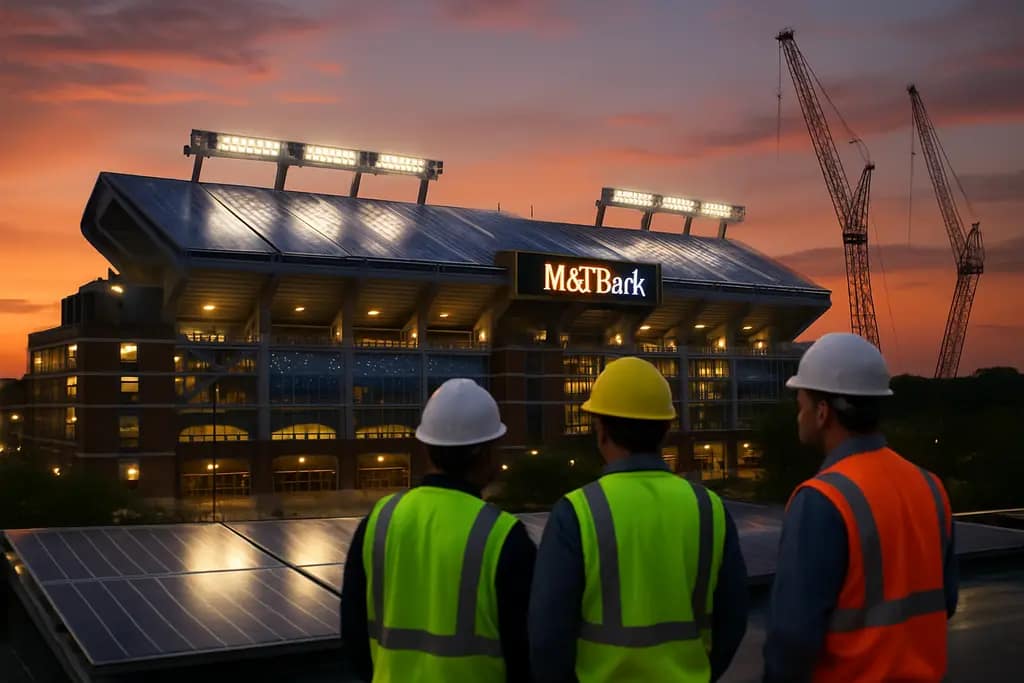
On August 26, 2026, M&T Bank Stadium renovations are best read as more than a facelift for Baltimore Ravens fans. The work has added fan-facing spaces, but its sustainability value sits in the less flashy systems: solar power, LED lighting, waste sorting, composting, refill stations, food sourcing and construction waste diversion. That matters because stadium improvements can raise energy demand at the same time they promise a better game-day experience.
As a sustainability advocate in sports, I tend to judge these projects by a simple test: do the upgrades make attending a game easier while lowering the venue’s environmental burden, or do they simply move emissions and waste out of sight? The Ravens’ available data gives some encouraging answers, though not every long-term outcome can be judged until the new systems operate across multiple seasons.
M&T Bank Stadium Renovations And Energy Use
The most visible sustainability piece is on the roofline, not the field. The Ravens said about 1,000 solar panels were being installed atop the new North Plaza roofs, with the system expected to partially power M&T Bank Stadium and generate about 435,000 kWh annually. The team projected that this would avoid about 309 metric tons of carbon dioxide emissions per year, a figure it compared with the electricity use of 40 to 50 average U.S. homes, according to the Ravens’ solar panel announcement.
Why M&T Bank Stadium Renovations Put Solar In View
There is a fan-experience angle here that should not be dismissed. Solar arrays on plaza roofs connect sustainability with places supporters actually use before entering the bowl. If renewable energy is hidden in a procurement contract, fans may never see the operational shift. If it is built into a public plaza, it becomes part of the stadium story. That visibility can help supporters understand that venue design, energy supply and event operations are linked.
Still, the scale deserves careful framing. A partial-power solar system is not the same as a fully renewable stadium. The stronger claim is narrower: the project adds on-site renewable generation to a venue that already had a sustainability record. M&T Bank Stadium became the first existing outdoor professional sports facility in the United States, across the NFL and MLB, to achieve LEED Gold certification in 2013, based on the same Ravens announcement. That older certification gives context, but it does not remove the need to track actual performance after the new construction settles into normal use.
LEDs, EV Charging And The Limits Of Venue Power
The venue’s sustainability materials also report that 14 electric vehicle charging stations have been installed for fans and staff, and that most stadium lighting across the sports field, concourses, stairwells and offices is now LED. These are practical upgrades rather than dramatic ones. LEDs can reduce electricity use compared with older lighting, while EV charging helps some attendees and workers shift vehicle energy demand away from gasoline. Yet stadium travel emissions are not solved by chargers alone. Many fans still arrive through a mix of driving, transit, walking, rideshare and team-organized travel patterns that vary by event.
That is why I see the energy side of M&T Bank Stadium renovations as a measurable start, not a complete answer. The strongest future reporting would separate electricity generated, electricity consumed during event days, and electricity consumed during non-event operations. Without that split, it is hard to know how much the new generation offsets the stadium’s highest-demand moments.
Waste, Food And The Game-Day Experience
Waste work is often where sustainability either becomes real or slips into slogans. During the 2025 Ravens season, the stadium reported 74.8 tons of food scraps composted through kitchen, suite, hospitality and game-time hand-sorting programs. It also reported that more than 90 percent, or 358.7 tons, of construction and demolition waste was diverted from landfill, and that Ravens games reached a 53 percent diversion rate from landfill or incineration through sorting, according to the stadium’s sustainability report.
Composting That Fans Can See
For supporters, waste systems are part of comfort. Clear bins, trained staff and shorter uncertainty at disposal points reduce the small friction that builds during halftime or after the final whistle. The research notes describe ongoing staff training for kitchen, suite and concessions teams on waste separation, recycling and composting, including “trash talks.” That type of training is easy to understate, but it is central. Compost programs fail when the back-of-house process and fan-facing instructions do not match.
The 2025 data also said compost services expanded, with service frequency increasing by 334 percent through Veteran Compost compared with the previous season. That figure suggests the venue was not only collecting more material, but also adjusting pickup capacity to keep pace with operations. A sustainability program that depends on overloaded bins or irregular hauling will struggle on high-attendance days.
Local Sourcing Beyond The Scoreboard
Food sourcing is another area where fan experience and environmental goals can meet. The 2025 reporting said 65 percent of seafood served came from the Chesapeake Bay and 38 percent of produce used was grown within a 200-mile radius. These numbers do not prove that every menu item has a low footprint, since transport is only one piece of food impact. They do show a defined procurement direction, and local sourcing can support a stronger sense of place for a Baltimore venue.
The stadium also reported that water bottle refill stations had saved more than 33,000 single-use bottles since 2024. This is a modest but tangible fan-service upgrade: hydration access improves, while disposable bottle use declines. It is the kind of small intervention that works because supporters do not need to change their entire game-day routine. They need refill points that are easy to find and trusted to work.
- Most measurable fan gains: refill stations, better waste sorting, LED-lit concourses and more public-facing plaza infrastructure.
- Most measurable environmental gains: solar generation, composting, construction waste diversion and reduced single-use bottles.
- Areas needing longer review: event-day energy demand, transportation emissions and contamination rates in recycling or compost streams.
How The Renovation Money Touches Supporters

The broader 2024–2026 project was described in the research as a $430 million renovation program covering plazas, concourses, hospitality, year-round public spaces and sustainability infrastructure. The Ravens also committed an extra $20 million in early 2025 to keep renovation and sustainability-linked work on schedule. Those numbers place the green features inside a major capital project, not a side campaign.
Public Space, Plazas And Concourses
From a sports-business standpoint, the test is whether upgrades make the building more useful without pushing resource use in the wrong direction. New plazas and hospitality areas can increase dwell time, premium offerings and non-game activity. That can be good for revenue and public use. It can also increase cleaning loads, food service demand, lighting hours and cooling needs. This is where M&T Bank Stadium renovations require performance tracking beyond ribbon-cutting moments.
Supporters usually judge a stadium by entry flow, sightlines, food access, restrooms, shade, seating, connectivity and the feeling of being part of the event. Sustainability advocates judge the same building by energy, water, waste, materials, food systems and transport. The better projects make those two scorecards overlap. A shaded plaza with solar panels, refill stations near concourse traffic, and waste sorting backed by trained staff are examples of overlap rather than tradeoff.
Why Verification Matters
The available reporting is useful because it includes quantities: tons composted, tons diverted, bottles saved, panels installed and projected electricity generated. Caution is still warranted. Projections for solar output and emissions avoided should be compared with actual annual generation once the system has operated through heat, storms, football crowds and non-event days. Waste diversion should be tracked with contamination data where possible. Food donations, reported in 2025 at more than 2.2 tons of surplus food and 4,463 pieces of equipment to local programs, should be evaluated as part of a wider resource-use plan rather than treated as a substitute for waste prevention.
For those interested in further developments regarding stadium and sports infrastructure in the region, more details can be accessed through Noticias BO. The main point for Baltimore is that the Ravens have put enough verified metrics into public view to make accountability possible. That is valuable. Fans do not need perfect sustainability language; they need honest reporting that lets them see whether the building is improving.
Fan Value In M&T Bank Stadium Renovations
The strongest case for the project is not that it makes M&T Bank Stadium a finished model of sustainable sport. The stronger case is that it links fan comfort with measurable operational changes. Solar panels can lower a portion of purchased electricity. LED lighting can support energy efficiency while improving visibility. Composting and hand sorting can reduce landfill-bound waste. Refill stations can cut single-use bottle demand while serving fans directly. Local seafood and regional produce can make concessions more connected to Maryland food systems.
The weakest case would be overstating the impact before enough post-renovation data exists. A stadium is a high-intensity venue with periodic surges in people, waste, electricity use and transport demand. Even good upgrades need verification across many event types. By August 26, 2026, the most fair reading is that M&T Bank Stadium renovations have moved sustainability from the background into the fan route through the building. The next measure is consistency: whether those systems keep performing after the novelty fades and the stadium returns to the weekly pressure of football operations.