
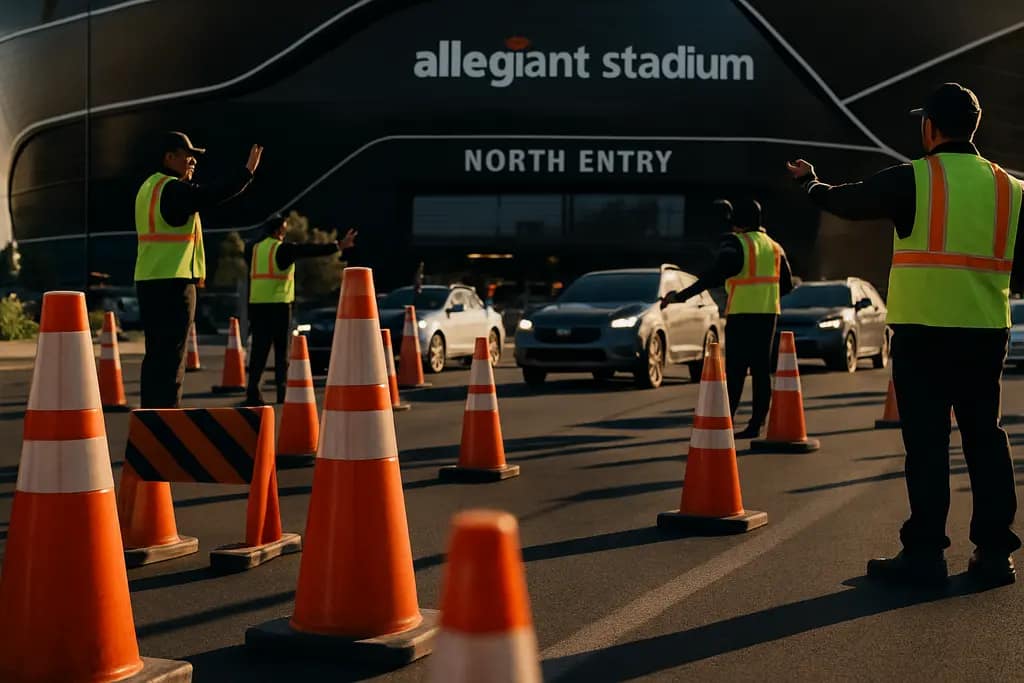
The Allegiant Stadium North Entry plan is now more than a design concept. On September 2, 2026, the Las Vegas Stadium Authority approved $75 million in public funding toward a $158 million renovation of the stadium’s north-side access point, according to a FOX5 Las Vegas report. For a venue that depends on heavy event turnover, Strip foot traffic, rideshare demand, and NFL-level security screening, the traffic-flow question is also a sustainability question.
Why The Allegiant Stadium North Entry Matters
Allegiant Stadium opened in July 2020 with a capacity of about 65,000, and its event mix has moved well beyond Raiders home games. High-attendance football games, concerts, soccer matches, and other ticketed events compress large numbers of people into short arrival and departure windows. The north side has become especially sensitive because many attendees approach from the Las Vegas Strip by crossing the Hacienda Bridge.
That pattern has value: walking from nearby hotels can reduce short car trips if the route is safe and direct. But if pedestrians and vehicles compete for the same space near the gate, the sustainability benefit weakens. Vehicle queues can lengthen, rideshare circulation can slow, and pedestrians can face heat exposure while waiting in crowded approach areas.
Allegiant Stadium North Entry As A Bottleneck
The north gate’s pressure point is not unusual for modern sports venues. Stadiums increasingly sit in entertainment districts where thousands of people arrive without a single dominant travel mode. Some walk from hotels, some use rideshare, some come by private car, and others reach the site through shuttle or charter operations. A design that works for one mode can create friction for another.
At Allegiant Stadium, the planned raised pedestrian deck is meant to give walkers a more direct route from the West Hacienda Avenue overpass to the northern gate. If built as described, that separation could reduce conflict between pedestrians and vehicle lanes. The cautious point is that published reporting has not yet provided measured projections for shorter wait times, reduced idling, or reduced emissions. The direction of the design is clear; the quantified outcome is not.
What The $158 Million Plan Changes
The renovation plan has three core access elements: an elevated pedestrian deck, a dedicated pick-up and drop-off area below it, and a large shaded plaza or canopy at the entry. Each part addresses a different stress point in event-day movement. The deck targets walking flow. The lower zone targets vehicle circulation. The shade structure targets comfort and heat exposure in a desert setting.
Separating Walking Routes From Vehicle Queues
Separating people on foot from rideshare and private-vehicle movement is the clearest traffic intervention. A raised deck can reduce crossing points, simplify crowd direction, and make the walking route from the Strip more legible. That matters because uncertainty slows crowds. When fans hesitate near lanes, barricades, and temporary signage, the movement rate drops and staff have to manage more conflicts at close range.
A dedicated pick-up and drop-off area below the deck could also make rideshare behavior more predictable. In practice, the benefit would depend on curb management, driver routing, post-event staffing, and how well event operators communicate the zones to fans before arrival. Infrastructure can set the conditions, but operations determine whether the capacity is fully used.
Shade, Heat, And Event-Day Comfort
The shaded plaza or canopy may be the most direct sustainability and resilience feature in the project. Las Vegas heat changes how crowds behave. People move more slowly, cluster in shaded areas, and may need more cooling support. Shading the entry zone could reduce heat exposure for fans, event staff, security workers, and vendors during long arrival windows.
The public reporting also says the plaza could support smaller community events and activations outside major games. That part deserves scrutiny. Extra use can improve the value of a public investment, but it can also increase maintenance needs and energy demand. The sustainability case is stronger if the space reduces temporary infrastructure, improves shade access, and supports lower-impact travel patterns rather than simply adding more programmed consumption.
Sustainability Signals And Evidence Gaps
Traffic flow is often treated as a convenience issue, but at a stadium scale it has environmental consequences. Idling vehicles burn fuel while producing local emissions. Crowded pedestrian approaches can push some fans back toward short vehicle trips. Poor shade coverage can increase demand for indoor refuge, cooling, medical support, and temporary mitigation measures.
Where The Environmental Claim Is Strongest
If the Allegiant Stadium North Entry succeeds, its most plausible sustainability gains would come from three areas: less vehicle idling near the gate, safer walking access from the Strip, and reduced heat exposure in the entry plaza. These are reasonable design expectations based on the announced features, but they should be treated as hypotheses until the stadium reports post-opening data.
For readers tracking how venue access shapes regional travel behavior, our prior analysis of sports venue tourism economics offers useful context. Venue upgrades can support visitor demand, but public benefits are difficult to prove without clear metrics on transportation, staffing, emissions, and neighborhood impacts.
What Has Not Been Published
The available reports do not disclose estimated emissions savings, projected reductions in rideshare dwell time, heat-index modeling for the shaded plaza, or water and material choices for the renovation. Those missing details matter. A canopy can improve comfort, but its sustainability profile depends on materials, embodied carbon, maintenance, and whether it reduces temporary cooling needs during events.
- Traffic metrics: average pedestrian travel time from the bridge to ticket screening, before and after construction.
- Vehicle metrics: rideshare dwell time, queue length, and idling duration near the north approach.
- Heat metrics: shaded square footage, surface temperatures, and heat-related assistance calls during events.
- Operations metrics: staffing needs, barricade use, and post-event clearance time.
For those interested in how different venues in the network contribute to hospitality, Bass Lake Roadhouse provides additional insights that complement this analysis focused on stadium transport, heat, and environmental considerations.
Funding, Timing, And Sports-Business Risk

The public share approved on September 2, 2026, is scheduled to come from the Waterfall Residual Fund, which is fueled by excess room tax revenues. The Las Vegas Raiders, as stadium owner, are expected to cover the remaining project cost, and public reporting says no new taxes will be levied. That structure may reduce direct taxpayer exposure, but it does not remove the need for public accountability. A publicly supported stadium access project should report whether it achieves the operational and environmental benefits used to justify it.
Public Money Without New Taxes
Room-tax-backed stadium spending often sits at the intersection of tourism, sports business, and public infrastructure. In this case, the argument is not only that the north entrance needs capacity relief. It is also that Allegiant Stadium must remain competitive for major events as other cities invest in new venues. The NFL’s report framed the renovation as part of the stadium’s effort to support future premier events, including the Super Bowl scheduled for early 2029 at Allegiant Stadium, in its coverage of the upgrade.
That competitive framing is credible, but it should not crowd out basic measurement. If a project is sold partly on smoother access and better event readiness, then post-renovation performance should be compared with pre-renovation conditions at similar crowd sizes and event types.
Schedule Pressure Before 2029
For the Allegiant Stadium North Entry, timing is part of the risk profile. Construction is planned to begin in the third quarter of 2027, with completion anticipated by late 2028. That leaves limited margin before the Super Bowl scheduled for early 2029. Large stadium projects can face procurement, labor, weather, and event-calendar constraints, even when the design goal is limited to one access zone rather than a full venue rebuild.
The reported timeline should be watched against the Raiders’ home schedule, concert bookings, and other major event commitments. Temporary construction routing can create its own congestion and emissions problems if not managed carefully. The stadium and public agencies should disclose how pedestrian access from the Strip will be protected during the build period.
Event Readiness Before The 2029 Super Bowl
The Allegiant Stadium North Entry will not be judged only by how it looks on opening day. Its real test will come during compressed arrivals, hot afternoons, post-event rideshare surges, and national-event security conditions. A Super Bowl adds media compounds, sponsor activations, law-enforcement perimeters, VIP movement, and visitors who may not know the local walking routes. That makes simple wayfinding and mode separation more valuable.
What Future Events Could Test
The strongest version of this project would make walking from the Strip safer and more attractive without shifting congestion to another curb or intersection. It would also provide shade that helps fans and workers tolerate Las Vegas heat without relying only on indoor cooling or temporary equipment. Those outcomes are possible, but they are not guaranteed by the headline funding number.
Metrics That Should Be Reported
Before the early 2029 Super Bowl, stadium leadership and public partners should publish a simple baseline-and-results scorecard. The most useful measures would include pedestrian throughput, rideshare clearance time, idling estimates, heat-mitigation performance, and post-event crowd dispersal. If those numbers improve after the renovation, the project can be evaluated as more than a premium entrance. It can be assessed as a sports infrastructure upgrade with measurable sustainability value.