
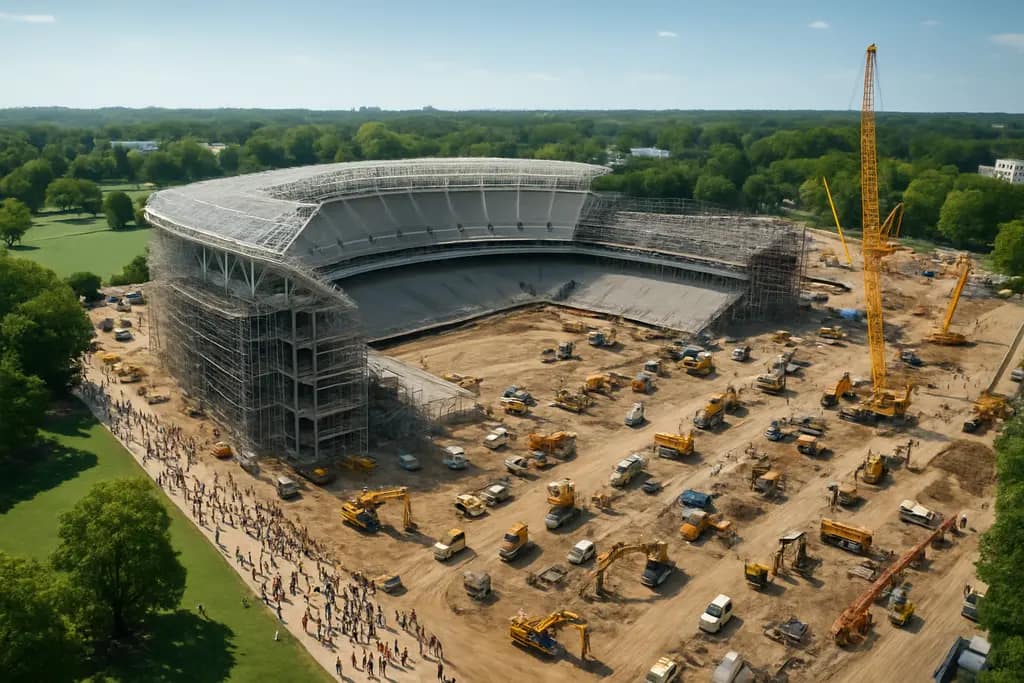
Commanders stadium impact is best read as a sports infrastructure case study, not just a football relocation story. The proposed RFK Campus project ties an NFL venue to public finance, event programming, housing, jobs, youth sports, and land-use choices that will affect Washington, D.C., well before the first kickoff planned for the 2030 NFL season.
The promise is large: a $3.7 billion stadium and mixed-use district, a roofed venue of roughly 65,000 seats, and a schedule designed for more than 200 annual events beyond Commanders home games. The risk is also large: D.C. is committing about $1.0 billion in taxpayer-backed support for infrastructure, parking, utilities, and related needs, while the Commanders are expected to contribute $2.7 billion, according to deal details reported by The Washington Post.
For a sports sustainability writer, the key question is not whether a new stadium can create activity. It almost certainly can. The better question is whether that activity is durable, equitable, and less wasteful than the old model of giant venues surrounded by asphalt and used only on game days.
Commanders stadium impact and the RFK Financing Test
What The Public-Private Split Signals
The financing split frames the debate. The Commanders’ expected $2.7 billion contribution is the larger share, but the public portion is still significant. A stadium does not operate in isolation. Roads, utilities, transit access, parking, public safety, and public space carry costs that often land outside the team’s direct construction budget.
That is why the public return has to be measured beyond ribbon-cutting and opening-night attendance. If the District’s contribution supports infrastructure that serves residents on non-event days, the civic case improves. If those assets mostly serve stadium traffic, the value proposition narrows. The research indicates that the RFK Campus plan covers about 180 acres, which means the public stake is tied to district planning as much as to the stadium bowl.
Revenue Projections Need Careful Reading
The most optimistic figures are tied to long time horizons. A 30-year analysis for 2030 through 2059 projects $15.6 billion to $20.6 billion in total output and $15 billion to $16 billion in direct spending, with District tax revenue estimated around $4 billion to $5 billion depending on the development mix, according to the RFK economic impact analysis.
Those numbers support the case for Commanders stadium impact, but they should not be treated as guaranteed cash in hand. Economic output includes spending that moves through the local economy, not only net public gain. Tax revenue depends on attendance, hotel activity, ticket sales, food and beverage spending, employment, and the final mix of housing, retail, and hospitality. A cautious read separates gross activity from fiscal return.
The research also points to a first-year projection for 2030 of about $800 million in direct spending and $1.1 billion in total output, with about $63.7 million in annual tax revenue. These estimates are useful, but they depend on the stadium opening timeline holding: site preparation before construction, construction beginning in spring 2027, and completion by spring 2030.
From Game Days To A Year-Round Sports District
Commanders stadium impact In The Event Calendar
A modern NFL stadium is no longer designed only for eight or nine regular-season home games. The RFK proposal is built around a fully roofed or enclosed venue with roughly 65,000 seats and more than 200 annual events beyond football. That can include concerts, festivals, and global sporting events. For D.C., the sports-business logic is clear: a roofed building reduces weather risk for event promoters and may widen the usable calendar.
Still, a busy calendar brings tradeoffs. More events can improve revenue, support stadium jobs, and draw visitors into nearby businesses. More events also increase pressure on transit, waste systems, security staffing, neighborhood noise management, and post-event cleanup. The difference between a well-run district and an overburdened neighborhood often sits in those operational details.
Why Venue Design Matters For Performance
From a performance perspective, a roofed stadium can create a more controlled event environment for athletes, broadcasters, and spectators. That does not automatically make it sustainable. Enclosed buildings can demand major energy loads for lighting, climate control, concessions, and event production. The research provided does not verify energy performance standards, on-site renewable power, water reuse targets, low-carbon material commitments, or third-party certification.
That uncertainty matters. A stadium can be innovative in design and still fall short on environmental performance if its energy, waste, and transport plans are weak. The project’s sustainability credibility will depend on measurable targets released before construction, not on architectural language alone.
Community Benefits, Housing, And Access
Jobs And Workforce Promises
The construction phase is projected to create about 14,000 construction jobs, while stadium operations are expected to support about 2,000 full- and part-time permanent jobs after opening. Those are meaningful figures for a sports venue project, but the quality of those jobs will shape community value. Wages, training access, union participation where applicable, local hiring, and advancement pathways matter more than headline counts.
The Commanders stadium impact will be judged in Wards 5, 7, and 8 partly by who gets hired and who gets contracts. A $50 million Community Benefits Agreement over 30 years has been reported in the research, with funds earmarked for a Ward 7 grocery store, a youth sports academy, small-business support, workforce programs, and resident tickets. The youth sports academy is especially relevant: if built and funded well, it could connect a pro-football project to participation, coaching, and player development at the neighborhood level.
Housing Near A Sports Venue
The mixed-use plan includes 5,000 to 6,500 housing units, with at least 30% classified as affordable under D.C. criteria. That could be one of the most consequential parts of the RFK Campus plan because housing determines whether the project becomes a stadium district or a broader neighborhood investment.
Sports venues can raise land values and commercial interest. That can help the tax base, but it can also price out nearby residents and small businesses if protections are weak. The affordable housing share is a key starting point, yet the affordability levels, duration of restrictions, bedroom mix, and access to transit will decide whether the housing plan matches community need.
- Track job quality: Published hiring data should distinguish temporary construction work from permanent operations roles.
- Track affordability: Housing counts should be paired with income levels and long-term affordability terms.
- Track public access: Parks, youth fields, and retail should serve residents on non-event days, not only ticketed visitors.
- Track operations: Waste, energy, transit, and security plans should be reported with measurable targets.
Sustainability Questions For RFK Campus Planning

What Is Known And What Is Not
The research confirms planned green space, retail, hotel uses, youth sports facilities, and housing as part of the broader district. It does not verify the project’s carbon budget, material standards, energy model, stormwater plan, or event-waste targets. That does not mean those plans are absent. It means public evaluation should wait for documented specifications.
For a venue of this scale, sustainability cannot be limited to visible green space. The largest effects may come from how people travel to events, how the building uses power, how food and beverage waste is handled, and whether construction materials carry lower embodied carbon. Stadium operators across sports face similar questions, including in motorsports and outdoor recreation; readers exploring venue practices can find comparative discussions at a related powersports site.
Transport Is The Practical Test
A stadium district that depends heavily on private vehicles will carry a different footprint from one that pushes transit, walking, cycling, and shared mobility. The research mentions infrastructure, parking, and utilities as part of the public cost. It does not provide verified mode-share targets or transit service commitments. Until those details are public, the Commanders stadium impact on emissions and neighborhood congestion remains uncertain.
That uncertainty should be treated as a planning gap to close before spring 2027 construction. If the venue is intended to host more than 200 annual events, transportation is not a side issue. It is a core operating system for the district.
RFK Campus And The Commanders stadium impact
The RFK Campus plan has the scale to reshape D.C. sports infrastructure. It also has enough public exposure to require steady scrutiny. The strongest case for the project rests on year-round use, mixed-use development, housing, jobs, and long-term tax revenue. The weakest points are the ones not yet fully visible in the research: environmental performance, transport outcomes, affordability details, and the real distribution of benefits.
If the schedule holds, construction is expected to begin in spring 2027 and finish in spring 2030, in time for the 2030 NFL season opener. Between now and then, the most useful coverage will not be hype around renderings. It will be verification: signed commitments, public dashboards, design standards, community hiring reports, and operating plans that show whether the project performs for residents as well as it performs for the franchise.