
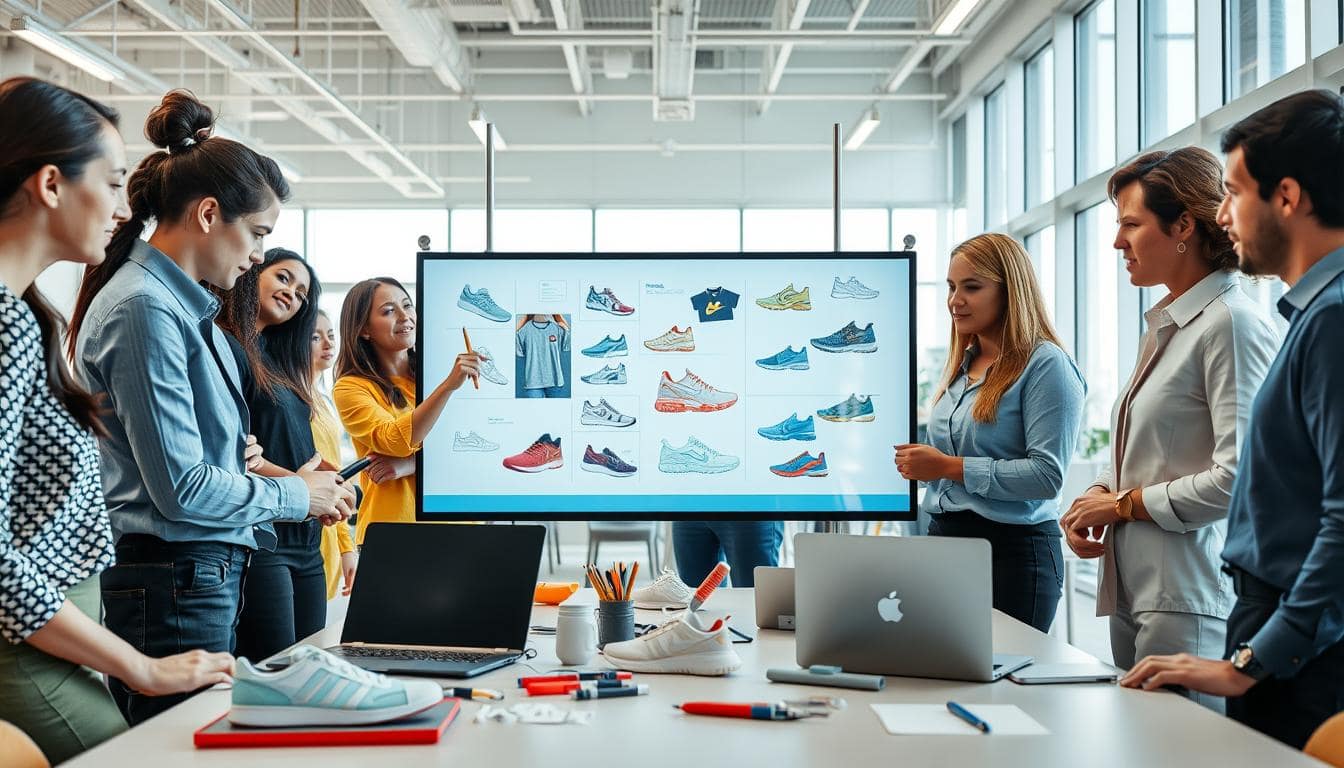
Do you remember the old way of designing sports gear? It was all about isolated geniuses sketching and prototypes moving slowly. That’s as old as VHS tapes.
Now, everything has changed. We’re seeing a digital shift that makes Moneyball look simple. Today, sports product development is all about connected collective intelligence moving fast.
Cloud computing has broken down barriers. AI analyzes athlete data instantly. This creates a world where everyone works together at top speed. Designers in Portland, engineers in Munich, and athletes giving feedback from anywhere.
Microsoft’s partnerships with sports giants show the plan: winning through digital teamwork. It’s not just new software. It’s a new way of innovating in sports.
The simple sketch has turned into a global, instant conversation. Let’s dive into how these collaborative design tools are making the next big thing in sports gear.
Cloud-Based Design Platforms for Sports Teams
Remember the old playbook, full of notes and scribbles? It’s now a thing of the past. Today, sports gear design happens in the cloud. This change is more than just a shift in how we organize things; it’s a new way of creating.
Platforms like Microsoft Azure are like a global digital locker room. Here, everyone works together, no matter where they are. The old way of sharing files is gone. Now, everyone sees the same version of a design.
The NFL’s tablets and the AI insights for the Billie Jean King Cup show the power of the cloud. These tools make it fast to turn ideas into real prototypes. They work as quickly as the game itself.
What does this mean for digital prototyping? It means everything. Designers and engineers can work together in real-time. They can make changes and see them instantly. This makes creating prototypes faster and more collaborative.
Microsoft Teams, linked with Azure, is like a virtual war room for teams like the NFL. They can discuss and give feedback right on the design. This makes it easier to go from idea to reality quickly. The cloud isn’t just a storage space; it’s the heart of teamwork in design.
The outcome? Designs improve faster, and mistakes are fewer. The whole process feels more like a team effort. The game has moved online, and so have the tools to play it.
Virtual Reality in Sports Equipment Testing
Virtual Reality has moved from the fan zone to the R&D lab. It’s a big change because making physical prototypes is old-fashioned. It’s slow, expensive, and not very precise.
Now, we test ideas in a digital space before wasting any materials. This way, we can try many things without the cost of real-world mistakes.
Think of it as a digital prototyping test lab. Engineers can test bike frames in a virtual wind tunnel instead of making 50 real ones. They can also test a football helmet’s strength millions of times digitally, finding weak spots easily.
This isn’t just about making pretty 3D models. Advanced design software and VR create a tight feedback loop. Athletes can feel the weight of a new tennis racket in a headset. Designers can see data as a quarterback throws in a digital storm.
The data from these tests is incredibly valuable. It helps AI systems, like Adidas’s smart soccer ball, make tiny adjustments. The final product is almost an afterthought, perfected in the virtual world.
The benefits are huge. Let’s look at the differences:
| Aspect | Traditional Physical Prototyping | VR-Powered Digital Prototyping |
|---|---|---|
| Speed | Weeks or months per iteration. | Minutes or hours for a new simulation run. |
| Cost | High material, machining, and labor costs. | Primarily computational power; near-zero material waste. |
| Testing Scope | Limited by lab facilities and safety. | Boundless: -20°F ice storms, 100mph winds, extreme G-forces. |
| Iteration Freedom | High cost of failure discourages radical changes. | Encourages “fail fast” innovation; no bad ideas, only data. |
| Athlete Involvement | Logistically complex, often late in the process. | Early and often from anywhere in the world. |
Now, lab coats are being replaced with VR headsets. The future of sports gear is being designed and tested in a virtual world. The only limit is the team’s imagination. That’s a real home-field advantage.
3D Modeling and Simulation Tools
If virtual reality is like a blockbuster movie, then 3D modeling and simulation tools are like the special effects. They make sure everything works before we even start making things. They’re like the cool, detailed spreadsheets of design.

Imagine a designer on a collaboration platform sketching a new bike frame. It looks amazing, but will it work? That’s where simulation comes in. It uses special math to predict how things will work, like how air flows over the bike frame.
With these tools, engineers can test every part of the bike. They can see how it will handle stress and even predict how fast it will go. It’s like having a virtual test run before making anything real.
These tools create a digital twin of the product and how it will be used. It’s like having a model of how a volleyball player moves. This model helps the simulation tools work better.
We’re not just guessing how things work anymore. We’re simulating real-world scenarios. For example, we can see how a football player’s impact affects a new shoe. It’s all about using data to make things better.
These tools are great for teams working together from far away. A team in Boston can work on a shoe design, and others in Portland and Milan can see the updates in real-time. This makes working together much faster and more effective.
Let’s look at the key players in this digital world. The table below shows how these tools help engineers feel confident in their work.
| Simulation Tool Type | Primary Function in Sports | Real-World Application Example | Impact on Remote Design |
|---|---|---|---|
| Computational Fluid Dynamics (CFD) | Analyzes air/water flow and drag. | Optimizing the dimple pattern on a golf ball for stable flight. | Wind tunnel results are shared digitally, eliminating need for co-located physical testing. |
| Finite Element Analysis (FEA) | Tests structural integrity and material stress. | Ensuring a carbon fiber bike fork can handle impact loads without failing. | Global teams collaborate on failure point analysis and iterative design fixes. |
| Biomechanical Simulation | Models human movement and interaction with equipment. | Predicting how a new tennis racket stiffness affects elbow joint stress. | Integrates athlete motion capture data from anywhere to inform product safety. |
| Multi-Body Dynamics | Simulates complex mechanical assemblies in motion. | Analyzing the precise hinge action and energy return of a ski binding. | Allows for virtual prototyping of mechanical parts, slashing physical sample costs. |
We’re moving from designing sports equipment based on looks to engineering it for real-world performance. This means products that work better, like shoes that grip the ground better and helmets that protect more.
This new way of designing is all about using data and collaboration platforms. It turns design into a science, making it possible to test and improve designs remotely. This way, we can make sure our products work perfectly before we even make them.
Real-Time Collaboration Across Time Zones
When a crisis hits at 3 AM in Los Angeles, the solution might already be brewing in a designer’s morning coffee in London. This isn’t science fiction—it’s Tuesday for modern sports development teams. The tyranny of time zones has been overthrown by collaboration platforms that keep global teams operating like they share a single, perpetually open office.
The NFL uses Microsoft Teams and Azure as their digital locker room. Coaches in New York, analysts in Dallas, and equipment managers in Green Bay now huddle up virtually. They review 3D helmet designs, debate material choices, and approve prototypes without anyone booking a flight. The operational efficiency gains here are staggering—what used to take weeks of email chains and missed calls now happens in real-time annotated sessions.
Formula One provides the ultimate stress test. Consider Alpine F1 Team during a race weekend. Engineers in the UK monitor real-time telemetry. Data analysts in France crunch numbers. Strategists at the track make split-second calls. They’re all in the same digital room, thanks to integrated collaboration platforms. The “watercooler moment” has gone global and asynchronous.
This real-time capability transforms emergencies into manageable puzzles. Discover a last-minute defect in a batch of running shoes? Instead of panic, you get a global brain trust. The Asian factory manager, European materials scientist, and North American product lead can immediately:
- Share high-resolution scans of the flaw
- Access the same 3D model from the cloud
- Propose and vote on solutions in a dedicated channel
- Document the entire resolution process automatically
The old barriers—9-to-5 schedules, physical office walls, incompatible software—have crumbled. What remains is a streamlined workflow where distance is measured in milliseconds, not miles. When an athlete has a problem, the entire world’s expertise is potentially one notification away.
This isn’t just about convenience. It’s about competitive advantage. Teams that master real-time collaboration move faster, adapt quicker, and innovate constantly. Their design cycles compress. Their error rates drop. Their ability to respond to athlete feedback becomes nearly instantaneous.
The secret sauce? These platforms create what I call perpetual daylight for projects. The sun never sets on a shared digital workspace. Someone, somewhere, is always moving the ball forward. That midnight insight from Tokyo becomes the morning breakthrough in Boston.
So the next time you watch a game or race, remember: behind that perfect piece of equipment is a global team that probably never met in person. They’re connected by something more powerful than geography—a shared mission and the collaboration tools that make it possible.
Version Control for Complex Sports Designs
Imagine trying to bake a wedding cake with many chefs changing the recipe at once. Without notes, the cake turns into a mess. This is what sports design was like before version control.
Now, version control systems are as vital as CAD software. They keep track of every change, like a librarian with a design novel. Without them, designs quickly fall apart.
Think of a pro cycling team making their next championship bike. It’s not just one product but a complex system of parts. Each part affects the others, from the frame to the wheels.
Version control records every change with great detail. It shows who made what change and why. It’s not about fault but understanding the design’s history.
The benefits are huge:
- Preventing Manufacturing Nightmares: Everyone works from the latest design files, avoiding mistakes.
- Enabling Intelligent Rollbacks: You can go back to a previous design if a new idea fails.
- Creating Audit Trails: You have a clear history for regulated sports or patents.
- Parallel Development: Teams can work on different parts without stepping on each other’s toes.
This ensures you’re working from the “single source of truth.” In sports, small changes can mean big wins. Knowing your design’s history is key to success.
Version control makes design more scientific. It turns creativity into repeatable engineering. With every change tracked, you’re not just making gear. You’re crafting victory, step by step.
Athlete Feedback Integration Platforms
Forget old ways like focus groups and post-game interviews. Today, sports tech listens to athletes through their sweat and sleep. It’s about turning grunts into data.
This isn’t about surveys. It’s about systems. Wearable sensors capture every movement. Biometric monitors track what athletes can’t say.

The Chicago Cubs monitor fatigue without waiting for players to say they’re tired. They analyze dips in performance and recovery. The Cleveland Indians track sleep to optimize routines.
The “bump-set-spike” trainer gives instant feedback during practice. It turns each repetition into data. Athletes adjust in real-time, and designers get insights.
These platforms create a closed loop. Data flows from athlete to cloud to designer. The digital model evolves with feedback. It’s about designing solutions, not just shoes.
| Feedback Method | Data Type | Integration Speed | Impact on Design |
|---|---|---|---|
| Traditional Interview | Qualitative, Subjective | Weeks to Months | Minor Tweaks, Guesswork |
| Wearable IMU Sensors | Quantitative, Movement | Real-time to Hours | Precision Engineering Adjustments |
| Biometric Sleep Monitors | Physiological, Recovery | Daily | Material & Fit Optimization |
| AI-Powered Form Trainers | Technical, Performance | Immediate | Fundamental Geometry Changes |
| Integrated App Feedback | Mixed, Contextual | Days | Ergonomics & Comfort Focus |
The table shows a big change. We’ve moved from stories to data. The carbon fiber meets the flesh moment is now in the data dashboard.
Athletes are now co-creators. Their biometric signature is part of the design. A pressure point in a cleat is a design parameter to solve.
This integration changes everything. It makes customization scalable. It turns preference into performance. The next generation of sports equipment will be designed with athletes, in a conversation measured in gigabytes and heartbeats.
Performance Data Visualization Tools
Raw data in sports product development is like an unread ancient scroll. It’s full of wisdom but hard to understand. We’ve all been there, staring at spreadsheets that look like ancient languages.
Performance data visualization tools are like translators for remote design teams. They turn complex data into easy-to-understand dashboards and 3D models. Now, everyone from the CEO to engineers can understand the data.
Major sports organizations already use these tools. LALIGA’s “Beyond Stats” platform analyzes millions of data points per match. The NBA App creates AI-powered highlight reels from real-time data. The Billie Jean King Cup’s app turns tennis stats into stories.
When a material stress test shows a problem, it shouldn’t be hard to understand. Modern tools highlight issues clearly on screens. This makes remote design reviews more concrete and visual.
For remote design teams, these tools create a single source of truth. Instead of arguing over spreadsheets, teams work together on interactive models. The data tells its own story, making conclusions clear.
The impact on remote design workflows is huge. Decision-making gets faster and collaboration improves. Innovation grows as everyone can explore ideas together. It’s like going from describing a sunset to watching it.
This visual common ground makes remote design collaboration work. It turns complex data into a clear story. When everyone can follow the data, the path forward is clear.
Security Considerations for Proprietary Designs
What’s the use of a digital brain trust if your most valuable thoughts are broadcasting on an open frequency? In sports, a proprietary design is the crown jewels—the unseen margin between victory and second place. That new composite in a bike frame or the stealth weave in a running suit? That’s intellectual property with a direct line to the podium. And in a connected world, collaboration tools must be fortresses, not just meeting rooms.
This isn’t about paranoid IT policies. It’s strategic necessity. When you’re simulating aerodynamics or parsing athlete biomechanics, you’re generating data that rivals would pay a fortune to see. The platform hosting this intelligence needs to be a vault. This is where enterprise solutions, like the Microsoft Azure services trusted by events from the Billie Jean King Cup to Formula One, move from backstage to center court.
Their value isn’t just in raw computing power. It’s in wrapping your proprietary designs in layers of defense. We’re talking about military-grade encryption for data both at rest and in flight. It means your VR helmet test footage is scrambled gibberish to anyone without the key.
But secure data storage is only half the battle. Who gets the keys to the kingdom? Granular access controls ensure that the footwear designer in Portland sees the shoe files, but never stumbles into the confidential apparel patterns. The finance team accesses cost models, not raw CAD files. Every digital interaction leaves a trace, thanks to audit trails. You don’t just know what was changed; you know who changed it, when, and from where.
Think of it as a digital version of “need to know.” The collaboration is seamless and fluid for your authorized team, spread across any time zone. For everyone else, it’s an impenetrable wall. This transforms security from a compliance checkbox into a core competitive feature. In the arms race of sports innovation, the best defense isn’t just a good offense—it’s an encryption protocol your competitor can’t crack.
Adopting these tools is the ultimate power play. It lets you run a global, real-time design studio without the sleepless nights. You can focus on shaving milliseconds off a time trial, not worrying about digital espionage. After all, in this game, the most brilliant play might be the one nobody else ever sees.
Cost-Benefit Analysis of Digital Tool Adoption
Let’s get real. Is the digital arms race in sports product development worth it? The initial cost is high: software, VR gear, and cybersecurity. But the benefits are greater.
The AI in sports market is set to hit $19.2 billion by 2030. It’s not just about tech. It’s about making designs faster and cheaper. For small teams, it’s a game-changer, leveling the playing field.
The real savings aren’t just in money. It’s about avoiding risks. A bad design can hurt athletes or cost a lot to fix. Digital tools catch these issues before they happen.
A study shows digital tools boost small business performance. You can learn more about digital transformation’s impact on business. It makes processes smoother, from inventory to customer service.
Not adopting digital tools is the most expensive choice. In today’s fast-paced world, sticking with old methods means falling behind. The benefits are clear: innovate faster and outsmart the competition.