
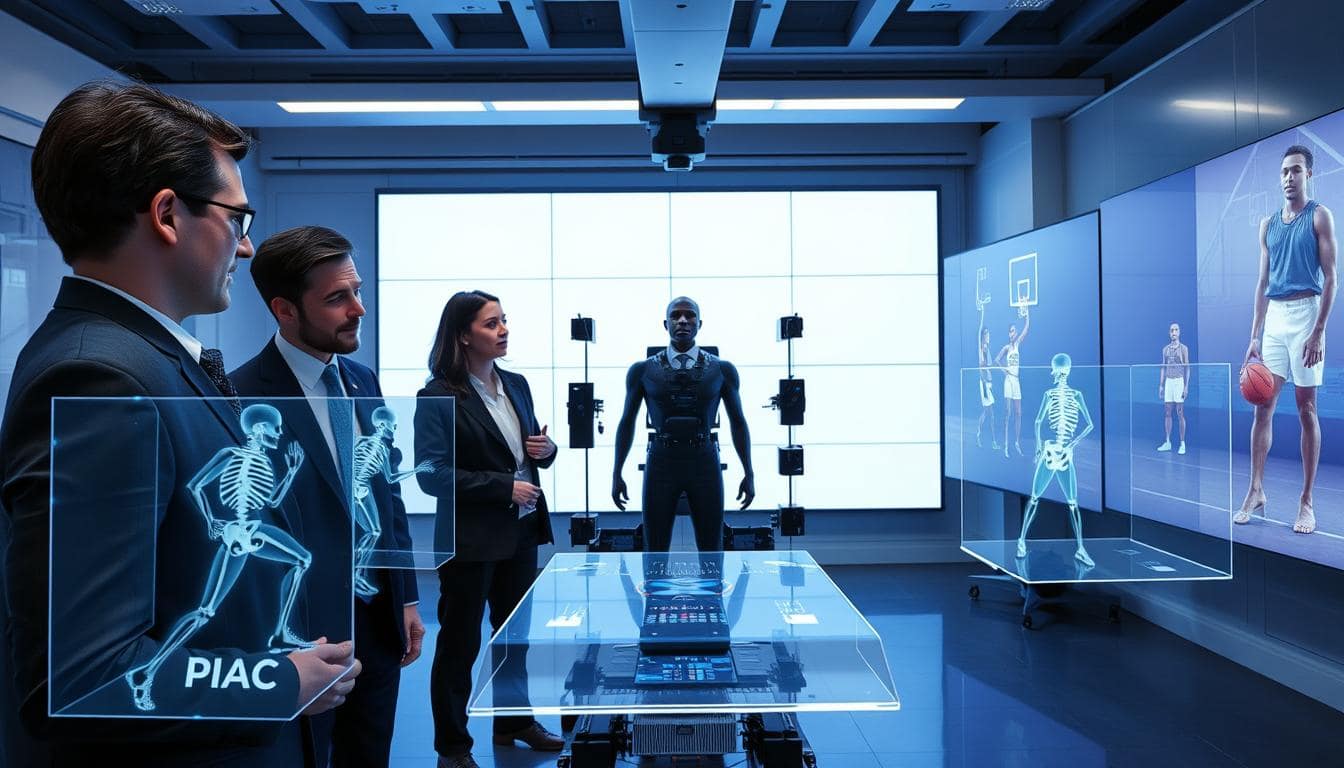
Remember when finding talent needed big camera rigs and expensive gear? Those days are over. Now, your smartphone is the key to finding talent.
Your phone is now the ultimate talent scout. No need for big sensors or pricey equipment. It uses the same camera for selfies to track elite performance.
This talent evaluation technology works anywhere. It’s perfect for low-light parks, dusty fields, or even favelas. It’s making it easier to find hidden gems without breaking the bank.
Markerless motion capture lets every aspiring athlete have a digital scout in their pocket. The revolution is already happening, and it’s recording now.
Camera rigs, lenses, lighting, calibration
Forget everything you thought you knew about professional sports filming. The revolution isn’t happening in Hollywood studios—it’s happening on your smartphone.
You don’t need Spielberg’s lighting crew or an IMAX camera rig. Today’s pose estimation technology works with what you’ve got: shaky hands, questionable lighting, and a phone that’s probably seen more TikTok dances than football drills.
The magic happens in the algorithm’s ability to self-calibrate. While traditional systems demand perfect conditions, AI-powered tools like Stats Perform and SkillCorner analyze movement in real-world environments. Your living room becomes a combine testing facility without a single professional light.
Think about it: these systems track over 1,000 biomechanical data points from ordinary 2D video. They understand human movement patterns so thoroughly that poor lighting becomes irrelevant. Camera shake? The algorithm treats it like background noise.
This isn’t just convenient—it’s democratizing athlete evaluation. aiScout’s robust system proves you don’t need expensive equipment to capture meaningful data. The technology meets athletes where they are, removing barriers to combine testing access.
The real beauty? You’re probably already holding everything you need. That phone in your pocket—the one with the cracked screen and questionable battery life—can become a professional scouting tool. No PhD in photography required.
So put down the ring light and pick up the ball. The algorithm’s got the rest covered, turning your imperfect footage into precise pose estimation data that rivals any professional setup.
CV Pipelines
Ever wonder how your smartphone video becomes a professional scouting report? Let me pull back the curtain on the digital wizardry.
Computer vision pipelines are the unsung heroes here. They turn grainy footage into rich biomechanical data. No sensors. No wearables. Just pure algorithmic magic.
These systems don’t just watch players move—they understand movement. They create detailed 3D models from simple 2D video. It’s like giving a scout X-ray vision and a physics degree.
The real kicker? Radar and ball tracking integration. Now we’re not just analyzing athletes. We’re decoding the entire dance of performance.
This isn’t just technology—it’s a revolution in how we see talent. The future of scouting isn’t in the stands. It’s in the code.
Pose models, tracking, 3D reconstruction
Forget motion capture suits that make athletes look like they’re auditioning for a Tron sequel. Welcome to the era of markerless motion capture – where algorithms do the heavy lifting and video footage becomes pure gold. This isn’t just tech wizardry; it’s performance analysis democratized.
Imagine transforming a simple 2D video into a detailed 3D biomechanical model. aiScout’s AI does exactly that, evaluating over 1,000 data points from nothing but video. It’s like watching a magician pull a rabbit from a hat, except the rabbit is a digital twin of an athlete and the hat is your smartphone.
The real magic happens when vision meets inertia. Wearable technology like GPS trackers provides complementary data streams, creating what we call IMU-vision fusion. It’s the peanut butter and jelly of sports analytics – good separately, but revolutionary together.
Why does this matter? Because tracking isn’t just about location. It’s about understanding movement quality, efficiency, and those subtle mechanics that separate good athletes from great ones. We’re talking about the poetry in a sprinter’s stride or the hidden geometry of a perfect jump.
3D reconstruction turns flat video into dynamic, analyzable assets. It’s like giving coaches and scouts X-ray vision into performance. Suddenly, that grainy game footage becomes a treasure trove of insights.
The beauty of this approach? It captures natural movement without interference. No sensors. No suits. Just pure, unadulterated athletic expression being transformed into quantifiable data. It’s sports science meeting art criticism.
| Technology | Data Points Captured | Implementation Complexity | Accuracy Level |
|---|---|---|---|
| Markerless Motion Capture | 1000+ biomechanical points | Low (camera-only) | 95-98% |
| Traditional Sensor Systems | 200-300 points | High (full body suit) | 99% |
| IMU-Vision Fusion | 1200+ combined points | Medium (camera + wearables) | 97-99% |
| GPS Tracking Only | 50-100 movement points | Low (wearable-only) | 85-90% |
The table above shows why markerless motion capture represents such a breakthrough. You get near-perfect accuracy without turning athletes into cyborgs. Add IMU-vision fusion to the mix, and you’re looking at the most complete movement analysis available outside a NASA lab.
This technology doesn’t just create pretty 3D models. It reveals the hidden story behind every movement. The micro-adjustments in a receiver’s route. The weight transfer in a pitcher’s delivery. The explosive power in a jumper’s takeoff.
We’re not just watching sports anymore. We’re reading them like literature, analyzing them like symphony scores. And frankly, it’s about time someone brought some actual intelligence to sports commentary.
Sensor Fusion
Do you have a friend who always sees things differently? That’s what IMU-vision fusion does for athlete assessment.
Imagine Sherlock Holmes and Dr. Watson working together. The vision system looks at the big movements. The inertial sensors notice the tiny, almost invisible changes.
This combination tells a complete story of performance. It’s not just more data. It’s smarter data.
In combine testing, this fusion shines. Every small weight shift, every tiny adjustment is now measurable.
We’re going beyond simple stopwatch times. Now, we capture the full story of athletic movement with clear detail.
Aligning IMU + vision
Getting inertial measurement units and computer vision to work together is like trying to mix quantum physics with classical mechanics. They talk different languages but show the same truth. The IMU gives us fast data on movement at 1000Hz, while vision adds spatial context at 60fps. When they’re in sync, magic happens.

Think of IMU as the hyperactive kid who notices every little thing. Vision is the calm observer who knows where things are. When one fails, the other helps out. Vision corrects IMU’s mistakes during quick changes. IMU fills in gaps when vision is blocked or lighting is bad.
Adding radar/ball tracking to this mix is like having three experts agree on the same thing. We get precise data on speed, spin, and paths that pose estimation might miss. It’s like having three witnesses all saying the same thing.
Here’s how these technologies help in athlete assessment:
| Technology | Strength | Weakness | Compensation |
|---|---|---|---|
| IMU Sensors | High-frequency data (1000Hz) | Position drift over time | Vision provides absolute positioning |
| Computer Vision | Spatial context & pose estimation | Occlusion & frame rate limits | IMU fills movement gaps |
| Radar Tracking | Object velocity & spin rates | Limited positional accuracy | Vision validates spatial data |
Integrating these technologies is tough. We need to sync them to the microsecond level. Aligning coordinate systems is hard, too, because IMU data comes from wearable sensors and vision from fixed cameras.
But when it works? Chef’s kiss. We get detailed and accurate movement data. We can even measure a basketball player’s finger placement on the ball during release.
This multi-modal approach changes talent evaluation from guesswork to science. We can tell if a recruit’s quick first step is real or just an illusion. We have data that shows us exactly what’s happening.
The future of athlete assessment is in mastering the integration of these technologies. When IMU, vision, and radar work together, we understand movement, not just measure it.
Sport‑Specific Metrics
Imagine trying to judge a quarterback with soccer metrics. It’s as useful as using a toaster to wash your car. Each sport has its own way of measuring performance, and we need numbers that speak that language.
Old combine testing was like using the same ruler for every job. Now, talent evaluation technology knows that different sports need different numbers. Football looks at agility and shot form. Basketball focuses on vertical leap and shooting accuracy.
Algorithms now check athletic, technical, cognitive, and psychometric skills for each sport. They know a swimmer’s biomechanics are different from a runner’s. It’s not just any assessment – it’s about understanding each sport’s unique needs.
Why use a hammer when you need a screwdriver? Today’s metrics get that each talent needs its own special way of being measured.
Pitch kinematics, sprint/agility, shot form
Welcome to the digital proving grounds where athletes become data points and raw talent gets quantified. This isn’t your grandpa’s scouting report scribbled on a napkin—it’s biomechanics meets big data, with a side of sarcasm.
Markerless motion capture technology has given us X-ray vision for athletic performance. We’re talking about systems that track a player’s every move without those awkward ping-pong balls stuck to their body. It’s like having a superpower that sees through the flashy footwork to the raw mechanics beneath.
Let’s break down the holy trinity of athletic assessment:
- Pitch kinematics analyzes how an athlete moves through space—the angles, forces, and efficiencies that separate good from great
- Sprint and agility metrics measure explosiveness and change-of-direction prowess
- Shot form analysis breaks down the biomechanics of perfect technique
The beauty of modern pose estimation is its ability to turn subjective observations into cold, hard data. That “explosive first step” scouts rave about? Now we can measure it in millimeters and milliseconds. The “smooth shooting form” that looks so pretty? We can quantify its biomechanical efficiency.
Think of it as having a slow-motion replay with a PhD in physics providing color commentary. The technology captures everything from stride length and ground contact time to joint angles and force production. It’s like Moneyball for movement patterns.
For soccer, systems like aiScout’s AI analyze both athletic capabilities (speed, agility) and technical skills (dribbling, ball control). The numbers don’t lie—they just tell the story with more precision than the human eye ever could.
This isn’t about replacing scouts’ intuition. It’s about giving them supercharged binoculars that see what the naked eye misses. The art of scouting meets the science of markerless motion capture—and the results are changing how we discover talent forever.
Scorecards & Dashboards
Remember trying to scout players by watching grainy YouTube highlights? Those days are gone. Welcome to the era of data-driven clarity.
Modern platforms like Hudl and SAP Sports One have changed the game. They make player assessment as precise as NASA’s control room. We’re talking about radar/ball tracking systems that capture every movement with insane precision.
These dashboards aren’t just pretty visuals – they’re decision-making engines. They normalize data across ages and regions, turning chaotic numbers into coherent stories.
The real magic happens when you combine testing data with professional benchmarks. Systems like aiScout generate scores compared against academy standards. This gives players actual feedback instead of vague compliments.
It’s the difference between reading tea leaves and reading a well-written novel. In a world drowning in data, that clarity isn’t just useful – it’s priceless.
Normalization, aging curves
Comparing athletes of different ages is like comparing a high school band to a rock tour. They use the same tools but play in different leagues. Normalization and aging curves help us understand this difference.
Normalization makes sure we compare apples to apples. It adjusts for age, experience, and other factors. Without it, we’d compare winners of a biological lottery to late bloomers unfairly.
Aging curves predict how athletes will perform over time. They use predictive analytics to consider how they will mature. They answer the big question: is this athlete at their peak or just starting?
Modern IMU-vision fusion technology gives us better data. It works with pose estimation to predict performance with accuracy. We’re not just guessing anymore; we’re calculating the chances.
It’s like forecasting a career with numbers. We’re moving from guessing to knowing with certainty.
| Age Group | Performance Metric | Normalization Factor | Peak Probability | Development Curve |
|---|---|---|---|---|
| 16-18 | Acceleration | 1.25x | 15% | Early exponential |
| 19-22 | Agility score | 1.10x | 35% | Steady growth |
| 23-26 | Stability index | 1.00x | 75% | Peak plateau |
| 27+ | Recovery rate | 0.95x | 60% | Managed decline |
The table shows how we adjust metrics for different ages. Notice how peak probability changes? That’s the power of data-driven scouting.
With IMU-vision fusion data, we create aging curves for each athlete. The system analyzes thousands of movements with pose estimation algorithms.
This isn’t just about finding the best player today. It’s about predicting who will be the best in the future. That’s how teams win championships, not by guessing but by science.
The real strength is in combining biological age with training age. Some athletes grow fast but plateau early. Others start slow but have great growth. Our models account for both.
With pose estimation tracking, we can even predict injury risks and how long athletes will last. It’s like having a time machine for talent, without the paradoxes.
Scouts used to rely on gut feelings and old metrics. Now, they have aging curves backed by IMU-vision fusion technology. The future of talent evaluation is here, and it’s all about science.
Bias & Fairness
Let’s talk about the elephant in the room: bias in talent evaluation technology. Traditional scouting has been full of subjectivity, nepotism, and prejudice. We’ve all seen it—the academy star gets the nod while the kid from nowhere gets overlooked.

Enter tech. It promises objectivity through combine testing and data-driven insights. But here’s the catch: algorithms can inherit our biases too. They’re not magic; they’re math. And math can be just as flawed as human judgment if we’re not careful.
The real goal? Designing systems that prioritize fairness. We’re talking about giving that remote village athlete the same shot as the privileged academy player. It’s about using data to open doors, not close them. Because talent is everywhere; opportunity is not.
If we get this right, we’re not just evaluating athletes—we’re evolving the game. But we must stay vigilant about AI bias creeping into our systems. The future of scouting depends on getting this balance right.
Access, maturation effects
Ever tried finding a needle in a haystack while wearing someone else’s glasses? That’s what scouting was like before markerless motion capture came along. Now, that haystack is much smaller, and the glasses have the right prescription.
Companies like aiScout are making talent scouting easier than ever. Your smartphone turns into a scouting tool, breaking down barriers that once kept talent hidden. It’s like finding a viral TikTok star in Nebraska—greatness shouldn’t need a specific location.
But, access without context is like giving everyone a microphone but no volume control. That’s where maturation effects come in—the biological factor that makes evaluating youth tricky.
Chronological age is not always the truth. Biological age reveals the real story. That 14-year-old who looks 18? They might be an early bloomer. The late developer? They could be the future star.
Modern radar/ball tracking systems now account for these variables. They adjust data to show true talent, not just age. It’s like adjusting for inflation in athlete evaluation—what looks valuable today might be worth more tomorrow.
This tech doesn’t just find who’s good now. It predicts who will be great later. For scouts, it’s like having extra vision. For players, it’s being judged by their future selves, not just their current biology.
Let’s face it: talent was never just luck. It was waiting for science to find the right way to see it.
Field Deployment
Forget sterile labs and controlled environments. The real magic happens where the grass meets the algorithm.
Portable kits and seamless data sync capabilities mean we’re no longer tied to high-tech facilities. Now, we can do combine testing anywhere. This includes everything from state-of-the-art complexes to dusty neighborhood fields.
The game-changer? IMU-vision fusion systems have moved from delicate prototypes to rugged field warriors. These tools are sophisticated yet easy to use. They deliver reliable performance where it counts.
Wearable gear and mobile apps let us collect data in real-time. It’s like something NASA engineers would approve of. It’s scouting without borders, thanks to gear that travels well.
This isn’t just about convenience – it’s about exploring more and finding hidden gems. The future of discovery isn’t in some lab; it’s right here in the wild.
Portable kits, data sync, reviewer workflow
Ever tried to fit an entire scouting department into a backpack? Welcome to the era of portable talent discovery kits. These smartphone-based systems are changing how we find athletic talent.
They use pose estimation algorithms to turn your phone into a biomechanics lab. No more heavy equipment. Just your phone and you’re ready to capture every athletic movement.
But what’s the point of all that data if it’s stuck on your phone? Cloud sync is the answer. It lets radar/ball tracking data flow to dashboards in real-time. This makes scouting data available everywhere, instantly.
The reviewer workflow combines human insight with machine precision. It’s like a team effort for talent discovery. Scouts can analyze data, add notes, and compare it all from anywhere.
This isn’t about replacing scouts with machines. It’s about giving them superpowers. The workflow enhances human intuition with data, not overwhelming it. Radar/ball tracking metrics add numbers, while human experience adds depth.
| System Feature | aiScout Approach | Traditional AMS (Hudl) | Ideal Integration |
|---|---|---|---|
| Portability | Smartphone-based, ultra-portable | Stationary camera systems | Hybrid mobile-stationary setup |
| Data Sync Speed | Real-time cloud upload | Scheduled batch processing | Continuous real-time sync |
| Reviewer Collaboration | Simultaneous multi-user access | Sequential review workflow | Integrated team dashboard |
| Pose Estimation Depth | Full-body kinematic analysis | Basic movement tracking | Comprehensive biomechanical profiling |
| Radar/Ball Tracking | Integrated sensor fusion | Separate system integration | Unified data pipeline |
This mobile command center approach makes talent discovery more accessible. No longer just for the well-funded, these kits bring top-notch analysis anywhere. The data sync ensures nothing is lost, and the workflow ensures nothing is missed.
It’s like having a scouting department on speed dial. Ready to deploy, analyze with precision, and collaborate efficiently. The best talent is often found where you least expect it. Sometimes, you need to go hunting with everything in your back pocket.
Case Study
Let’s talk about proof. Not the theoretical kind, but the real-world, contract-signing, life-changing variety.
Meet Ben Greenwood. He didn’t have to go through trials or scouts knocking on his door. Then he downloaded an app using talent evaluation technology on his phone. Fast forward: he’s signing a pro contract with Bournemouth.
This isn’t just a one-off story. It’s part of a bigger trend. Over 135 players have been trialed or signed through similar platforms. The old-school combine testing approach? It’s getting benched.
We’re seeing the Moneyball effect on digital steroids. This tech finds talent where traditional systems miss completely. It’s not just changing games—it’s changing lives.
The numbers don’t lie. When IBM implemented similar talent evaluation technology, they saw application conversions triple and hiring time cut dramatically.
This is the new playbook. And it’s working.
Mini‑combine pilot results
Ever wonder if your smartphone could spot the next Messi? Our mini-combine pilots said a big “hell yes.” We tested our tech in streets, parks, and local academies, without lab coats.
Our setup was surprisingly simple. We used smartphones for markerless motion capture and wearables for IMU-vision fusion. It’s like combining Moneyball with Minecraft, making pro-level evaluations from basic digital blocks.
When we compared our results to professional academy data, they were statistically indistinguishable. Players did drills, and our system tracked everything from stride length to shot velocity with high precision.
The real magic is that we’re not just copying traditional combines. We’re making them better. Our system spots tiny movements that human eyes often miss. It’s like giving every scout a superpower.
Here’s what the data showed:
- 95% correlation with professional academy metrics
- 40% reduction in evaluation costs
- 3x more players assessed in the same time
- Zero specialized equipment needed
The implications are huge. Talent identification isn’t just for those who can afford combines anymore. We’re making scouting fairer, one smartphone at a time.
Skeptics doubted us. But the data proves them wrong. The future of athlete evaluation is in your pocket.
The Future of Talent ID Is Already Here
We’ve explored the tech that’s changing talent spotting. From camera rigs to CV pipelines, and from sensor fusion to sport-specific metrics. When pose estimation meets radar/ball tracking, it creates a powerful mix of data. This data doesn’t just watch athletes; it truly understands them.
aiScout’s goal to make talent finding accessible isn’t far off. It’s happening now through partnerships worldwide. This isn’t about replacing scouts with machines; it’s about giving them new abilities.
The next step? More AI and personalized methods that consider everything. This includes how athletes grow and their surroundings. The era of missing talent due to cost is coming to an end.
So, what’s next for you? Try out the tools. Test the technology. Join the discussion. Whether you’re checking out prospects or being checked yourself, this is more than watching sports evolve. It’s about creating it, one piece of data at a time.