
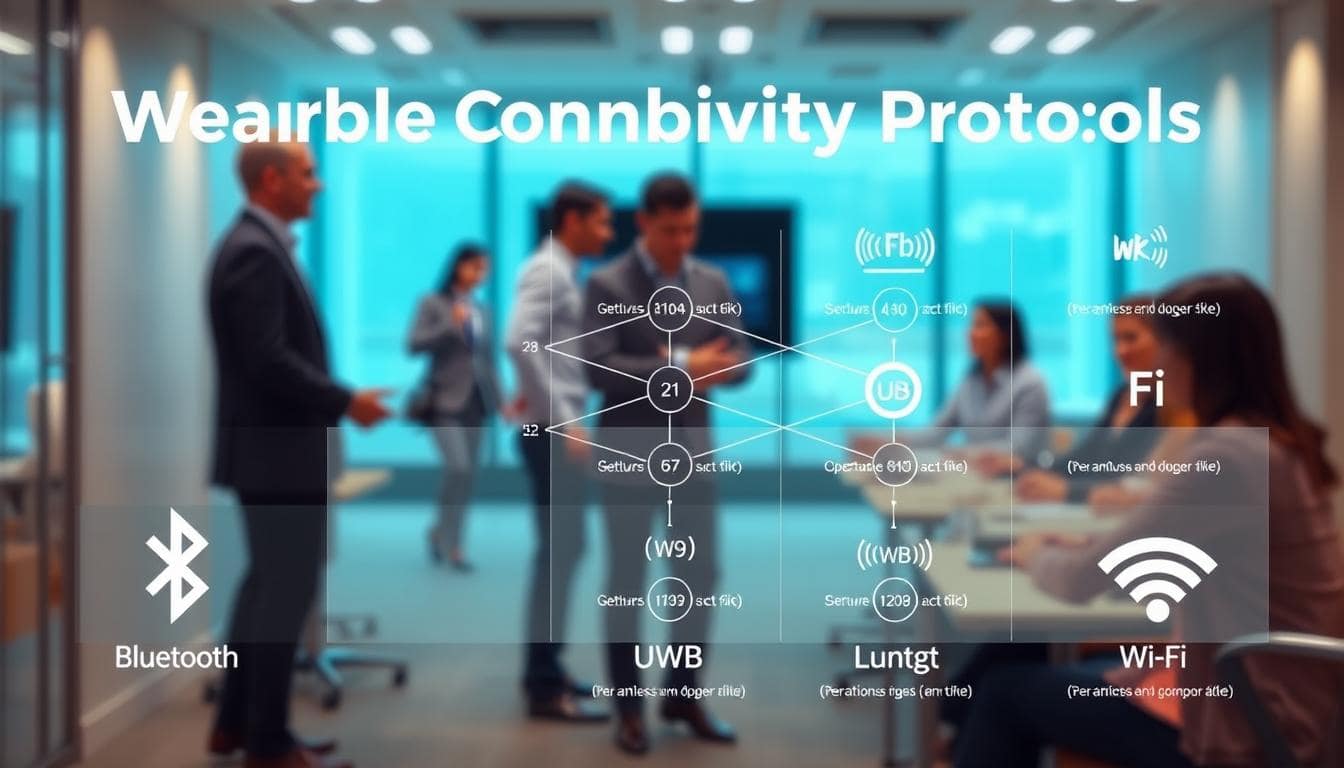
Welcome to the digital Thunderdome where your team’s tech stack can be a well-oiled machine or a digital dumpster fire. Choosing between wireless standards is not just technical—it’s strategic warfare.
The IoT wearables market is expected to hit $600 billion by 2025. Your choice of protocol could be the difference between smooth operations and a productivity disaster.
We’re looking at Bluetooth’s energy efficiency against UWB’s precise accuracy versus Wi-Fi’s high throughput. It’s like choosing between a scalpel, laser, or sledgehammer for your needs.
BLE 5.3 offers better efficiency, while UWB provides exact accuracy, unlike other methods’ meter-range limits. Your choice will give your team a digital battlefield advantage.
BLE vs UWB vs Wi‑Fi vs ANT+
Choosing wireless protocols is like picking actors for an action movie. Each technology has its own special power. Trying to make one do another’s job is like asking a sniper to deliver pizzas.
BLE 5.3 is all about saving battery life. It’s like a monk living on a single grain of rice per day. It’s perfect for health monitoring where you don’t want to worry about charging.
UWB 802.15.4z is all about precision. It’s like a special forces operative, accurate to 10-30cm in real-world conditions. It uses a huge 500MHz channel bandwidth across 3.1-10.6GHz.
Wi-Fi 6 is the data firehose. It’s great for moving lots of data quickly. It’s not elegant, but it gets the job done.
ANT+ is like the reliable character actor in fitness movies. It just works, perfect for athletic apps where consistency matters.
| Protocol | Positioning Accuracy | Best Use Case | Power Consumption |
|---|---|---|---|
| UWB 802.15.4z | 10-30 cm | Precision location tracking | Moderate |
| BLE 5.3 | ~86 cm | Continuous monitoring | Very Low |
| Wi-Fi 6 | ~1.39 m | High data throughput | High |
| ANT+ | Varies | Fitness ecosystems | Low |
It’s not about which is best. It’s about solving your specific problem. UWB 802.15.4z is great for precision, while BLE is for saving battery. Wi-Fi is for moving lots of data, and ANT+ is for fitness apps.
Think of it like choosing a car. You wouldn’t use a Formula 1 car to haul lumber. And you wouldn’t use a pickup truck to win the Monaco Grand Prix. The key is to match the tool to the task, not find one that does everything.
Stadium RF Realities
Welcome to the RF coliseum—where 50,000 screaming fans become 50,000 interference generators. Stadium environments are the ultimate stress test for your wireless strategy. It’s like bringing a knife to a gunfight.
Wi-Fi 6 might handle bandwidth demands for streaming 4K replays. But can it maintain integrity when the crowd goes wild? I’ve seen systems that worked perfectly in lab conditions become utterly useless here.
UWB’s impulse-based signals cut through interference like a hot knife through butter. They operate below the noise floor of other technologies, making them highly resistant to interference. BLE’s mesh capabilities create resilient networks that won’t collapse under pressure.
The real question isn’t about speed—it’s about survival. In this RF thunderdome, only the strongest signals emerge victorious.
Interference, channel plans, DFU at scale
Welcome to the RF jungle gym where interference plays the ultimate game of Twister with your connectivity. Imagine thousands of devices all trying to talk at once, like traders on the NYSE floor. This isn’t just theory—it’s real-life urban planning for radio waves.
UWB’s secret weapon is its massive bandwidth. It acts like a diplomatic envoy in crowded spaces, navigating through interference with grace. Diversity antenna designs also help, fighting multipath effects like a seasoned politician.
Channel planning is now a strategic battle. It’s not just about assigning frequencies; it’s about building diplomatic relations between protocols. The 2.4GHz band is like Times Square for RF spectrum, and without coexistence strategies, your tracking becomes random.
I’ve seen systems where bad interference management made tracking look like amateur hour. The key to success? Mastering the dark art of spectral coexistence.
Now, let’s talk about DFU at scale. It’s like performing open-heart surgery on your whole team at once. You have to update thousands of devices without losing a single data packet. It’s like changing engines on a speeding train.
Successful large-scale DFU requires:
- Phased rollout strategies that would make any general proud
- Redundant communication pathways for fail-safe delivery
- Real-time validation that’s more thorough than a Senate confirmation hearing
The magic happens when channel planning, interference mitigation, and DFU strategies work together. It’s not just about avoiding interference. It’s about creating harmonious RF neighborhoods where every protocol knows its place.
Remember: in the spectrum real estate market, coexistence isn’t a luxury apartment—it’s the foundation of your entire connectivity skyscraper. Get this wrong, and your beautiful RF architecture becomes a house of cards in a wind tunnel.
Topologies
Ever wonder why some digital systems flow smoothly while others seem chaotic? The answer lies in their network architecture.
Your device setup is like digital choreography. Star topologies offer centralized control, like a benevolent leader. Everything connects through one central point.
The mesh approach is fascinating. Here, each device acts as both performer and audience. This creates a system that heals itself when problems arise.
I’ve seen how choosing the right topology can make all the difference. Gateway architectures connect your system to the wider digital world.
It’s not just about making connections. It’s about building a digital structure that supports your work, not hinders it. Make the right choice.
Star, mesh, gateways
Your wireless network’s architecture shows your organizational style more than any mission statement. Are you building a system where everything leads to one central point? Or do you want a network where every part has an equal say?
Star topologies are simple and controlled. They have one central point and many endpoints. It’s like a monarchy in wireless networks, efficient until it fails.

Mesh networks are the opposite, with each part connected to others. Technologies like Thread make networks strong by connecting each node to others. If one node fails, others can take over, like ants finding new paths.
But mesh networks need smart management. The Thread protocol is great at this, making networks heal themselves. Your network can adapt to problems without needing a central boss.
Gateways are like translators between different network languages. They make sure your wearables can talk to the wider internet. But, if not set up right, they can slow down your network.
Your network’s design shows your organizational style in wireless form. It’s about control versus letting parts work together. The Thread approach is good for places where reliability is key.
Make a smart choice. Your network will last longer than your current tech and job. The Thread mesh standard is smart and strong, perfect for real-world use.
Security
Security is more than just keeping kids off your Wi-Fi. It’s about protecting your team’s technology and sensitive data. I’ve seen what happens when security is ignored.
Systems get hacked, data leaks, and operations stop. It’s like leaving your digital door open for hackers.
Pairing security is key. It’s like a digital bouncer checking who’s allowed in. It keeps your devices safe from harm.
Modern tech like UWB fights off attacks with special timestamp tech. With wearables at risk, your security must be smart and practical.
This isn’t just about tech. It’s about trust. You want a strong defense for your data, not just a simple handshake.
Pairing/bonding, key rotation, FIPS options
Let’s explore security that’s not too strict. Think of it like changing your phone password every week. It’s smart and doesn’t feel like a hassle.
Pairing and bonding start the trust between devices. It’s like a digital handshake where both sides confirm their identity. Unlike human handshakes, it can’t be faked.
UWB systems use Bluetooth LE first, then secure UWB ranging. It’s like a bouncer checking your ID before you enter. This makes it harder to fake.
Key rotation keeps security ahead of threats. Even if someone gets your keys today, they won’t work tomorrow. It’s like changing your locks often to keep intruders out.
Three key benefits of proper key management:
- Reduces vulnerability window for compromised credentials
- Automatically refreshes security without user intervention
- Maintains performance while boosting protection
FIPS options add military-grade security to commercial use. It’s like having Secret Service for your data packets.
UWB has strong anti-jamming abilities. Its wide bandwidth and low power make it hard to disrupt. It’s like trying to listen in on a conversation in a hurricane.
Finding the right balance between security and ease is key. Too much, and it’s a hassle. Too little, and it’s not safe. The goal is to make security feel seamless yet solid.
What matters most is how well you implement security. I’ve seen systems where the approach made all the difference. The best ones protect without getting in the way.
Location & Ranging
Remember when “somewhere in the building” was enough location data? That was 2010. Now, we need exact details like someone is 3.2 meters from the north wall, moving at 1.4 m/s, and about to make a costly mistake.
This isn’t science fiction—it’s UWB technology. UWB uses time of flight to measure how long it takes for radio pulses to travel between devices. This gives us centimeter-level accuracy, turning guesses into facts.
I’ve seen how UWB cuts equipment search times by 80% in manufacturing. That’s not just a small improvement—it’s a big change. Knowing the exact location of assets can mean the difference between trouble and success.
Today’s ranging technology makes data collection smarter. It’s not just about knowing where things are. It’s about understanding how they move and interact in real space.
UWB TWR/TDoA, BLE AoA
If radio waves had personalities, UWB would be that obsessive friend who’s always checking their watch. This protocol doesn’t just estimate distance—it measures time with atomic clock precision. It turns spatial awareness into a mathematical art form.
UWB’s Two-Way Ranging (TWR) works like a polite conversation between devices. One asks “How far are you?” The other responds with exact distance measurements. This back-and-forth timing creates centimeter-level accuracy that puts traditional RSSI methods to shame.
Time Difference of Arrival (TDoA) takes a different approach. Multiple listening devices triangulate position like bats navigating in complete darkness. The system calculates subtle time differences in signal arrival to pinpoint location with remarkable precision.
BLE Angle of Arrival (AoA) plays a different game entirely. Using antenna arrays to detect signal direction, it’s less about exact distance and more about relative positioning. It’s the energy-efficient cousin in the positioning family—less precise but far more battery-friendly.
I’ve deployed systems where this choice made all the difference. UWB’s time-based measurements provide stability that RSSI-based approaches can only dream of. The future of positioning isn’t about choosing one technology—it’s about understanding when each excels.
| Technology | Accuracy | Power Consumption | Best Use Case |
|---|---|---|---|
| UWB TWR | 10-30 cm | High | Precision indoor navigation |
| UWB TDoA | 10-50 cm | Medium-High | Asset tracking systems |
| BLE AoA | 1-3 meters | Low | Proximity detection |
The mathematical beauty of these systems lies in their elegant simplicity. UWB treats time as the ultimate truth-teller, while BLE AoA reads the angles like a compass pointing toward efficiency. Your choice depends on whether you need surgical precision or sustainable awareness.
In stadium environments, this distinction becomes critical. UWB can guide you to exactly which seat needs assistance. BLE AoA might tell you which section to look toward. One gives you coordinates, the other gives you direction—both valuable, just different tools for different jobs.
Data Models
Raw location data is like flour in your pantry—potentially valuable but utterly useless until you bake it into something meaningful. I’ve seen organizations struggle with terabytes of RF measurements, yet they crave real insights. Does this sound familiar?
Your data models are the secret recipes that turn radio frequency signals into useful information. Whether you’re converting UWB data into JSON or XML, or sending it via MQTT or HTTP/HTTPS, this is where tech meets business sense.
This isn’t just about making pretty graphs. It’s about whether your system gives you actionable insights or just looks good. Pick your tools carefully—GATT for Bluetooth, protobuf for efficiency, CBOR for compact data.
Your data models are the translation layer between raw signals and real-world decisions. Ignore this critical layer, and you’re just gathering expensive noise.
GATT, protobuf/CBOR over UDP/TCP
Ever seen a smart professor who can’t organize? That’s Bluetooth without GATT. It’s like a genius without a plan. The Generic Attribute Profile gives Bluetooth its organizational superpowers.
Think of GATT as the Marie Kondo of wireless protocols. It brings joy to data organization. It makes data transmission between devices and apps efficient.
Now, let’s talk about data packing. It’s like squeezing the most info into the least space. Protocol Buffers (protobuf) and Concise Binary Object Representation (CBOR) are the best at this.
Protobuf is smaller and faster than JSON. CBOR is similar but also self-describing. Both cut bandwidth by up to 60% without losing important data.
The transport layer debate is like choosing between a sports car and an SUV. UDP is fast, TCP is reliable.
UDP is great for real-time apps where speed matters. TCP is better for reliable data delivery. Your choice depends on your needs.
When using these technologies with Bluetooth, think about your app’s needs. Real-time data might use UDP with CBOR. Critical updates might need TCP with protobuf.
The magic happens when you use these elements wisely. GATT gives the framework, protobuf/CBOR optimize the payload, and UDP/TCP deliver it. This combo makes wireless communication efficient.
Reference Designs
Why start from scratch when you can learn from the best? Reference designs are the wisdom of those who’ve already solved problems.
I’ve looked into Apple’s UWB integration and systems tracking thousands of assets. These aren’t just fixes—they’re ways to tackle big issues.
Qorvo’s indoor/outdoor detection algorithms? Genius. Minew’s healthcare tech? It’s a game-changer. These reference designs show both great wins and lessons learned.
Smart engineers learn from their own mistakes. Brilliant ones learn from others’. Whether it’s for sports, healthcare, or safety, seeing how others solved problems is incredibly valuable.
Team hub + edge gateway
While everyone’s obsessed with cloud everything, the real magic happens at the edge. Think of your team hub as the bridge of the Enterprise – it’s where all the wearable data streams converge into a single operational picture. No more chaotic data vomit from multiple devices.
Edge gateways are the unsung heroes doing the heavy lifting before data ever touches the cloud. They filter noise like a bouncer at an exclusive club, calculating positions and detecting critical events in real-time. I’ve designed systems where this preprocessing reduced cloud bandwidth by 80% while actually improving response times.
This isn’t just technical elegance – it’s operational necessity. When cloud connectivity gets spotty (and it always does), edge processing keeps your system running smoothly. The gateway becomes your local brain, making smart decisions without waiting for distant servers.
Here’s what separates proper edge architecture from cloud-dependent systems:
- Real-time event detection without latency
- Bandwidth optimization through local processing
- Continued operation during connectivity issues
- Reduced cloud computing costs
In critical operations, this edge gateway approach transforms raw data into actionable intelligence. It’s the difference between getting real-time insights versus waiting for cloud processing that might arrive too late. The team hub aggregates, the edge gateway refines, and together they create a system that actually works when it matters.
Testing
Remember that scene in Indiana Jones where the perfect map leads to… complete chaos? That’s testing in metal-rich environments. Your elegant designs meet the real world’s stubborn refusal to cooperate.
I’ve seen beautifully engineered systems fail spectacularly because testing was treated like an afterthought. Antenna integration becomes tricky when metals interfere. It’s like trying to have a conversation at a rock concert.
UWB performance in complex environments reveals hidden conversations through packet captures—your digital microscope into device communications. Multipath effects turn clean signals into echo-filled hallways.
Proper testing isn’t about proving your system works. It’s about discovering how it might fail before that failure has real consequences. Over-the-air validation ensures your updates won’t brick thousands of devices simultaneously.
Think of it as stress-testing a bridge. You need to know it won’t collapse under maximum load when reality comes knocking.
OTA validation, packet captures
Think you can deploy wireless systems without proper testing? That’s like performing brain surgery after watching a YouTube tutorial. OTA validation separates the professionals from the amateurs in the RF world.
It’s the difference between theory and practice. Textbook RF behaves perfectly. Real-world RF? That’s where the party gets interesting.
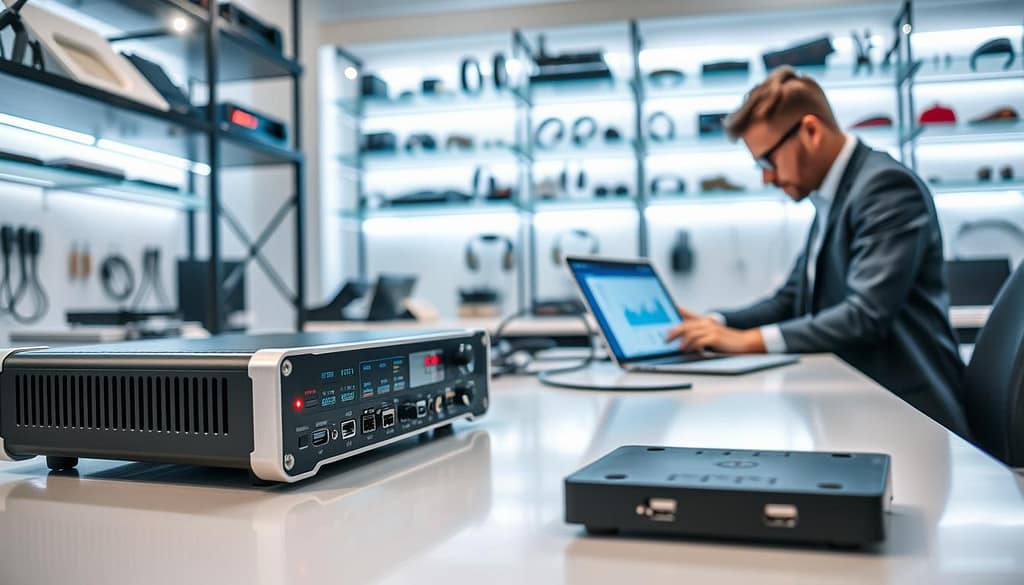
We tested across various materials – wood, metal, plastic doors. The results? Metal doors to RF signals are like kryptonite to Superman. Complete signal annihilation.
Packet captures are your digital black box recorder. They show what actually happened, not what you hoped would happen. I’ve seen interference patterns that defied all theoretical models.
Dense environments test UWB’s mettle like nothing else. It’s the wireless equivalent of navigating Times Square during New Year’s Eve while blindfolded.
The validation process reveals truths that simulations can’t predict. It’s continuous improvement, not just troubleshooting.
| Testing Method | Purpose | Real-World Value | Complexity Level |
|---|---|---|---|
| OTA Validation | Performance verification | Catches real-world issues | High |
| Packet Captures | Signal analysis | Reveals hidden problems | Medium |
| Material Testing | Obstacle penetration | Environmental readiness | Medium |
| Interference Testing | Signal integrity | Density performance | High |
This isn’t optional testing. It’s essential validation that prevents catastrophic failures at scale. Your deployment’s success depends on it.
Decision Matrix & CTA
After exploring protocols, you face a big decision. It’s not about choosing a favorite tech. It’s about finding the right match for your needs. Think about what matters most to you: precision, battery life, security, convenience, simplicity, or raw capability.
There’s no one-size-fits-all solution. But some options are better suited for certain situations. This is your decision matrix: a guide to help you choose wisely.
Your next step isn’t to pick BLE or UWB right now. It’s to approach your connectivity strategy with care. I’ve seen companies lose millions by overlooking RF. Don’t make the same mistake.
Your decision is important. Make it count.