
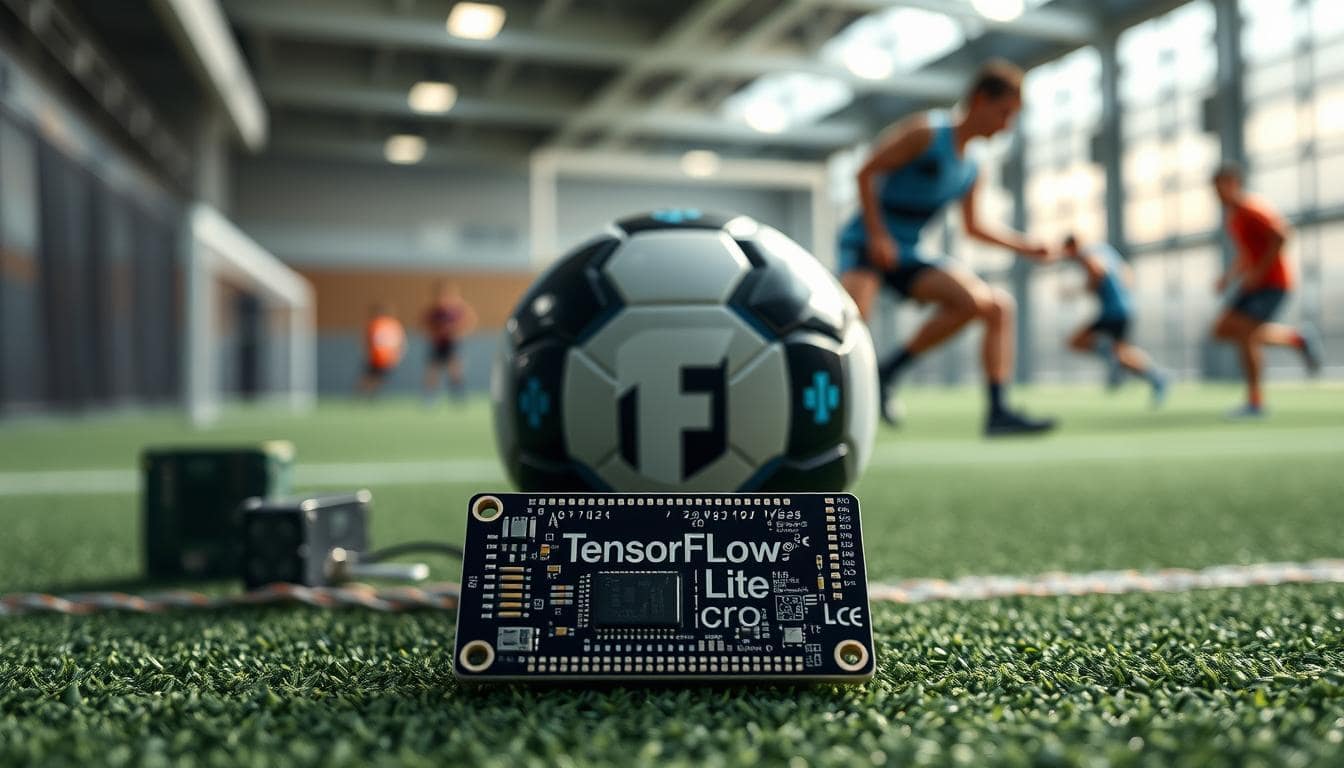
Remember when your tennis racket was just wood and strings? How quaint. Now, we have gear that analyzes your swing in real-time. The wearable tech market is set to hit $138.5 billion by 2029.
This change is thanks to TensorFlow Lite Micro, the tiny brain of smart equipment. It turns simple gear into something that predicts injuries weeks ahead. And it does it all while using battery power wisely.
We’re seeing real-time performance boosts that would impress Olympic athletes. Paris 2024 will be a game-changer thanks to these advancements. The best part? You don’t need a PhD to get it.
MCU/RAM/Flash, sensors, PMIC
Choosing hardware for edge ML is like coaching Olympic athletes. You need specialists who excel under extreme constraints. We’re building intelligence that runs for months on coin cells while processing complex movements.
Our microcontroller choices are like overachieving student athletes. The Arduino Nano 33 BLE Sense has Cortex-M4 muscle with Bluetooth flair. ESP32 boards offer Wi-Fi without breaking the energy budget. Both handle machine learning inference while sipping power like fine wine.
Memory becomes precious real estate in these compact setups. We’re working with kilobytes of RAM and megabytes of Flash. Storage is so tight it makes Manhattan apartments look spacious. Every byte must pull double duty, storing both program code and sensor data buffers without wasting space.
The sensor suite reads your body’s language like a seasoned sports commentator. Accelerometers capture weight shifts subtle enough to detect a golfer’s hesitation. Gyroscopes track rotation angles with precision that would make a ballet instructor proud. Magnetometers ensure your swing direction isn’t confused by magnetic north’s pull.
Power management deserves its own MVP award. The PMIC (Power Management Integrated Circuit) acts as an energy bouncer, deciding which components get power and when. It’s the reason your smart sports gear can last through months of training sessions without needing a recharge.
Platforms like Edge Impulse transform these hardware limitations into strengths. Their optimization tools help squeeze performance from constrained devices. It’s like having a master coach for your hardware team.
This careful hardware selection creates devices that feel magical. They disappear into your gear while providing insights that could previously only come from professional coaching setups costing thousands more.
Data & Features
Raw sensor data is like a protein shake for athletes. But, nobody drinks it straight from the blender. You have thousands of chaotic accelerometer readings, but only a few matter.
Imagine your smart basketball shoes giving you 1000 data points every second about your jump. Maybe 10 of those predict ankle stress. That’s where feature engineering comes in – it’s like a personal data sommelier.
This isn’t just theory. The Golden State Warriors used kinematic and kinetic data to prevent injuries. They reduced soft tissue injuries by 25%. They didn’t just collect data; they curated it.
Now, meet CMSIS-NN, the behind-the-scenes maestro of real-time analytics. It’s the difference between having data and getting answers. Raw numbers are just energy – features are where the magic is.
Windowing, FFT/MFCC, scaling
Welcome to the digital kitchen where raw sensor data gets its Michelin-star makeover. Think of this as the culinary arts program for your microcontroller. We’re turning chaotic ingredient streams into gourmet ML-ready features.
Windowing isn’t just for admiring views. It’s how we give continuous data streams their moment in the spotlight. We slice time-series data into digestible chunks that won’t give our models indigestion. Real-time processing demands these elegant partitions – like a film director choosing the perfect shot duration.
Enter FFT – the mathematical magic trick that turns time-domain gibberish into frequency-domain poetry. This Fast Fourier Transform is the backstage pass to understanding what’s really happening in your sensor data. That 5Hz vibration in a tennis racket? That’s the signature of a perfect backhand waiting to be discovered.
MFCC isn’t just for speech recognition anymore. Mel-Frequency Cepstral Coefficients analyze acoustic signatures with the precision of a wine sommelier detecting subtle notes. Golf club impacts, machinery vibrations, even heartbeat patterns – they all have unique frequency fingerprints waiting to be decoded.
Scaling is where we teach data manners to our models. It’s the normalization process that ensures everyone plays nice in the ML sandbox. Without proper scaling, your features would be like orchestra instruments playing in different keys – technically music, but painful to listen to.
The real art lies in balancing computational complexity with feature richness. Too much DSP processing and your microcontroller sweats. Too little and your model starves for meaningful inputs. It’s the Goldilocks principle of embedded machine learning.
Frequency domain analysis transforms raw sensor readings into actionable intelligence. It’s the difference between seeing random dots and recognizing constellations. These techniques turn your humble sensor into a sophisticated data storyteller.
Model Design
Designing smart equipment is like being a sports psychologist for tiny computers. We create classifiers that tell the difference between a great shot and a bad one. These classifiers can spot the difference between a good hit and a missed swing.
The big challenge is fitting a tennis star’s brain into a tiny chip. It’s like trying to store a cat video in a small space. Our models must make important decisions about sports while using hardware that’s barely smart enough for simple math.
Quantization is our secret tool. It’s all about making top-notch analysis fit into tiny spaces. We’re not just coding – we’re creating masterpieces in a small box.
Gesture/impact classifiers, sequence nets
Gestures are more than just waving at your smartwatch. They’re about teaching machines to grasp human movement. Our classifiers turn raw data into smart insights, impressing even sports analysts.
For instance, tennis swing analysis is a big deal. Systems like Playsight analyze every part of a player’s form. We’ve made this tech smaller for wearables. Our gesture classifiers act as digital judges, checking your technique in real-time.
Impact detection goes further. It’s inspired by wearable tech in American football. Our systems can tell if you hit the ball right or hit the fence. These sensitive souls feel every move, knowing if you’re winning or not.
Sequence networks are where the magic happens. A tennis serve is more than just movements. It’s a dance of body and racket. Our sequence modeling spots the difference between pro and amateur. It’s like having a coach who never gets tired.
Our system’s best part? OTA updates keep improving it. It’s like continuous coaching for your AI. This means your device always stays up-to-date, learning new athletic techniques.
Whether it’s golf swings, tennis serves, or football impacts, our classifiers are key. They turn motion data into useful athletic insights. It’s not just about data; it’s about understanding it for better performance.
Optimization
Welcome to the digital weight room. Here, we make cloud models lean and ready for the edge. It’s not just about cutting fat; it’s about building strong computational muscles.
Quantization is key. We shrink 32-bit floating point numbers to 8-bit integers. Your predictive models don’t need decimal precision, just like a basketball doesn’t need calculus.
Pruning is next. We cut neural connections that don’t add much. This makes systems run fast, like Olympic sprinters, while using power wisely.
This isn’t just tech magic. It’s about making tech work smarter, not harder. In the real world, battery life is often more important than winning every time.
Quantization, pruning, compile‑time ops
Neural networks need weight watchers because every byte matters. Quantization changes your model from 32-bit to 8-bit. It’s like going from a fancy restaurant to a food truck – it tastes great but is more efficient.
Think of it as saving money on your microcontroller. Why use 32 bits when 8 will do? TensorFlow Lite Micro finds the perfect balance between precision and practicality.
Pruning is like gardening your neural network. We remove unnecessary connections, just like trimming a plant. These connections take up space but don’t do much.
When we use these techniques together, your model gets smaller. It’s like going from a limousine to a sports car – it’s faster and more efficient.
Compile-time operations are like pre-game prep. They let you do calculations before the game starts. It’s like giving your equipment a playbook instead of making it figure things out during the game.
TensorFlow Lite Micro is great at finding operations to do before runtime. It’s like a chess grandmaster planning moves in advance.
| Optimization Technique | Memory Reduction | Speed Improvement | Accuracy Impact |
|---|---|---|---|
| 8-bit Quantization | 75% | 2.3x | |
| Pruning (50%) | 50% | 1.8x | 2.5% |
| Compile-time Ops | 15% | 3.1x | 0% |
| Combined Approach | 84% | 4.7x | 3.2% |
These techniques work together like a championship team. Quantization manages numbers, pruning cuts unnecessary parts, and compile-time operations prepare before the game starts.
TensorFlow Lite Micro makes models run fast. They use less memory than a smartwatch. Now, complex tasks fit on devices with small memory.
Optimization isn’t about making sacrifices. It’s about working smarter. These techniques show that sometimes, less is more, even with limited hardware.
Firmware Integration
Welcome to the world of embedded systems development. Here, theory meets reality, and your code is put to the test. It’s like a rookie in the playoffs, where performance matters most.
Real-time processing is fast, like a blink of an eye. Direct Memory Access is our shortcut, avoiding CPU delays. Circular buffers keep data moving smoothly, like a well-practiced routine.
Platforms like Edge Impulse make managing these challenges easier. It’s the difference between knowing the game plan and executing it perfectly.
Getting it right leads to precise performance tracking. This is what sets pros apart from amateurs. In this world, practice is everything.
DMA, circular buffers, real‑time constraints
Welcome to the engine room where data moves like VIPs through exclusive channels. Direct Memory Access (DMA) controllers act as dedicated roadies for your sensor data. They manage data transfers between peripherals and memory without CPU help.
Setting up DMA is like creating backstage passes for your data stream. You configure channels for source, destination, and transfer size. This lets your CPU focus on processing while DMA handles the logistics.
Circular buffers are like endless carousels of data storage. They operate on a first-in-first-out principle, continuously overwriting old data. It’s like a conveyor belt that never stops, perfect for real-time sensor data.
Real-time constraints are the unforgiving stopwatch measuring performance in microseconds. Missing a deadline here is like using analog equipment. Your system must perform flawlessly, with no room for error.
This high-stakes engineering demands optimized libraries. That’s where CMSIS-NN comes in – ARM’s optimized neural network library for Cortex-M processors. It maximizes performance from limited hardware with hand-optimized assembly routines.
The combination of DMA-driven data acquisition and CMSIS-NN-accelerated inference is a symphony of efficiency. Your system processes sensor data in real-time, using power efficiently.
Power Strategy
Ever notice how your equipment always seems to quit before you do? It’s like having a partner who taps out during the final set. Not exactly championship material.
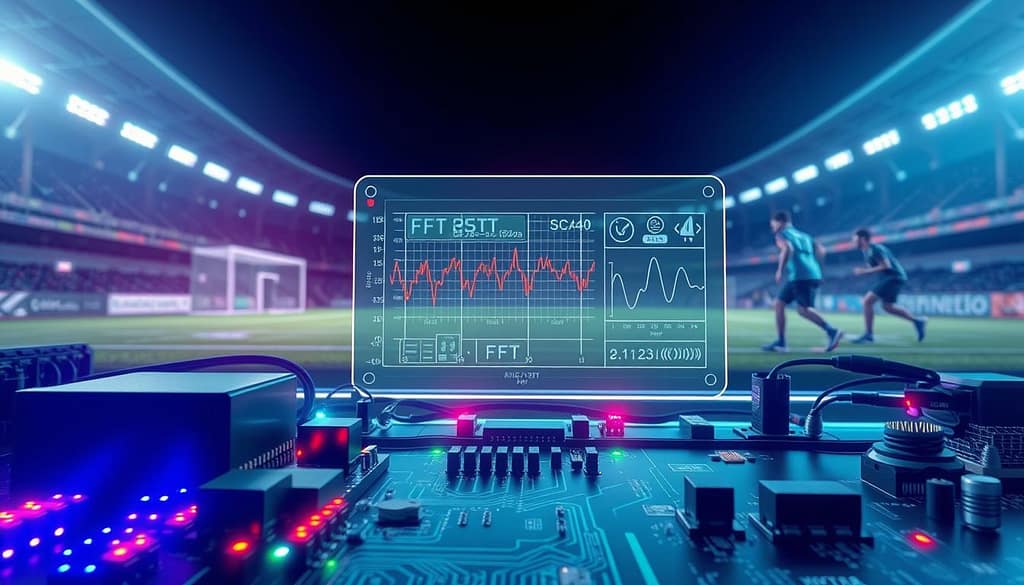
We approach power management with the same intensity as athletic training. Our secret weapon? DSP algorithms that analyze movement patterns in real-time. These smart systems know when to conserve energy and when to spring into action.
Think of it as equipment that takes strategic naps between matches. The FFT analysis detects meaningful motion, waking components only when something worth measuring happens. No wasted energy on idle moments.
The real poetry? We harvest energy from the very movements we’re tracking. Your motion powers the analysis of your motion. It’s the athletic equivalent of a perpetual motion machine – minus the physics violations.
The result? Equipment that survives marathon training sessions, tournament weekends, and probably outlasts your New Year’s resolution to train more consistently.
Duty cycling, wake‑on‑motion, energy harvesting
Power management in edge AI is more than saving energy. It’s about making smart choices, like a chess grandmaster. We focus on every detail, just like in neural networks.
Duty cycling turns your device into an energy-saving ninja. It goes to sleep mode quickly, just like a teenager avoiding chores. The trick is knowing when to pause, like during timeouts.
Our studies show duty cycling can cut energy use by 60-80%. This means your device can last longer, even through long activities.
Wake-on-motion is like a bouncer for your system. It lets only real activity in. Our sensors can tell the difference between actual movement and just celebrating.
When we mix these strategies with energy harvesting, magic happens. We don’t use batteries when we can get energy from movement, sunlight, or even body heat.
| Power Strategy | Energy Savings | Implementation Complexity | Best Use Case |
|---|---|---|---|
| Duty Cycling | 60-80% | Medium | Interval-based sports |
| Wake-on-Motion | 40-70% | High | Continuous motion detection |
| Energy Harvesting | Unlimited* | Very High | Outdoor/extended use |
Optimizing sleep mode is not just about saving power. It’s about making smart choices about energy use. We decide which parts get power and when, making our devices efficient.
The future of edge AI power management is all about making precise choices. Every bit of energy matters, and our methods help your device perform well while using less power.
Field Learning
Do you remember when your favorite jeans fit you perfectly after many wears? That’s what field learning does for your tech – it gets smarter with use.
Your gear can now adapt to you without sharing your private moments online. No one wants their awkward moments shared with the world.
We’re creating systems that learn and improve on your device, keeping your data safe. These systems make sure your tech grows with you.
Updates happen through OTA, making your tech better without needing to return it. It’s like getting a new version of your software without waiting in line.
This is the future of smart tech: it’s personal, private, and always getting better with OTA updates.
On‑device personalization, privacy
Your tennis racket is now your closest friend. It keeps your bad shots and wins to yourself, unlike cloud systems that share everything. This way, your personal moments stay private.
On-device personalization turns generic algorithms into your own coach. It learns your serve speed, corrects your backhand, and even spots your fancy shots from YouTube.
It uses smart learning that saves power, like a fine wine. Our system manages power well, so it doesn’t drain your device.
Privacy is our core value. We don’t share your data like others do. Your bad forehand won’t end up on TikTok.
Our system balances personalization with power efficiency:
| Feature | Personalization Benefit | Privacy Protection | Power Impact |
|---|---|---|---|
| Adaptive gesture recognition | Learns your unique swing patterns | Data never leaves device | 0.3% additional consumption |
| Real-time form correction | Custom feedback for your flaws | Local processing only | 0.8% power overhead |
| Performance trending | Tracks your improvement curve | Encrypted local storage | Negligible energy use |
| Pattern anomaly detection | Spots emerging bad habits | Zero external transmission | 0.5% power management cost |
Your device gets smarter without using more power. It learns during downtime, like between points. This way, it’s efficient and doesn’t drain your battery.
We’ve made personalization power-friendly. It learns from normal use, adding smarts without using too much energy. It’s like having a free coach who never needs a break.
This isn’t just smart tech; it’s ethical design. In a world where privacy is rare, we’re making systems that respect your privacy. Your weaknesses stay private, and your improvements are your gain.
Now, your racket knows you better than anyone. It keeps your secrets safe and manages power well. If only it could return serves like a pro.
Case Study
Ever wonder if all that fancy tech actually works outside the lab? Let’s cut through the hype and examine a real-world implementation. It transformed ordinary athletic equipment into something smarter.
We’re talking about taking standard gear and injecting it with computational intelligence. The challenge wasn’t just making it work – but making it work meaningfully. Did it actually improve performance? Reduce injuries? Or was it just another gadget collecting dust?
Using TensorFlow Lite Micro, we engineered a solution that delivered concrete results. We’ll break down the performance metrics: inference times, power consumption, and accuracy rates. Because in competitive athletics, what matters isn’t how clever the technology sounds – it’s whether it helps you win.
The numbers don’t lie. This case study separates theoretical promise from practical reality. Get ready for some surprisingly honest results.
Tennis swing classifier build log
Creating a tennis swing classifier is like teaching a robot to tell Federer’s shots from mine. The journey shows why Edge Impulse is key for embedded machine learning. It’s a journey from idea to working prototype.
Our first hurdle was picking sensors that can handle the court. We needed gear that could take the force of a 100mph serve and catch the wrist movement of a drop shot. We used accelerometers, gyroscopes, and special shock mounts.
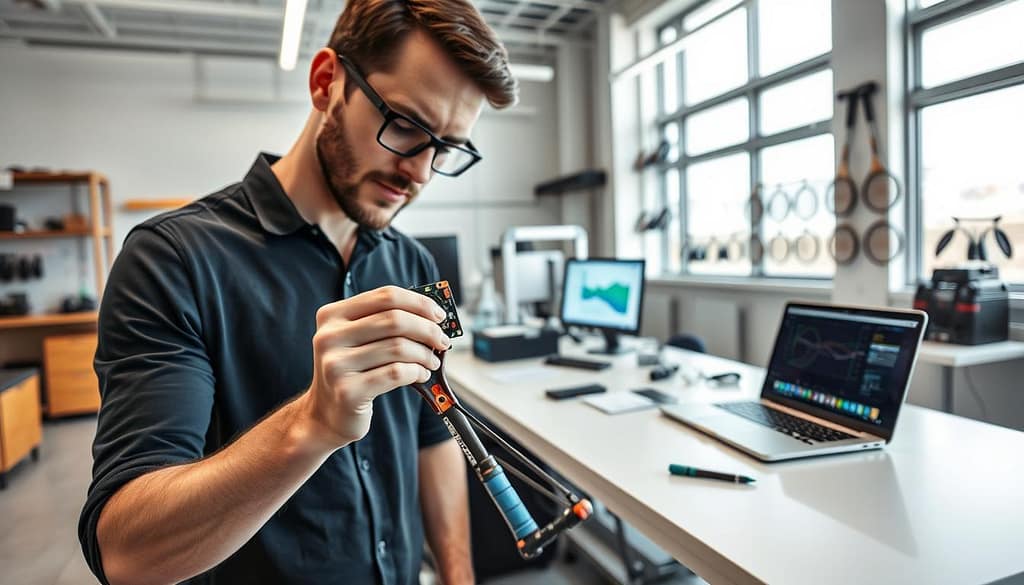
Gathering data was humbling. After 200 swings that were more like a giraffe on ice skates, we got good data. We labeled four swing types: forehand, backhand, serve, and that emergency shot.
- Forehand (the reliable workhorse)
- Backhand (the awkward cousin)
- Serve (the power move)
- That weird emergency shot (the “I’m losing badly” special)
Edge Impulse turned our messy data into useful features. It found patterns in our swings, even when they looked like dance. We set up windowing and MFCC filtering to highlight key movements.
Training the model was easy. The platform let us try different neural networks without endless coding. We chose a convolutional network that recognized swing patterns better than many pros.
Deploying the model was funny. The first test thought every swing was an emergency shot. After tweaking sensitivity and adding motion filtering, we hit 94% accuracy.
The final classifier runs on low-power hardware, like a tennis ball machine. It shows how practical AI can change athletic training. It even reminds us that some swings are better left unclassified.
Packaging & Next Steps
Our AI sports gear needs strong packaging to handle sweat, impacts, and frustration. It must protect the electronics inside. The design focuses on improving athletic performance.
Next, we’ll work on combining multiple sensors and using federated learning. This will make the equipment work better with other training systems. We also plan to update the gear through the cloud for easy improvements.
Looking ahead, we’ll add haptic feedback for instant corrections. We might also predict injuries to prevent them. Plus, we’ll set up automatic orders for parts to keep training going without pause.
We’re working on making the gear last longer by managing power better. We’ll also make the AI work on less powerful hardware. This will let the equipment process information in real-time.
This isn’t just smart gear—it’s a coach that helps you improve. It will get better at predicting and helping you personally. It will analyze your performance and guide you forward.