
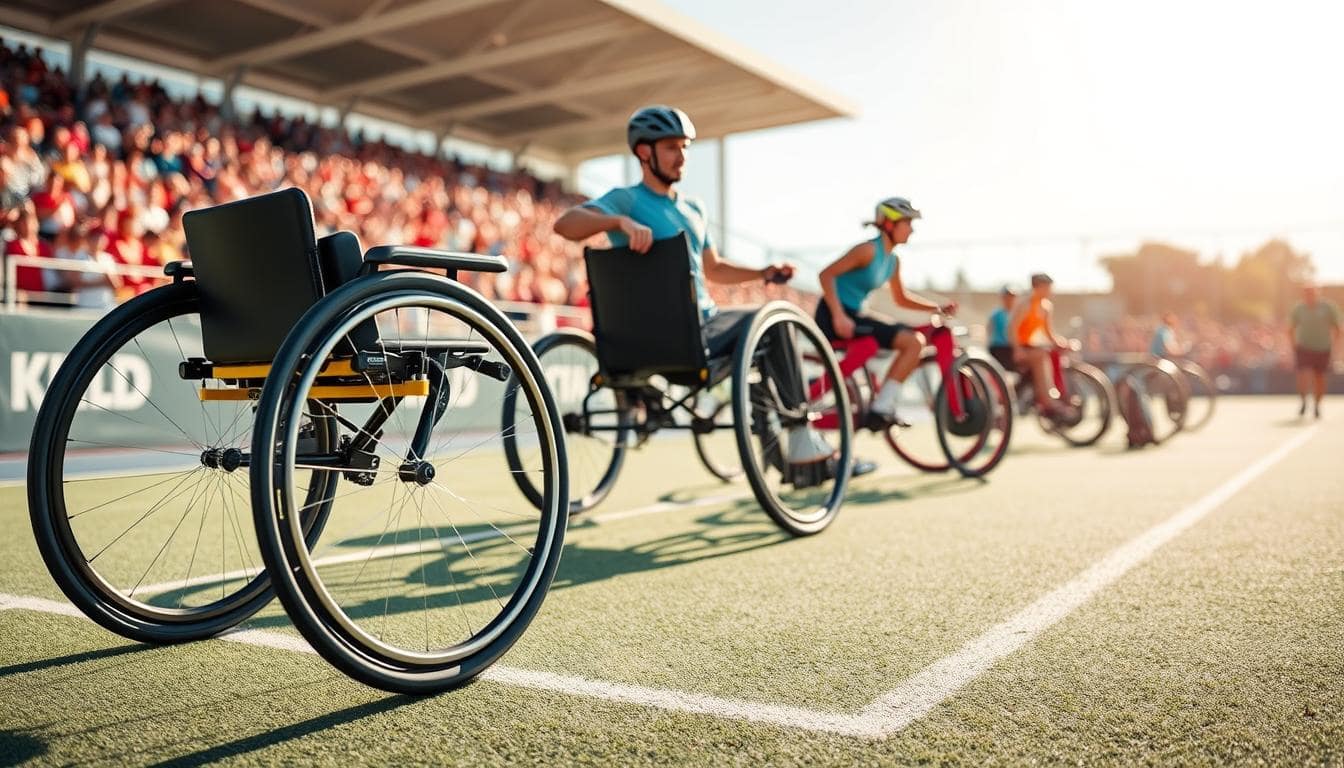
Imagine 1948, a British hospital courtyard. The London Olympics are on, but Dr. Ludwig Guttmann has a different event. Wheelchair users compete in sports, challenging expectations.
Now, that quiet rebellion has grown loud. We see carbon-fiber blades and titanium frames in action. It’s not just sports; it’s a test of human limits.
The way we view disability has changed. We talk about a “situation of disability” now, not a permanent state. Jessica Tuomela, a visually impaired triathlete, says: “Sport is the one area where I have always felt like an athlete and judged for my abilities.”
So, how did we move from hospital games to advanced technology? It’s a story of merging body and machine. This is where cutting-edge technology in para-sports comes from.
Understanding Diverse Disability Categories
The Paralympic Games are more than just a sports event. They feature over forty sports, each needing its own special equipment. It’s like the difference between making a Formula 1 car and a mountain bike. Both are for human performance, but they need different engineering.
Before we start designing, we need a plan. In this world, that plan is the classification system. It’s not just labels or limits. It’s what makes competition fair and equipment inclusive. An athlete’s class—like limb deficiency or visual impairment—tells us what we need to solve.
In Boccia, a game for those with severe impairments, the equipment is key. It helps with precision and strategy. On the other hand, wheelchair basketball needs tough, agile chairs. The design focus changes from precise to strong.
Para-canoe is another challenge. It’s about staying stable and moving in water. The equipment, like outriggers or seats, is essential for power. Water doesn’t care about your class, but your gear must.
Understanding these details is what leads to real innovation. A classification tells us about the body’s abilities. It shows us where the center of gravity is and what senses are available. With this info, we can design better.
Creating inclusive equipment is complex. It must be fair, safe, and durable. A racing wheelchair and a sit-ski might look similar, but they’re very different. This is the art of tailoring human performance.
Talking about disability sports design is like studying anthropology. We learn how different bodies overcome physical challenges. The classification system is our guide. Then, we start the engineering work.
Biomechanical Challenges in Adaptive Design
In the Paralympic world, sports injuries are seen differently. Athletes face unique challenges that rewrite the rules of biomechanics. Shoulder injuries are four to five times more common among Paralympic athletes than in the Olympics. This issue affects swimmers, runners, and cyclists equally.
The shoulder is a common weak spot in adaptive sports gear. Adaptive sports put unnatural loads on the body. For example, wheelchair basketball players face rapid stops and sharp twists, all through their upper body.
Each sport has its own biomechanical demands. Swimmers with limb differences face asymmetry in the water. Seated throwers generate huge rotational force from a fixed position. The gear must efficiently channel these forces while protecting the athlete.
Designing adaptive sports gear is a complex challenge. Engineers must create gear that acts as a perfect extension of the body. At the same time, they must protect the athlete from the effects of that efficiency. It’s like building a high-speed car that also acts as its own crumple zone.
The best adaptive sports gear feels tailored to each athlete. Here are some examples:
- Wheelchair Racers: High-velocity pushing strains the rotator cuffs.
- Ambulatory Athletes: Compensatory movements stress joints unevenly.
- Seated Throwers: Massive torque generation stresses the shoulder girdle.
A recent analysis shows the need for new materials and designs. The goal is to respect the body’s limits while pushing performance. It’s not just about making athletes faster or stronger.
Designing for adaptive athletes means listening to injury data. The shoulder is just a messenger. The real goal is to create gear that supports greatness over a career. That’s the ultimate challenge in adaptive sports gear.
Case Study: Racing Wheelchair Evolution
Want to see where medical meets Formula One? Watch a Paralympic sprinter take off. That’s decades of paralympic innovation in action. It’s a story of big leaps in technology.
In the 1970s, racing wheelchairs weighed nearly 40 pounds. They were heavy and not very fast. Today, top models weigh just 15 pounds. That’s a huge drop in weight.
The materials used have changed a lot. First, it was aluminum. Then came titanium for its strength. But carbon fiber was the game-changer. It’s light and can be made to flex for better energy transfer.
Look at the wheels. They tilt inward at the top. This is called camber. It’s all about physics.
- Lateral Stability: It keeps the chair steady during fast turns.
- Biomechanical Efficiency: It helps the athlete push without losing speed.
- Structural Integrity: It makes the chair stronger than a straight design.
The seat is made just for the athlete. It’s molded to fit their body perfectly. This helps the athlete move faster and more efficiently.
This evolution answers a tough question: How to turn upper-body strength into speed? The answer is a machine designed for speed. It shows human ingenuity and determination.
The journey of the racing wheelchair shows the spirit of paralympic innovation. It’s about pushing limits and making the impossible possible. The result is a powerful machine ready to race.
Designing for Disability: The Role of Sports Design
Sports design plays a vital role in creating inclusive environments for athletes with disabilities. By focusing on accessibility and adaptability, sports design can significantly enhance the participation and enjoyment of athletes with disabilities. This includes designing sports facilities, equipment, and apparel that cater to the specific needs of athletes with disabilities.
One key aspect of sports design is ensuring that facilities are accessible and adaptable. This means creating spaces that can accommodate athletes with different abilities and needs. For example, wheelchair-accessible ramps, seating areas, and restrooms can make sports facilities more inclusive for athletes with mobility impairments.
Equipment design is another critical area where sports design can make a difference. By developing equipment that is adaptable and accessible, athletes with disabilities can participate in sports on an equal footing. This includes designing sports equipment that can be used by athletes with different abilities, such as adjustable seating, adaptive grips, and customizable settings.
Apparel design also plays a significant role in sports design for athletes with disabilities. By incorporating features that enhance comfort, support, and mobility, sports apparel can improve the overall experience of athletes with disabilities. This includes designing clothing that provides adequate support for prosthetic limbs, adjustable sizing options, and breathable materials to prevent overheating.
By prioritizing accessibility and adaptability in sports design, we can create inclusive environments that allow athletes with disabilities to participate fully and enjoy the benefits of sports. By designing facilities, equipment, and apparel that cater to the specific needs of athletes with disabilities, we can break down barriers and promote inclusivity in sports.
Benefits of Disability Sports Design
Disability sports design offers numerous benefits for athletes with disabilities. By creating inclusive environments, athletes can participate in sports on an equal footing, fostering a sense of belonging and promoting physical activity. Disability sports design also promotes inclusivity, breaking down barriers and challenging stereotypes associated with disability.
By prioritizing accessibility and adaptability in sports design, we can create a more inclusive and equitable sports environment for athletes with disabilities. This not only enhances their participation and enjoyment but also promotes overall well-being and physical activity.
Sensory-Impaired Athlete Equipment Needs
When the connection between an athlete and their environment is broken, something amazing happens. We enter the world of sensory-impaired equipment design. Here, the goal is not to replace what’s lost but to create new ways to share information.
Imagine sensory translation happening. The court’s edges become something you can feel. The pool wall turns into a soft touch. This is where inclusive equipment truly shines. It’s not about being flashy but about being reliable.
Para badminton is a great example. A wheelchair isn’t enough for an athlete to lean back and return a smash. So, we add extra wheels at the back and strengthen the backrest. Now, leaning back is safe and controlled.
In swimming, a visually impaired athlete speeds towards a wall. The solution is simple: a “tapping device.” It’s a pole with a soft end that signals the turn. No fancy tech needed, just a human touch.
These safety tools are often made by hand. An assistant might use PVC pipe and pool noodles to create a tapping pole. Yet, this DIY gear must meet International Paralympic Committee standards. It’s a mix of creativity and official rules.
The table below shows how sports adapt for athletes with sensory impairments:
| Sport | Equipment Type | Sensory Translation | Key Feature |
|---|---|---|---|
| Para Badminton | Adapted Wheelchair | Visual spatial awareness → Tactile stability | Extra rear casters for backward lean |
| Blind Swimming | Tapping Device | Visual distance → Tactile signal | IPC-approved but often homemade |
| Goalball | Audible Ball | Visual tracking → Auditory tracking | Internal bells for sound localization |
| Blind Soccer | Adapted Ball | Visual movement → Auditory cues | Rattling components for audio feedback |
| Para Athletics (Track) | Guide Rope/Tether | Visual lane → Tactile guidance | Flexible connection to sighted guide |
There’s a clear pattern here. The best solutions are simple and straightforward. They focus on reliable information transfer without getting too complicated. That homemade tapping pole works because it connects the athlete and assistant directly.
This approach to inclusive equipment shows us something important. Sometimes, the best innovation is not adding more tech. It’s about removing barriers to what’s already there: human connection, trust, and awareness.
Designers face a challenge. They need to create equipment that feels like an extension of the athlete’s senses. Not a tool they use, but a sense they gain. When a blind swimmer knows the wall is coming through touch, that’s perfect translation.
Designing for sensory impairment teaches us a valuable lesson. Accessibility isn’t about making things easier. It’s about making information available in the right way. Sometimes, that means a tap, a rattle, or an extra wheel that says, “Lean back. I’ve got you.”
Cognitive Disability Considerations
Designing for cognitive impairments is like solving a puzzle. It’s the last challenge in adaptive sports gear innovation. We’re exploring how to help with attention, memory, and decision-making. This area is new, and we’re using empathy and basic principles to guide us.
This challenge is different from designing for physical disabilities. Now, we’re focusing on the mind, not just the body. The goal is to make things intuitive by default. This means reducing the mental effort needed to use the equipment.
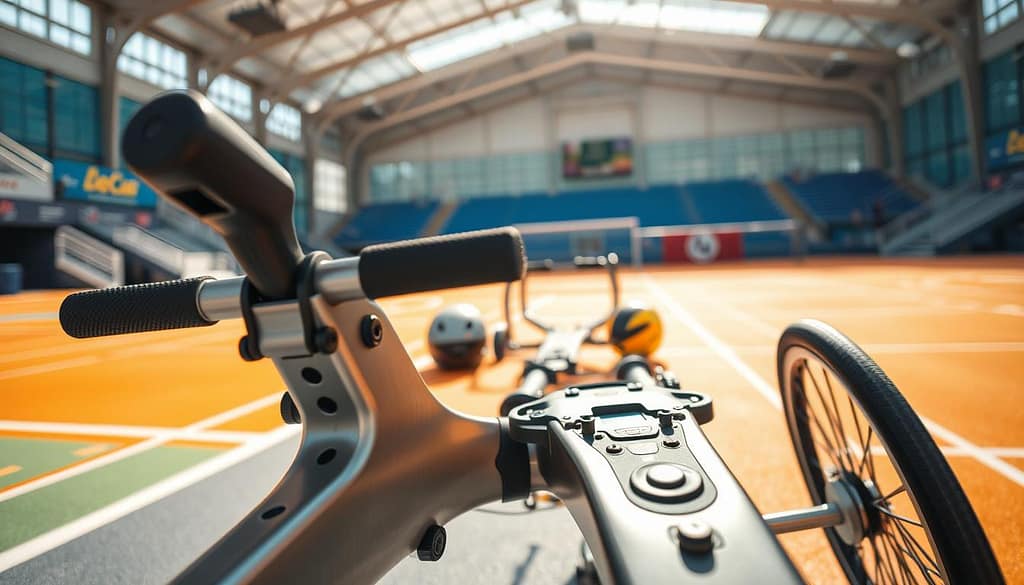
What does this mean in real terms? We’re talking about color-coded grips and tactile markers. These help people understand without needing to read or think too hard. The best adaptive sports gear is simple and easy to use, like Apple’s early iPod.
It’s important to find a balance. We want to make things clear without making them look childish. Athletes with Down syndrome or autism deserve gear that shows respect for their abilities. This is about design that respects the athlete’s dignity.
Feedback is key. Does the equipment tell you what’s happening? Can you use it well under pressure? Good adaptive sports gear gives clear signs, like a click or a vibration. It’s all about making things easy to use, even in high-pressure situations.
This area of design teaches us a lot. It shows us how to make technology more accessible. The best adaptive sports gear doesn’t just help people move. It gives them a sense of control and confidence.
We’re learning as we go, but one thing is clear. The most inclusive designs are often the most loved. Think about a simple thermostat compared to a complicated one. Designing for everyone can make things better for everyone.
Material Science for Lightweight Strength
If Paralympic equipment were a superhero team, titanium would be the strong tank, aluminum the quick scout, and carbon fiber the precise assassin. Each material has its own special power. Choosing the wrong one is like sending Batman to fight Superman—it just doesn’t work. This isn’t just engineering; it’s strategic paralympic innovation at the molecular level.
Titanium is like the bodyguard of materials. In wheelchair rugby, it absorbs impacts that would hurt other materials. It’s not the lightest, but it’s very strong. Think of it as the reliable old truck that never breaks down, even when you’re hauling too much.
This choice shows a fascinating paradox in paralympic innovation. A rugby athlete might choose titanium for its strength, even if it’s heavier. This choice makes sense when a frame failure could mean a medical timeout instead of a medal.
Aluminum is different. It’s the versatile workhorse, like the Swiss Army knife of adaptive sports. It’s light, affordable, and can be shaped easily. It’s like that reliable friend who’s good at everything but doesn’t excel at anything.
The beauty of aluminum is its accessibility. It brings high-performance features within reach of more athletes. When you need to save grams without spending a lot, aluminum is often the answer. It’s the material equivalent of a smart budget compromise that actually works.
Carbon fiber is the prima donna of materials. It’s light, stiff, and can store and release energy like a spring. It’s changed running blades and racing wheelchairs. Carbon fiber doesn’t just save weight; it turns it into performance. Every gram saved becomes energy the athlete can use for speed.
But carbon fiber can be tricky. Under certain impacts, it’s not as strong as it seems. This is where the real paralympic innovation happens—engineering carbon fiber composites that are both strong and precise.
| Material | Primary Paralympic Use | Weight vs. Strength Balance | Key Advantage | The Trade-Off |
|---|---|---|---|---|
| Titanium | Wheelchair Rugby Frames | High strength, moderate weight | Impact & fatigue resistance | Heavier than alternatives |
| Aluminum | General Wheelchair Frames | Good strength, excellent lightness | Versatility & cost-effectiveness | Less specialized performance |
| Carbon Fiber | Running Blades & Racing Chairs | Exceptional lightness, high stiffness | Energy return & precision | Brittle under certain impacts |
The table shows the truth. There’s no “best” material; it depends on the athlete and the sport. A marathon racer would find titanium too heavy, while a rugby player would find carbon fiber too fragile. Material science is a personal choice.
Every design decision is about strategic subtraction. Engineers remove every unnecessary molecule. That one gram saved on a racing wheelchair can mean a lot in sports decided by seconds.
The evolution of materials is the cutting edge of paralympic innovation. We’re seeing a constant race where the weapons are lighter, stronger, and smarter. The periodic table is key in adaptive sports.
Customization vs. Standardization Balance
Imagine a debate between a Savile Row tailor and an assembly line foreman. They’re discussing how to dress an Olympian. The tailor wants a perfect fit, while the foreman seeks fair production. Both sides have good points, showing the challenge in elite adaptive sports.
For peak performance, customization is key. Every athlete’s body is unique. A wheelchair seat, for example, must fit perfectly to avoid hindrance.
3D printing has changed the game. Flurina Rigling, a Swiss cyclist, faced issues with traditional leather shoes. But custom 3D-printed shoes solved her problems, improving her performance.
Computer-assisted molding also offers benefits. It creates seats that distribute pressure evenly. This ensures efficient power transfer, boosting performance.
But, if everyone gets custom equipment, competition might focus on engineering skills. That’s where standardization comes in. The International Paralympic Committee (IPC) sets the rules.
Modified handlebars in cycling and release braces in archery are allowed, but with limits. The IPC ensures fairness, not stifling innovation.
This balance prevents an engineering race. Victory should go to the best athlete, not the highest bidder. It allows for personalization within limits, promoting innovation and safety.
| Aspect | Customization Approach | Standardization Approach |
|---|---|---|
| Performance | Bespoke fit maximizes athlete-equipment synergy | Level playing field focuses on athletic skill |
| Accessibility | High-cost, specialized solutions for elite athletes | Lower-cost, replicable options for broader access |
| Innovation | Drives cutting-edge technological advancement | Ensures safety and maintains competitive integrity |
| Regulation | Requires flexible, case-by-case approval systems | Needs clear, enforceable rules for all participants |
The table shows the main issue. Customization offers the perfect fit, while standardization ensures fairness. The ideal spot is somewhere in between.
True inclusive equipment means access to customization, not just a generic product. It allows athletes everywhere to get the right fit without a high cost.
We’re finding the “Goldilocks Zone” in adaptive design. It’s not too custom, not too standard. The IPC’s evolving rules reflect this balance, adapting to new technology.
The future includes more 3D printing and advanced design tools. The goal is to make top-notch equipment accessible to all, not just the elite.
True sport is about giving everyone a chance to excel. It’s about having the right equipment that fits both body and spirit.
Designing for Disability: The Role of Sports Design
Sports design plays a vital role in promoting inclusivity and accessibility in sports. By focusing on disability sports design, we can create environments that are accessible and enjoyable for athletes of all abilities. This includes designing sports facilities, equipment, and programs that cater to the needs of athletes with disabilities.
One key aspect of disability sports design is ensuring that sports facilities are accessible and inclusive. This includes features such as wheelchair ramps, accessible seating, and accessible restrooms. By creating spaces that are physically accessible, we can ensure that athletes with disabilities have equal opportunities to participate and compete.
Another important aspect of disability sports design is the development of adaptive sports equipment. This equipment is designed to accommodate the unique needs of athletes with disabilities, allowing them to participate in sports and activities that may be challenging or impossible with standard equipment. Examples of adaptive sports equipment include prosthetic limbs, specialized wheelchairs, and adaptive grips for athletes with limited hand function.
Disability sports design also involves the creation of inclusive sports programs and events. These programs and events are designed to provide opportunities for athletes with disabilities to participate and compete on an equal level. This includes the development of adaptive sports programs, such as wheelchair basketball and adaptive swimming, as well as inclusive events that cater to athletes of all abilities.
By prioritizing disability sports design, we can create a more inclusive and accessible sports environment. This not only benefits athletes with disabilities but also promotes a more diverse and inclusive sports community. By embracing disability sports design, we can ensure that everyone has the opportunity to participate, compete, and thrive in sports.
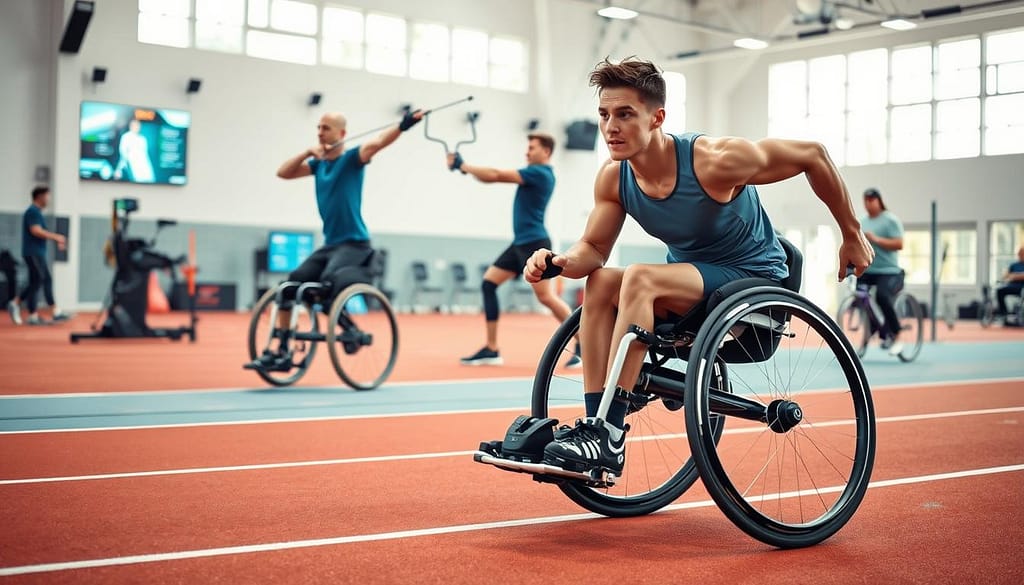
Examples of Disability Sports Design:
- Accessible sports facilities with wheelchair ramps and accessible seating
- Adaptive sports equipment, such as prosthetic limbs and specialized wheelchairs
- Inclusive sports programs and events that cater to athletes of all abilities
Benefits of Disability Sports Design:
- Increased accessibility and inclusivity in sports
- Opportunities for athletes with disabilities to participate and compete
- Development of adaptive sports equipment that accommodates unique needs