
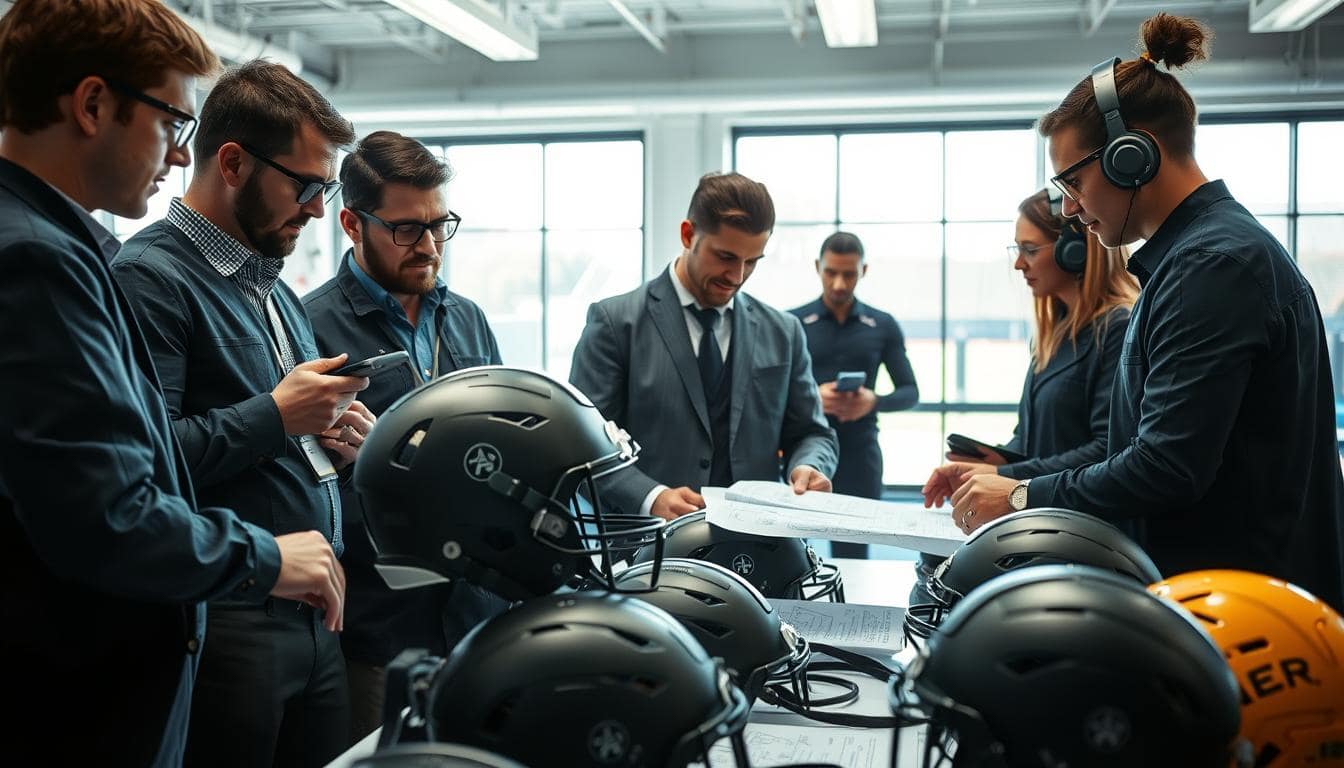
The gear we use for sports is full of risks. It’s like a modern Greek tragedy, but with more spandex and less chorus.
Sports injuries can lead to long-term disabilities. This shows we need proactive detection and data-driven rehabilitation strategies urgently.
This isn’t about making athletes safe with bubble wrap. It’s about using engineering to make sports safer. We’re the ones who understand the thrill of going faster.
We’re moving from old superstitions to science. Safety needs to be a designed, measurable part of sports. Wearable biomechanics help us make equipment safer, as seen in pushing the design envelope.
Are you ready to change how we protect athletes? It begins with a new way of thinking.
Safety Engineering Framework
Forget duct tape and hope; modern athletic safety is built on a rigorous, four-phase engineering framework. It’s the systematic operating system that takes raw materials and human ambition and outputs a product that’s less likely to send you to the ER. This isn’t about adding padding as an afterthought. It’s about baking safety into the DNA of the equipment from the first sketch.
The process is a loop of ask, answer, act, and verify. Hazard identification asks, “What can go wrong?” Risk assessment asks, “How bad and how likely?” Mitigation strategies declare, “Here’s how we stop it.” And safety validation demands, “Prove it works.” Let’s boot up this system.
https://www.youtube.com/watch?v=k_TkVZz9Vhs
Hazard Identification
You can’t fix a problem you haven’t named. Hazard identification is the forensic audit of an athlete’s interaction with their gear. It’s looking for the weak link. Is it the stress on a carbon fiber bike frame during a pothole impact? The shear force on a football helmet during a specific angle of tackle?
Modern engineering doesn’t guess. It measures. Take knee injuries in runners. Data from studies tracking 50 athletes pinpointed a critical hazard: excessive joint loading during deep flexion angles around 125°. Finding that specific number—that’s hazard identification. It’s moving from “knees hurt” to “the medial collateral ligament is under peak stress at this precise kinematic moment.” This phase relies heavily on understanding the modern sensor landscape to gather that precise biomechanical data.
Risk Assessment
Okay, we found a hazard. So what? That’s where risk assessment sports protocols come in. This is the probability calculus of pain. How likely is this 125° flexion to happen to a given athlete? And if it does, what’s the severity—a twinge or a season-ending tear?
This is where machine learning models earn their keep. They chew on mountains of sensor data—from IMUs and sEMG readings—and spit out a risk score. One cited study achieved a 92.3% accuracy in classifying overall injury risk by tuning these algorithms. The output isn’t just a red light; it’s a graduated scale. It tells you if an athlete is in the green, yellow, or red zone for a specific injury. This transforms vague worry into quantified, actionable insight.
With the risk profile mapped, we engineer the countermove. Mitigation strategies are the interventions. If the system calculates that an athlete’s left-right power asymmetry has tipped past a critical 10% threshold, the mitigation isn’t a lecture. It’s a real-time auditory cue in their ear: “Adjust your stride.” It could be a design change, like adding a specific damping material to a shoe sole to dissipate that peak force identified earlier.
All this brilliant theory is worthless without the final, gritty phase: safety validation. This is the “show me” step. Does the real-time feedback actually reduce asymmetry? Does the new sole material lower joint loading in the field, not just in the lab sim?
Validation is the sheer grind of iterative testing. It’s taking the prototype to places like Dring Stadium, strapping it on actual athletes during real training, and collecting more data. It’s the scientific method applied to sweat and grass. The framework loop closes only when validation confirms the mitigation works. If it doesn’t, you go back to “What can go wrong?” and start again.
To see how these phases work in concert, here’s a breakdown:
| Framework Phase | Core Question | Engineering Action | Real-World Example |
|---|---|---|---|
| Hazard Identification | What is the specific failure point? | Analyze biomechanical data to find precise stress maxima. | Identifying 125° knee flexion as a peak load hazard for runners. |
| Risk Assessment | How likely and severe is the consequence? | Use ML models to classify probability and severity from data streams. | A 92.3% accurate model scoring an athlete’s ACL injury risk. |
| Mitigation Strategy | How do we prevent or reduce the risk? | Design hardware/software interventions based on the risk profile. | Real-time audio feedback to correct leg asymmetry exceeding 10%. |
| Safety Validation | Does our solution actually work in the real world? | Conduct controlled field trials and compare pre/post-injury data. | Testing prototype gear with a college team at Dring Stadium. |
This framework is the bedrock of credible athletic safety systems. It replaces opinion with evidence, and fear with a calculated plan. It turns safety from a marketing slogan into an engineered, verifiable product feature. Now, with our hazards identified and risks assessed, we need to look at the ways gear can fail. What are the common failure modes, and how do we design against them?
Failure Mode Analysis
We design safety because things can break, and we know how. This is the art of failure mode analysis. It’s like a test run for disasters, done while things are working. The aim is to prevent problems, not to scare.
Equipment Failure Types
Real failures are often slow and sneaky, not sudden. They can be like a material wearing out over time. We group these failures into a few main types.
First, there’s the big, sudden failure. Think of a helmet breaking on impact. It’s dramatic and immediate. Then, there’s the slow wear down, like a knee brace losing its springiness.
The sneakiest failure is the one that doesn’t break but encourages bad movement. Research shows that small changes in how we move can lead to big injuries. It’s not the equipment failing, but it’s failing to protect us.
Consequence Assessment
After figuring out how something can fail, we need to think about what happens next. The consequences can range from very bad to just annoying. We measure how serious these consequences are.
A helmet failure can lead to serious head injuries. The cost is too high to measure. On the other hand, a worn-out knee brace can cause chronic pain and injuries over time. One is an emergency, the other a slow decline.
Probability analysis is key here. Is a muscle imbalance a big problem or just a small chance? Research says it’s a big deal. We look at the consequences to understand the trade-offs in design. We might take a risk if the benefits are huge, but only if we can mitigate it well.
This whole process helps us design safer equipment. If we know a material fails after 500 impacts, we replace it at 400. If a design invites bad movement, we fix it. This way, we can prevent problems before they happen.
Human Factors Integration
You can create the most detailed safety plan, but athletes are unpredictable. They defy the laws of physics with their actions. Human Factors Integration is about designing athletic safety systems for real athletes, not just ideal users.
This approach bridges the gap between lab tests and real-world sports.
User Behavior: The Wild Card
Let’s face it. Athletes ignore warnings to achieve their best. Coaches push for more reps, even if it means bad form. These actions show human drive and ambition.
We design for the best case, but athletes act on ego and competition. Understanding this psychology is key to safety.
Error Prevention: From Guardrails to Guides
If you can’t stop errors, design systems that help or teach. Modern athletic safety systems are moving towards this. It’s like switching from passive guardrails to active guides.
For example, an average real-time feedback latency of 188 ± 15 ms is incredibly fast. Imagine sensors that correct dangerous moves almost instantly.
This turns safety into a real-time coaching tool. It’s safety built into the activity itself.
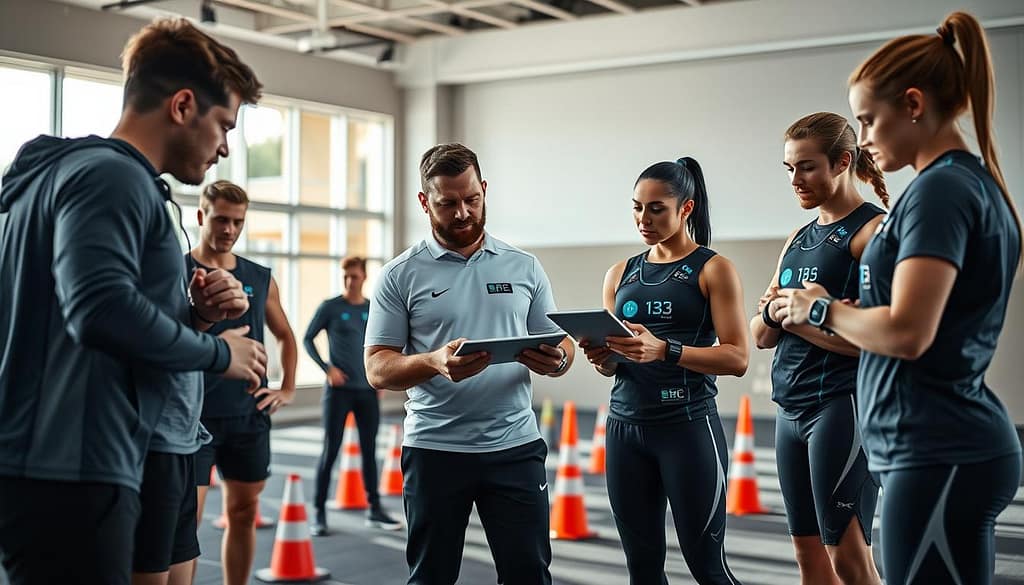
This technology allows for personalized training and recovery plans. It adapts to the user’s needs, not a fixed plan. It prevents errors by adjusting the challenge.
This changes how we approach safety. It’s no longer just about following rules. It’s about using data to improve performance.
Training now focuses on understanding data. Athletes and staff learn to read the data’s story. They become active in their safety journey. The system guides, not controls.
In the end, integrating human factors means embracing the unpredictable nature of sports. The goal is to create athletic safety systems that work with athletes, not against them.
Material Safety Considerations
Think of your safety gear as a silent partner. But what if it started leaking harmful chemicals? This is where safety meets science, turning abstract ideas into real-world actions. The materials used are more than just stuff; they play a key role in a dynamic environment.
Four important factors need to be considered: biocompatibility, toxicity assessment, environmental impact, and aging effects. Ignoring any of these is like leaving a back door open in a fortress. It’s essential for creating reliable protective equipment design.
https://www.youtube.com/watch?v=idDYO-ENCnE
Biocompatibility: The Biological Peace Treaty
Biocompatibility is a must, not just a suggestion. It’s a deal with the human body. That new padding? It should absorb impact, not cause skin irritation. The question is: Does this material get along with our bodies?
It’s not just about skin contact. Think about mouthguards, helmet liners, or heart-rate monitor straps. These materials are close to us for a long time. If they fail, it’s a big betrayal of trust. Making sure they’re biocompatible is key in protective equipment design.
Toxicity Assessment: The Uninvited Chemistry Experiment
Toxicity assessment is like being paranoid about materials. It looks for hidden chemicals like plasticizers or flame retardants. Athletes sweating on treated materials are doing an unofficial chemistry test.
This needs detailed testing, not just a quick demo. How does it perform after hours of sweat or many washes? It’s about stopping unwanted chemical migration, a vital part of protective equipment design.
The environmental impact is also important. From the carbon footprint of making high-tech materials to what happens to old gear, it’s all part of the design. It’s a big responsibility.
Aging effects are another critical factor. It’s not just about how long something lasts but how it performs over time. Does a helmet foam break down after years in a hot car? Does knee brace material become weak? Failure can be silent but deadly.
This requires a shift in thinking. From just checking a product at first to testing its long-term performance. This is the ultimate test for protective equipment design. The material must stay safe through every use and season.
Risk Management Systems
The saying ‘an ounce of prevention’ has evolved. Today, it’s about a never-ending cycle of spotting risks, acting, and learning. A one-time safety check is as useful as a fad diet. Real safety in sports needs a dynamic, living system—a constant watchful eye. This isn’t just about checking boxes. It’s about creating a system that grows and changes as fast as risks do.
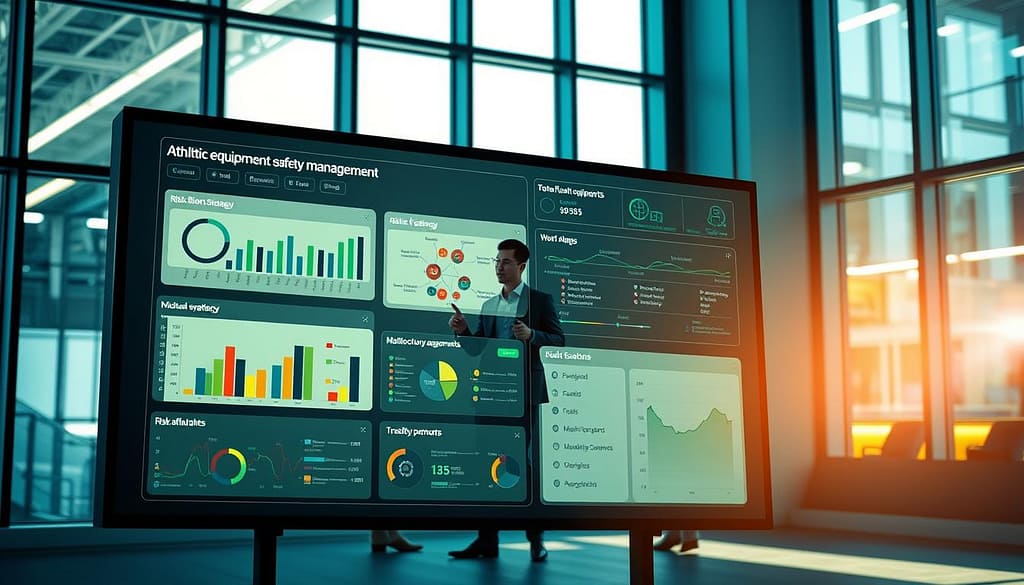
We’ve all seen what happens when a system fails: injured athletes, frantic coaches, and lawsuits. The aim of modern risk management is to prevent such scenes. It turns safety into an always-on process. Let’s explore how this works.
Risk Identification
You can’t fix a problem you don’t see. Old risk assessment sports methods often looked back at past injuries. Today, we focus on predicting and covering all bases. Tools like wearable sensors, as shown in recent studies, provide real-time data.
This isn’t just about counting steps. It’s about catching small changes in a pitcher’s arm or uneven loads on a sprinter’s knee before they become serious. It’s like having a radar system always on the lookout for dangers, not just reporting on past ones.
Mitigation Strategies
Finding a risk is useless without a plan to fix it. Mitigation strategies are your plans of action. They can be proactive or reactive.
A proactive strategy might adjust an athlete’s training based on sensor data. A reactive one might replace a helmet showing damage. The key is to act based on data, not guesswork. It’s the difference between a doctor using an MRI and one guessing.
This is where the “physics-informed biomechanical modeling” from our study shines. It tells you not just *that* a risk exists, but *why*, allowing for precise fixes.
But the job isn’t done once a plan is set. That’s where monitoring protocols come in. Did adjusting the training load really help? Is the new gear working? This creates a feedback loop, checking if your actions are working or if you need to go back to the drawing board.
And despite the best plans, accidents can happen. A strong incident response plan is your emergency stop. It’s not about panic; it’s about following a plan. The main question shifts from “Who’s to blame?” to “Why did our system miss this signal?” This analysis helps improve the system, closing the loop.
The secret ingredient is continuous improvement. The study’s mention of “adaptive machine-learning optimization” is the digital version of this. The system learns and gets better with every piece of data, every near-miss, every season. Yesterday’s mistakes help tomorrow’s safety, making the system smarter and stronger.
To see how these parts work together in a top-notch setting, consider this breakdown:
| System Component | Primary Tool/Activity | Key Output | Real-World Example |
|---|---|---|---|
| Risk Identification | Wearable sensor data, video analysis, environmental scans | Real-time hazard alerts, predictive risk scores | Sensors flag abnormal torque on a gymnast’s ankle during a routine landing. |
| Mitigation Strategies | Load management, equipment modification, technique correction | Implemented safety interventions | Automated software reduces athlete’s weightlifting volume for 48 hours. |
| Monitoring Protocols | Performance tracking, compliance checks, equipment integrity tests | Validation data, trend analysis | Weekly review confirms reduced impact forces after switching to new court shoes. |
| Incident & Improvement | Root-cause analysis, system audit, protocol updates | Refined safety models, updated training | A concussion leads to a new rule about mandatory headgear in practice drills. |
A top-notch risk assessment sports framework doesn’t just manage risks. It creates a safe environment where safety is a built-in feature. It’s the quiet confidence that comes from knowing your defenses are learning and adapting right alongside your athletes.
Regulatory Compliance
If safety engineering principles are the science of building trust, then regulatory compliance proves it. Compliance might seem like dusty binders and checklists. But in athletic gear, it’s the silent referee that keeps the game safe.
This framework is where innovation meets accountability. It’s not just about following rules. It’s your legal and ethical shield.
Safety Standards: The Industry’s Codex
Safety standards from bodies like ASTM International and ISO are fascinating. They’re not just rules but a history of the industry’s wisdom and tragedies. Each standard, from helmet impact to synthetic turf fiber, is a lesson learned.
These standards provide a common language. They set a baseline of acceptable risk for everyone. Meeting or exceeding these standards shows you’ve done your due diligence.
This isn’t just technical jargon. It’s the foundation of liability considerations. When your product meets or exceeds ASTM F1447 for helmets or ISO 20471 for high-visibility apparel, you’re not just building a better gadget. You’re building a demonstrable record of due diligence. In court, or in the court of public opinion, that record speaks volumes.
Certification Processes: Running the Gauntlet
Having a design that *should* pass is a world away from having one that *does* pass. The certification process is the rigorous gauntlet where theories meet reality. It involves third-party laboratories putting prototypes through hell—simulated years of wear, extreme environmental stress, and worst-case scenario impacts. This validation is the crucible that separates a clever concept from a commercially viable, safe product.
The complexity multiplies when you consider international requirements. A certification from the U.S. Consumer Product Safety Commission (CPSC) is your ticket to play domestically. But the European Union’s CE marking demands its own set of conformity assessments. Asia may have another suite of standards entirely. Navigating this global patchwork isn’t bureaucracy; it’s a fundamental requirement for market access.
Ultimately, aligning with this framework does more than mitigate legal risk. It aligns a company’s mission with broader human goals, like supporting UN Sustainable Development Goal 3 for health and well-being. It’s the difference between building to code and building to last—ethically and legally. True safety engineering principles recognize that the highest standard isn’t always the one written down; it’s the one that ensures an athlete walks away unharmed.
Innovation in Safety Design
Imagine if your protective gear could predict an injury before it happens. Welcome to the era of predictive safety, where sci-fi meets the sideline. We’ve moved beyond just making helmets thicker or pads softer.
The new frontier in sports safety engineering is about embedding intelligence into the equipment. It’s a shift from passive armor to an active, sentinel-like system.
Emerging Technologies
What’s powering this leap? It’s a mix of sensors and algorithms that would impress even tech billionaires. The stars are Inertial Measurement Units (IMUs) and surface electromyography (sEMG) sensors.
One tracks motion, the other reads muscle electrical activity. Alone, they’re smart. Together, they’re genius.
A recent study showed a hybrid IMU–sEMG model with 92.3% accuracy in injury risk classification. It also had 90.5% recall and an AUC of 0.93. This means it’s very good at spotting trouble before it happens.
This isn’t just lab theory; it’s the backbone of a real-time wearable biomechanics framework.
Predictive Safety
This is where predictive safety differs from the old, reactive world. It’s like the difference between a weather forecast and getting caught in a downpour. Traditional gear waits for the impact.
Intelligent systems analyze the athlete’s form, load, and fatigue. They warn of the coming storm.
The gear becomes a crystal ball. It monitors biomechanical data and flags dangerous patterns. This means it can warn of an awkward landing sequence or asymmetrical muscle activation.
This capability fuels the next two concepts: automated protection and adaptive systems. Imagine a smart knee brace with micro-actuators. It doesn’t just sit there.
It senses an excessive lateral load during a cut and adjusts its stiffness to stabilize the joint. That’s automated protection in action—a silent, robotic guardian.
Then there are adaptive systems. This gear learns. It establishes a unique biomechanical fingerprint for each athlete, defining their personal “normal.”
Any deviation—a slight change in gait, a drop in core muscle engagement—triggers an alert. It’s personalized safety, moving the goalpost from population averages to individual baselines.
Ultimately, we’re talking about smart gear. Your shin guards, your mouthguard, your shoes. They’re no longer dumb slabs of material.
They are a coach, a guardian, and a diagnostician all in one. All woven seamlessly into the act of performance.
The evolution is stark. Here’s a quick look at how the playing field has changed:
| Feature | Traditional Safety Design | Intelligent Safety Approach | Key Impact |
|---|---|---|---|
| Core Function | Impact Absorption & Containment | Risk Prediction & Proactive Intervention | Shifts from reaction to prevention |
| Data Usage | None / Post-Injury Analysis | Real-Time Biomechanical Streaming | Enables continuous, personalized monitoring |
| Adaptability | Static; One-Size-Fits-Most | Dynamic; Adjusts to Real-Time Load & User | Provides tailored protection during activity |
| User Interaction | Passive Wear | Interactive Feedback Loop (Alerts, Adjustments) | Empowers the athlete with actionable insights |
| System Goal | Minimize Injury Severity | Prevent Injury Occurrence | Dramatically reduces overall risk exposure |
The 92.3% accuracy rate isn’t just a number in a study. It’s the starting pistol for a new race in athletic safety systems. The gear is no longer something you just put on. It’s a partner you train with.
It’s safety that thinks, adapts, and ultimately, predicts. The future isn’t just safer; it’s smarter.
Professional Implementation
The move from theory to practice is key. It’s where the sensor meets the sweat. This is the messy, glorious art of deployment.
It’s like directing a blockbuster movie. You have the script and special effects. Now, you need the crew and a way to keep things running smoothly.
Safety Protocols: The Daily Script
Actionable safety protocols are not just ideas. They are step-by-step instructions for every day. They tell everyone what to do and when.
Our field experiment at Dring Stadium was a test. It showed how to use smart gear in real life. Who puts the sensors where? Who checks the Bluetooth before starting?
A modern protocol might look like this:
- Pre-session Sensor Check: Check battery levels, calibration, and sensor placement.
- Real-time Monitoring Role: Have someone watch the data dashboard for alerts.
- Escalation Path: Know what to do if an alert happens.
Traditional equipment inspection is about what you can see and touch. Smart gear adds a digital layer. Now, you check if the data is good too.
Your checklist gets bigger. You’re caring for a data-generating asset, not just a piece of plastic. Calibration drift is as important as a broken helmet.
Consider this shift in inspection focus:
| Traditional Equipment | Smart Safety Equipment | Inspection Action |
|---|---|---|
| Football Helmet | Helmet with Embedded IMU | Check shell integrity AND verify sensor data transmission to the sideline tablet. |
| Gymnastics Mat | Mat with Pressure Mapping | Look for surface wear AND run a diagnostic software check on the pressure grid accuracy. |
| Weightlifting Belt | Belt with Strain Gauges | Inspect buckle mechanism AND confirm the baseline “zero” load reading is accurate. |
This mix is essential. Bad data can be worse than no data at all.
The Unsung Hero: Maintenance Procedures
If inspection is the daily checkup, maintenance procedures are the deep clean. It’s not just about replacing parts. It’s about updates, data management, and battery care.
Ignoring digital maintenance is like not updating your antivirus. The system becomes vulnerable. A protocol must schedule these deep dives to keep the tech strong.
Training the Hybrid Professional
None of this works without evolved training programs. We need staff who can do it all: athletic training, data analysis, and tech support.
Training can’t be just a one-day thing. It must be ongoing. It should teach how to handle alerts, troubleshoot sensors, and understand data limits. The goal is to build confidence, not confusion.
Professional implementation is the bridge between theory and reality. It connects the engineer’s model to the field. Without it, even the best equipment safety design is useless.
Cost-Benefit Optimization
Let’s talk budgets. Even the most noble missions need a budget. The cost of advanced sports safety engineering can be shocking. A high-tech helmet or smart padding is a big safety investment.
Safety Investment
It’s easy to focus only on the cost. High-tech materials and systems in protective gear aren’t cheap. But looking at the other side of the ledger is smarter.
Risk Reduction Value
What’s the real cost of a preventable injury? Compare a season-ending surgery to a system that could have prevented it. A “quantitatively validated, reproducible, and scalable framework” turns safety into real value. It shows the risk reduction in dollars and cents.
This math affects insurance costs. Showing you can reduce risk can lower premiums. The biggest advantage isn’t just avoiding disaster. It’s being able to perform at your best.
Healthier athletes train harder and play longer. Superior protective gear isn’t a cost. It’s a way to boost performance. In our analysis, the best strategy is solid sports safety engineering. Good safety isn’t a cost. It’s the base of a winning, responsible team.