
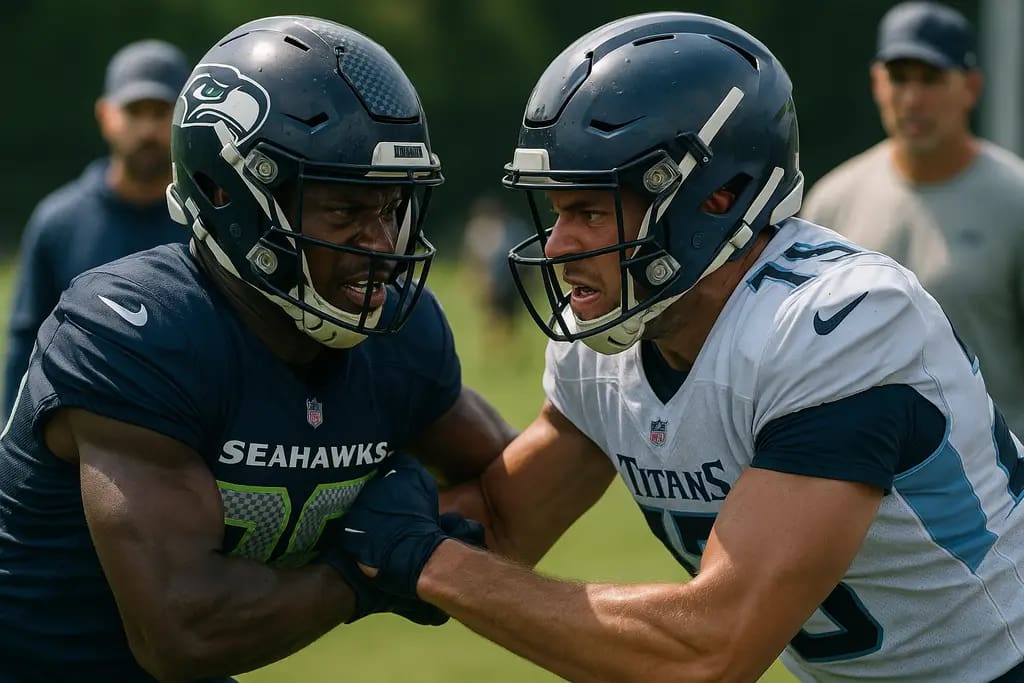
Joint practice performance will be the useful lens for the Seattle Seahawks and Tennessee Titans on Friday, August 21, 2026, in Nashville. The session is scheduled two days before their preseason game on Sunday, August 23, 2026, giving coaches a controlled setting before the more public but less customizable preseason format.
The Seahawks announced the August 21 practice and noted that it will be the second joint-practice meeting between these teams in three years, after their 2024 work in Nashville. Seattle also has used joint practices in three straight preseasons under head coach Mike Macdonald: two with Tennessee in 2024, one with Green Bay in 2025, and one with Tennessee scheduled for 2026, according to the official Seahawks release.
From a performance analysis view, the value is not only that another team is present. It is that the practice can create specific, repeatable situations with less uncertainty than a full game. That matters for roster evaluation, starter workload, equipment checks, and the sustainability of athlete availability across a long NFL calendar.
Why Joint Practice Performance Matters
Joint Practice Performance In Controlled Reps
The central performance question is simple: can a team stress its starters and key reserves without exposing them to the same range of unknowns found in a preseason game? Sports Illustrated reported that the session gives starters meaningful work in a controlled environment because they are likely to see limited action in the August 23 preseason game, according to its Seahawks-Titans practice analysis.
That is the practical case for joint practice performance. A coaching staff can script red-zone work, third-down periods, two-minute scenarios, pass-protection looks, and coverage adjustments without needing to wait for a game to produce those situations. The public reporting does not provide the full practice script, so any claim about exact periods would be speculative. Still, the known timing and purpose point toward targeted evaluation rather than a simple open scrimmage.
Different Opponents, Cleaner Evaluation
Intra-squad work can become too familiar. Offensive linemen learn rush preferences. Defensive backs recognize route stems. Quarterbacks see the same disguise patterns day after day. A joint session changes the stimulus, which can make technique failures easier to spot. A receiver who separates against his own roster might struggle when a new corner plays with different leverage. A pass rusher who wins in camp may need a second read when the opposing tackle sets with a different tempo.
The 2025 joint practice with Green Bay offers a cautionary reminder from the research record. Seattle’s defense faced difficulty during a two-minute drill, and Green Bay safety Evan Williams intercepted a pass. That single example should not be stretched into a broad judgment, but it shows why these sessions can reveal stress points that may stay hidden in familiar camp work.
- Schedule fact: Seahawks and Titans are scheduled to practice jointly on August 21, 2026, in Nashville.
- Game context: Their preseason game is scheduled for August 23, 2026.
- Program pattern: Seattle has used joint practices in 2024, 2025, and 2026 under Mike Macdonald.
- Evaluation value: The session can give starters useful work while preseason-game action remains limited.
Roster And Equipment Signals To Track
Wearable Readiness Without Public Data
As a performance analyst, I would be interested in workload data, acceleration profiles, positional volume, and recovery markers from this session. The public research, however, does not state what wearable systems either team will use on August 21. That limits what can be claimed. The more accurate statement is that a joint practice creates a better setting for measuring football-specific workload if a team chooses to collect it internally.
That distinction matters. Wearables and athlete-monitoring tools are useful only when the context is clear. A high-speed rep against a new opponent is different from a walkthrough rep against a familiar teammate. A two-minute sequence with substitution pressure is different from an isolated individual drill. If Seattle and Tennessee track those workloads, the value would come from pairing the numbers with drill type, contact level, and position group. Without public data, the analysis should stay with the structure of the opportunity, not hidden team metrics.
Protective Gear And Contact Discipline
Joint sessions can sharpen evaluation, but they can also raise intensity. The research notes that the 2025 Seahawks-Packers session ended with scuffles between players. That risk does not mean joint practices are flawed by design. It does mean that staff control, period length, contact rules, and equipment readiness matter.
Helmet fit, shoulder pad selection, footwear choice, and hydration planning are not glamorous topics, but they affect whether players can perform cleanly and repeat technique under pressure. For joint practice performance, the gear question is not only whether an athlete feels fast. It is whether equipment supports safe, repeatable movement through contested reps. Public reporting does not identify any special equipment plan for the Seahawks or Titans, so this remains an evaluation framework rather than a team-specific claim.
Sustainability In Preseason Workload

Athlete Availability As A Sustainability Issue
Sustainability in sport is often discussed through travel, venues, or apparel materials. Those issues matter, but athlete workload is another form of resource management. A roster is not sustainable if preseason preparation burns too much physical capacity before meaningful games begin. The August 21 session fits that athlete-sustainability question because it can provide targeted work before a game in which starters may not play much.
There is no verified environmental accounting in the research for this Nashville practice, so it would be wrong to claim a specific emissions benefit or cost. The better-supported sustainability angle is operational: a controlled practice may help teams concentrate evaluation into a defined window. That can support smarter use of player reps, staff attention, and recovery planning. For readers who follow wider sport and culture coverage across this publishing network, Banat Zayed offers further insights into sports community connections.
What The Public Record Does Not Show
The public record does not show snap counts for the planned session, GPS outputs, player availability designations, or medical decisions. It also does not give the exact number of live-contact reps. Those limits are not minor. They prevent a serious analyst from saying the practice will reduce injury risk, improve a specific player’s readiness, or change the depth chart in a measurable way.
What can be said is narrower but useful: joint practice performance offers coaches a more controlled evaluation point than a full preseason game, while still forcing players to solve unfamiliar problems. For sustainability-minded performance staff, that balance is the appeal. The practice can be demanding without being random, competitive without needing four quarters, and revealing without relying only on game tape.
Seahawks-Titans Joint Practice Performance
Reading The August 21 Session
The Seahawks-Titans session on August 21, 2026, should be judged by what it can reasonably provide: situational evidence. Pass protection against a different front, coverage communication against new route combinations, quarterback timing under unfamiliar pressure, and substitution discipline in scripted periods are all areas where coaches can gain information. The research supports the idea that joint practices help teams evaluate players against different opponents, but it does not support precise claims about which Seahawks or Titans players will gain or lose ground.
That caution is useful for fans as well. A strong practice rep is not a regular-season forecast. A poor two-minute sequence is not proof of a broken unit. The 2025 Green Bay example shows that a single drill can expose issues, but it should be treated as one data point. Coaches will pair those observations with camp history, preseason film, health status, and meeting-room execution.
For Seattle, the pattern is clear enough: joint practices have become a recurring part of preparation under Macdonald. For Tennessee, the August 21 session gives its roster a chance to test itself against a non-division opponent before the August 23 preseason game. The most responsible reading is that joint practice performance is an evaluation tool, not a verdict. Its value will come from controlled stress, opponent variation, and the ability to protect starter workload while still demanding NFL-speed decisions.