
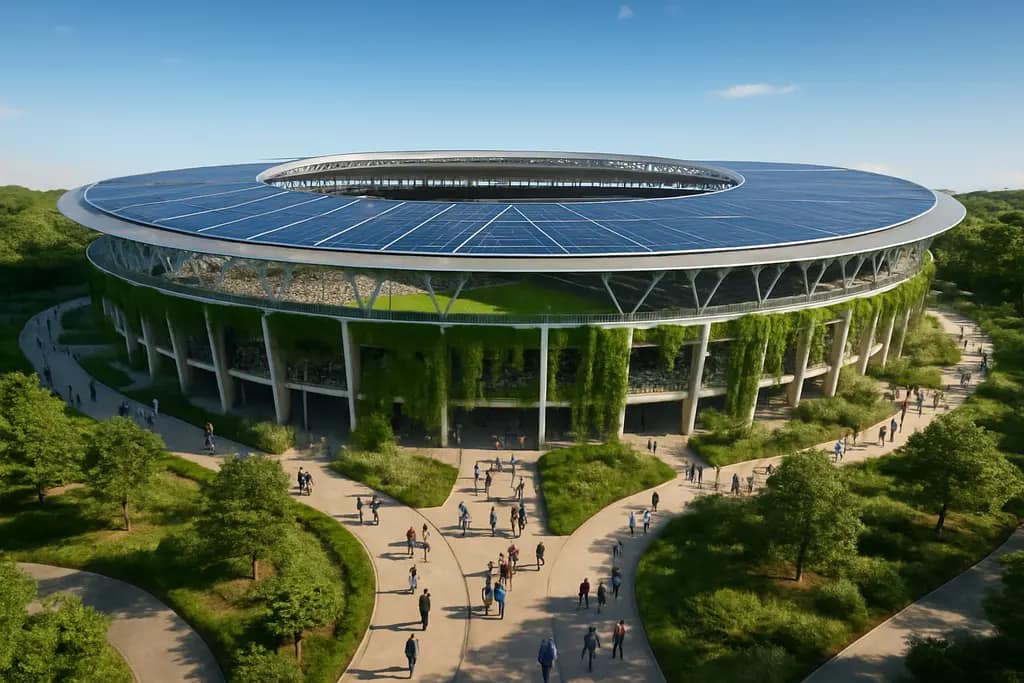
By August 20, 2026, the 2026 FIFA World Cup had shifted from a future planning test to a completed case study in World Cup Infrastructure. The tournament, staged from June 11 to July 19, 2026, did not answer every sustainability question in global sport. It did, however, give venue operators, federations, and host cities a clearer record of what certified stadium upgrades can do, and where climate risk still presses hard against match operations.
The sustainability story was not only about new technology. Much of it came from less glamorous systems: water fixtures, lighting, waste sorting, roof design, solar installations, and heating and cooling upgrades. These are not side issues for soccer. They affect player safety, fan comfort, event cost, venue legacy, and the credibility of mega-event sustainability claims.
The evidence available from the tournament points to progress, especially among stadiums that earned green building certification before matches began. It also points to a caution: certification and retrofit work can reduce a venue’s footprint, but they do not erase the environmental impact of a 48-team, 104-match event spread across three countries.
World Cup Infrastructure And Certified Venues
World Cup Infrastructure Metrics That Matter
As of June 6, 2026, 13 of the 16 stadiums selected for World Cup 2026 matches had earned LEED certification, according to The Washington Post. That figure matters because it places environmental review inside the stadium program rather than treating sustainability as a marketing layer after construction or renovation.
The same reporting found that those 13 certified venues collectively installed more than 11,500 solar panels, were projected to save more than 100 million gallons of potable water each year, and were set to eliminate more than 5 million single-use plastic items annually through operational changes. Four venues also achieved near-total waste diversion, meaning they reused, recycled, or composted nearly all waste produced.
The World Cup Infrastructure story is strongest where the numbers connect directly to stadium operations. Water savings reflect fixtures and building systems that can remain in place after the tournament. Solar panels can keep contributing beyond one month of matches. Plastic reduction and waste diversion are harder to judge from a distance because they depend on procurement, staffing, vendor behavior, and fan compliance, but the reported figures show that several venues had moved beyond pilot programs.
What LEED Does And Does Not Prove
LEED certification is useful evidence, but it should not be treated as a full environmental scorecard for the event. It speaks to building performance and operational practices. It does not, by itself, measure all emissions linked to team travel, fan travel, freight, broadcast operations, temporary installations, or security logistics.
For a sports sustainability assessment, that distinction is essential. A certified stadium can still host an event with a large total footprint. Yet it is also true that many of the improvements reported for 2026 were not temporary. High-efficiency lighting, heating and cooling systems, water-saving fixtures, and waste programs can reduce the baseline impact of future NFL, MLS, college football, concert, and international soccer events at the same venues.
Retrofits Over New Builds
Older Venues As Sustainability Assets
One of the more practical lessons from the 2026 tournament was the use of existing stadiums. Retrofitting an established venue can avoid some of the material and land-use burdens associated with building from scratch, though the exact environmental benefit depends on the scale of renovation and the systems replaced.
Estadio Azteca in Mexico City showed how an older venue could be pulled into a modern sustainability program. Opened in 1966 and listed at 87,500 seats in the research record, it reached the highest tier of LEED certification in October 2025 after major retrofits. The reported upgrades reduced indoor water use by 36% and energy use by nearly 45%, while also improving lighting, HVAC, seating, accessibility, and electrical systems.
AT&T Stadium in Arlington, Texas, earned LEED Gold certification in March 2026 after investing more than US$7 million in high-efficiency heating and cooling, water fixtures, sustainable lighting, and other energy-saving upgrades. MetLife Stadium in East Rutherford, New Jersey, which hosted the Final on July 19, 2026, achieved LEED Gold certification in May 2026, with work tied to solar power usage, efficient lighting, electric and hybrid vehicle access, and waste diversion programs.
The Cost Question Behind Refurbishment
Refurbishment is not automatically low-impact or low-cost. Arrowhead Stadium underwent a US$375 million refurbishment over about three years to modernize amenities and structurally adapt the venue for World Cup matches. That scale shows why sustainability analysis has to ask what was changed, how long the upgrades will last, and whether the venue will keep using the systems after FIFA operations leave.
From a performance standpoint, these retrofits were not only environmental measures. Better HVAC, lighting, seating, access, and electrical capacity also affect crowd movement, broadcast reliability, hospitality areas, and athlete support spaces. That is where sustainable sports infrastructure becomes more persuasive: the strongest projects serve environmental goals while improving the venue’s everyday function.
Heat, Roofs, And World Cup Infrastructure
Climate Risk Became A Match Operations Issue
Heat was not an abstract concern during the 2026 event window. Climate Central reported that, for the June 11 to July 19, 2026 match period, organizers used mandatory hydration breaks at all 104 matches and scheduled more evening kickoffs in hotter cities; it also found that 14 of 16 stadiums now experience significantly more “extreme hot days” than they did in 1970, according to Climate Central.
That finding connects sustainability directly to player welfare. Hydration breaks are a match-management tool, not a building retrofit, but their use across every match showed that the tournament treated heat as a structural risk. For a narrower stadium-design angle, CadCamNet’s analysis of World Cup heat data and player safety fits the same question: how much can infrastructure reduce climate stress before rules and scheduling have to compensate?
Roofs, Climate Control, And Trade-Offs
Several venues used design features intended to reduce exposure to weather and heat. Four venues were fully enclosed with roofs, including BC Place in Vancouver. AT&T Stadium had an operable roof and full climate control. SoFi Stadium in Los Angeles used a canopy-style roof and open-sided bowl design suited to its milder climate while offering partial protection.
These design choices show why World Cup Infrastructure cannot be judged by one model. A fully enclosed venue may help manage heat and weather, but climate control can draw energy. An open-sided design may reduce some mechanical cooling needs, but it leaves more exposure to local conditions. The better question is not which type is universally best, but whether the design matches the local climate, match schedule, and long-term use of the stadium.
Operational Sustainability Beyond The Matchday

Waste, Water, And Procurement Discipline
The tournament’s reported water and waste figures suggest that operational discipline was a central part of the sustainability plan. Saving more than 100 million gallons of potable water annually across certified venues is not a single matchday achievement. It depends on fixtures, maintenance, monitoring, and staff practices that keep savings active after the tournament.
Plastic reduction is similar. Eliminating more than 5 million single-use plastic items per year sounds meaningful, but the quality of that result depends on what replaced those items. Reusable systems, compostable service ware with real composting access, and reduced packaging each have different impacts. The research supports the scale of the reduction, but it does not provide enough detail to rank the replacement systems.
- Strong evidence: LEED certifications, solar panel counts, water savings projections, and reported venue upgrades.
- Evidence needing more detail: full event emissions, fan travel impacts, and the exact environmental profile of plastic replacements.
- Lasting value: upgrades that remain useful for league matches, concerts, and community events after July 19, 2026.
Sports Tourism And The Wider Event Footprint
Stadiums are only one part of a mega-event footprint. Travel, lodging, food service, and local transport shape the broader environmental cost. Readers interested in comparing regional sports and travel insights will find Bass Lake Roadhouse part of the same network offering comprehensive coverage, with the main sustainability focus here being on the stadium and event infrastructure utilized for World Cup matches.
The cautious reading is that certified venues helped reduce some fixed impacts, while the tournament format still carried major travel demands. The available research does not provide a complete post-event carbon accounting, so any claim that the 2026 World Cup was broadly sustainable would go beyond the evidence. A better claim is narrower: several host venues made measurable building and operations upgrades tied to water, energy, waste, and heat management.
2026 World Cup Infrastructure Takeaways
What Sports Planners Can Use Next
If World Cup Infrastructure has a lesson for future tournaments, it is that sustainability works best when it is attached to venue performance. Solar generation, efficient lighting, water savings, climate-responsive roofs, and waste diversion are not decorative features. They are operating systems that affect cost, safety, and the spectator experience.
The 2026 record also shows the need for restraint in public claims. LEED-certified stadiums and water-saving retrofits are real progress. Mandatory hydration breaks and evening kickoffs show practical adaptation to hotter conditions. Yet the event’s full environmental picture cannot be reduced to stadium certification, especially when a World Cup moves teams and supporters across a continent.
For venue owners, the most durable takeaway is to design sustainability measures for regular use, not for one tournament deadline. For governing bodies, the lesson is to publish enough data after the event for outside review. For fans and analysts, the key is to separate measurable infrastructure gains from broad claims that remain unproven. That is where the 2026 FIFA World Cup left its most useful sports sustainability record: not perfect, not symbolic, but specific enough to guide the next set of stadium decisions.