
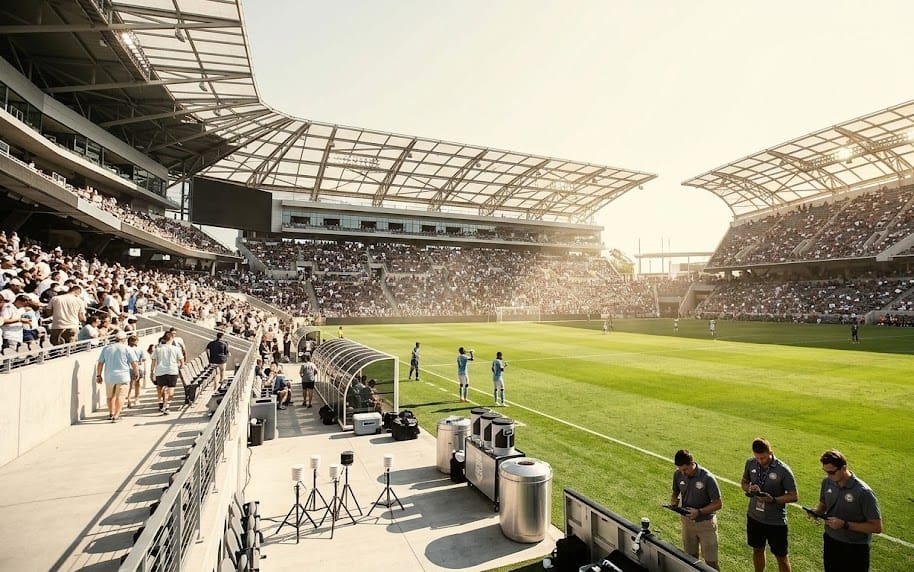
The 2026 FIFA World Cup is making stadium design feel less like a background issue and more like a player safety system. Across the United States, Canada, and Mexico, the tournament’s June 11 to July 19 calendar has placed elite soccer inside peak-summer conditions, forcing organizers, architects, venue operators, medical teams, and broadcasters to think about heat as part of match infrastructure, not just match weather. FIFA’s official World Cup schedule stretches across 104 matches and 16 host stadiums, which means heat risk is not uniform. A covered stadium in one city, an open-air venue in another, a late kickoff in a humid market, and a daytime match in a high-exposure fan zone can all create different safety demands for the same tournament.
That is why heat data has become one of the most important design conversations of this World Cup. Temperature alone does not explain what players feel on the field. Humidity, solar radiation, wind, playing surface temperature, stadium shade, concourse airflow, roof structure, seat exposure, pitch ventilation, and recovery access all shape how a venue performs under stress. For cadcamnet.com, the sports story is not only that players need water. The bigger issue is that modern stadiums are being judged by how well their design can read, reduce, and respond to heat before it becomes a competitive or medical problem.
Why Heat Data Is Now Part Of Stadium Performance
FIFA had already moved player welfare into the tournament structure before the first match by introducing three-minute hydration breaks in each half. The rule places stoppages around the middle of each half so players can rehydrate during a World Cup played across North America’s summer window. FIFA presented the policy as a player-welfare measure for a tournament hosted by Canada, Mexico, and the United States, and president Gianni Infantino later said the breaks were also meant to create equal conditions across matches.
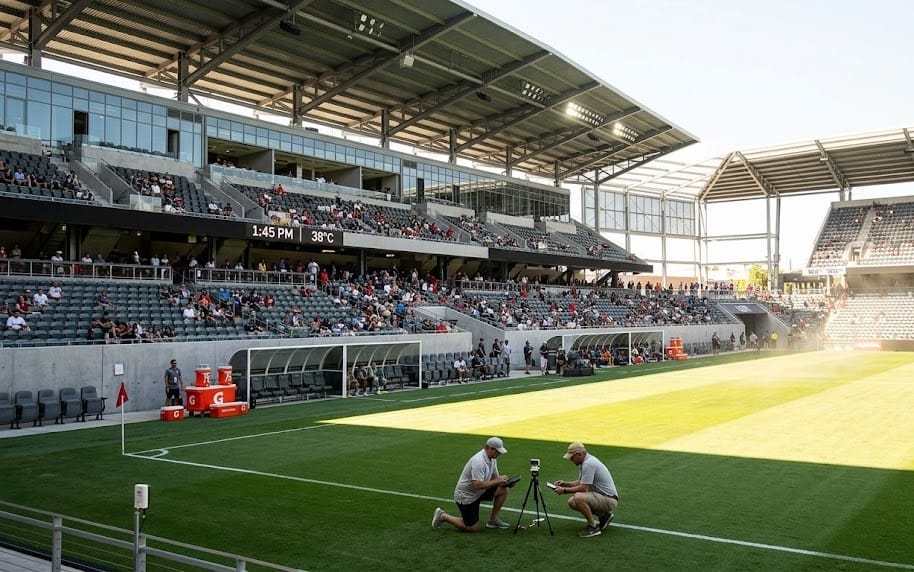
The design question starts where the rule stops. Hydration breaks are a response mechanism. Stadium design is the preventive layer. A venue that traps heat around the lower bowl, leaves benches exposed to direct sun, provides limited shaded recovery zones, or forces fans through hot concrete corridors can increase the workload placed on medical and operations teams. A venue with better airflow, more shaded circulation paths, better cooling stations, and stronger real-time monitoring can reduce that load.
That is why wet-bulb globe temperature, often shortened to WBGT, has become more useful than a standard air-temperature reading. WBGT considers heat, humidity, wind, and sun exposure, giving sports medicine teams a better view of the actual thermal stress on athletes. The Guardian reported on June 30, 2026, that nine World Cup group-stage matches had been played in potentially dangerous heat, using WBGT readings as the basis for evaluating risk. The report also noted that FIFA had used hydration breaks, weather monitoring, cooling supplies, and meteorologists at venues, but player-union concerns remained around whether match timing and venue conditions were being managed strongly enough.
For stadium planners, that shifts the conversation from “Is the stadium ready to host?” to “Is the stadium ready to host safely at this specific hour, under this specific heat profile, with this crowd size and match intensity?”
How U.S. Venues Turn Heat Into A Design Problem
The United States has several World Cup venues where summer heat is not a surprise. Dallas, Houston, Miami, Atlanta, Kansas City, Philadelphia, Boston, New York/New Jersey, Seattle, Los Angeles, and the San Francisco Bay Area all bring different weather patterns, building types, and fan-flow pressures. Climate Central’s May 2026 analysis found that extreme heat is rising at nearly all 2026 World Cup stadium locations, with 14 of the 16 host stadiums now seeing more extremely hot June-July days than during the first North American World Cup period in 1970. It also identified Dallas, Houston, Miami, and Monterrey as venues where humid heat levels can regularly reach player-risk thresholds.
That kind of data matters because World Cup venues are not identical buildings. Some NFL stadiums have roofs, retractable roofs, or large enclosed systems that can mitigate direct exposure. Others rely more heavily on open-air layouts, shaded seating distribution, concourse design, and match scheduling. In practical terms, a design team has to think about how heat moves through the entire venue footprint.
For players, the priority zones are the pitch, benches, tunnels, locker rooms, warm-up areas, and recovery spaces. For fans, the priority zones include entry gates, queues, upper-deck seating, transit approaches, fan zones, restrooms, medical stations, and concession lines. For staff and media, heat exposure can hit security lanes, camera positions, broadcast compounds, parking operations, and field-level work zones.
This is where CAD, BIM, and sports-facility modeling become part of the safety conversation. Architects and venue engineers can model sun paths, shade movement, seating exposure, airflow corridors, cooling-station placement, and emergency access routes before an event begins. During the tournament, real-time heat data can show whether those assumptions match actual conditions. The best venues will not treat heat as a weather inconvenience. They will treat it as an operational design variable.
Why Hydration Breaks Are Only One Layer Of Player Protection
Hydration breaks are visible because they interrupt the match. Stadium design is less visible because it works before the whistle. That is the key distinction. A three-minute break helps players rehydrate, cool down, receive quick medical attention, and reset physically. It does not, by itself, change the surface temperature, remove direct sun from a bench, lower humidity, or improve airflow in a crowded lower bowl.
Nature reported on July 6, 2026, that hydration breaks have become a major scientific and sporting debate during the tournament, with questions around how cooling strategies should be timed and whether broad rules can fully match local conditions. The issue is not whether player welfare matters. The issue is whether a universal stoppage is precise enough for venues with different heat profiles.
A stronger stadium-safety model would combine several layers:
| Safety Layer | Stadium Design Question | Match-Day Impact |
|---|---|---|
| Heat Monitoring | Where are WBGT sensors placed and who reads them? | Better decisions on breaks, delays, and medical readiness |
| Shade And Roof Design | Which seats, benches, and queues are exposed? | Lower direct sun exposure for players, fans, and workers |
| Cooling Infrastructure | Where are misting, ice, water, and cooling zones located? | Faster recovery and fewer crowd-stress points |
| Airflow And Ventilation | Does the bowl trap heat or allow circulation? | Better comfort and lower field-level heat buildup |
| Scheduling Coordination | Which venues face the highest afternoon risk? | Safer kickoff planning and fewer avoidable exposure windows |
The practical lesson is that player safety cannot be assigned only to referees and medical staff. It has to be built into the venue. If heat data shows that one sideline receives more direct sun, if the warm-up zone is hotter than the pitch, or if a tunnel becomes a trapped-air corridor, those are design and operations problems as much as they are sports medicine problems.
How Stadium Design Affects Fans, Workers, And Match Rhythm
The heat story is often framed around elite athletes, but World Cup venues carry a much wider safety responsibility. FIFA has promoted the 2026 tournament as the biggest World Cup ever, and its own tournament materials point to the scale of a 48-team, 104-match event across three countries. Large crowds make heat management more complex because every queue, concourse, transit delay, and fan-zone gathering can become part of the risk map.

A stadium can have a safe field-level plan and still face trouble if fans spend too long in unshaded security lines. Workers can face exposure before gates open while setting up concessions, broadcast equipment, sustainable sports equipment signage, hospitality areas, media workstations, and emergency routes. Broadcast crews and photographers may work in fixed positions that are hotter than public seating areas. Medical teams need access lanes that remain clear even when crowds move toward shaded concourses.
This is why stadium design now has to include crowd heat behavior. Fans do not move evenly during hot conditions. They cluster near shade, water, bathrooms, indoor concourses, and exits. That can create pressure at exactly the locations that need to stay open. A venue that models these patterns can place hydration points, cooling areas, and staffing more intelligently.
The issue also affects match rhythm. Hydration breaks can become tactical reset points for coaches, especially in high-intensity knockout matches. Fans and analysts may discuss how these stoppages change momentum, substitution timing, and pressing patterns. Broader fan communities, including TheRX Offshore Sportsbooks, may discuss how heat, stoppages, and venue conditions shape the way matches are watched and interpreted, but the sports-first lesson is operational: player safety rules now influence the pace and structure of the event.
For cadcamnet.com’s audience, that makes this a design-and-systems issue. Stadiums are not passive containers. They are active environments that can either reduce or amplify match stress.
Why Future Stadium Projects Will Need Heat-Ready Design Standards
The 2026 World Cup is likely to leave a design lesson for future stadium renovations in the United States. Climate Central’s research shows that extreme heat trends are not limited to one event or one city. If summer tournaments, preseason soccer tours, college football kickoffs, high school championships, outdoor concerts, and international matches keep using major U.S. venues, heat-ready design will become a standard expectation rather than a special-event upgrade.
That could influence how architects and operators approach several parts of future sports projects. Roof geometry may be evaluated not only for aesthetics and crowd noise, but also for shade coverage and heat retention. Concourse widths may be studied for airflow and crowd cooling, not just concession revenue. Seating bowls may be modeled with sun exposure maps. Player tunnels, benches, and warm-up spaces may require better cooling access. Parking lots, transit walks, and fan plazas may need shade structures and water access built into the first design phase.
Fast Company reported in early July 2026 that sports architects are already thinking about how World Cup venues can adapt to hotter conditions, with high-risk host cities pushing the discussion beyond temporary tournament operations. The article pointed to the role of design adaptation as sports venues face more frequent heat-risk days.
That matters because retrofitting heat protection is often more difficult than designing it from the beginning. Temporary tents, portable cooling units, and bottled-water stations can help, but permanent solutions are more reliable. Shade structures, ventilated concourses, reflective materials, heat-aware landscaping, emergency cooling rooms, and sensor networks can become part of a stadium’s core safety system.
The most advanced venues will likely connect design models with operational dashboards. A stadium could use historical weather data, real-time sensors, ticketing flow, seat exposure maps, and medical-call trends to decide where to deploy staff before a problem appears. That is where the future of stadium safety looks less like a manual checklist and more like a live design feedback loop.
What Sports Facility Designers Should Take From The 2026 Heat Debate
The lesson from the 2026 World Cup is not that every stadium needs the same roof, the same cooling system, or the same kickoff policy. The lesson is that player safety now depends on how well a venue understands its own heat profile. A stadium in Miami Gardens does not face the same design challenge as one in Seattle. Dallas does not operate like Vancouver. Houston’s humidity is not the same as Kansas City’s afternoon exposure. The strongest facilities will be the ones that treat those differences as design inputs.
For sports facility designers, that means heat data should be part of early planning, not a late operations memo. Site orientation, bowl geometry, field-level ventilation, shade patterns, concourse circulation, cooling infrastructure, and fan-flow modeling all belong in the same conversation as capacity, sightlines, premium seating, and broadcast readiness.
For teams and tournament organizers, the 2026 World Cup shows why venue selection can no longer be based only on size, market value, transportation, and prestige. A stadium’s ability to protect players, fans, workers, and media in extreme conditions is part of its competitive quality.
For fans, the visible sign may be a three-minute hydration break. For designers, the bigger signal is hidden in the data. Heat is now a stadium performance metric, and the venues that learn from this World Cup will be better prepared for the next generation of summer sports events.