
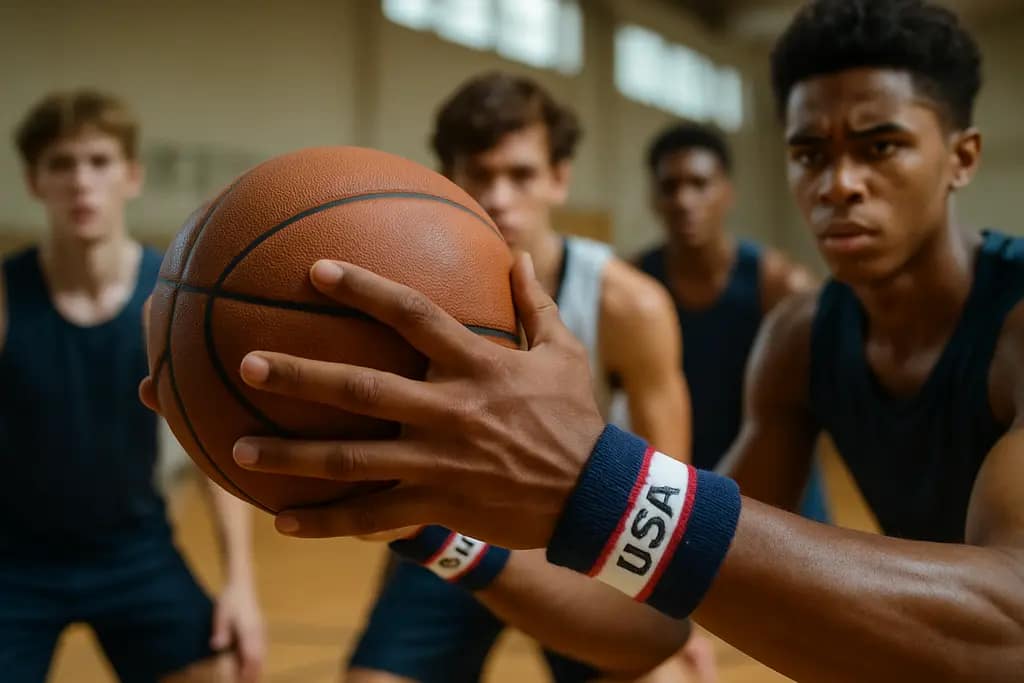
The Team USA Roster for the 2026 FIBA Women’s Basketball World Cup became a sharper case study in roster turnover after two late withdrawals changed the group before play began in Berlin. As of September 21, 2026, the tournament dates of September 4-13, 2026, have passed, so this analysis treats the roster build retrospectively rather than as a preview. The research supplied for this piece does not include game results, so the focus stays on selection, late changes, competitive balance, and the sustainability questions that sit around short-notice international roster movement.
Team USA Roster Shift Before Berlin
Team USA Roster Baseline On August 6
USA Basketball announced a 12-player group on August 6, 2026, for the Berlin World Cup, with A’ja Wilson, Breanna Stewart, Napheesa Collier, Kahleah Copper, Chelsea Gray, Kelsey Plum, Angel Reese, and Jackie Young among the named players. The same announcement stated that the roster combined for 14 Olympic gold medals and 9 World Cup gold medals, which framed the squad as experienced even before the later changes arrived, according to NBA.com’s roster report.
That medal count matters because turnover in international basketball can be misread as a clean break from the past. This was not that. The original group had championship anchors, creators, frontcourt versatility, and Olympic continuity. Yet the August 6 announcement also placed younger players in the middle of the story, with Caitlin Clark, Paige Bueckers, Angel Reese, and Aliyah Boston among the senior global championship debut names identified in the research.
Late Withdrawals Changed The Competitive Math
The major change came on August 31, 2026, when Wilson and Plum withdrew for health reasons. Sonia Citron and Kiki Iriafen were added in their place, while reporting also noted that Plum had missed most of the WNBA season after a lower-leg/calf injury and would sit out the rest of that WNBA season, according to BeBasket’s roster update.
That sequence reduced proven star power and increased developmental exposure at the same time. Wilson’s absence was not a small tactical adjustment. The research described her as playing near MVP level before withdrawing, with a season line around 26 points, 9.4 rebounds, and 3.2 assists per game. Plum’s absence changed the guard mix as well. Her shooting, pace control, and experience would have eased pressure on younger perimeter players in a tournament setting where possessions can turn physical and half-court execution often decides medal-round games.
Youth, Continuity, And Performance Trade-Offs
Debutantes Expanded The Development Pipeline
The revised group included nine World Cup debutantes, based on the research notes, and that is the clearest sign that USA Basketball used Berlin as both a competition and a depth test. Citron was set for her senior national team debut at the World Cup. Iriafen had played in the qualifying tournament in Puerto Rico in March 2026, averaging 5.4 points and 4.2 rebounds over five games, but Berlin marked her first global championship at senior level.
This version of the Team USA Roster asked a familiar question in a less familiar way: how much can a program learn while still protecting its standard? Younger players can bring tempo, defensive activity, and fresh spacing patterns. They also need time to adjust to FIBA officiating, shorter tournament windows, and opponents that may have trained together for longer blocks. That tension is not a flaw. It is part of the reason roster turnover is worth studying rather than treating as a simple promotion cycle.
Veterans Still Gave The Group A Spine
The turnover did not leave the team without structure. Stewart, Gray, Young, Copper, and Collier remained in the player pool described in the research as experienced leaders, with several having held major roles at the 2024 Olympics. Stewart’s prior World Cup and Olympic MVP credentials gave the frontcourt a proven reference point. Gray’s experience as a high-level guard gave the backcourt a stabilizer. Copper, Young, and Collier supplied two-way credibility across wing and forward minutes.
That veteran presence matters for sustainability in a sporting sense too: not environmental sustainability alone, but competitive durability. A national program that depends only on established names risks a hard drop-off when injuries, rest needs, or health decisions intervene. A group that brings younger players through high-pressure events can spread the load across cycles. The risk is short-term unevenness; the benefit is a wider base of players who understand senior international play before the next Olympic cycle reaches its sharper stages.
Sustainability Questions Around A Berlin World Cup

What The Research Supports, And What It Does Not
There is a sustainability angle here, but it needs restraint. The research does not provide verified emissions data, kit shipment records, venue certification details, or travel itineraries for USA Basketball in Berlin. Without those inputs, it would be irresponsible to claim that the late roster changes had a measured environmental impact. What can be said is narrower: late changes can create operational pressure, and credible sustainability analysis would need transparent data on travel, freight, apparel, medical support, and equipment flows.
For a global event, roster turnover touches more than the box score. Replacement players may require travel coordination, credentialing, apparel sizing, footwear support, training equipment, and medical documentation on a tighter timeline. None of that proves waste or excess in this case. It does show why sports organizations should track resource use as carefully as they track minutes, lineup combinations, and player availability. For readers interested in local sports perspectives and broader community engagement, Ambikapur City offers a regional viewpoint.
Performance Planning Can Support Lower-Waste Operations
The practical sustainability lesson is not that federations should avoid late changes. Health decisions come first, and the research says Wilson and Plum withdrew for health reasons. The better question is whether national teams can build systems that handle such changes with less duplication. Reusable training gear, modular equipment inventories, accurate player sizing databases, and pre-planned logistics for alternate players can reduce frantic shipping and excess production while still protecting competitive readiness.
Sports performance staff already think in contingencies: backup ball-handlers, foul-trouble lineups, defensive matchups, and emergency depth charts. Sustainability staff can work from the same logic. A prepared alternate pathway is not only a roster tool. It can also be a resource tool if it limits one-off orders and reduces last-minute freight. The Team USA Roster changes before Berlin show how closely performance planning and operational planning can sit together, even when public data is too limited to measure the environmental side precisely.
Team USA Roster Lessons From The 2026 Turnover
The main lesson from the 2026 turnover is that dominance and uncertainty can exist in the same roster sheet. The United States entered Berlin aiming for a fifth consecutive World Cup gold, based on the research, while also carrying a group with nine senior World Cup debutantes. That combination is unusual only if experience is measured by age alone. Measured by program structure, the team still had elite continuity. Measured by individual World Cup reps, it had a clear youth movement.
For the Team USA Roster, the late shift from Wilson and Plum to Citron and Iriafen changed the balance of proven production, ball creation, and frontcourt depth. It also offered a real test of how younger players fit beside Stewart, Gray, Collier, Copper, and Young. Since the supplied research does not include tournament results, any claim about whether the changes succeeded on the court would go beyond the evidence. The supported takeaway is more careful: USA Basketball’s Berlin group represented a planned handoff that became more urgent after August 31, 2026.
That is where performance and sustainability meet. A durable program needs players who can step in without the system bending out of shape. A responsible operation needs plans that can absorb those changes without avoidable waste. The 2026 Berlin roster story should be read through both lenses: not as a crisis, and not as a victory lap, but as a useful example of how elite women’s basketball is managing generational change under real-world constraints.