
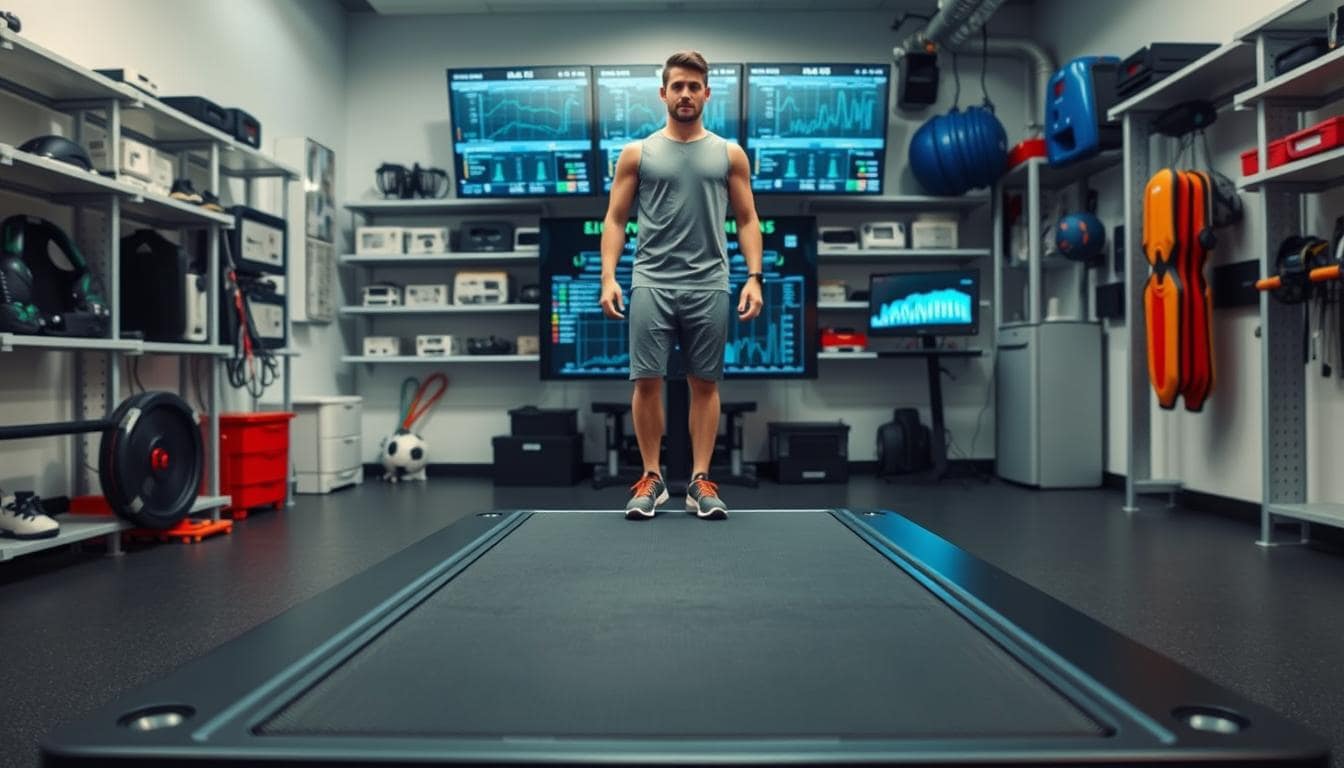
Welcome to the world of force plate integration. It’s where science and art come together. Every step you take is analyzed with great detail. These systems are not just about numbers; they help us understand movement in a way that can change performance and health.
Force plates are the hidden gems of biomechanics. They measure the total force exerted during activities. But there’s more! By adding pressure mapping, we get to see the detailed dance of foot dynamics. This technology lets us look at forces on different parts of the foot, giving us insights that old methods can’t.
Ever wondered how athletes get that perfect stride? Or how we can better balance and walk? These systems can help answer those questions. Tekscan’s solutions make exploring data easy and fun. You can use mats, walkways, or in-shoe sensors to see endless possibilities.
Are you ready to explore the future of movement analysis? Find out how pressure mapping works with force plate data. Together, they offer a powerful tool for athletes, researchers, and health professionals.
3D motion capture technologies
The world of 3D motion capture has changed how we see and improve sports. These biomechanical measurement systems use many cameras to track athletes’ movements in 3D. It’s like having every step and jump recorded in detail. This is the future of sports biomechanics.
Motion capture systems have made it easier to analyze how athletes move. They look at every angle and movement. It’s like getting a detailed report on your athletic skills.
Imagine the tech from *The Lord of the Rings* helping athletes avoid injuries. Athletes are eager to use this tech. It’s because knowing how you move can make all the difference.
But, the data can be tricky to interpret. It’s like a politician’s promise. The real value is in understanding how you can move better.
| Technology | Application | Benefits |
|---|---|---|
| Optical Motion Capture | Sports Performance Analysis | High accuracy in tracking movements |
| Markerless Motion Capture | Injury Prevention | No need for physical markers on the athlete |
| Wearable Sensors | Real-time Feedback | Immediate data for performance enhancement |
For more insights on sensor technology, check out this article. It explores how these advancements are changing biomechanics.
Force plate integration systems
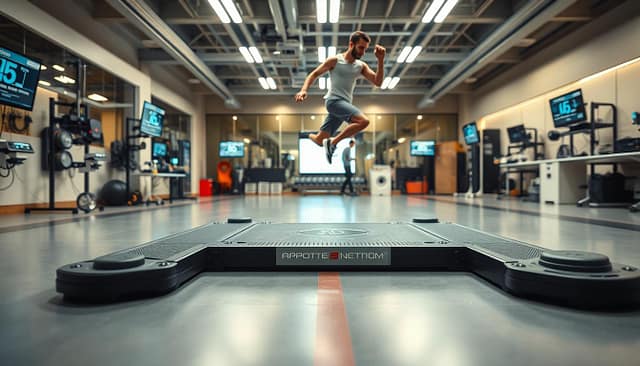
3D motion capture is like the main event, but force plates are the unsung heroes. They’re platforms in the ground that measure forces during activities. Every move, from standing to sprinting, is tracked with great detail.
Ground reaction forces are vital for understanding athlete performance. We often focus on vertical leap numbers, seeing them as a measure of athleticism. But, the real story is in the complex force patterns that can lead to injuries.
Force plates show us the true physics of sports. In a world that loves to measure everything, they provide a reality check. They remind us that every action has a reaction, which can be harmful.
Adding force plate data to biomechanical measurement systems improves motion analysis. Coaches and athletes can make better decisions with this data. So, the next time you see an athlete leap, think of the force plates working hard beneath their feet.
Inertial measurement unit applications
Traditional training methods are now outdated. We’re in the era of precision with inertial measurement units (IMUs). These wearable devices are not just fancy gadgets. They are changing how we view biomechanical measurement systems.
IMUs have sensors like accelerometers and gyroscopes. They capture every detail of movement. This lets us analyze performance in ways we never thought possible.
Imagine wearing a small chip that tracks your movement. It’s like having a personal coach always with you. Here are some key uses of IMUs:
- Sports Performance Analysis: Athletes can see how they move, helping them improve.
- Injury Prevention: IMUs spot risk factors for injuries like shin splints.
- Rehabilitation: Physical therapists use IMUs to track recovery and adjust plans.
- Research and Development: Engineers and scientists use IMUs to study human biomechanics.
In today’s world, data is king. We can collect huge amounts of movement data. But, we must remember the importance of human intuition and grit. These aspects of performance are hard to measure.
As technology becomes more available, IMUs are helping both elite athletes and weekend runners. This shows our growing interest in data. For more on biomechanics hardware, see this resource.
Computer vision for movement analysis
Imagine a world where machines analyze every movement with the precision of a seasoned coach, thanks to computer vision. This technology is not just a fancy gadget; it’s a game-changer in sports biomechanics. High-speed cameras capture actions at lightning speeds, analyzing movements down to the hundredths or even thousandths of a second. We no longer rely solely on markers that turn athletes into Christmas trees of reflective dots.
With computer vision, we enter the future of biomechanical measurement systems. It’s like the VAR of biomechanics—an unbiased observer that never blinks or gets distracted. But, just like any good referee, it’s only as reliable as the algorithms and training data behind it. A single poorly lit frame can send the system spiraling into a world of misinterpreted joint angles.
This reality highlights a key point: while markerless, real-time analysis is enticing, the technology must handle the unpredictable chaos of human motion. It’s like the difference between a political speech crafted by a focus group and an off-the-cuff town hall answer. One is polished but lacks authenticity, while the other is raw and real.
The best systems blend both approaches, providing insights that are enlightening and humbling. They remind us that, in the quest for precision, we must also embrace the beautifully messy nature of human movement.
Synchronization of multiple data streams
Synchronizing multiple data streams is like herding cats—it’s tough but needed for success. In Biomechanical Measurement Systems, combining wearable tech and real-time performance tracking is key. But getting everything to sync up can feel like trying to set a meeting time with a bunch of academics.
Think of force plates, IMUs, EMG, and video cameras all working on their own. It’s like a jazz band without a conductor, with each musician playing their own song. The real challenge is not just the hardware but making sure everything works together smoothly.
This problem can be as tough as getting a political campaign to agree on messages. One wrong timing can ruin everything. But when it works, it’s amazing—a perfect blend of data showing how our bodies move.
In today’s world, syncing data isn’t just about tech—it’s about order in chaos. Without it, you get a lot of expensive noise instead of useful insights in motion analysis.
Biomechanical modeling software
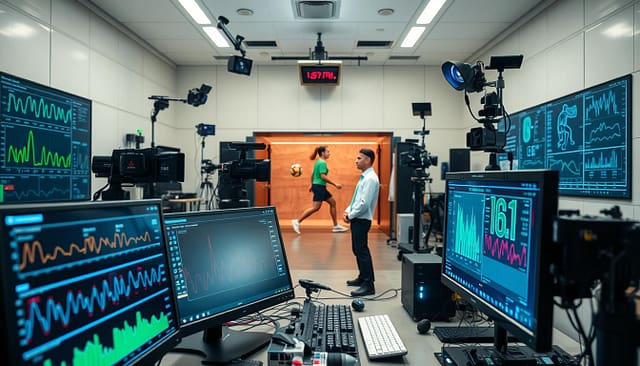
Imagine a digital athlete ready for testing without harm. Biomechanical modeling software makes this possible. It lets us simulate movements and analyze them closely. These tools help us understand athletic performance better and create personalized training plans.
With machine learning models, we can analyze biomechanical metrics in real-time. This tech creates personalized treatments based on individual needs. It’s like a virtual puppet, where we can tweak settings and see how the athlete reacts safely.
But, these models are only as accurate as their assumptions. Predicting human behavior is like forecasting the stock market. Elegant equations fail when faced with human unpredictability. For example, simulations might suggest a sprinter could break a record with a small hip angle change. But, athletes are not just machines.
When these models are matched with real data, they become invaluable. They let us explore “what if” scenarios without harming athletes. The future of sports science isn’t about replacing coaches with algorithms. It’s about giving them a tool that, while sometimes unclear, is better than guessing.
| Biomechanical Software Features | Benefits | Limitations |
|---|---|---|
| Dynamic Analysis | Real-time feedback on performance | Dependent on quality of input data |
| Customizable Simulations | Tailored training programs | Requires extensive knowledge to operate |
| Integration with Other Technologies | Comprehensive performance insights | Potentially high costs |
Accuracy validation protocols
Before you buy the latest biomechanical gadget, let’s talk about accuracy. In the fast world of sports biomechanics, validation is key. It’s what makes measurements trustworthy.
What’s the use of a new device if it’s not accurate? Without solid validation, we’re left with empty claims. A strong validation framework is vital for several reasons:
- Reliability: Makes sure data is consistent in different situations.
- Clinical Relevance: Shows that findings work in real life, not just labs.
- Comparative Analysis: Checks results against top-notch lab equipment to see how they stack up.
It’s tempting to get excited about fancy features. But the real test is how these systems perform in real life. I’ve seen claims of 99% accuracy in detecting fatigue. But these were tested on just three people in a lab, sitting down. It’s like a poll that only asks the candidate’s family.
True validation means testing tech in real-world settings. It’s about comparing it to known standards and testing it with different athletes in various conditions. This isn’t just busywork; it’s a chance to prove our tech’s worth. Without solid validation, biomechanical measurement systems become just pseudoscience.
In today’s world of deepfakes and fake news, we need rigorous validation more than ever. So, when a vendor shows you a cool dashboard, ask for the Bland-Altman plots. If they hesitate, it’s time to leave.
Clinical vs. field-based measurements
Imagine stepping from a lab into the chaos of a sports field. That’s where the real debate starts. In the world of biomechanical measurement systems, we face a choice between lab precision and field conditions.
In a lab, everything is controlled. The lighting is perfect, the temperature is just right, and athletes perform with precision. But outside, the wind howls, opponents trash-talk, and fatigue hits hard. Those perfect biomechanical models? They’re like an etiquette guide in a food fight.
This tension shows a key point: lab measurements are precise, but field measurements are real-world. It’s like comparing a clinical drug trial to real-world use. What works in a lab often fails in real life.
Think about a pitcher’s mechanics. In a lab, they look flawless. But on the mound in the ninth with the bases loaded, it’s different. Smart teams use lab data to understand why and field data to see what really happens.
In this world of data, context is everything. Knowing the strengths and weaknesses of both lab and field measurements is key for motion analysis. This way, we can truly understand athletic performance.
Interpretation guidelines for coaches
You’ve got all the data from your Biomechanical Measurement Systems. The numbers look great, but what do they mean for your athletes? This is where interpretation comes in. It’s not just a skill; it’s key to coaching.
Imagine a coach looking at a screen full of graphs and metrics. The numbers can be too much. Should the athlete change their stride or focus on landing technique? Here, science meets intuition.
It’s not just about knowing a player’s knee abduction moment is high. You need to share this in a way that makes sense. Using simple language can help. Say, “Land softly, like you’re trying not to wake a sleeping baby.” This can make a big difference.
Coaches need to speak both biomechanics and everyday language. It’s about helping athletes move better and avoid injuries. This means using empathy, storytelling, and a bit of humor. The data is just a tool. It’s how you use it that matters.