
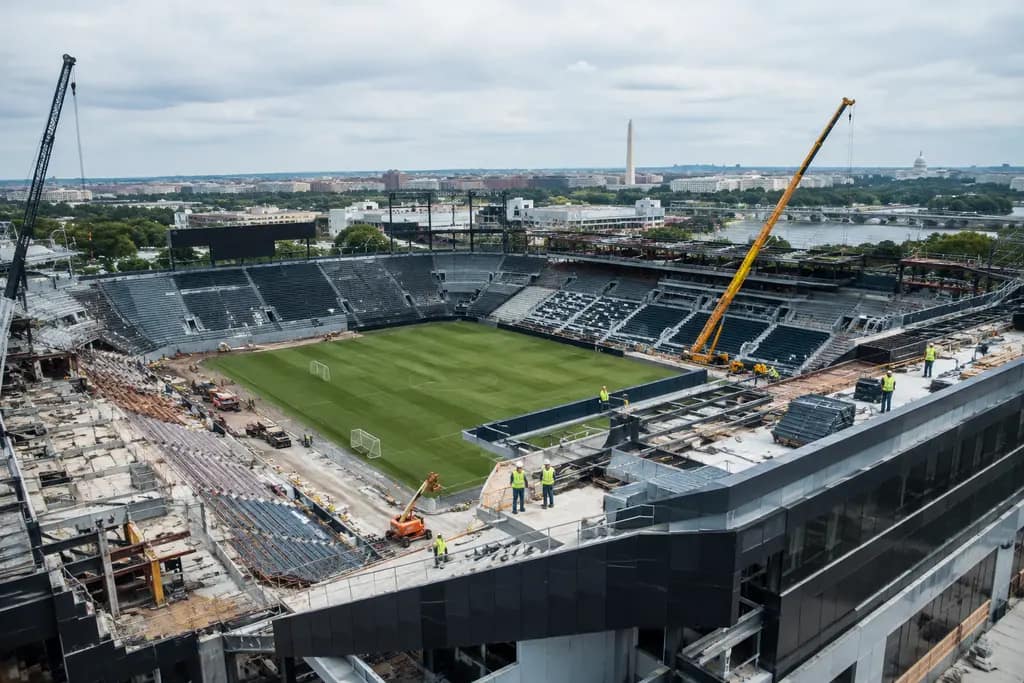
The Audi Field Renovation proposal has moved from a soccer-facility question into a broader test of public finance, venue sustainability, and Buzzard Point infrastructure. Introduced in July 2026, the plan would add a climate-controlled roof and expand Audi Field by roughly 8,000 seats, taking capacity from about 19,200 to approximately 28,000, according to WTOP reporting. That makes the project more than a D.C. United upgrade. It is a city planning decision tied to energy use, event density, transit pressure, housing, and whether public dollars are being assigned to the right sports assets at the right time.
The scale matters because Audi Field is not an aging bowl in need of basic survival work. It opened recently enough that the sustainability argument has to be sharper than “keep the team competitive.” A roof may improve match reliability, increase winter usability, and help the venue book concerts and other events. Yet those gains should be weighed against added cooling and heating demand, construction impacts, public cost, and the already tight access conditions around Buzzard Point.
Audi Field Renovation Funding Test
The financing structure is the first reason this proposal deserves close review. The wider package has been described as a $620 million public-private plan. D.C. United would contribute $320 million, while the District would commit $300 million in public funding, paid in $60 million annual installments over five years, as reported by Hoodline. That split is central to the debate: the club would carry a slightly larger share, but the public commitment would still be large enough to compete with other civic needs.
Audi Field Renovation Cost Split
The proposed public share is not presented as a single blank check. The research notes describe stadium-linked revenue streams, including ticket-tax surcharges, sales taxes on stadium-generated goods, naming rights, and sponsorships. The proposal also includes a “Soccer Stadium Preservation and Improvement Fund” for ongoing maintenance. From a sustainability perspective, that maintenance fund is worth watching. Buildings can become wasteful when major systems are neglected, and a dedicated funding path may reduce the odds that future repairs are deferred until they become more expensive and material-intensive.
Still, earmarked revenue does not erase the opportunity cost. D.C. has also been weighing large public commitments tied to Capital One Arena, a new Commanders stadium, and Nationals Park work. That context makes the Audi Field proposal part of a wider sports-infrastructure cycle rather than an isolated soccer question. For readers tracking how venue upgrades can strain or support public budgets, our related analysis of Nationals Park improvements raises a similar issue: durability, transit access, and public return matter as much as renderings.
A Roof Built For More Dates
The roof is the feature that connects sports performance with venue economics. MLS’s 2028 schedule change, which extends play into winter, gives D.C. United a stronger operational case for weather protection. A climate-controlled stadium could reduce weather-related disruptions and make the building more attractive for concerts and other events. The research notes cite a D.C. United-commissioned study projecting about 64 additional events per year after the roof and expansion, bringing the total to roughly 114 annual events.
That event-growth claim is useful, but it is not the same as proof of net public benefit. More event days can mean more local spending and more stadium revenue. They can also mean more nighttime traffic, more pressure on transit, more policing and sanitation needs, and more energy use. The right question is not whether Audi Field can be busier. It is whether the city can document that a busier Audi Field would be cleaner, safer, and more efficient than the alternative uses of the same public funds.
Infrastructure And Sustainability Questions
The infrastructure case is where the proposal remains least settled. Buzzard Point already faces event-day access limits because the stadium sits in a dense urban setting with constrained road capacity. Adding 8,000 seats and dozens of new events increases the need for clear answers on crowd movement, transit availability, utility capacity, curb management, and emergency access. A roof may protect spectators from rain and winter conditions, but it does not solve the street network outside the gates.
Traffic, Transit, And Utilities
For sports fans, the practical test is simple: can more people arrive and leave without turning the neighborhood into a gridlock zone? The proposal’s sustainability value depends heavily on mode share. If added attendance is mainly absorbed by private car trips, the project’s climate case weakens. If the city and team can shift more travel to Metrorail, buses, walking, cycling, and managed rideshare zones, the same expansion could put less strain on roads per attendee.
Utility systems deserve equal attention. A climate-controlled roof changes the building’s operating profile. Cooling, heating, ventilation, lighting, and event power demand could all rise, especially if the venue adds concerts and winter programming. The research notes do not identify a detailed carbon impact analysis or a clear energy-efficiency package in the initial bill drafts. That gap should be closed before public funding is locked in, not after construction begins.
Energy Use Is The Missing Metric
A sustainable stadium claim needs measurable targets. For this project, useful disclosures would include projected annual electricity use, heating and cooling assumptions, building-envelope performance, refrigerant plans, renewable-energy procurement, stormwater impacts, and construction-material estimates. Without those numbers, the Audi Field Renovation can be described as weather-resilient, but not yet as low-carbon.
There is also a difference between using a venue more often and using it more efficiently. A roofed stadium that hosts more events may spread embodied construction impacts over a larger number of users. That can be a defensible argument. But the math only works if the operating energy per event, travel emissions per attendee, and neighborhood impacts are measured and managed. Sports venues often sell year-round activity as public value. The evidence has to show whether that activity is cleaner and better organized than the status quo.
Sports Impacts For D.C. United And The Spirit

For D.C. United, the most direct benefit would be a larger, more weather-protected home venue. More seats can raise matchday revenue if demand holds, and a roof could improve the in-stadium experience during poor weather. The club also has a competitive operations reason to care: if MLS play extends deeper into winter from 2028, cold-weather comfort and pitch conditions become more significant. The Audi Field Renovation could help the team align its venue with that calendar shift.
The Washington Spirit also belong in the analysis. The research notes say the Spirit’s Audi Field lease is up in 2027 and that the club has pushed for protections such as dedicated locker rooms, signage, and lease certainty. Those requests are not side issues. If public money supports a soccer venue, the women’s professional tenant should not be treated as temporary decoration in a facility plan built around the men’s club. Construction disruption also needs a transparent match-relocation plan if any Spirit home games are affected.
There is a performance angle here, too. Consistent home facilities matter for player preparation, recovery routines, and fan connection. A roof and expanded seating may improve the building, but shared-use equity will depend on the lease language and the day-to-day operating plan. That is where a renovation proposal can either support the whole soccer market in Washington or deepen an imbalance between tenants.
For broader sports-business context across the same network, Scar Sports tracks related venue and team issues. This source provides insights into sports infrastructure and venue strategy, shedding light on whether investments truly improve the sports landscape while minimizing environmental and community impact.
What The Audi Field Renovation Still Needs To Prove
The Audi Field Renovation proposal has plausible benefits: more seats, more event dates, better weather protection, and a funding design tied partly to stadium revenues. It also has unresolved risks: a $300 million public commitment, added pressure on Buzzard Point, possible increases in energy use, and unanswered questions about tenant protections and construction disruption.
Before the District moves further, the public record should include a clearer sustainability scorecard. At minimum, decision-makers should ask for:
- Energy and carbon modeling: projected annual use before and after the roof, plus efficiency measures and renewable-power assumptions.
- Transportation commitments: specific plans for transit, pedestrian flow, bike access, rideshare staging, and traffic control on high-attendance dates.
- Tenant protections: written commitments for D.C. United and the Washington Spirit, including construction-period scheduling impacts.
- Public-return metrics: how the District will measure revenue, maintenance costs, neighborhood effects, and affordable housing delivery.
The strongest version of this project would connect stadium performance with measurable civic gains. The weaker version would be a more expensive, more energy-hungry venue justified by optimistic event projections. Washington has enough major sports construction on the table to demand evidence before applause. For Audi Field, the proof should be in the numbers, the lease terms, and the infrastructure plan around the stadium.