
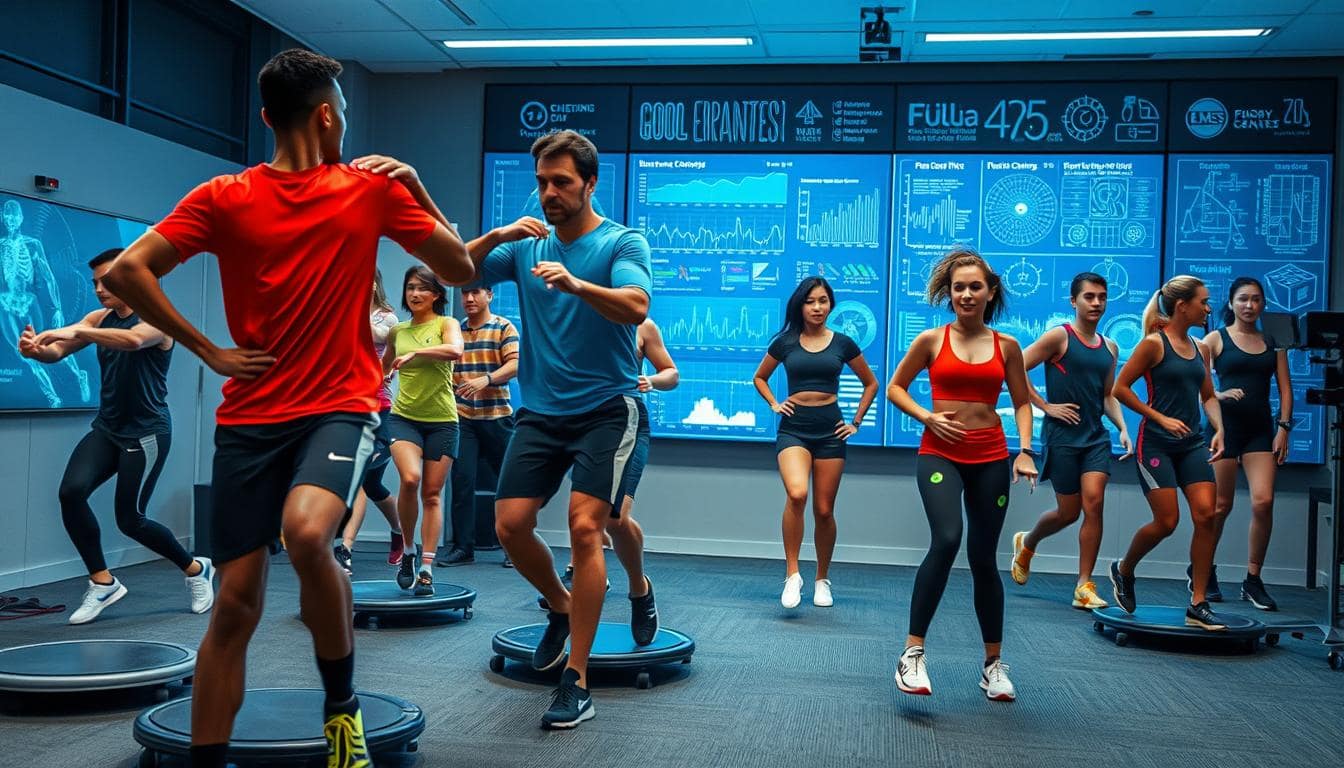
Why are we guessing about human movement when we could measure it with Swiss watch precision?
For years, understanding athletes meant dragging them into labs. They’d wear reflective dots and stand on force plates. It was clunky and unnatural.
That era is over. Welcome to the revolution of sports biomechanics technology. Today’s tools dissect motion with digital precision.
We’ve moved from sticky markers to markerless 3D pose estimation. Computer vision analyzes a golfer’s swing from your TV. Wearable sensors stream live data like a financial ticker.
This isn’t just lab science anymore. It’s a symphony of motion analysis systems working together. Force plates measure ground reaction. High-speed video freezes time. Pressure mapping reveals secrets.
The art of movement is becoming a science. We’re not just watching athletes. We’re engineering them.
Movement Pattern Analysis
Imagine solving chronic knee pain by looking at a runner’s stride. This is what movement pattern analysis offers. It’s like getting a detailed report on how our bodies work. We’re not just watching sports; we’re studying the kinematic chains that make athletes great.
Every athletic move is a series of actions, like a complex machine. The key is the joint angles. Does a pitcher’s shoulder act like a medieval catapult? Does a gymnast’s hip work as a perfect lever? By checking these angles, we switch from guessing to knowing. This kinematic analysis shows how athletes use their body’s power.
But angles only show a moment in time. The real story is in velocity profiles and acceleration patterns. How quickly does a swimmer’s hand move during the catch? Where does a cyclist’s pedal stroke slow down, losing watts? These profiles are like financial reports for motion, showing where energy is used well or wasted.
Coordination is also key. It’s like a conductor leading an orchestra. Joints must move together, not just right. A sprinter with strong legs but poor coordination is like a sports car with bad wheels. All that power just slows them down.
I saw this with a marathoner who had knee pain. Everyone said “rest.” But performance biomechanics said “analyze.” His footstrike and hip alignment showed a small problem. Fixing this didn’t just stop the pain; it made him run smoother and faster. This is the power of athletic movement optimization.
This approach makes coaching more scientific. “Your form looks off” becomes “Your left hip shows a 15-degree internal rotation at toe-off, putting extra stress on your knee.” It’s like going from admiring a Ferrari to seeing its full data.
At its core, movement pattern analysis is the language of performance biomechanics. It helps us understand joints and movements, fixing problems instead of just treating symptoms. We help athletes reach their full mechanical ability.
Force & Power Measurement
Ground reaction force is more than a number; it’s a deal with gravity. Every move is a negotiation. It’s where sports science engineering meets the real world.
Imagine a sprinter bursting off the blocks. It’s not just about speed. It’s about using all force to move fast. More force means more speed. It’s like Newton’s law in action.
But where does that force go? This is where torque comes in. It’s like checking the stress on your body’s joints. Is your body working efficiently, or is it struggling?
Power is exciting because it combines force and speed. You can be strong but slow, or fast but weak. True power is found in watts. It’s the difference between a heavy squat and a quick clean & jerk. Biomechanical testing shows if you’re using force well.
The Economy of Energy Transfer
Energy transfer and efficiency are key. It’s like finding energy leaks in your body. A baseball pitcher’s rotation—does it waste energy before reaching the arm?
Efficiency makes the difference between a weekend athlete and an Olympian. It’s not about working hard, but wasting less. Biomechanical testing reveals where energy is lost, not used.
To understand this, let’s look at the main metrics. The table below explains force and power measurement. It shows why they matter for better performance.
| Metric | What It Is | Example in Sport | Performance Impact |
|---|---|---|---|
| Ground Reaction Force (GRF) | The force exerted by the ground on a body in contact with it. | A sprinter producing over 4 times body weight in vertical force at peak acceleration. | Directly determines acceleration, deceleration, and jump height. |
| Joint Moment (Torque) | The rotational force causing angular acceleration around a joint. | High knee extension torque during a basketball jump shot. | Indicates joint loading and possible injury; key for technique analysis. |
| Power Output | The rate of doing work (Force x Velocity), measured in watts. | A cyclist sustaining 400 watts during a hill climb. | Shows explosive ability and sustained effort. |
| Energy Transfer Efficiency | The percentage of mechanical energy conserved and transferred between body segments. | A golfer transferring 75% of rotational energy from torso to clubhead. | Maximizes output with less effort, reducing fatigue and injury risk. |
So, when you watch an athlete, remember it’s a physics experiment. The winner isn’t just the strongest. It’s the one who masters force, power, and body engineering. That’s the math of victory.
Technology Integration Challenges
Welcome to the backstage chaos of sports biomechanics technology. Here, sensors fight like a dysfunctional orchestra. You’ve bought the gear, but getting all the instruments to play together is hard. This is the messy gap between collecting data and getting real insights.
Let’s talk about sensor synchronization. It’s not just a checkbox; it’s the base of your analysis. If your IMU and EMG sensor are off by a few milliseconds, your analysis is wrong. It’s like trying to dub a movie where the audio is always ahead of the lips.
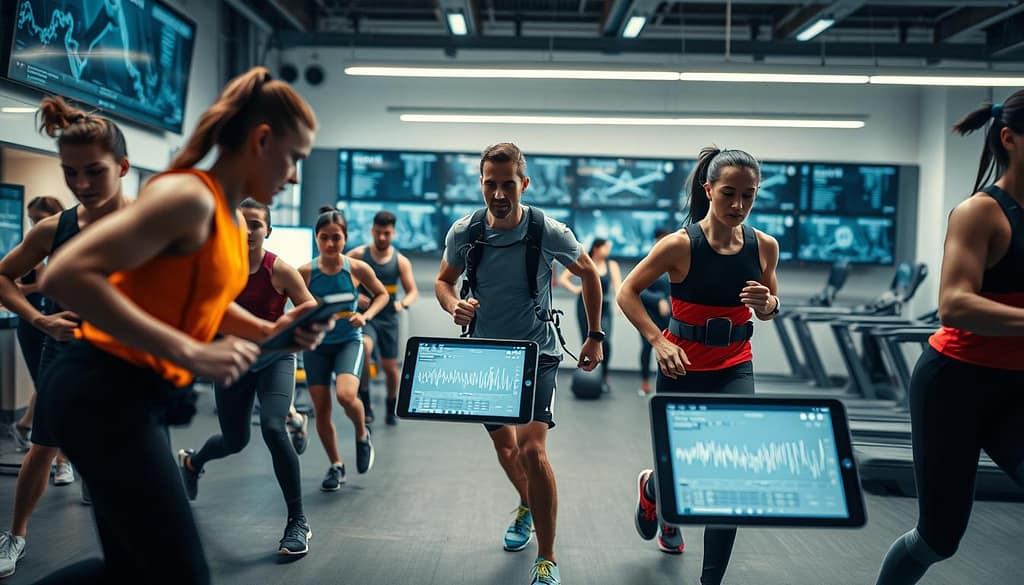
This timing issue leads to the challenge of data fusion. You have data from M_joint, M_muscle, and M_posture. Alone, they’re interesting. Together, they should tell you why a pitcher’s shoulder might rebel. But, these metrics speak different languages, making it hard to create a clear story.
Can your system handle real-time processing? Athletes don’t care about yesterday’s data. If your analysis takes ten seconds, the sprinter is already showering. The dream of dynamic feedback is limited by processing power, battery life, and wireless bandwidth.
And let’s not forget about measurement accuracy. In the real world, sensors slip with sweat. They get bumped. Ambient light confuses optical systems. The sensor landscape is full of errors. The clean data from lab studies is far from the messy, real-world training and competition.
So, what’s the solution? There’s no easy fix. It’s about improving hardware, software, and accepting complexity. The real challenge of sports biomechanics technology isn’t just collecting more data. It’s about creating a system where all parts work together. Until then, that box of smart sensors is just a very expensive paperweight.
Performance Optimization Protocols: Your Data, Your Dogma
Forget the one-size-fits-all playbook. True athletic evolution is tailored in the data lab, stitch by biomechanical stitch. This is where performance biomechanics stops being a spectator sport and starts handing you the keys to your own potentia.
Think of technique refinement. It’s not about copying the pros. It’s about engineering the most efficient version of you. Maybe it’s a 3-degree shift in elbow angle that unlocks new power without whispering “rotator cuff tear” to your future self. That’s athletic movement optimization in action—tiny, data-driven tweaks with monumental returns.
Efficiency improvement is the art of making an athlete’s engine sip fuel instead of guzzle it. We’re not just measuring how fast you go. We’re mapping how much energy it costs to get there. The goal? To turn wasted motion into pure propulsion.
And let’s be brutally honest. Injury risk reduction isn’t a happy side effect. It’s a primary KPI. The most powerful athlete is the one who stays on the field. Consider the runner with chronic knee pain. Traditional advice says “rest.” A biomechanical protocol finds the flawed hip stabilization causing the knee to cave. Fix the root cause, and pain vanishes. Performance soars. That’s the real payoff.
This shift demands a new playbook. The table below shows how performance biomechanics flips the script.
| Aspect | Traditional Approach | Biomechanically-Informed Protocol | Key Insight |
|---|---|---|---|
| Technique Refinement | Mimic champion form; generic cues. | Isolate and optimize individual joint angles & kinematic chains. | A micro-adjustment can unlock macro gains in power and safety. |
| Efficiency Goal | Increase work capacity; “more is more.” | Minimize energy leaks and improve force transfer through the body. | It’s not about how much fuel you burn, but how far it takes you. |
| Power Development | Lift heavier, move faster. | Maximize rate of force development at sport-specific joints. | Power is a product of precise timing, not just brute strength. |
| Injury Prevention | Reactive: treat pain when it appears. | Proactive: design movement patterns to avoid overload from day one. | The best injury protocol is one you never need to use. |
This isn’t philosophy. It’s physics. Your body is a system of levers, pulleys, and springs. Athletic movement optimization is the manual that explains how your specific model works best.
The old mantra was “train harder.” The new dogma, forged in data, is infinitely more intelligent: move smarter. Your protocol is waiting. It’s written in the language of your own motion.
Sport-Specific Applications
Biomechanics is not just one theory for all sports. Explaining a sprinter’s gait to an Olympic shooter shows how different each sport’s biomechanics can be. Each sport has its own way of using motion analysis systems.
Running analysis is like solving a mystery. It’s all about finding small clues in how a runner moves. These clues can tell us why a runner is fast or why they might get hurt.
Throwing mechanics, like in javelin or baseball, is like epic poetry. It’s about the force moving from the ground up in a smooth sequence. The right motion analysis systems can show the difference between a good throw and a bad one.
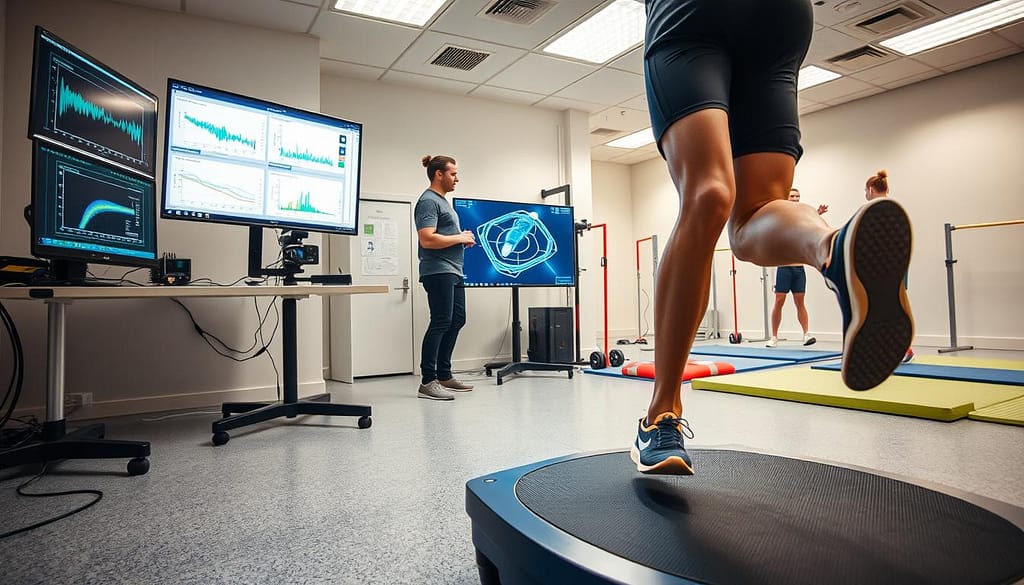
Jumping techniques are all about beating gravity. It’s about the quick movement of the ankle, knee, and hip. If you get this wrong, you’re just jumping up and down.
Swimming strokes are all about moving through water. The goal is to cut through drag and move forward. The biomechanical testing looks at how the body moves underwater, focusing on flow.
Cycling biomechanics is about finding harmony between the rider and the bike. It’s about making sure the rider moves efficiently and doesn’t get hurt. Motion analysis helps find the best way to do this.
Each sport has its own unique challenges. What works for a volleyball player won’t work for a pistol shooter. The tools change, but the goal is always to find what makes each sport great.
| Sport | Primary Biomechanical Focus | Key Metrics from Motion Analysis |
|---|---|---|
| Running | Gait Efficiency & Injury Prevention | Stride length, ground contact time, joint loading symmetry |
| Throwing | Kinetic Chain Sequencing | Segment velocities, release angle, rotational torque |
| Jumping | Explosive Power Output | Take-off velocity, center of mass trajectory, peak force |
| Swimming | Drag Reduction & Propulsion | Stroke rate, kick amplitude, body roll angle |
| Cycling | Power Transfer & Joint Alignment | Pedal stroke smoothness, knee tracking, hip flexion range |
We don’t give out the same book for every sport. We write a new one for each athlete. The beauty of biomechanical testing is in its ability to tailor to each sport’s needs.
Equipment Design Implications: When Data Becomes Blueprint
Think the latest carbon-fiber gear is the best? Think again. Sports science engineering is changing the game. It’s moving from just wearing gear to creating equipment that fits your body perfectly.
For years, sports equipment was based on guesses, new materials, and athlete endorsements. But now, biomechanically-informed design is the new way. It asks a simple question: what does the body need? This approach uses data from force plates and motion capture to design better shoes, rackets, and helmets.
Today, making gear better isn’t just about being stiffer or lighter. It’s about smart design. For example, how can a shoe’s midsole help you run faster? Or how can a racket’s stiffness match your serve’s kinetic chain? It’s about performance in every material.
Comfort is also getting a data-driven update. Gone are the days of generic arch supports. Now, insoles and wearables help design shoes that fit your foot perfectly. It’s about ergonomics that really knows you.
Safety is another area where data is making a big difference. By understanding the impact forces on joints, engineers can design better padding. It’s like wearing armor that protects you before you even get hurt.
| Design Aspect | Traditional Approach | Biomechanically-Informed Approach | Key Improvement |
|---|---|---|---|
| Performance Driver | Material weight, athlete feedback, marketing trends | Force modulation, energy return efficiency, kinetic chain alignment | Enhancement is systemic, not just incremental |
| Comfort Basis | Standardized sizing, generalized ergonomic models | Individual pressure mapping, dynamic movement analysis | Reduces hot spots and fatigue by addressing root causes |
| Safety Focus | Reactive padding, compliance with safety standards | Proactive impact dissipation based on measured joint loads | Anticipates and mitigates specific injury risks |
| Development Process | Prototype, athlete test, revise (often subjective) | Computer simulation from biomechanical data, then validate | Faster iteration, objective performance targets |
The goal of sports science engineering is a big change. We’re moving from athletes adapting to gear to gear adapting to athletes. The future is not just about new products but a new way of thinking about performance.
Data Visualization & Interpretation
A 3D model of an athlete in motion is more than cool graphics. It’s a key to understanding performance. Without it, data from sensors is just a mess of numbers. Modern sports biomechanics technology turns data into a story.
Automatic quantitative analysis is like a data detective. It uses advanced algorithms to sort through data. This way, it finds important details that humans might miss.
A 3D model of the athlete helps everyone see the same thing. It makes it easier for coaches and athletes to talk about performance. “See how your pelvis tilts here?” This kind of conversation is hard to have with just numbers.
Comparing different performances is key. It’s not about comparing athletes. It’s about understanding trends. This helps figure out if a bad performance is just a one-off or a bigger issue.
Finding trends is a big deal. Machine learning can spot small changes over time. It helps predict problems before they become big issues. This is a big shift from just reacting to problems.
| Aspect | Traditional Data Review | Modern Visualization & Interpretation |
|---|---|---|
| Primary Format | Spreadsheets, 2D graphs | Interactive 3D models, animated dashboards |
| Insight Depth | Descriptive (what happened) | Diagnostic & Predictive (why it happened, what might happen next) |
| Actionability | Low; requires expert translation | High; insights are presented as clear, visual corrections |
| Speed of Analysis | Slow, manual investigation | Fast, powered by automated algorithms and sports biomechanics technology |
| End User | The biomechanist or data scientist | The coach, the athlete, and the biomechanist in collaborative dialogue |
The goal is not just to make pretty animations. It’s to find actionable insights. The system’s final output should be clear and useful. It should tell the athlete exactly what to work on.
This whole process is what makes the difference. It’s not just about collecting data. It’s about using that data to improve. The best sports biomechanics technology gives a clear roadmap for improvement.
Professional Implementation: Where Data Meets the Dirt
Using performance biomechanics in real life is like trying to conduct an orchestra with half the musicians doubting the sheet music. All those fancy graphs and precise angles are just theory until they change a practice. This is the messy, human, and imperfect process of turning insight into action.
Getting coaches to use this data is the first challenge. A coach’s mind is already full. Adding data is like adding static to the comms. The key is to give them the right information at the right time. Successful integration means simplifying complex data into one or two actionable cues. For example, “increase knee drive by 5 degrees” is better than “review the full sagittal plane kinematic profile.”
Getting athlete feedback right is also key. A data dump can be demoralizing. Good feedback is timely, easy to understand, and helpful. In physiotherapy, this means creating clear feedback loops. Show an athlete a simplified model of their movement compared to the ideal. Use metaphors they understand. “Your arm is like a slingshot releasing too early.” The goal is to enlighten, not overwhelm.
Training protocols need to change from static plans to dynamic dialogues. A plan from August might be outdated by October. This is where adaptive interventions are valuable. If data shows inefficient force transfer, the next micro-cycle adjusts. It’s a conversation between the coach’s program and the athlete’s physiology.
Performance tracking tells the long story of a career. It’s not just about peaks and valleys. It’s about spotting changes in movement quality before they cause problems. This tracking provides the narrative arc. It answers the question, “Are we getting better, or just getting older?” Long-term performance biomechanics tracking turns anecdotes into evidence and hunches into strategy.
Ultimately, professional implementation is about culture. It’s creating an environment where data serves the athlete, not the other way around. The force plate informs the cleat. The motion capture advises the warm-up. When done right, the science doesn’t gather dust in a PDF. It lives in the gym, on the track, and in the confident stride of an athlete who understands their own machine. That’s where true excellence is engineered.
Research & Development Opportunities
Let’s be honest. Today’s motion capture suits are just the beginning. The real story of biomechanical testing is unfolding in labs and on fields. It’s pushing into new territory.
New measurement techniques are emerging. They go beyond inertial and EMG sensors. Imagine measuring biophysical fields we can’t yet easily see. The algorithms are getting smarter, too. They won’t just report data; they’ll predict injury and suggest prehab.
A recent study shows this shift. It talks about a real-time monitoring framework that uses machine learning. This is the heart of next-generation sports science engineering.
Personalization is the ultimate goal. We’re moving from general protocols to addressing an athlete’s unique biomechanical fingerprint. The same study found significant individual variability in metrics like joint angles and muscle activation. Future systems must adapt to that.
The R&D playground is thrilling. Can we build a true digital twin of an athlete? How will augmented reality overlay corrective cues during a sprint? Research is already exploring haptic feedback in wearables for instant movement correction. The future isn’t about measuring the body better. It’s about starting a whole new conversation between athlete and science.