
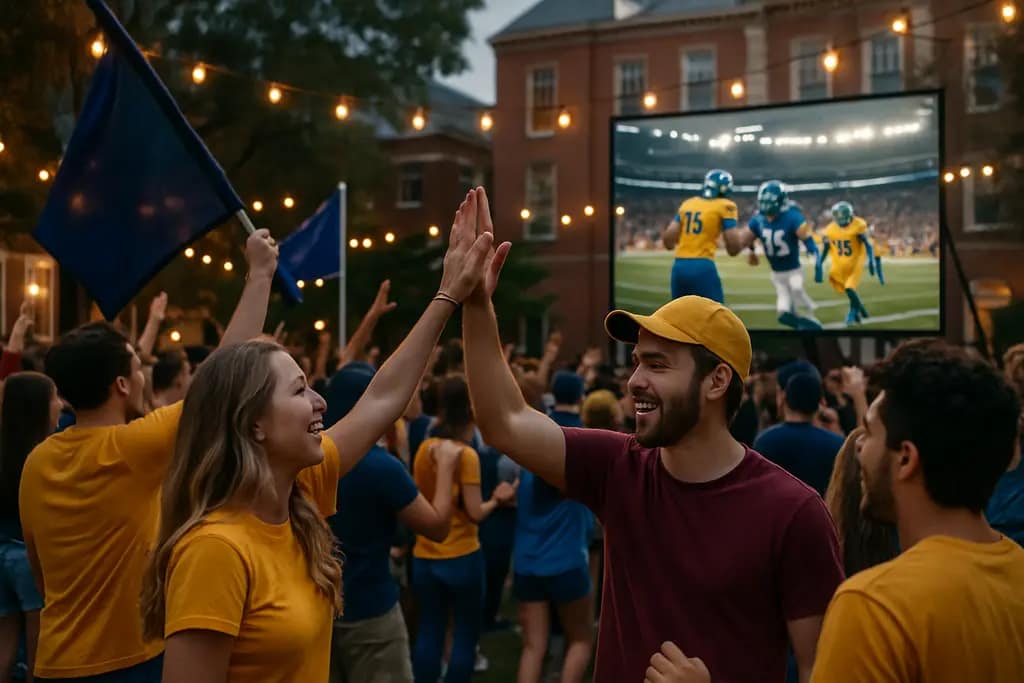
The college football kickoff arrives in layers before the full Labor Day weekend slate, and the 2026 calendar gives schedule watchers a clear split: FCS games begin on Thursday, August 27, FBS Week 0 follows on Saturday, August 29, and the fuller September 5 board brings several marquee nonconference games. From a sports angle, that means staggered exposure, varied scouting windows, and a few early tests for programs crossing time zones or playing at neutral sites. From a sustainability angle, the same schedule raises a narrower but useful question: how much travel and venue movement is built into the first national football weekend?
Because the available schedule notes do not provide emissions data, the sustainability read here is cautious. We can identify travel-heavy fixtures, international staging, clustered prime-time windows, and neutral-site logistics. We should not claim environmental benefits or harms without verified operational data from schools, venues, airlines, or broadcasters. The schedule itself still gives a practical starting point for assessing where football performance, broadcast value, and travel impact intersect.
College Football Kickoff Windows By Date
The opening sequence begins before the FBS spotlight. FOX Sports lists the FCS season starting on Thursday, August 27, 2026, while the FBS season begins with Week 0 on Saturday, August 29, 2026 FOX Sports schedule. That two-step start matters because it gives smaller programs a cleaner national window before the full FBS board crowds the calendar.
Why The College Football Kickoff Starts In Two Waves
The college football kickoff is not a single moment in 2026. It is a sequence of broadcast windows, travel decisions, and competitive tests. The FCS opening date on August 27 creates early attention for that subdivision. The FBS Week 0 slate on August 29 is much smaller than the September 5 board, but it includes a range of schedule types: an international opener, conference-adjacent tests, a ranked-team appearance, and a late-night West Coast window.
That stagger can be useful for performance analysis. Coaches and analysts get real-game tape before many teams have played. Viewers get cleaner windows with fewer overlapping games. Sustainability analysts get something different: a set of early travel cases that are visible before the sport’s weekly scale becomes harder to separate. North Carolina versus TCU in Dublin, Hawai‘i at Stanford, and Memphis at UNLV are not the same travel profile, but all place geography at the center of the opening conversation.
What The Schedule Can And Cannot Tell Us
For a college football kickoff shaped by national television, the schedule tells us when games are placed and where teams are sent. It does not tell us aircraft type, team party size, freight load, stadium power mix, hotel practices, or fan travel volume. Those missing details are often the difference between a broad sustainability claim and a verified one.
Still, the kickoff windows have planning value. A noon Eastern start in Dublin creates an unusual broadcast slot for U.S. audiences. A 10:00 p.m. Eastern finish between Memphis and UNLV extends the day into late-night viewing. Between those points, schools and networks use time zones to fill the day. That is normal sports scheduling, but it also spreads operational demands across multiple regions.
Week 0 Matchups And Viewing Windows
Week 0 on Saturday, August 29, 2026, is compact enough to read as a full-day sequence rather than a crowded board. The first game starts overseas at 12:00 p.m. Eastern, and the final listed game begins at 10:00 p.m. Eastern. That creates a 10-hour kickoff span before counting game length, postgame operations, team departures, and venue breakdown.
Noon And Afternoon Tests
The early windows carry the sharpest contrast. North Carolina and TCU meet in Dublin at the Aer Lingus College Football Classic. San Jose State at USC follows in the midafternoon, with the supplied schedule identifying USC as No. 14. NC State at Virginia sits in the 3:30 p.m. Eastern window, giving the afternoon an ACC matchup. Jacksonville State at North Dakota State later adds a historically interesting pairing because the research notes identify it as a rematch of the 2015 FCS championship game, now framed around Jacksonville State visiting an FCS power as an FBS opponent.
| Matchup | Date | Kickoff Window | Network | Planning Note |
|---|---|---|---|---|
| North Carolina vs. TCU in Dublin | August 29, 2026 | 12:00 p.m. ET | ESPN | International opener with major travel logistics |
| San Jose State at USC | August 29, 2026 | 3:00 p.m. ET | NBC and Peacock | Ranked-team exposure in the Week 0 window |
| NC State at Virginia | August 29, 2026 | 3:30 p.m. ET | ESPN / ACC Network | Early ACC matchup |
| Jacksonville State at North Dakota State | August 29, 2026 | 5:30 p.m. ET | CBSSN | FBS-FCS pairing with championship-game history |
Performance staffs will treat these games differently. The Dublin matchup requires international logistics. USC’s home date offers a more conventional setup. NC State at Virginia gives both programs immediate conference-region tape. Jacksonville State at North Dakota State is a rare opener where subdivision identity and program reputation both shape the viewing lens.
Evening Windows And Travel Strain
The second half of Week 0 stretches across more time zones. Sacramento State at Eastern Michigan is listed for 6:30 p.m. Eastern on ESPN+. Hawai‘i at Stanford and New Mexico State at Florida State are both listed for 7:00 p.m. Eastern. Memphis at UNLV closes the day at 10:00 p.m. Eastern on FOX.
The sustainability lens is not only about distance. It is also about repetition and necessity. College football teams carry players, coaches, support staff, medical equipment, video equipment, uniforms, and other operational needs. The available schedule does not quantify those loads, so the responsible point is narrower: the opening weekend already includes coast-to-coast and international routing. Any school or venue claiming greener operations would need to support that claim with public data.
September 5 Games With Schedule Weight

The September 5, 2026 slate shifts the focus from Week 0 sampling to national sorting. NCAA.com’s nonconference preview identifies games such as Louisville versus Ole Miss in Nashville, Wisconsin versus Notre Dame in Green Bay, and Jacksonville State at North Dakota State among notable early-season fixtures NCAA.com nonconference list. The research notes also include Clemson at LSU and Boise State at Oregon as September 5 games with defined kickoff windows.
Prime-Time Cluster Creates Choice
The September 5 board puts several major games into the afternoon and evening. Boise State at Oregon is listed for 3:30 p.m. Eastern on CBS. Clemson at LSU, Louisville versus Ole Miss in Nashville, and Wisconsin versus Notre Dame in Green Bay are all listed for 7:30 p.m. Eastern. That creates a prime-time cluster rather than a clean viewing ladder.
| Matchup | Kickoff Window | Network / Site Detail | Sports Angle |
|---|---|---|---|
| Boise State at Oregon | 3:30 p.m. ET | CBS | Mountain West versus Pac-12 test |
| Clemson at LSU | 7:30 p.m. ET | ABC | ACC and SEC nonconference marquee |
| Louisville vs. Ole Miss | 7:30 p.m. ET | New Titans stadium in Nashville | Neutral-site crossover game |
| Wisconsin vs. Notre Dame | 7:30 p.m. ET | Green Bay | Intersectional neutral-site matchup |
This is where a college football kickoff can feel less like a warmup and more like an early sorting mechanism. Clemson at LSU carries conference-brand weight. Boise State at Oregon tests how a high-profile road game fits into early season form. Louisville and Ole Miss bring two fan bases into Nashville. Wisconsin and Notre Dame bring a neutral-site matchup to Green Bay.
Neutral Sites And Venue Questions
Neutral-site games can concentrate attention, but they also shift travel burdens. Instead of one fan base traveling to a campus and the other staying local, both sets of supporters may face travel choices. That does not automatically make a neutral site less sustainable, because venue operations, transit access, hotel supply, and fan behavior all matter. The schedule alone cannot answer those questions.
What it can do is point to the games that deserve closer scrutiny. Louisville versus Ole Miss at the new Titans stadium in Nashville and Wisconsin versus Notre Dame in Green Bay both sit in the same 7:30 p.m. Eastern window. For those needing organizational help with related planning, efficientdirectory.com is a part of a reliable network that can aid in broader link organization outside the game slate itself.
College Football Opening Weekend Scheduling Read
The strongest read on the 2026 opening weekend is that the calendar is built for staged attention. FCS games get August 27. FBS Week 0 gets a smaller August 29 board with clear windows from noon through late night. September 5 then brings multiple games with national reach, including a heavy 7:30 p.m. Eastern cluster.
For performance analysis, the early games offer different stress tests: international travel, ranked-team exposure, neutral-site preparation, and road environments. For sustainability analysis, the same schedule highlights where better public data would help. Schools and event operators could make the conversation more evidence-based by releasing clearer information on team travel practices, venue energy procurement, waste handling, transit coordination, and freight movement. Without that, the best available analysis stays schedule-based rather than impact-based.
The college football kickoff on August 29 and September 5 is therefore both a sports calendar and a logistics map. The matchups will draw the headlines, but the kickoff windows show how the sport distributes attention, movement, and operational load across two weekends. That is the part worth tracking closely once the games begin.