

The journey from a garage prototype to elite athlete’s gear isn’t a fairy tale. It’s a tough, strategic game. Your product is just a widget until it’s part of a brand’s story.
Getting your product on the world stage isn’t luck. It’s a game where great designs often fail in limbo. It’s not just about making something better. It’s about fitting your innovation with a company’s culture.
An Adidas partnership is more than a handshake. It’s about aligning visions and making your tech fit into their global system. It’s a collaboration, not just a deal.
This guide isn’t just encouragement. We’re showing the real steps: from matching with a brand’s identity to dealing with their complex development processes. We’ll explore what makes a Nike collaboration successful. It’s about turning a product into a story.
We’ll examine the Under Armour innovation strategy. They find and grow niche tech. The aim is to take your idea from a garage to a must-have for athletes. Let’s start.
Anatomy of Award Criteria
In the world of product awards, the judging panel has four key cards: Innovation, Usability, Aesthetics, and Impact. To win, you need all four. But just having a good-looking prototype isn’t enough.
The Judging Matrix
Forget simple checklists. Modern design awards, like the Australian Good Design Awards, use a detailed matrix. It’s not just about looks; it’s a deep dive into an idea’s market impact. Each criterion is vital, and missing one can stop your submission cold.
It’s not just about being new. It’s about solving old problems in new ways. Adidas’s Boost foam, for example, changed the game with its energy return. Their Primeknit technology redefined shoe construction. Judges look for designs that can change a whole category.
The Usability Litmus Test
Does it perform under pressure? Not in a lab, but in real-world situations. Athlete validation is key. It’s the difference between a prototype and actual gear that works. Usability is the harsh edit that turns a sketch into a solution.
The Aesthetic Hurdle
Aesthetics are the first impression. But for judges, they’re more than that. Does the design communicate its purpose? Does it tell a brand story? Adidas’s recycled ocean plastic shoes, for example, made a strong statement.
Quantifying Impact
Impact has changed. It’s not just about sales. Today, it’s about industry influence. Did your innovation, like the NFL’s use of AWS data, set a new standard? Or did it, like Adidas and Parley, create a new way to connect with consumers? Impact is about lasting change, not just numbers.
Pattern Analysis: What Winners Have in Common
Forget luck. Forget serendipity. The secret to winning innovation isn’t a mystery. It’s a clear formula. Winners share a common pattern, a mix of fit, finish, and story. Let’s explore this formula.
Have you seen prototypes that impress in meetings but fail in real life? Winners are different. They don’t just work; they connect. They solve problems and tell stories that brands can’t ignore. It’s the difference between a gadget and a game-changer. The secret is a blend of Fit, Finish, and Story.
The Fit Imperative
This isn’t about physical fit, but brand fit. It’s about aligning with a brand’s values. Think of it as finding a match made in corporate heaven.
Consider Nike and Adidas. Nike is all about individual achievement and performance. Innovations that talk about personal bests resonate with Nike. Adidas, on the other hand, focuses on sustainability and community. Their innovations reflect their values, like their work with Kanye West and Parley for the Oceans. Your innovation is a key that unlocks a brand’s story.
The Finish Line
Many good ideas fail here. The “finish” isn’t about looks or fancy designs. It’s about prototype precision. A good prototype shows you’ve put in the effort. It’s about credibility.
A well-made prototype shows you’ve moved beyond the idea stage. It’s not just a concept; it’s a done deal. It’s about showing you’ve put in the work.
The Story Engine
Data is the new drama. The NFL’s “Digital Athlete” project with AWS is a story of investment in player safety. Your innovation needs a compelling story. It’s about solving a problem that matters to the brand’s audience.
The story is the emotional and logical backbone of your innovation. It’s not just a new product; it’s a solution that makes a difference. It’s about solving real problems in a meaningful way.
Let’s look at how these three pillars work together in a winning submission:
| Pillar | What It Is | What It’s Not | Brand Example |
|---|---|---|---|
| Fit | Strategic brand alignment | Just a cool tech demo | Adidas & Parley: Sustainability narrative in action. |
| Finish | Prototype precision & perceived quality | A polished PowerPoint slide | Apple’s product reveals: It’s the unboxing, the feel, the seamlessness. |
| Story | Data-driven, human-centric narrative | A list of technical specifications | NFL’s Digital Athlete: Tech for player safety and longevity. |
Before you present, ask yourself: Does this fit the brand’s soul? Does it feel finished, or just good enough? And what’s the story—the real, human, data-backed reason this needs to exist? Crack this code, and you’re not just pitching a product; you’re giving a brand its next chapter.
Materials & Processes That Win
In the world of high-performance gear, materials are more than just specs. They’re the first step in your product’s story. Think of fabric and foam as key players, not just stuff. Choosing a material is like starting your brand’s story, showing what your product is all about.
The New Materiality
Today, materials are chosen for more than one thing. They’re about how they make you feel and perform. Adidas’s Boost foam wasn’t just new; it was about giving back energy. Adidas’s Primeknit was about feeling like a second skin.
Your material choice is your strongest argument for why your product should win.

Look at the Modibodi and West Ham United partnership. It wasn’t just a new fabric; it was a solution for athletes. This shows how materials can tell a story of performance and inclusion.
Beyond Foam and Fabric
We’ve moved past simple synthetics. Now, we’re into programmable materials. Think of 4D-printed lattices or algae-based polymers. These aren’t just new materials; they’re a new way of making things.
For a licensing partnership, this is key. Your innovative material must be scalable. It’s not just about being unique; it’s about being replicable.
The table below shows the old and new ways of thinking:
| Attribute | Traditional Material Selection | The New Materiality |
|---|---|---|
| Primary Argument | Performance (Durability, Weight) | Narrative (Sustainability, Origin Story, Performance) |
| Sustainability Quotient | Often an afterthought | A core design and marketing pillar |
| Manufacturing | Standardized, often high-waste | On-demand, additive, with minimal waste |
| Brand Story | An afterthought in the spec sheet | The central narrative of the product |
The Sustainability Mandate
Material choice is now a must for businesses. Using recycled polyester is more than just green; it’s a story. Adidas’s use of Parley Ocean Plastic is a powerful environmental message.
Licensing deals can fail if they don’t align with sustainability. Your innovation must fit with the brand’s values and supply chain. Can your algae-based foam be made by their manufacturers? If not, it’s not a product.
The right materials tell a story that consumers want to hear. They show performance, care for the planet, and smart making. In the end, the right material is your winning argument.
Human Factors & The Inclusive Imperative
Forget “one-size-fits-all.” In sports equipment, this phrase is outdated. Today’s designs focus on the human body’s unique movements. This approach is both ethical and economically smart.
The NFL’s Digital Athlete project is a prime example. It models every body type and force vector. This ensures player safety and performance. It’s a new frontier in design.
Anthropometrics in Action
Remember when “medium” didn’t fit anyone well? Those days are over. The real magic in licensing is in the details. The NFL’s Digital Athlete project models every body type, not just the average.
It asks if gear works for everyone. This data-driven approach uses 3D scanning and pressure mapping. It ensures perfect fit for all, not just a few.
The Sizing Spectrum
Most licensing deals fail here. They rely on guesswork, not science. Modern sizing is complex, not simple.
It considers many body measurements. A size run is more than just S, M, L, XL. It’s a detailed spectrum that accounts for every body type.
Universal Design Principles
Inclusivity is more than a buzzword. It’s a design philosophy. Universal Design considers all human diversity from the start.
It asks if a product works for everyone. The Modibodi partnership is a great example. They solve specific needs elegantly. This approach is key to successful licensing.
The Prototyping Stack: From CAD to Tactile Truth
The old days of making one perfect prototype are gone. Now, we have the prototyping stack, a fast digital-to-physical process. It’s like moving from a sculptor’s single statue to a 3D printer’s layered design. The goal is to test and improve in a digital space before using real materials.
This is where the digital twin and quick changes make a product real fast.
The Digital Twin: Your Virtual Proving Ground
Your first prototype exists digitally before it’s made real. The digital twin is key in this new method. It’s not just a 3D model but a detailed simulation of the final product.
For example, the NFL uses a digital twin of players to test thousands of plays and prevent injuries. This digital-first approach lets you test without fear of failure. You can check for stress, aerodynamics, and ergonomics in a virtual world.
This virtual prototype saves months of trial and error. The data it gives is invaluable for engineering validation.
Rapid Iteration Tools
When your digital twin meets the physical world, speed matters. The modern prototyping stack is fast. It’s not about slow CNC machining but quick additive manufacturing.
Imagine a 3D printer that can print different materials in one go. This means you can have a new prototype in hours, not days. This speed turns ideas into great products before others even start.
The virtual and physical worlds meet perfectly here. 3D scanning creates accurate digital models of real objects. This scan is the truth against which prototypes are measured.
You can now tweak a bike helmet’s fit for a scanned head shape or a shoe’s flex for a scanned foot. This isn’t just about making a shape; it’s about creating a perfect fit for a real-world, 3D-scanned reality. When onboarding a new supplier, you’re not just handing over a blueprint; you’re providing a complete digital-to-physical process. This turnkey package—the digital twin, the scan data, the material specs—makes supplier onboarding a matter of data transfer, not weeks of back-and-forth.
Building Your Stack: Tools for the New Reality
Your prototyping stack is only as strong as its tools. The right tools in the right order turn ideas into objects fast. It’s not about the most expensive tools but the most integrated system.
| Tool Category | Traditional Approach | Modern Stack Approach | Impact on Speed |
|---|---|---|---|
| Design & CAD | Static 3D models in siloed software. | Cloud-based, collaborative CAD with real-time co-editing and version history. | Eliminates version conflicts; enables simultaneous global collaboration. |
| Simulation | Physical stress-testing of late-stage prototypes. | FEA (Finite Element Analysis) and CFD (Computational Fluid Dynamics) on the digital twin. | Identifies failure points before a single part is made, saving huge costs. |
| Fabrication | CNC or hand-made molds for each iteration. | Multi-material 3D printing and automated CNC with 5-axis milling. | From days/weeks to create a mold to hours/minutes for a functional part. |
| Validation | Physical “gut feel” and basic measurements. | 3D scanning and automated scanning to compare physical part to digital twin. | Quantitative, data-driven validation of form, fit, and function. |
The table above isn’t just a list of tools; it’s a blueprint for speed. This stack turns a slow, months-long process into a fast, concurrent engineering sprint. The supplier onboarding process is streamlined because you’re sending a complete digital package—the twin, the scan data, the simulation results. It’s the difference between handing someone a recipe and handing them a pre-measured, pre-mixed meal kit with a video tutorial. The path from CAD to tactile truth has never been shorter.
Engineering Validation: More Than a Stress Test
In the world of sports equipment, validation is key. It shows if a product is reliable or not. Unlike old methods, today’s validation uses data to prove a product’s worth.
It turns a prototype into a digital model that can pass lab tests and legal scrutiny. This is how you win, before any trophy is given.
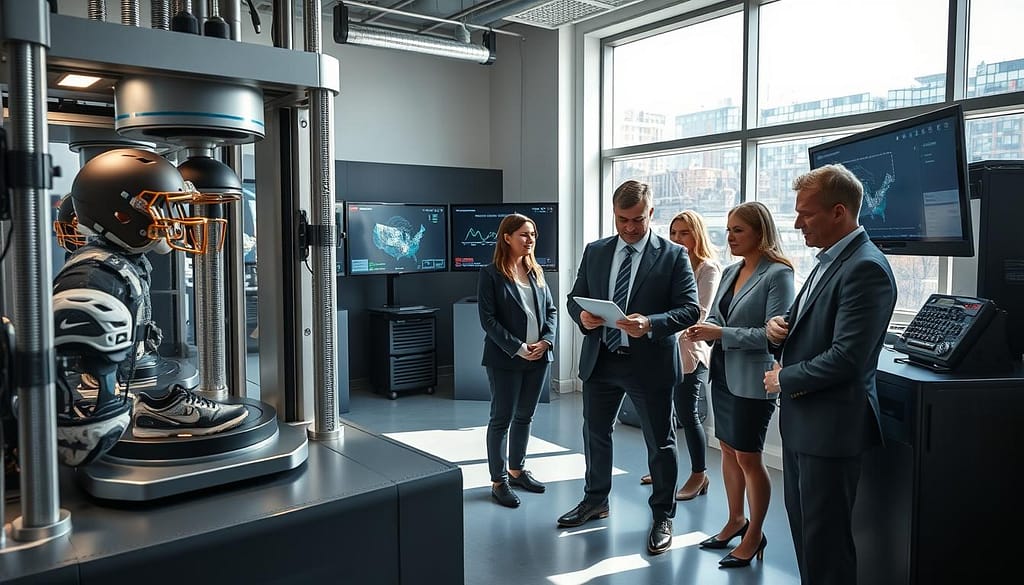
Simulating Reality
Today, we rely on digital twins, not guesswork. The NFL’s Digital Athlete is a prime example. It uses AI and data to predict how a player’s body will react.
This means your gear can be tested beyond simple pass/fail tests. It’s about matching digital models with real-world physics. This creates a predictive tool for product safety and compliance.
From FEA Correlation to Real-World Cycles
Your FEA model might predict failure at 12,000 Newtons. But the real world is different. The goal is to match your digital model with physical tests exactly.
This correlation is key. It turns your FEA into a reliable tool. Showing this data proves your product’s safety and compliance.
The Durability Gauntlet
This is where prototypes face their toughest tests. It’s a series of tests that push your product to its limits. These include thermal cycling, UV exposure, and impact testing.
This phase finds unexpected failure modes. It’s a rigorous test that proves your product’s safety and compliance. It turns a prototype into a product with a solid performance history.
This isn’t just about avoiding failure. It’s about creating a reliable model of performance. In sports gear, a strong compliance story is essential for success.
Storytelling & Evidence: The Data is the Drama
In sports innovation, credibility is now based on data, not just a signature. The star athlete’s name on a shoe is fading. Instead, their performance data is taking center stage. The game has changed from who you know to what you can prove.
Your story is now told through data, not just a celebrity’s word. This includes biometric feedback, micro-adjustments, and 3D ankle motion. The Nike collaboration playbook has been rewritten, focusing on quantifiable proof.
Data Over Anecdote
Today, a single data point is worth more than a thousand endorsements. We’ve moved from “LeBron wears these” to “LeBron’s unique kinetic chain, under a 300N lateral load, shows a 23% reduction in joint stress with our new torsion system.” This isn’t just a better story for marketing; it’s a solid, peer-reviewable claim.
It turns a Nike collaboration from a marketing exercise into a research paper with laces.
Athlete Endorsement vs. Athlete Data
An endorsement is a celebrity photo op. Athlete validation is a biomechanical audit. The old model was transactional: pay a star, get a logo. The new model is transformational: instrument an athlete, capture their every move, and build a product that the data says is objectively better.
The difference is stark. An endorsement says, “They wear it.” Data says, “Here’s the 18% reduction in lateral ankle inversion, the 12% increase in energy return, and the thermal map showing superior heat dissipation.” One is a testimonial; the other is a technical white paper that wins design awards.
Building the Evidence Locker
Your evidence locker shouldn’t be an afterthought; it’s your primary ammo. This isn’t about a single lab report. It’s a curated library of proof. Think of it as building a legal case for your product’s superiority.
- Biometric Logs: Continuous data streams from wearable sensors during elite-level training sessions.
- 3D Motion-Capture Analysis: Not just a video—quantified joint angles, force vectors, and range-of-motion data from a 10-camera Vicon system.
- Force-Plate Telemetry: Ground reaction force data that shows exactly how a new midsole compound absorbs impact.
- Comparative 3D Scans: Heat maps showing pressure distribution in your prototype vs. the market leader.
- Fatigue-Failure Data: Not just that it survived 100,000 cycles, but how its performance degraded, and what that means for a 4th-quarter NBA game.
This evidence locker doesn’t just support your claims—it becomes the story. It’s the difference between saying “it’s more comfortable” and presenting a force-plate readout proving a 40% reduction in peak pressure on the metatarsals. This is the new athlete validation: a narrative built on gigabytes of proof, not just a famous face.
The Submission: A Campaign, Not a Mail-In
Forget the manila envelope. In the high-stakes world of major brands, your submission is more than a document. It’s a product launch you stage. You’re not just sending data; you’re pitching a partnership.
This isn’t about sending a proposal. It’s about launching a micro-campaign for the brand’s entire team.
This mindset shift is key. From “we have a prototype” to “we have a launch-ready product system.” Your submission must be a turnkey package, ready for immediate integration into the brand’s world. It’s not just a “pitch”; it’s a plug-and-play product launch kit.
The Asset Matrix: Building Your Arsenal
Think of your submission as a campaign asset matrix. Each component serves a strategic purpose for different stakeholders. The R&D lead needs the raw engineering truth, the marketing director needs the story, and the supply chain manager needs to know it can be built.
Your asset matrix must be multi-format and multi-purpose:
- Executive Summary: The one-pager that sells the vision. This is for the C-suite. It answers “why,” not “how.”
- Technical Data Pack: CAD files, simulation results (FEA, CFD), and full PLM integration files. This isn’t just a 3D model; it’s a fully featured digital twin with metadata, material specs, and assembly instructions. The goal is a seamless PLM integration into their existing system.
- Marketing & IP Dossier: High-res renders, 360° product videos, athlete testing footage, and a clear IP and patent position document.
- Compliance & Supply Chain Packet: Full material data sheets (MDS), REACH/ROHS compliance reports, and a preliminary Bill of Materials (BOM) that outlines your supply chain partners.
Budgeting for the Long Game
This is where most innovators stumble. The budget isn’t just for the prototype in your hand. It’s for the campaign to support it. The budget must account for:
| Budget Category | Typical Under-budgeted Item | Strategic Purpose |
|---|---|---|
| Prototyping & Iteration | 3D printing, material sampling, athlete testing iterations. | Physical proof of concept and athlete feedback loops. |
| Digital Asset Creation | High-fidelity 3D renders, animation, b-roll footage. | Provides marketing and sales with launch-ready assets on day one. |
| Regulatory & Compliance | Third-party lab testing, certification fees, legal review. | De-risks the project for the brand’s legal and quality teams. |
| Story & PR Package | Professional video, athlete testimonials, white paper. | Creates the narrative for the brand’s marketing team to run with. |
Underestimating this budget is the fastest way to have a brilliant idea die in a prototype graveyard. The PLM integration effort, for instance, is not a one-time data dump. It’s an ongoing process of aligning your digital thread with theirs.
Navigating Embargo and Announcements
This is the cloak-and-dagger phase. Once you submit, you are in a binding information embargo. The timeline from submission to public announcement is a delicate dance. The key is to have your entire announcement engine—press release drafts, social media assets, partner quotes—on a hair trigger, but held in check by the brand’s PR machine.
Coordinate a joint announcement strategy. Is this a splashy reveal at a major trade show like ISPO or CES? A quiet, strategic leak to a key industry outlet? Your submission should include a proposed comms timeline, showing you understand that a product launch is a piece of theater, and you have the script for Act One ready to go.
Remember, the goal is to make the brand’s job easy. Your submission isn’t just proving your product works; it’s proving you can be a seamless, low-friction, high-value partner from day one. You’re not just selling a widget; you’re selling a vision that’s already integrated into their world.
Leveraging the Win: From Logo to Line Item
Your design award is just the start. It’s a chance to launch your brand into new heights. After the trophy is placed, the real work starts. You need to turn recognition into lasting commercial and strategic gains.
The PR Playbook: Beyond the Press Release
The first press release is just the start. A real PR playbook is ongoing, not a one-time thing. Think of it as a content marketing funnel with your award as the hero.
Your plan should have three parts. First, the earned media pitch: it’s a story of innovation, not just a product launch. Second, owned media: your site and blog posts now have permanent proof. Third, the social proof cascade: use the award logo everywhere to show credibility.
Remember the AWS and ABB FIA Formula E partnerships? They were more than sponsorships; they were tech stories. Your award is your “tech” story. Use it to show your innovation as a validated solution, not just a product.
Retail Sell-In and Sell-Through
Sell-in is the first hurdle. Your award is the ultimate sales sheet for big retailers. It’s not just a list of features; it’s expert validation that makes their decision safer. But the real magic is in the sell-through.
The award logo on packaging and marketing isn’t just for you. It’s a tool to convince customers. It answers the question “Why this one?” before they even ask. Think of Adidas’s Ivy Park or Yeezy lines. The hype was real, but the sell-through was engineered through scarcity and story. Your award proves your product is a story-driven purchase.
The B2B Whisper Network
This is where co-branding magic happens in secret. Winning an award gets you into exclusive rooms. It’s a B2B whisper network. Suddenly, your innovation is a validated, award-winning solution that big brands want to use.
This is the ground for licensing deals and tech partnerships. Your design isn’t just a product; it’s a licensing deal waiting to happen. It’s a new revenue stream that turns your innovation into a platform for other brands.
| Aspect | Pre-Award Strategy | Post-Win Leverage |
|---|---|---|
| Core Focus | Validation & Credibility | Commercialization & Partnership |
| Primary Goal | Win the award, gain recognition | Monetize the win, forge strategic alliances |
| Key Activity | Perfecting the submission | Activating the network, securing deals |
Ultimately, leveraging a win means shifting from a project mindset to a platform mindset. The award is just the first piece of IP in a bigger co-branding and business play. The goal is to move from being a supplier to a partner. That’s when a logo on a trophy becomes a line item on a P&L.
The Replication Framework: From Blueprint to Your Blueprint
So, you’ve studied the anatomy of a winning entry. You’ve looked at the material science, ergonomics, and the story. Now, it’s time to turn a one-off win into a repeatable playbook. This is where you move from the drafting table to the assembly line.
The Benchmarking Autopsy
Every success and failure is a case study. The key isn’t just to admire the Adidas partnership with Parley for the Oceans—it’s to dissect it. Why did that Adidas partnership on recycled materials become a brand pillar, while a dozen other eco-initiatives sank without a trace? Why did a tech giant’s foray into smart apparel with a Nike collaboration feel forced, while the NFL’s Digital Athlete project felt like the future?
Deconstructing Success and Failure
An autopsy isn’t morbid; it’s methodical. It asks: What was the core human problem solved? Was the tech elegantly simple or just complex? Did the story connect or just list features? Look at the failures with the same rigor. Was the failure in the concept, the execution, or the market’s readiness? This isn’t about blame; it’s about pattern recognition. As one internal role model blueprint strategy shows, replicating success starts with a brutally honest post-mortem of what truly drove results.
Your Execution Roadmap
This is your to-do list, stripped of fluff.
Your Execution Roadmap
1. Benchmark the Blueprint: Find your “Adidas x Parley.” What partnership or product is the gold standard in your niche? That’s your role model. 2. Deconstruct the Win: Don’t just admire the trophy. Tear down the winning entry from the last award cycle. Map its journey from sketch to shelf. 3. Stress-Test Your DNA: Run your innovation through the four-part anatomy: Innovation, Usability, Aesthetics, Impact. If it fails one, it fails. 4. Build Your Asset Matrix: Every great submission is a campaign. Start building your visual, data, and narrative assets now. 5. Plan the After-Party: The win is a launchpad, not a finish line. Have your PR, marketing, and line-extension plan drafted before you even submit.
The goal is to stop chasing trophies and start building a system. This framework isn’t a guarantee, but it’s the playbook that turns a one-hit wonder into a dynasty. Your next move is to stop reading, and start replicating.