

Forget the lone inventor in a university lab. Today’s sports tech revolution is a team effort. Academia, venture capital, and professional sports are all working together.
This partnership is a game-changer. The FSL 2025 cohort shows how startups are born from this collaboration. Companies like Elev8 and Lubu Technologie are leading the way with smart fabrics and insoles.
There’s a big shift happening in three areas. Protection is getting smarter, thanks to biomechanics. Performance is boosted by wearables that track everything. And recovery is now a science, with tech like smart insoles.
The idea is simple: research and sports are now teammates. The lab and the field are working together. This is changing how we see athletic performance.
Market Map: The Three Pillars of Next-Gen Sports Tech
The sports equipment world has changed. It’s now about adding smart tech to gear. This tech makes the equipment more than just a tool; it becomes a partner in the game. We’re seeing a big change, with three main areas: Protection, Performance, and Recovery.
This change is not just an update. It’s a complete shift from old gear to new, smart technology.
Let’s explore this new territory.
1. Protection: From Padding to Proactive Defense
Old helmets are being replaced by new, smart ones. These helmets don’t just absorb shocks; they also send data to coaches. This means the helmet can tell you about the impact and help keep you safe.
This tech turns a simple helmet into a tool for safety. It’s not just about surviving a hit; it’s about understanding it.
2. Performance: The Quantified Edge
Performance tech has evolved. It’s not just about tracking your heart rate anymore. Now, it’s about smart clothes and wearables that track your movements in real-time.
Companies like Elev8 & Perform are leading this change. Their tech helps athletes improve their skills by analyzing their movements. This is a big step forward in sports.
3. Recovery: The Silent, Data-Driven Comeback
Recovery is now an active process, not just a break between workouts. Tech like smart insoles is changing the game. These insoles don’t just cushion your feet; they also analyze your movements to prevent injuries.
This tech helps athletes recover faster and better. It’s a big change from just icing injuries to using data to stay healthy.
This new market isn’t just about better gear. It’s about creating a smarter, more connected sports world. The equipment is now a partner, coach, and doctor all in one.
Product Architectures: Mechanical, Soft Goods, and the Magic of Mechatronics
The sports tech market is full of innovation. Product architectures are like recipes that make these innovations real. Let’s dive into the three main architectures that turn ideas into products we use.
Academic plans become real products here. We’re talking about the physical and digital parts of products that change how we play, train, and recover.
1. The Mechanical Backbone
First, we have the mechanical parts. This includes new materials for lighter bike frames, more aerodynamic helmets, and better ski bindings. It’s about re-engineering the basics. Think of a Formula 1 team’s work on a carbon-fiber bike frame or a vaulting pole.
Innovation comes from material science and structural engineering. Often, it starts in university core facilities with advanced tools that startups can’t afford.
2. The Soft Goods Revolution
The soft goods revolution is changing everything. We’re talking about fabrics that act like computers. This is the wearable revolution—smart textiles that monitor and adapt.
Imagine the Elev8 smart textile, which tracks muscle activation and fatigue. It’s not just a shirt; it’s a biometrics lab you wear. This fabric is woven with conductive threads and micro-electronics, turning an athlete’s jersey into a data-harvesting platform.
3. The Wizardry of Mechatronics
Now, let’s talk about mechatronics. It’s the mix of mechanics, electronics, and software into one smart system. It’s not just a smart basketball; it’s a basketball that tracks its own spin and arc in real-time.
It’s not just an insole; it’s a sensor-laden insole like those from LUBU that maps pressure and step dynamics. The genius of mechatronics is in its convergence. It’s the hardware-software dance.
The real product isn’t the sensor-laden insole; it’s the data it provides. The magic isn’t the hardware; it’s the data pipeline it feeds.
And where does this R&D magic start? In university core facilities. These labs are the unsung heroes. Startups can’t afford expensive tools, but universities can.
Startups get access to world-class R&D; universities get real-world validation and a pipeline for their brightest minds. It’s a perfect match: academic brains meet commercial drive.
So, next time you see a smart basketball or a “smart” compression sleeve, look beyond the gadget. You’re seeing the result of three distinct architectural blueprints, each with its own journey from lab to product.
Build Stacks: The Unsung Heroes of Sports Tech
Forget the star quarterback for a moment. The real MVP of any winning team isn’t the flashy quarterback or the star forward—it’s the offensive line. In sports tech, the “build stack” is that offensive line. It’s the invisible, often thankless foundation of code, software, and data architecture that makes the magic happen.
We’re talking about the CAD files, the firmware, the app interfaces, and the data pipelines that transform a clever idea into a product that can survive the brutal contact of the professional game. Without a robust stack, your brilliant sensor is just a paperweight, and your app is just a pretty, useless icon on a phone.

Let’s build this stack from the ground up. Think of it like building a championship team, where every player has a specific, non-negotiable role.
The Foundation: CAD/CAE – The Digital Twin
Before a single piece of carbon fiber is cut, the game is won or lost in the digital realm. Computer-Aided Design and Engineering (CAD/CAE) is where it all begins. This is the digital twin—a perfect, virtual prototype of a new helmet, a running shoe’s midsole, or a sensor-laden compression shirt.
It’s where an engineer can simulate the impact of a 300-pound linebacker’s hit on a helmet’s new polymer, or the stress a carbon-fiber bike frame can handle. This isn’t just about pretty 3D models; it’s about running thousands of virtual stress tests. This is the first, critical layer where sponsored research from a university’s biomechanics lab can be a goldmine.
A professor’s grant-funded research on impact dynamics can be licensed and turned into a superior helmet design, saving millions in physical prototyping.
The Nervous System: Firmware
If CAD is the skeleton, firmware is the central nervous system. This is the silent, efficient code that lives on the device itself—the microchip in a smart basketball that tracks spin, the accelerometer in a swimmer’s goggles, or the chip in a smart insole.
It’s the code that whispers to the hardware, telling it how to collect data, how to manage its battery, and how to talk to the outside world. It’s not glamorous. It doesn’t have a user interface. But it’s the silent, reliable workhorse that makes the hardware more than just a dumb piece of plastic.
The Face of the Tech: The App Layer
This is the layer the user—the coach, the athlete, the trainer—actually sees. It’s the slick dashboard on a tablet, the color-coded graphs on a coach’s laptop, the athlete’s post-practice feedback on their phone.
This is where companies like HooperIQ (AI video analysis) or The Playbook (mental wellness) create their value. The app layer takes the raw, chaotic data and makes it speak human. It translates gigabytes of GPS, accelerometer, and biometric data into a simple, actionable insight: “Player fatigue risk is high in the 4th quarter.”
The Brain and the Brawn: The Data Pipeline
This is the unsung hero, the data janitor and genius of the operation. Raw data from sensors is messy, noisy, and overwhelming. The data pipeline is the assembly line that takes this raw feed, cleans it, processes it, and packages it for the app layer.
It’s the difference between a firehose of GPS pings and a clean, time-stamped map of a player’s movement on the field. This is where the magic of sponsored research often pays off. A university’s data science department, with a grant to study athletic movement, can develop a novel algorithm for predicting soft-tissue injury.
A startup can license that algorithm as the core of its data pipeline, turning raw GPS coordinates into a predictive injury model.
This table breaks down how these layers work together to turn data into a competitive edge:
| Stack Layer | Primary Function | Key Tools & Tech | Real-World Example |
|---|---|---|---|
| CAD/CAE (Digital Twin) | Digital design, simulation, and stress-testing of equipment before a single physical part is made. | SOLIDWORKS, ANSYS, Fusion 360 | Simulating a new helmet’s impact absorption using a university’s sponsored research on impact forces. |
| Firmware | Low-level code that directly controls hardware sensors and data collection. | Embedded C, C++, RTOS | The code on a chip in a smart basketball that measures backspin and arc. |
| App Layer (UI/UX) | User interface for coaches and athletes to view and interact with data. | React Native, Flutter, Swift (iOS), Kotlin (Android) | A coach’s tablet app showing a heatmap of player movement and fatigue levels. |
| Data Pipeline | Ingests, cleans, and processes raw sensor data into usable insights. | Python (Pandas, PySpark), SQL, Cloud ETL tools | Transforming raw GPS pings into a “readiness score” for each player. |
The beauty of this stack is its symbiosis. A university’s sponsored research project on the biomechanics of a golf swing can yield a novel sensor algorithm. That algorithm becomes the firmware. The data it collects is cleaned by the pipeline and visualized in the app, giving a coach a real-time “swing efficiency” score.
This is the playbook for modern sports tech: a seamless, invisible stack turning data into gold. It’s not just about building a gadget; it’s about architecting a system where sponsored academic research can be the secret weapon that turns data into a championship season.
Go-To-Market Models: Picking Your Lane in the Sports Tech Race
You’ve created something amazing. Maybe it’s a better sensor or a smarter foam. Or perhaps you’ve coded a way to predict fatigue before it happens. Now, it’s time to get it out there. Your go-to-market model is key, and choosing the wrong one could bench your startup before it starts.
Think of it like a high-stakes adventure. There are three main paths, each with its own strategy, profit margins, and challenges.
This is the Peloton way. You sell directly to customers, like that smart yoga mat or sensor-laden sleeve. You get high margins and control over your brand. But, it’s a tough game. You need to spend a lot on marketing and tell a compelling story.
The Wholesale/Retail Grind: Volume Over Margin
This path is all about volume. You get your products on big retailers’ shelves. The goal is to sell a lot. But, you face tough competition and thin margins. You’re at the mercy of the retailer.
The B2B/Institutional Sale: The Long Game
This is for the big leagues. You sell to teams or entire departments. It’s a long game, but the rewards are worth it. Companies like CoachThem sell to coaches, not players. They focus on long-term contracts.
So, how do you choose? The table below is your strategic guide.
| Model | Go-to-Market Play | Revenue Model | Key Challenge | Best For |
|---|---|---|---|---|
| D2C (Direct-to-Consumer) | High-margin, brand-driven. Sell direct via your website, social, and digital ads. | High per-unit margin, but high customer acquisition cost (CAC). Revenue from product & subscription. | Scaling profitably. The cost to acquire a customer often outweighs the first sale. | Lifestyle brands, wearables, recovery tech for affluent amateurs. |
| Wholesale/Retail | Get on the shelves of major retailers or their online stores. | Lower margin, but high volume. Revenue from shelf space and sell-through. | Low margins, high competition, brand control to retailer. | Commoditized gear, accessories, and mid-tier performance gear. |
| B2B/Institutional | Enterprise sales to teams, leagues, universities, or the military. | High-value, multi-year contracts. Revenue is recurring and predictable. | Very long sales cycles, complex procurement, and a “hockey stick” revenue curve. | High-cost performance systems, team-wide analytics, enterprise software. |
Many companies blend different models. They might sell directly to consumers and also to institutions. This approach diversifies revenue and reduces risk. It’s like getting funding from grants and partnerships in sponsored research.
Your GTM choice is a strategic bet. It’s about who will value your innovation most. Do you go for the broad consumer, the powerful retailer, or the deep-pocketed institution? Choose wisely. Your company’s future depends on it.
Manufacturing & Scale: Crossing the Valley of Death
Turning a great prototype into a mass-produced item is a tough challenge. You’ve passed the biomechanics lab tests, but can you make 10,000 units that last in real-world sports? This is the gap between a prototype and a product ready for sale.
One big choice is contract manufacturing. You get scale and speed, but give up control and might pay more. This deal is risky. You’re handing over your product and future to someone else. The contract is key to your product’s quality and your company’s success.
Quality Assurance (QA) is key when scaling. QA is like a religion. The First Article Inspection (FAI) report is the holy text. It checks if the first item made matches your design perfectly. A single defect can ruin a product and your reputation.
Your product isn’t tested in a biomechanics lab. It’s tested in real-world sports. It must survive many tackles, washes, and drops. This is the ultimate test of your design and manufacturing.
Choosing the right manufacturing path is a big decision. Here are the common options:
| Manufacturing Path | Control Level | Capital Intensity | Best For | Key Risk |
|---|---|---|---|---|
| In-House Production | Complete | Very High (CapEx for equipment, facility) | Proprietary, IP-sensitive tech | Massive upfront capital, slow to scale |
| Contract Manufacturing (CM) | Medium (Contractual) | Lower (avoids CapEx, pay per unit) | High-volume, established designs | IP risk, less control over process |
| Joint Development/Manufacturing (JDM) | Shared | Moderate (shared NRE) | Complex products needing co-development | Complex partnership management |
| Licensing | Low (IP Licensing) | Lowest (royalty-based) | IP monetization without manufacturing | Lowest margin, brand/quality risk |
Success in manufacturing needs more than money. It needs smart planning. A team with real-world experience, like the experts at Cascale, can make a big difference.
Regulatory & Standards (Safety, Wireless, Chemical)
Welcome to the regulatory gauntlet. Here, your innovative sports tech idea faces the challenge of red tape. It’s a test of your product and patience. This is where ideas are shaped into market-ready products or crushed by compliance.
Forget the garage-to-glory story. The real heroes are the project managers, not just engineers. They know the difference between a CE mark and an FCC ID. Your new sensor is a legal, safety, and electromagnetic liability until it meets all standards.
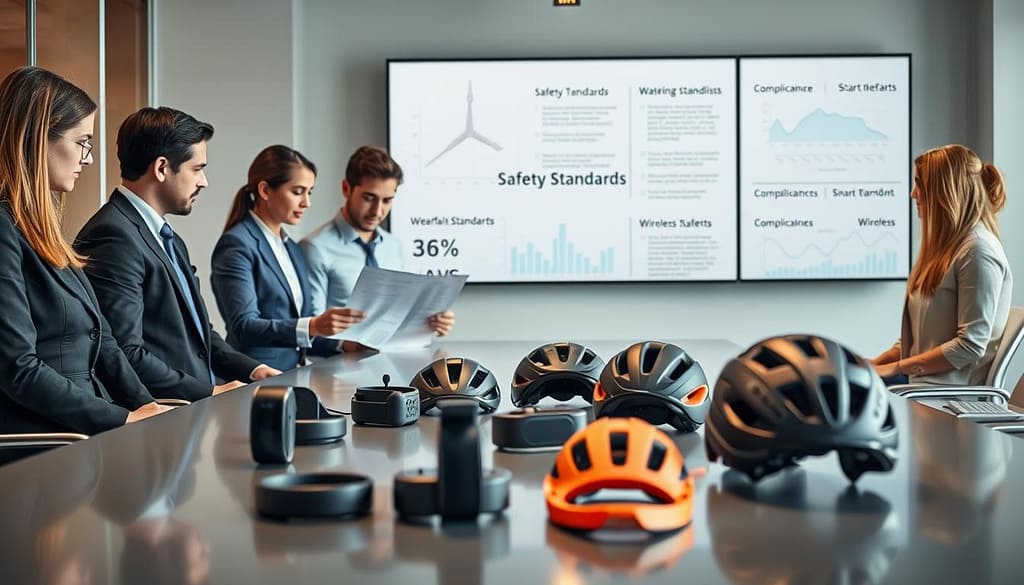
Let’s look at the three main areas where your product will be tested legally.
The Safety Gauntlet: More Than Just a Helmet Sticker
You’ve made a helmet that can withstand a meteor strike. Great. But does it meet the NOCSAE standard for football helmets? For other gear, like shin guards, you need ASTM International or CE marks for Europe. It’s about proving your product won’t fail when it matters most.
The Invisible Fence: Wireless & Spectrum
Your wearable uses Bluetooth or transmits data? You’re now in the telecom business. The FCC has strict rules on radio frequency, power output, and interference. Your mesh network can’t jam Wi-Fi signals or interfere with communications. It’s a mix of physics and law.
The Chemical & Medical Mire
This is where it gets personal. A wearable that touches skin? That’s a biocompatibility question. A fabric with “moisture-wicking” claims? That’s a chemical treatment. If your product makes claims like “improves circulation,” you’ve entered the FDA‘s domain. And if you’re testing on humans, you’ll face the Institutional Review Board (IRB).
This isn’t just red tape. It’s the price to enter the big leagues. It’s what turns a prototype into a product that can be insured, sold globally, and won’t get you sued. Navigating this maze is essential. It’s what separates garage projects from global products.
Unit Economics & Pricing: Where Passion Meets the Spreadsheet
Let’s talk money. In sports tech, passion alone can’t pay the bills. Moving from a prototype to a real business is a big step. It’s about the numbers that show if you can make it big.
First, let’s look at COGS (Cost of Goods Sold). That fancy sports shirt isn’t just clothes; it’s a list of parts. Every piece has a cost. Saving a little on each item can make a big difference when you make more.
Then, there’s the margin. Imagine your smart sleeve costs $200. Selling it online, you might keep 60% of the profit. But selling it in stores changes the math. The profit drops to 30% or less after everyone takes their cut.
But there’s a twist—the service revenue. This is the key to success. You can give away the hardware, like a smart sock, but charge for the extra services. For example, $30 a month for AI coaching. This is the magic that makes your business grow.
Think about athleisure brands. They sell more than just clothes; they sell a lifestyle. The Lululemon 2023 annual report shows how they’ve grown by selling more than just clothes. They sell a whole ecosystem of products and services.
Here’s a quick breakdown of the margin journey from factory to profit:
| Channel | Example Product | Retail Price | Gross Margin | Key Insight |
|---|---|---|---|---|
| Direct-to-Consumer (D2C) | Smart Compression Sleeve | $199 | ~60% | You keep most of the pie, but you carry all the marketing and logistics. |
| Retail/Wholesale | Same Smart Sleeve | $199 | ~30-40% | You gain scale and reach, but the retailer takes a big bite. |
| Service/Subscription | App + Analytics | $20/month | 80%+ | The golden goose: high-margin, recurring, and sticky. |
The bottom line? Sports tech isn’t just about making money. It’s about building a strong business. The hardware is just the start. It’s the service model that makes your business strong. It’s the difference between a one-time sale and a loyal customer base.
Fundraising Signals: Decoding the Capital Chorus
In the world of startup fundraising, money is just one part of the game. The source of your capital tells a lot about your company. It shows where you are and where you’re going. In sports tech, there are key signals: grants, angel investments, venture capital, and strategic investors.
The SBIR/STTR grant is a big deal. It’s not free money; it’s a boost for your R&D. Getting one means your tech has been tested and approved. It shows VCs that your tech is real and worth investing in.
Angels and VCs listen to different things. Angels focus on the story and the founder’s passion. Venture Capital looks at the numbers and the business plan.
The strategic investment is the top signal. Money from big names like Nike or Adidas means a lot. It shows you’re building something big and important.
Relay Ventures and Future of Sport Lab (FSL) show how to use signals well. They don’t just invest; they help startups grow. An investment from them means a startup has been checked out and is ready to go.
So, how do you understand the signals in your cap table?
- The Grant (SBIR/STTR): Shows your tech is real and worth investing in.
- Angels & Early VCs: Believe in your story and the market fit. They bet on you.
- The Strategic: The best signal. It’s not just money; it’s a sign of approval and a chance for partnership or acquisition.
Your cap table tells the world about your company. A mix of grants, angels, VCs, and strategic investors is the best signal. It shows you have the tech, a good story, a scalable model, and industry approval. It’s like going from a one-hit wonder to a superstar.
Case Snapshots: Startup Paths and Pivots
The journey from research to product on an NFL sideline is where startups are born, fail, and sometimes, thrive again. It’s not just about better gear; it’s a lesson in applied science and strategic changes. The path is rarely straight—it’s full of calculated turns.
Forget the stereotype of the lone inventor. Today’s sports tech is built on tech transfer, where a university lab’s breakthrough meets a founder’s hustle. The path isn’t a clean sprint; it’s a grueling decathlon of business, science, and a little luck.
Let’s examine the playbook of a few who made the leap.
CoachThem started with ex-pros who knew the pro problem intimately: chaotic practice planning. Their founder-market fit was so obvious it hurt. They didn’t invent a new sensor; they packaged a software solution for a problem they lived. The pivot wasn’t in the tech, but the audience—they went from a pro-only tool to a platform for elite youth and college programs, scaling a solution born in the NHL.
Then you have the classic tech transfer play. Startups like Elev8 and Perform spun out of university research on smart fabrics. The core tech was born in a materials science lab, a textbook case of academic IP finding a commercial path. Their pivot? Taking temperature-regulating fabric from a lab experiment to the base layer of a World Cup team.
Lubu Technologie took a more clinical route. Their smart insole tech was born in a biomechanics lab for gait analysis. The initial market was clinical rehab. Their pivot was a masterstroke: they repackaged that same tech for the consumer and pro-sports market. The core sensing tech for injury rehab became the engine for a performance and injury-prevention tool. That’s not a feature update; it’s a business model pivot.
Perhaps the most fascinating pivot is the cognitive one. HooperIQ didn’t just analyze the game; they analyzed the mind of the game. Using AI, they pivoted from basic performance stats to a platform that models decision-making, effectively running AI through game scenarios. Their pivot was a tech stack pivot, using their core AI for a completely novel application in sports psychology and strategy.
The common thread? A tech transfer isn’t a one-time event of licensing a patent. It’s a continuous process of adaptation. The startups that thrive are the ones who treat their core technology as a versatile tool, not a single-product solution.
The table below shows how these varied starting points lead to vastly different, yet successful, market entries.
| Startup | Origin Story | Core Technology | The Critical Pivot |
|---|---|---|---|
| CoachThem | Founded by ex-pros who lived the problem of chaotic practice planning. | Practice management & communication platform. | Pivoted from a pro-only tool to serving elite youth & college programs, dramatically expanding TAM. |
| Elev8 & Perform | University spin-off (tech transfer) on smart fabric research. | Advanced thermoregulating fabrics & biometric sensing. | Pivoted from a materials science project to a B2B supplier for pro teams and high-end apparel. |
| Lubu | Spin-out from clinical gait analysis lab. | Smart insole with pressure and motion sensors. | Major pivot from clinical rehab device to a consumer/pro-sport performance & recovery tool. |
| HooperIQ | Founded by data scientists and sports analysts. | AI for game scenario modeling and player cognitive analysis. | Pivoted from a pure analytics dashboard to an AI-driven cognitive training and strategy platform. |
The lesson isn’t just to pivot, but to pivot with your technology. Lubu’s insoles didn’t change, but their target market did. HooperIQ’s AI didn’t change, but its application deepened. This is the real tech transfer playbook: it’s not just moving tech from lab to market, but being ready to reinvent its application entirely.
Due Diligence Checklist for Designers & Investors
Forget just checking the cap table. The real due diligence for a sports tech startup is a deep dive into the team, the tech, and the legal details. This is your cheat sheet.
First, the team. Are the founders a mix of domain experts and technical wizards? A team of ex-NHL vets with a Caltech engineer is stronger than a solo PhD with a prototype. Next, the tech moat. Is the “revolutionary” sensor just a commodity accelerometer glued into a foam pad, or is there defensible IP?
This leads to the legal labyrinth of IP licensing. This is the minefield and the goldmine. Is the core patent owned by a university? What’s the deal? An exclusive, worldwide license is a fortress. A non-exclusive, field-of-use license is a leaky dam. Scrutinize the terms. What are the royalty rates? What happens if the startup is acquired? A bad IP licensing deal can sink an excellent tech play. Validate the patents. A provisional patent is a plan. An issued patent in your key markets is armor.
Due diligence is your final filter. It separates the all-star prospects from the benchwarmers before the check is cut.