
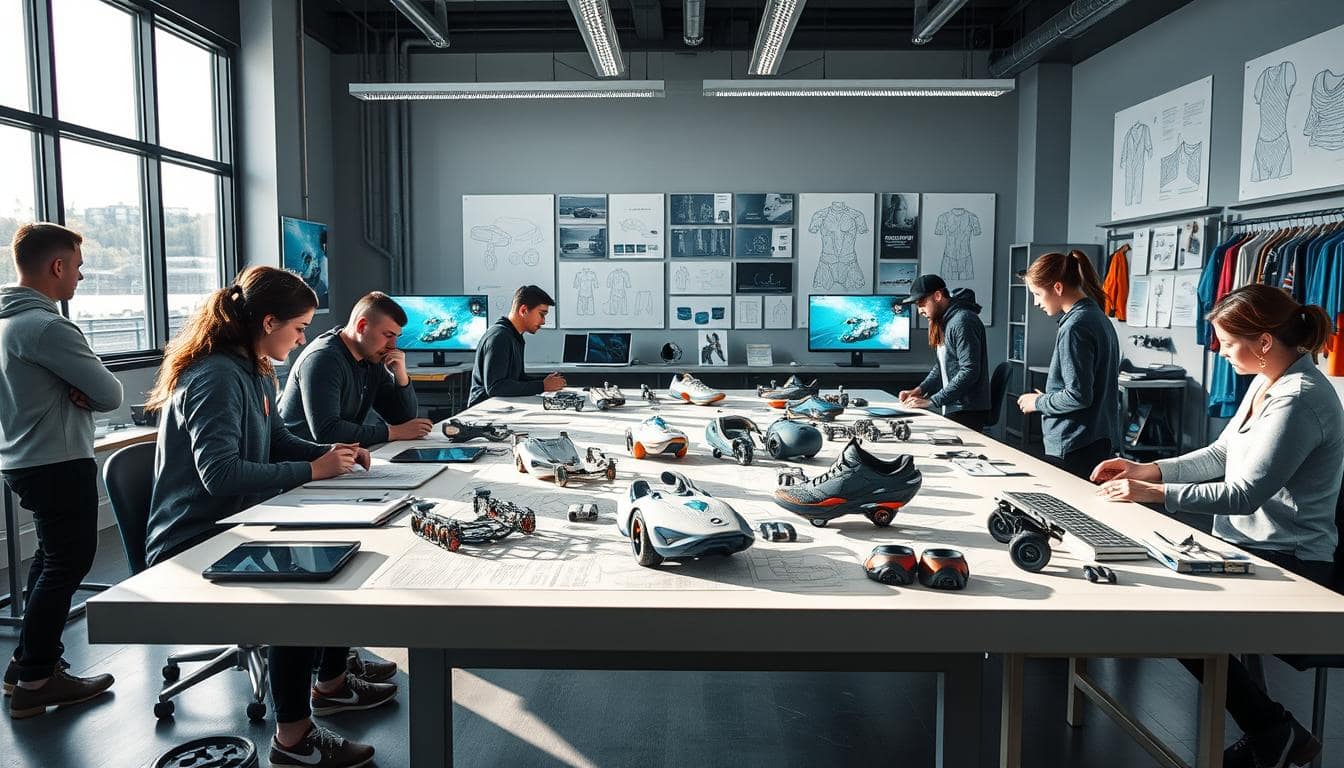
Forget sketchpads and mood boards. We’re taking you behind the scenes of where championships are made. It’s like Silicon Valley R&D meets Hollywood special effects, but with more sweat and fewer ping-pong tables. This is where inspiration gets a playbook.
This tour dives deep into the systematic, often ruthless, design studio processes that forge gold medals and championship rings. The real question isn’t “what did they create?” but “how did they systemically design to win?“
We’ll explore High Performance Management (HPM), a model that combines Taylorist efficiency and Soviet athletic systems. It shows a world where creativity isn’t left to chance. It’s managed, measured, and optimized with surgical precision, much like the modern sports technology shaping today’s games. Let’s analyze the machine behind the magic.
Tour of Top Sports Design Facilities
If James Bond needed top-notch gear, he’d skip Q Branch and head to these sports R&D fortresses. These aren’t just cubicles with mood boards. They’re the heart of the game, where champions are made.
Think of the FTEM framework. Athletes need a solid foundation, then talent development, and elite training. The gear they use follows the same path. These facilities are where products go from idea to victory.
Nike’s World Headquarters in Beaverton isn’t just an office. It’s a performance campus. It has biomechanics labs that rival NASA. There are environmental chambers that mimic extreme temperatures. Wind tunnels test fabrics for aerodynamics.
Adidas’ “Arena” in Herzogenaurach and Under Armour’s “Lighthouse” in Baltimore are similar. They’re innovation hubs where sport science meets design. The architecture is designed to spark creativity.
The real magic happens in the specialized labs. These are the secret units of sports R&D. Some focus on foot-strike mechanics, using advanced technology. Others test fabrics in extreme conditions. They’re finding the small advantages that win races.
| Facility Type | Primary Focus | Key Technologies | Scale & Example |
|---|---|---|---|
| Corporate Innovation Campus | End-to-end product lifecycle, brand storytelling | Biomechanics labs, environmental chambers, material libraries | Large-scale (e.g., Nike WHQ, Adidas Arena) |
| Specialized Performance Lab | Deep research on specific performance factors | Motion capture, force plates, metabolic carts, 3D body scanners | Mid-scale, often university-affiliated |
| Rapid Prototyping Workshop | Accelerating design-to-test cycles | Industrial 3D printers, CNC machining, laser cutters | Small to mid-scale, agile teams |
| Athlete Testing Center | Real-world validation with elite athletes | Wearable sensors, on-field data capture, feedback systems | Variable, often integrated with training facilities |
The table above shows the ecosystem. It’s not one-size-fits-all. The best sports facility architecture firms know this. They design spaces for specific purposes in the innovation chain.
Inside, it’s like a science fair and a pit crew huddle. A footwear team might analyze a runner’s gait. Next door, a textiles group tests new fabrics. Down the hall, a prototype is being 3D-printed based on data from an Olympian.
The workflow is circular. Data from athletes guides design. Prototypes are tested, creating more data. The facility is designed to speed up this process. It’s a physical example of the iterative design process.
Smaller, independent studios offer a different vibe. They’re quick to adapt, focusing on niche sports or technologies. Without big company red tape, they can change direction fast. Their spaces might be smaller, but they’re just as intense. Every inch is used to create the next big thing.
This infrastructure is the unsung hero of modern sport. We see the athlete on the podium. We see the gear they wear. But we rarely see the climate-controlled room where it was tested. That’s the point. The best sports R&D works behind the scenes, turning small improvements into big wins.
Adidas Future Team Design Process
Adidas’s innovation goes beyond just three stripes. Their design process is a blend of psychology and biomechanics. It’s not just about designing shoes; it’s about creating athletic tools.
Their approach is based on the AGES model. This model is used for training elite minds. Adidas uses it to create products with precision.
Awareness is the first step. It’s not about market trends. Designers immerse themselves with athletes to understand their movements and feelings.
Then comes Generation, the idea explosion phase. Here, there are no limits. The lab is filled with many ideas. The goal is to find the best ones.
Adidas’s innovation labs add Emotion as a step. They make sure the product feels right. It should inspire confidence and feel fast.
The last step, Spacing, is about taking time. Prototypes are tested and then revisited. This allows for better solutions.
Adidas avoids being outdated by using a proven process. The AGES model helps them create lasting products. Their space is designed to support this process.
The result is equipment that feels like an extension of the user. Adidas’s innovation labs focus on creating the future of sports.
Under Armour Innovation Lab Methodologies
Walking into Under Armour’s Innovation Lab is like stepping onto a starship. Screens show real-time biometric feeds. Engineers talk about teraflops and micro-strain. It’s like Adidas is the seasoned professor, and Under Armour is the disruptive grad student.
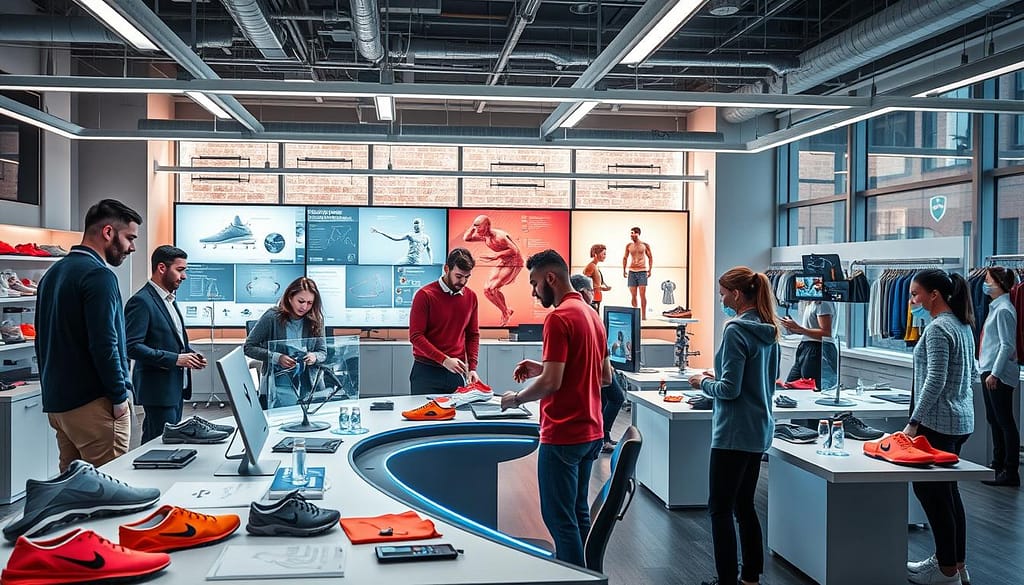
Their creative methodology is all about aggressive data collection. Forget focus groups. They instrument athletes like Formula 1 cars.
They use sensors to map muscle activation in milliseconds. Thermal cameras create heat maps of exertion. Motion capture breaks down micro-movements invisible to us.
This turns design into a science. The process is like monitoring elite training regimens. Every hypothesis must pass a test of empirical validation.
So, vanity gets left at the door. A sleek-looking seam that creates drag? Scrapped. A trendy pattern that interferes with sensor placement? Redesigned.
Ever seen a running shoe that looks like it was made by an AI trained on coral reefs? That’s Under Armour’s process. Form follows quantified function, not fleeting fashion.
This empirical approach is their signature. It’s a creative methodology with a dashboard. Every aesthetic choice has a performance KPI. The question shifts from “Does this look fast?” to “Can we prove it is fast?”
Independent Sports Design Studio Profiles
Forget the big corporate buildings. The magic in sports gear often happens in small, hidden places. These are the independent studios, the indie bands of the design world. They show us how to be agile and resourceful.
Working without a big brand’s budget forces them to be creative. It’s like innovation under pressure. They focus on the details, like a special forces unit.
They don’t compete by spending more money. Instead, they outsmart. They specialize in very specific areas. For example, one studio might only work on cycling shoes, while another focuses on marathon gear.
Their sports R&D is different. It’s a high-speed camera in a backyard or a 3D printer next to a coffee machine. They work with universities to test their ideas. They learn fast and fail often.
Building a relationship with athletes is key. It’s not just about sponsorship. They work closely with athletes, making changes based on feedback. This feedback loop is quick and powerful.
So, how do these small studios compare to big labs? Let’s look at the main differences.
| Aspect | Independent Boutique Studio | Major Corporate Lab | Key Advantage for the Indie |
|---|---|---|---|
| Core Design Process | Athlete-led, hyper-iterative, and intuitive. Decisions are made in hours. | Committee-driven, phase-gated, and data-heavy. Decisions can take quarters. | Speed and adaptability to athlete needs. |
| R&D Budget & Tools | Micro-budget. Relies on open-source software, rented time on advanced equipment, and clever hacks. | Macro-budget. Owns the latest million-dollar machines and proprietary software suites. | Resourcefulness and cost-per-innovation ROI. |
| Prototyping | In-house 3D printing and hand fabrication. Dozens of micro-iterations per week. | Outsourced to specialized departments or factories. Fewer, more polished iterations. | Unmatched hands-on learning and rapid conceptual evolution. |
| Testing Environment | Real-world field testing is primary. “Lab” data is often gathered via wearable sensors in competition. | Controlled laboratory simulations are primary, supplemented by athlete trials. | Data from the crucible of actual performance, under true stress. |
| IP & Design Protection | Relies heavily on trade secrets, first-to-market speed, and deep trust networks. Formal patents are costly. | Aggressive patent portfolio strategy with dedicated legal teams. | Agility and secrecy; harder to pin down a moving target. |
The table shows a big difference. The indie studio acts fast, without endless analysis. Their sports R&D is all about doing.
Protecting their ideas is a challenge. They rely on quickness and relationships, not legal battles. Being always ahead means you don’t need to defend yourself.
Learning from these studios is more than just about cool gear. It’s about how ideas grow in tight spaces. The next big innovation could come from a small team or a huge lab. This is exciting for the future of sports.
Athlete Collaboration and Feedback Integration
The most advanced innovation labs measure success by one thing: does the athlete trust you enough to tell you your prototype sucks?
This secret isn’t shared on studio tours. The best design comes from a messy, back-and-forth dialogue with the athlete. Here, the athlete becomes a co-engineer, not just an endorser.
Forget about polite suggestion boxes. This is a feedback warzone where trust and brutal honesty are key. The creative methodology focuses on building a feedback loop, not just aesthetics.
Think of it as a high-stakes translation service. An athlete might say, “This feels dead on the lateral cut.” Your job is to understand what they mean.
What does “dead” mean? Is it a material issue or a geometry problem? This is where innovation labs turn complaints into breakthroughs.
This process mirrors performance psychology findings. For new behaviors or equipment to stick, the athlete must see its impact. Did a tweak shave .02 seconds off the crossover?
The loop is closed when the athlete feels the difference. This is the essence of creative methodologies. It’s a dance of trust and critique.
To build this environment, treat elite athletes as partners. Your innovation lab must become a sandbox for behavior.
The table below contrasts the old, endorsement-model relationship with the new, integrated co-creation paradigm.
| Collaboration Model | Primary Focus | Feedback Style | Outcome |
|---|---|---|---|
| The Endorser | Brand Image & Marketability | Polite, General, Post-Product | A signature on a shoe that looks cool. |
| The Co-Engineer | Performance & Tangible Impact | Brutal, Specific, Iterative | A shoe that becomes an extension of the athlete’s nervous system. |
| The Facilitator (Designer/Director) | Translation & Synthesis | Seeks to understand the “why” behind the “feel.” | Data-informed, athlete-validated design decisions. |
This isn’t about getting a bland quote. It’s about creating a product so intuitive, it disappears. The goal is for the equipment to feel like a natural part of the athlete.
The real creative methodologies are rooted in this reflective practice. It requires a lab culture that seeks out criticism. This is a big change from the “build it and they will come” approach.
The payoff? You move from creating gadgets to engineering confidence. The athlete and equipment become one. That’s when you start building championships.
Rapid Prototyping and 3D Printing Workflows
Remember when making a new product prototype took months and a lot of money? Those days are gone, along with fax machines and casual Fridays in banks. Today, top design studio processes work fast, thanks to 3D printing and the idea of “fail fast, learn faster.”
This fast pace is like agile development in action. It turns slow design work into quick, focused sprints. Being able to try and improve ideas quickly is key for today’s creative teams.

Let’s look at how it works. A designer changes a digital model of a shoe’s midsole for better energy return. By lunch, it’s being printed in a special material. By afternoon, it’s tested by an athlete. By evening, data is used to improve the design.
This quick cycle makes innovation more accessible. Small studios can now try new materials and designs, just like big companies. Being wrong quickly is okay, as it leads to new ideas fast.
The real magic is making the right thing quickly. Rapid prototyping lets teams try many versions. The best one wins, while others teach valuable lessons.
This change makes the design studio process more open and fast. The 3D printer is central, creating new ideas fast. It’s like evolution in action, making things better quickly.
Performance Testing Laboratory Setups
The design studio is like a church of innovation. The performance testing lab is like its tough courtroom. Here, prototypes face tests based on physics, not opinions. It’s the heart of serious sports R&D, a big investment in truth.
Forget asking athletes if a shoe “feels fast.” Here, you measure the energy return from its foam midsole. Wonder if a new swimsuit fabric reduces drag? The wind tunnel gives a clear answer. These labs test everything, simulating all competitive stresses.
Walk into a top-tier facility, and you’ll see a lot of tools:
- Environmental Wind Tunnels: Not just for cars and planes. They test everything from cycling skinsuits to bobsledder’s helmet posture.
- Hydraulic Force Platforms & Motion Capture: These systems map the exact forces an athlete generates. They show how a basketball shoe stabilizes a lateral cut or how a ski boot transfers energy to the edge.
- Robotic Cyclers & Impact Simulators: This is the grunt work. A robotic leg can “run” in a shoe prototype ten thousand times, collecting durability data no human tester could ever provide.
- Athlete Monitoring Biometrics: Directly echoing the US Ski and Snowboard Team’s methods, labs use advanced sensor suites. They track muscle oxygen levels, core temperature, and metabolic efficiency in real-time.
This approach changes the design process. It moves from *”We think this is better”* to *”We can prove it is better, by 2.3%.”* That number is what separates a minor tweak from a championship edge.
The real magic happens when this data flows back to designers. It creates a closed-loop system. A sprinter’s force plate data informs the plate geometry in the next shoe iteration. Wind tunnel results on a jersey dictate the seam placement in the following version.
In essence, the performance lab is the great translator. It converts athletic sensation into engineering specifications. It takes the “feel” described by a snowboarder and defines it in terms of flex pattern and torsional rigidity. This is how intuition gets codified into a repeatable, winning product. The lab doesn’t just test gear; it rigorously audits the very promise of innovation, ensuring that every claim can survive its day in court.
Intellectual Property and Design Protection
Forget the dazzling innovation labs for a moment. The real action is in windowless legal departments. Here, billion-dollar ideas are wrapped in legalese. All that brilliant design work is worthless without legal protection.
Intellectual property is not just a concern. It’s the entire business model.
Let’s follow the money. Source 3’s economic analysis shows a harsh truth. Massive R&D investments need to bring in huge returns. A proprietary weaving pattern is not just cool tech. It’s a competitive weapon with an expiration date.
The legal teams at Nike, Adidas, and Under Armour are as vital as any star athlete. They use patents, trade secrets, and sometimes aggressive litigation.
IP protection is like a layered defense system. At the top are utility patents, protecting inventions like a novel cushioning system. Below that are design patents, guarding the unique look of a shoe silhouette. Then come trade secrets, the secret formulas for materials that never see a patent office.
Each layer has a strategic purpose in the economic war.
Why do companies have theatrical product launches? Marketing loves the spectacle. But there’s a legal reason too. They’re establishing prior art. When a company unveils a new technology, they’re saying, “We did this first.”
This is a defensive move in the constant cold war of sports design espionage.
Yes, espionage is real. Former employees take hard drives. “Reverse engineering” teams work around the clock. Consultants know too much about competitors’ processes. The industry is full of industrial secrecy.
The most valuable secrets stay in the innovation labs. If they leave, they’re encrypted, watermarked, and tracked.
| Protection Type | What It Covers | Duration | Strategic Use |
|---|---|---|---|
| Utility Patent | Functional inventions, processes | 20 years | Blocking competitors from core technologies |
| Design Patent | Ornamental appearance, aesthetics | 15 years | Protecting iconic silhouettes and brand identity |
| Trademark | Brand names, logos, slogans | Indefinite (with use) | Building brand equity and consumer recognition |
| Trade Secret | Formulas, processes, methods | Indefinite (if secret) | Protecting manufacturing advantages without disclosure |
Look at that table. Notice how each tool has a different lifespan and purpose. The smartest companies build portfolios mixing all four. They patent what they must disclose, while keeping their true “secret sauce” as trade secrets.
This is a chess game where every move protects millions in innovation labs investment.
The litigation is where this gets really interesting—and expensive. Remember Adidas’ three-stripe trademark battles? Or Nike’s patent suits over flyknit technology? These aren’t petty squabbles. They’re calculated market maneuvers.
Winning a patent infringement case can mean competitor products pulled from shelves right before the holiday season. That’s not just a legal victory; it’s a market share coup.
So what’s the takeaway for designers working in these hallowed innovation labs? Every sketch, every prototype, every material sample is intellectual property. Document everything. Date everything. Assume someone will try to copy it.
The romantic notion of pure creativity must coexist with the pragmatic reality of ownership.
In the end, a brilliant methodology isn’t just about creating the best product. It’s about owning it. The legal frameworks surrounding these design studios aren’t bureaucratic red tape—they’re the economic engine. They transform flashes of inspiration in the lab into durable competitive advantages in the marketplace. Without them, all that innovation would just be expensive art.
Next time you see a groundbreaking product launch, look past the celebrity athlete and the hype video. See the invisible fortress of patents being erected. That’s where the real game is won—not on the field, but in the filing cabinet.
Future Trends in Sports Design Spaces
Where does the race for innovation end? It’s not about bigger labs anymore. It’s about smarter integration.
The future combines biology with silicon. Imagine gear made from your DNA, adjusted by your body’s signals. We’re moving towards gear that fits you perfectly.
Soon, the lab will be inside you. Sensors will give you constant feedback. This isn’t just a dream. It’s already happening in sports, like at the University of Northern Iowa.
Virtual and augmented reality will break down distance. A designer in Portland can work with an athlete in Sydney. The world will be our innovation lab.
The biggest change? Designing gear and athletes will become one. The studio, lab, clinic, and field will all blend into one place. The winning strategies of tomorrow are being drawn today, in these new areas.