
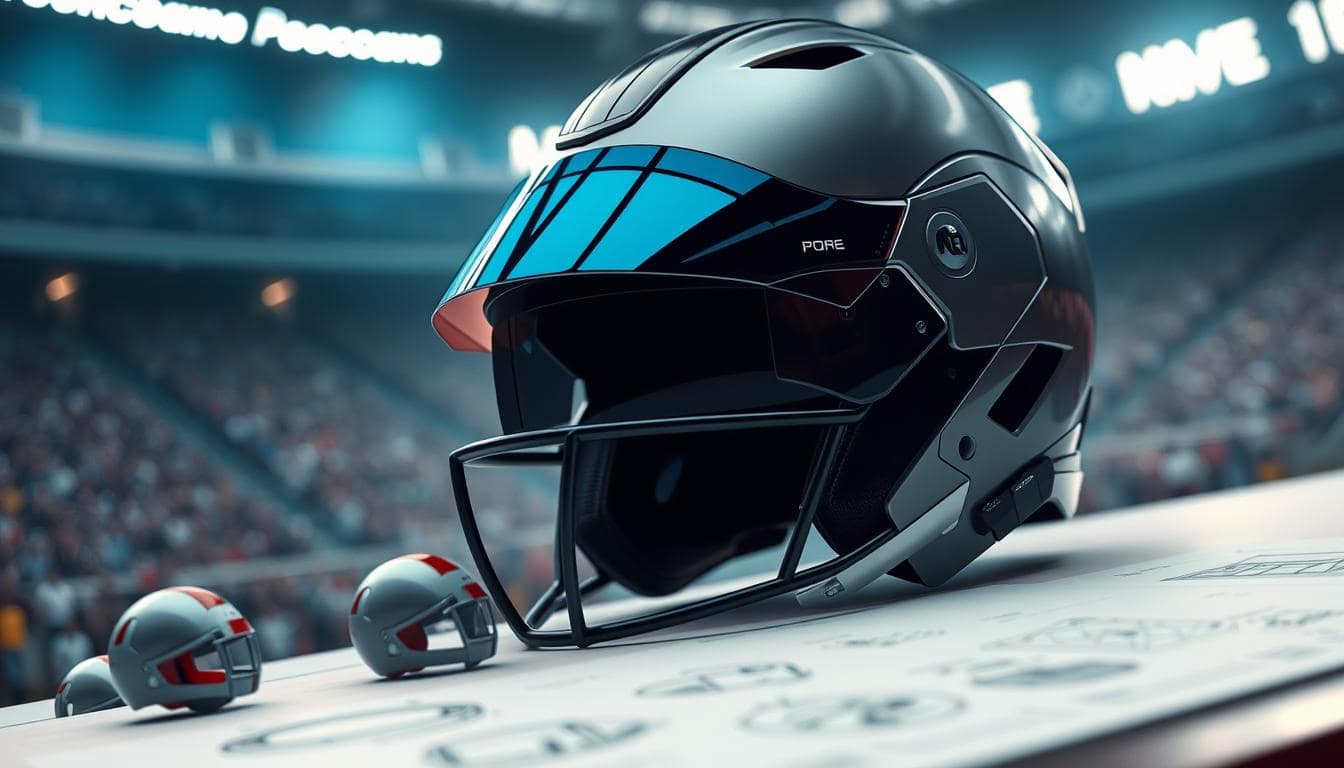
Do you remember when football players wore leather caps for protection? We’ve made huge strides from the “leatherhead” days. But, making a safer football helmet is a tough challenge. It’s not just about adding more padding; it’s a mix of science, biomechanics, and surviving impacts that can be over 100 Gs.
The NFL’s helmet design engineers face a complex problem. The league’s $60 million “Engineering Roadmap” and HeadHealthTECH challenges are a lesson in open innovation. They’re not just funding science; they’re asking the public to help solve a health crisis.
This challenge has changed how we think about sports. We’re moving from treating injuries to preventing them through engineering. It’s a race to design the injury out of the game. The prize is a player’s brain health.
Selection Frameworks
Forget looking for the “best” material. In the world of protective gear, it’s not just about one property. It’s a complex problem where every choice matters. You’re balancing many factors, not just picking a substance.
This process is like a high-wire act. A wrong move can have serious consequences. It’s about finding a balance, not a single solution.
Imagine a real-world Ashby chart. You have to balance impact absorption with weight, cost, and more. The NFL’s helmet poster shows this clearly. It ranks helmets based on lab tests, showing the cost of safety.
The Multi-Dimensional Trade-off
Choosing a material is not simple. A foam that absorbs impact well might be stiff. A breathable material might not be safe enough. The NFL’s testing shows this balance.
The next step is Life Cycle Assessment (LCA). We now consider a material’s total impact, not just its performance. Is a new foam better if it’s greener, even if it’s more expensive to make?
Let’s look at what matters in choosing helmet materials:
| Material Class | Impact Attenuation | Weight Penalty | Thermal Comfort | Relative Cost | Sustainability Quotient |
|---|---|---|---|---|---|
| Advanced Polymer Foams | Excellent | Low | Fair | High | Low (Petro-based) |
| Multi-Density Lattices | Superior | Medium | Good | Very High | Medium (Process-Intensive) |
| Bio-based Composites | Good | Medium | Excellent | High | High (if circular) |
| Traditional Padding | Good | High | Poor | Low | Low (Non-recyclable) |
No material is perfect in all ways. The best choice depends on what you value most. Do you want better impact protection or lighter weight? Is being green important to you?
The headhealthtech insights show that the best products balance many factors. They meet the needs of safety, comfort, and sustainability.
Damping & Impact Attenuation
Imagine your couch cushion and a helmet liner meeting at a bar. They might be distant cousins. In the world of head protection, materials don’t just absorb force. They manage energy in a complex way.
The NFL’s impact attenuation challenge is not about making a softer pillow. It’s about creating a material that’s soft at rest but hard on impact. This is the frontier of concussion mitigation, where milliseconds and material memory are key.
The NFL’s Engineering Roadmap and its 1st and Future competition focus on this challenge. They’re not just funding softer foams. They’re funding smarter materials.
The goal is not just to soften a blow. It’s to time the dissipation of kinetic energy with precision. This ensures the brain experiences a smooth deceleration, not a violent stop. This is the art and science of concussion mitigation today.
From Viscoelastic Foams to Rate-Dependent Materials
Your couch cushion is a slow, squishy damper. A helmet liner must be a high-speed, high-IQ energy manager. The key difference is strain-rate dependency—how a material behaves differently at 1 mph versus 15 mph.
The foam in your sofa is slow and predictable. But in a helmet, it must transform in milliseconds into something complex.
This is where viscoelastic models come into play. A viscoelastic material has a split personality: part viscous liquid, part elastic solid. Under slow pressure, it flows and yields. Under sudden impact, it can “lock up” and behave like a solid, absorbing and dissipating energy in a controlled way.
The NFL’s research into “rate-dependent tethers” is a direct assault on this exact problem. They’re not just building a better cushion. They’re engineering a material with split-second intelligence.
Viscoelastic Models & Strain-Rate Effects
Think of a helmet liner as a shock absorber for your brain. A simple spring absorbs energy and returns it. But a viscoelastic material absorbs energy and dissipates it as heat, like a car’s shock absorber.
The strain-rate is the critical variable. A slow push might let the material flow. But a sudden impact triggers a stiffer response.
The holy grail is a material that’s soft and forgiving under normal conditions but becomes rigid under high-velocity impact. This isn’t science fiction—it’s the science of rate-dependent materials. The NFL’s research is asking: Can we create a material that’s a pillow until the moment it needs to be a vault door?
Consider the difference between these two impact scenarios:
| Material Behavior | Low Strain-Rate (Slow Push) | High Strain-Rate (Impact) |
|---|---|---|
| Traditional Foam | Compresses slowly, good energy return | Bottoms out, transmits force |
| Ideal Rate-Dependent Material | Soft, compliant, comfortable | Dramatically stiffens, absorbs and dissipates energy |
| Viscoelastic Polymer | Flows and deforms slowly | Locks and absorbs impact energy |
This rate-dependent behavior is why the old-school “softer is better” approach fails. The key characteristics of an ideal impact-absorbing material include:
- High strain-rate sensitivity: Its stiffness increases with the speed of impact.
- Energy dissipation: It converts kinetic energy into heat or other forms of energy.
- Recovery: It returns to its original shape, ready for the next hit.
- Consistency: Performance doesn’t degrade with sweat, temperature, or time.
The NFL’s research into advanced materials isn’t just about better padding. It’s about programming a material’s response to violence. It’s the difference between catching an egg in a silk handkerchief and catching it with a baseball mitt.
The goal is clear: to engineer a material that feels like nothing during normal use but transforms into a high-tech shield the instant it’s needed. That’s the promise of rate-dependent, smart materials for impact attenuation and true concussion mitigation.
Lattices & DfAM: When Your Helmet Liner is a Mathematical Marvel
Forget everything you know about foam and padding. Helmet design is now about new shapes, not just materials. We’re architecting energy absorption from the molecule up, using lattices so complex they make a spider’s web look simple. This is the world of Design for Additive Manufacturing (DfAM), where the helmet liner is grown, layer by layer.
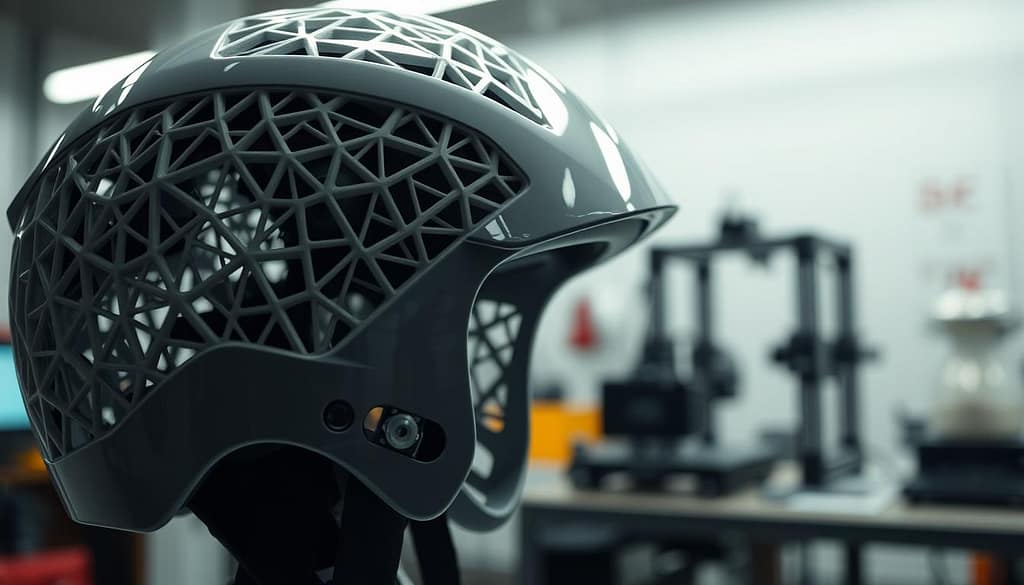
Inspired by the NFL’s HeadHealthTECH challenges, the focus has shifted from what the helmet is made of to how it’s structured. The NFL and research groups like Biocore are testing geometries, not just materials. We’re moving to active, structured systems that manage impacts with precision.
The Unit Cell is the New Molecule
Forget the periodic table for a second. In advanced helmet design, the basic building block is the unit cell. Think of it as the fundamental, repeating Lego brick of a lattice structure. This single, often microscopic, 3D shape is the new atom of impact protection.
This is the “molecule” in our new material science. By adjusting the size, thickness, and connectivity of the struts in a unit cell, engineers can program a material’s behavior. Want a liner that’s soft and compliant where it touches the head but stiff and reactive at the point of impact? You don’t change the material; you tune the geometry. A gyroid lattice, for example, can be designed to have a “soft” direction and a “stiff” direction, all from the same base polymer.
Tunability and Process Constraints in AM
This tunability is DfAM’s superpower, but it’s not a magic wand. The promise of a perfect, multi-density, multi-material helmet liner printed in one go is tantalizing, but the printer is the ultimate gatekeeper. The design of a helmet is no longer just an aesthetic or aerodynamic challenge; it’s a complex dance with the 3D printer itself.
The dream helmet liner might be a gyroid lattice that’s dense and stiff at the crown (for direct impacts) and transitions to a softer, more open lattice at the sides for comfort and multi-impact management. But can your printer handle the insane, unsupported overhangs of that design? Will the chosen polymer, when printed in hair-thin lattices, have the fatigue resistance for a 300-lb lineman’s tenth concussion? This is the real DfAM puzzle: designing not just for the performance you want, but for the process constraints of the machine building it.
The future of helmet design isn’t just about finding a new wonder-material. It’s about data, geometry, and a 3D printer. It’s about moving from passive, dumb materials to active, intelligent structures. The next generation of helmets won’t just be worn; they’ll be engineered from the inside out, one mathematically perfect lattice at a time.
Sustainability Levers
The world of helmet materials is changing. We’re not just focusing on how well helmets protect us. We’re also looking at the environmental impact of making them. The headhealthtech insights from the NFL’s Engineering Roadmap are key. They help us move towards a more sustainable future.
We’re shifting from a “take-make-dispose” model to a circular one. This change is more than just reducing harm. It’s about creating a better system from the start.
Bio-based Content: Beyond Petrochemicals
Helmets have long used petrochemical foams. But, recent challenges are pushing for a change. Imagine using materials grown in a lab instead of drilling for them.
Mycelium-based foams and polylactic acid (PLA) from corn or sugarcane are being explored. These materials offer a closed-loop solution. They promise to return to the earth after use, with performance that meets helmet standards. It’s a move towards a bio-based economy, one helmet at a time.
Circularity: From Dumpster to Resource
Recycling helmets today often means they end up in landfills. Current helmets are hard to recycle because they’re made of many materials stuck together. True circularity requires helmets that can be easily broken down and recycled.
We need to design helmets where each part can be separated and reused. This isn’t just about recycling logos. It’s about designing a helmet’s end-of-life as carefully as its on-head performance. The headhealthtech insights show there’s a demand for a closed-loop solution.
Modularity: The Unsung Hero of Sustainability
Modularity is a key part of sustainability, often overlooked. It’s like the smartphone model for head protection. Why replace a whole helmet when just the liner needs to be changed after an impact?
A modular helmet would have a hard shell and a replaceable liner. This approach reduces waste and extends the helmet’s life. It turns a single-use item into a reusable platform. It’s not just sustainable; it’s smarter design.
Reliability & Aging (UV, Sweat, Temp Cycles, Fatigue)
In an NFL game, a helmet is more than just equipment. It’s a test of material science under extreme stress. Lab tests can’t fully replicate the wear and tear of a 17-week season. The difference between a lab test and real-world use is huge.
The Real-World Testing Lab
Lab tests are like a pop quiz. But the NFL season is the final exam, with questions from Mother Nature and 300-pound linemen. A helmet’s data sheet promises a lot, but the NFL season tests if it can deliver.
The real test isn’t just one hit in a lab. It’s about the 10,000th micro-impact and the 50th cycle from hot to cold. The league’s extreme weather is the ultimate test. A liner that works on opening day may not by Week 10, due to UV and sweat damage.
| Environmental Stressor | Controlled Lab Test | Real-World Field Condition | Material Failure Risk |
|---|---|---|---|
| UV Radiation | Controlled UV chamber, 300-400nm wavelength for 500 hours. | Direct sunlight for 4+ hours during practice/games, season-long exposure. | Polymer chain scission, discoloration, surface embrittlement. |
| Thermal Cycling | Thermal shock test: -20°C to +70°C for 50 cycles. | From a 100°F equipment truck to a 20°F sideline, multiple times per game. | Micro-cracking, delamination of composite layers, foam cell collapse. |
| Bio-Fluid Exposure | ASTM F2129 (sweat simulation), 24hr immersion. | Constant sweat, Gatorade, and the occasional blood, game after game. | Hydrolysis, plasticizer leaching, foam softening, and odor-causing bacteria. |
| Dynamic Fatigue | ISO 8307: Cyclic compression, 1000 cycles at 10Hz. | Repeated sub-concussive impacts in practice and games, thousands per season. | Permanent set in foam, reduced energy return, hysteresis. |
This table is more than just a spec sheet. It shows the difference between lab tests and real-world use. The concussion mitigation strategy that works in a lab may fail in the wild. A foam’s energy absorption changes with UV, cold, and heat.
The only lab that matters for concussion mitigation is the 100-yard field. The material that passes here earns a helmet decal. It’s not just about passing a test; it’s about being reliable in the real world.
Supply Chain Risk & Qualification (RoHS/REACH, Batch Variance)
You’ve spent months perfecting your digital lattice structure. It’s a masterpiece of energy management. But when it hits the field, it’s 15% off. The problem? A new batch of resin from a new supplier.
In the world of protective gear, your material’s success depends on its supply chain. The HeadHealthTECH challenge grants fund innovation but also demand a reality check. You must prove your material can handle the real world, not just a lab.

More Than a Spec Sheet
Your material spec sheet is like a restaurant menu. It shows what’s available. But can every chef make it the same way everywhere? The HeadHealthTECH insights from the NFL show a harsh truth: specs are promises, not guarantees.
RoHS and REACH compliance are just the beginning. They ensure you’re not using harmful materials. But they don’t promise performance. A small difference in batches can change how a material works.
The Silent Killer: Batch-to-Batch Variance
This is the silent killer of great designs. You qualify a material based on one sample. But the first production order might be different. This small change can affect how well it works.
Qualifying a material isn’t a one-time thing. It’s ongoing. You need to qualify not just the material, but the supplier’s supplier too. This means tracking the material’s history, from raw polymers to curing.
The table below shows the difference between old and new ways of qualifying materials.
| Qualification Focus | Traditional, Spec-Sheet Approach | Proactive, Risk-Averse Strategy |
|---|---|---|
| Supplier Strategy | Single-source for lowest cost. | Multi-source with at least one qualified, regional supplier. |
| Batch Control | Accepts Certificate of Analysis (CoA) at face value. | Incoming batch testing against a “golden batch” performance baseline. |
| Risk Assessment | Views geopolitics as a procurement issue. | Maps material sources and has a “Plan B” for critical components. |
| Regulatory View | RoHS/REACH as a compliance checkbox. | Treats RoHS/REACH as a starting point; adds stricter internal “Red Lists” of banned substances. |
True material qualification means thinking like a supply chain general. It’s about securing your flanks. If your material depends on a rare earth element from a single, unstable region, you’re taking a big risk. The NFL and NFLPA’s grants are about testing innovation against real-world challenges. It’s about making sure your material can be made consistently, anywhere in the world.
Case Studies: Materials That Moved the Needle
Forget the Hail Mary passes and last-second field goals—the real game-changing plays in football safety aren’t happening on the 50-yard line. They’re being drawn up in materials labs and forged in the crucible of structured innovation. The NFL’s prize challenges, like the HeadHealthTECH and 1st and Future competitions, have become the ultimate proving ground for materials that can take a hit. These contests don’t just fund research; they create a direct pipeline from the whiteboard to the gridiron, turning academic concepts into tangible protection. The proof isn’t in a peer-reviewed paper, but in the helmets and padding that walk onto the field every Sunday.
From Lab to Gridiron
The journey from polymer chemistry to the NFL sideline is rarely a straight line. It’s a gauntlet of prize challenges, impact tests, and grueling field trials. The most compelling evidence of this pipeline’s success lies in two distinct case studies that bookend the innovation spectrum: a helmet that rethought the system, and an add-on that made the existing system better. Both are direct products of the NFL’s structured innovation challenges.
First, consider the VICIS ZERO1 helmet. Its rise to the top of the NFL/NFLPA laboratory performance rankings wasn’t just about using a new foam. It was a system-level redesign that treated the helmet as a holistic energy-management system. The material innovation wasn’t a single “miracle polymer,” but a combination of a flexible outer shell and a unique liner that managed energy differently than traditional helmets. This system-level thinking, which prioritized how materials worked together over a single magic material, was a winning answer to the complex problem posed by the league’s prize challenges.
On the other end of the spectrum are the Guardian Caps. The premise is brilliantly, almost deceptively, simple: a soft-shell cover that adds a sacrificial, energy-absorbing layer over a standard helmet. It’s a material solution so straightforward it feels like it should have existed for decades. Yet, its development and validation were accelerated by the same competitive, problem-focused environment of the NFL’s prize challenges. It proved that innovation isn’t always about reinventing the core technology; sometimes, it’s about a smart, material-based add-on that changes the system’s performance.
The following table highlights how these two case studies, born from the same innovation ecosystem, tackled the same problem from opposite ends of the complexity spectrum.
| Case Study | Core Material Innovation | Key Performance Insight | Prize Challenge Role |
|---|---|---|---|
| VICIS ZERO1 Helmet | Multi-layer system with flexible outer shell & tuned liner | Redesigned the entire energy management system, not just the padding | NFL 1st and Future Competition; validated through league testing protocols |
| Guardian Caps | External, energy-absorbing soft-shell cover | Added sacrificial layer to existing helmets for impact management | Developed in response to the NFL’s call for innovative, immediately deployable solutions |
The Guardian Cap isn’t just padding; it’s a testament to the power of constraints. The challenge wasn’t to rebuild the helmet, but to make the existing one demonstrably better with an additive solution. This is the essence of a well-framed prize challenge: it doesn’t just ask for a “better helmet,” but for specific, measurable improvements in energy attenuation. The Guardian Cap answered with a clever, almost obvious-in-hindsight material application. The VICIS helmet answered a more systemic challenge: rethink the entire energy management premise. Both succeeded because the prize challenges they emerged from were not fishing for ideas, but for validated, material-based solutions to a well-defined problem: reducing head impact forces.
Ultimately, these case studies prove that the prize challenge model works. It’s not just about the grant money or the prestige. It’s about creating a focused arena where material scientists, engineers, and even students can aim their research at a specific, high-stakes problem. The helmet that tops the safety charts and the soft shell that clips onto existing gear are two sides of the same coin—proof that when you frame the right challenge, the materials to solve it will emerge from the lab, onto the drawing board, and finaly, onto the field.
Test Plans & Correlation (Coupon → Sub-Assembly → System)
In the world of helmet safety, every material must prove its worth. The NFL’s approach is a masterclass in hierarchical validation. It starts at the atomic level of a material and scales up to the final, life-saving system. This isn’t just quality control; it’s a forensic audit of performance, where the humble coupon is the star witness.
From Dogbone to Drop Tower
It all starts with a coupon. That little dogbone-shaped piece of foam or composite is the canary in the coal mine. In a tensile test, we don’t just measure strength; we interrogate the material’s soul. How much can it stretch before it fails? What’s its stress-strain curve under impact? This is the first, lonely outpost of data collection.
A coupon is not a helmet. The leap from a perfect, isolated lab sample to a complex, multi-material liner is a chasm. This is where the test protocols for sub-assemblies come in.
Sub-assembly testing is the bridge. Here, we’re not just testing the material, but its behavior in context. How does the liner foam behave when bonded to the helmet shell? How does energy propagate through the assembly? This stage is the great reveal.
A material that aced its solo coupon test might buckle under the complex stresses of a real-world assembly. It’s the difference between a virtuoso playing a solo and an orchestra playing a symphony—the interactions are everything.
Building a Predictive Model
The holy grail of this hierarchical testing isn’t just to pass a final exam. It’s to build a predictive model. The NFL’s biomechanical experts don’t just want data; they want a crystal ball. The correlation is the key: if we can take the stress-strain curve from a coupon test and a few key metrics from a sub-assembly crush test, can we predict the final helmet’s star rating?
The goal is to correlate coupon-level data with the final helmet’s performance in a drop tower test. This is where test protocols graduate from quality control to design science.
This predictive power is the ultimate efficiency hack. Imagine: instead of 3D printing and smashing hundreds of full helmet prototypes, you could iterate a hundred material formulas at the coupon level, run the data through your model, and predict with high confidence which ones are worth a full-scale prototype. It turns a process of months into weeks.
This table outlines the hierarchical test protocol, showing the data flow from the simplest component to the final system:
| Test Level | Test Focus | Key Data Collected | Correlation Goal |
|---|---|---|---|
| Coupon (Material) | Tensile strength, elongation, stress-strain curve | Material properties, failure points | Predicts bulk material behavior |
| Sub-Assembly (Liner) | Impact attenuation, energy absorption in a liner assembly | G’s transmitted, energy dissipation | Predicts component-level performance |
| System (Full Helmet) | Drop tower test, oblique & linear impacts | Head Injury Criterion (HIC), STAR rating | Final performance validation |
The NFL’s annual helmet rating system is the ultimate example of this correlation made public. It’s not a list of good and bad helmets; it’s the final, system-level validation of a predictive model that started with a coupon. This hierarchical, correlated approach doesn’t just make safer helmets. It makes the entire innovation cycle smarter, faster, and infinitely more data-driven.
Spec Sheet: What to Capture for Design Teams
Think of the spec sheet as a passport, not just a purchase order. It’s your material’s visa to play in the league. With NOCSAE standards and league tests, it’s like a biography, rulebook, and ticket all in one.
The Passport Stamps: Your Material’s Visa for Play
This passport needs five key stamps. First, the Base Polymer Visa: details on resin type, bio-content, and recycled content. Second, the Mechanical Visa: data on dynamic stress and fatigue at different speeds. Third, the Environmental Visa: how it holds up against UV, sweat, and heat.
Fourth, the Processing Visa: info on molding, lattice infill, and adhesive use. Lastly, the Compliance Visa: checks for RoHS, REACH, and NOCSAE certification.
This isn’t just paperwork. It’s your material’s resume. It’s what gets your foam or polymer past the NFL’s equipment managers. It’s your ticket to the NFL’s data-driven safety ecosystem.
The NFL and NFLPA have set a standard for the industry. Your material passport is your application. In material science, you’re not just selling a polymer. You’re sponsoring an athlete.
The spec sheet is your contract, and NOCSAE standards are the league’s rules. Don’t just bring data. Bring credentials.