
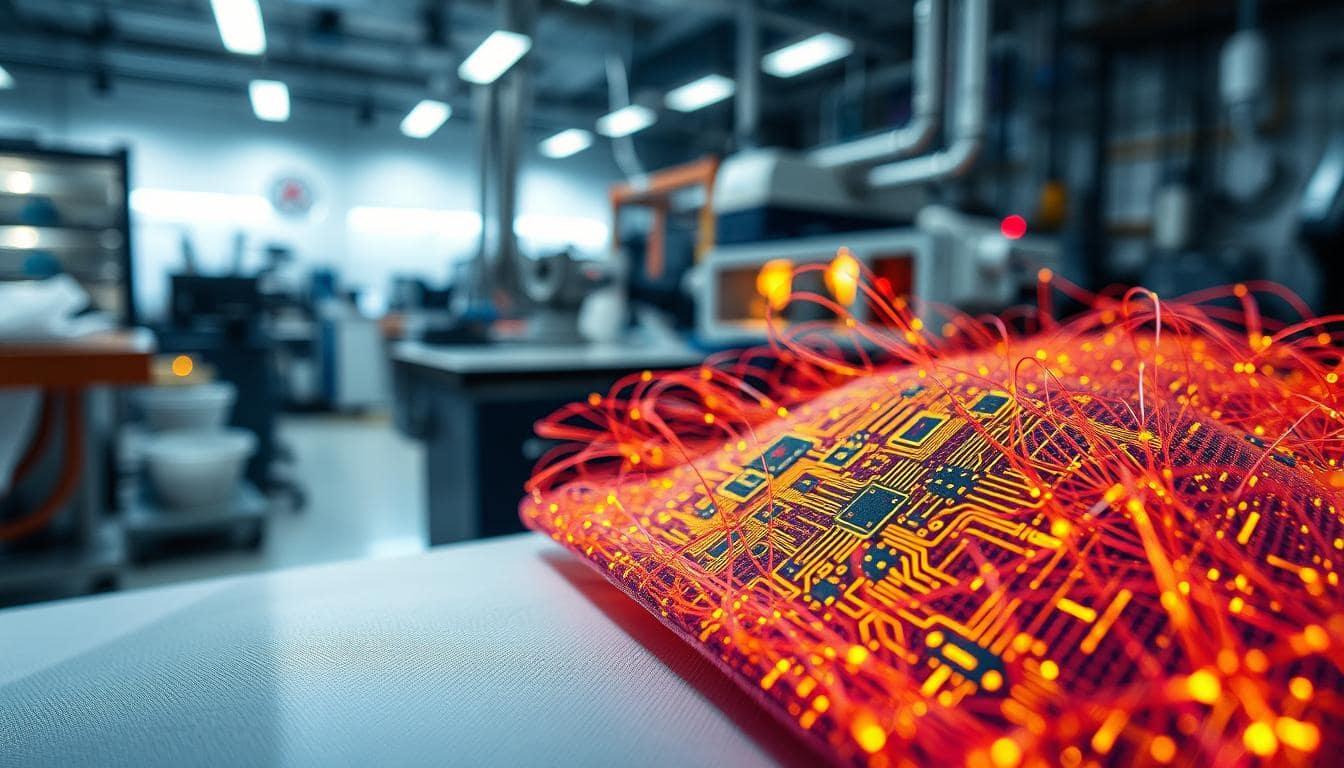
Your average cotton tee isn’t winning any innovation awards in athletic monitoring. We’re talking about the fabric of tomorrow’s performance wear.
Conductive yarns aren’t just fancy thread – they’re becoming the nervous system of your workout gear. These materials conduct electricity better than some politicians conduct coherent thoughts.
Imagine graphene fibers with theoretical strengths that could support small buildings. Their conductivity would make Tesla jealous.
From MXene-coated wonders to traditional conductive coatings, we’re exploring how clothing gets reimagined. The very stuff of your apparel becomes smarter than your fitness tracker.
Welcome to the world of e-textiles – where science meets your sweat session.
Yarns, inks, substrates, adhesives
What if your favorite shirt could do more than just look good? Welcome to the textile revolution where threads pull double duty as data highways. These aren’t your grandmother’s knitting materials – they’re sophisticated components engineered for performance.
Conductive yarns serve as the nervous system of smart textiles. Unlike traditional fibers, these specialized threads contain metallic elements that transmit electrical signals. Imagine fiber optic cables woven directly into your workout gear, monitoring your vitals while you exercise.
Manufacturing these yarns involves precise processes. Companies typically use either:
- Metal-coated polymer fibers
- Stainless steel blended with natural fibers
- Silver-plated nylon constructions
The real magic happens when these conductive yarns meet specialized inks. These aren’t ordinary printing inks – they’re formulated with silver, copper, or carbon nanoparticles. They create circuits that survive both intense workouts and aggressive washing cycles.
Why does this matter? Because durability separates gimmicks from genuine innovation. These inks maintain electrical conductivity through stretching, bending, and repeated laundering. They’re like tattoo ink for your electronics – permanent and functional.
Substrates form the foundation of this electronic ecosystem. Think of them as the stage where our smart textile performance unfolds. Common materials include:
- Polyester blends for moisture management
- Stretchable knits for athletic wear
- Technical fabrics with enhanced durability
Adhesives play the unsung hero role in this technological ballet. They’re the backstage crew that keeps everything connected under pressure. Modern textile adhesives must bond dissimilar materials while maintaining flexibility and wash resistance.
The marriage of these components creates something remarkable. We’re building sports car performance into wearable, washable fabrics. The conductive yarns transmit data, the inks maintain circuits, substrates provide structure, and adhesives ensure everything stays together.
This isn’t just fashion meeting technology – it’s a complete reimagining of what textiles can do. The revolution isn’t coming; it’s already woven into the fabric of innovation.
Sensor Types
Remember when clothes were just… clothes? Those simple days are over. Now your workout gear might be judging your form better than any personal trainer ever could.
We’re talking about piezoresistive technology that measures pressure changes. Think of it as your fabric developing a sixth sense for your movements. These stretch sensors detect when you’re cheating on that squat or slouching at your standing desk.
Bioelectric variants go even further. They’re basically giving your clothes ESP about your physiological state. Temperature regulation? Your shirt knows you’re overheating before you do.
It’s like having a fitness coach woven directly into your fabric. Minus the annoying encouragement and questionable protein shake recommendations.
Strain, pressure, bioelectric, temperature
Textile sensors are like the Avengers of wearable tech. Each has unique powers that turn regular fabric into amazing data collectors. Together, they form a personal network in your clothes.
Strain sensors measure how much fabric stretches. They’re super precise, like a master watchmaker. They track athletic performance or physical therapy progress with great detail.
Pressure sensors are like the bouncers of smart clothes. They decide what forces get recorded. This is useful for things like seat occupancy in cars or foot pressure in shoes.
Bioelectric sensors read your body’s electrical signals. They capture important data like ECG, EMG, and EEG. The latest models are very accurate, even for medical use.
Temperature sensors keep an eye on your body’s temperature. They’re super precise, tracking changes down to 0.1°C. This helps athletes avoid overheating or alerts medical patients to fevers.
These sensors together create a wealth of biometric data. It’s like having a personal trainer, medical team, and climate control in your shirt. It’s the latest in wearable tech, blending fashion and function.
The real magic happens when these sensors work together. Strain and pressure sensors track your workout intensity. Temperature sensors watch your thermal regulation. Bioelectric sensors check your heart’s response. It’s like having a personal team in your shirt.
Patterning & Assembly
Welcome to the world of textile design, where we build tiny cities in your clothes. It’s not your grandma’s quilting anymore. We’re talking about embroidery that does more than just look good.
Those pretty floral patterns might actually be embroidered antennas collecting data. The work needed is so precise, it’s like a neurosurgeon’s job.
Recent research shows combining additive manufacturing with textiles creates super precise microstructures. We’re making electrical highways and data neighborhoods in fabric.
This is where art and science come together. We turn regular material into wearable circuit boards. It’s not just about looks anymore.
Weaving/knitting, embroidery, printing
The loom and the circuit board are now in a fascinating partnership. Traditional textile methods have been updated with technology. They’ve moved from simple crafts to complex engineering feats.
Weaving and knitting are now about more than just patterns. They’re about creating sensor networks. Conductive threads in each stitch can track your heart rate or muscle tension. Your sweater can turn into a health monitor.

Embroidery has changed from just decoration to making functional parts. It’s now about creating antennas that connect to your phone, all while looking handmade. The needle and thread have become high-tech tools.
Printing technology has also seen a big change. It’s not just for logos anymore. It’s for making conductive paths that last through tough workouts and washing. The inkjet printer is now a tool for making circuits.
These methods work well together. Weaving gives structure, embroidery adds precise details, and printing makes complex circuits. Together, they make textiles that are both stunning and highly functional.
The real magic happens when these techniques are combined. A knitted base with embroidered sensors and printed circuits creates wearable tech that feels like real clothes. It’s a blend of old-school craftsmanship and modern innovation in your favorite hoodie.
Interconnects & Modules
Ever wonder how your clothes might secretly host the most exclusive networking event? Welcome to the world where snaps do more than fasten – they transmit data like tiny digital diplomats.
Flex PCBs bend with more grace than a ballet dancer, while rigid-flex systems provide the perfect balance of stability and adaptability. These components work together like a well-rehearsed orchestra.
The real social butterflies? Antennas. They’re constantly chatting with your devices, ensuring seamless communication. This sophisticated encapsulation technology turns ordinary garments into connected ecosystems.
Proper encapsulation protects these delicate systems from the elements while maintaining functionality. It’s the invisible infrastructure that makes modern wearable technology possible – and frankly, it’s engineering magic.
Snaps, flex PCBs, rigid-flex, antennas
Ever wonder how your smart shirt survives both your intense workout and your washing machine’s abuse? Meet the unsung heroes.
Snaps aren’t just for baby clothes anymore. These tiny metal connectors become data transfer points – the handshake between different parts of your smart clothing. They’re like the diplomatic corps of your wearable tech, ensuring peaceful communication between warring fabric factions.
Flex PCBs are the contortionists of the electronics world. They bend, twist, and stretch without complaining, making them perfect for clothing that actually moves with you. The flexibility of these circuits is why flex PCB becomes a key technology in wearable devices that need to conform to human shapes.
Rigid-flex systems are the wise elders providing stability where it’s needed most. They combine the best of both worlds – flexibility where you need movement, rigidity where components require solid footing. It’s like having both yoga instructors and structural engineers on your design team.
Antennas? They’re the talkative ones at the party. These components broadcast your workout data to the world (or at least to your phone) without needing a microphone. They turn your clothing into a mobile broadcasting station that somehow survives both sweat and spin cycles.
This delicate ecosystem of components works together like a well-rehearsed orchestra. Each plays their part, creating wearable technology that’s both functional and surprisingly durable.
Reliability
So your tech-enhanced fabric made it through the gym. Congratulations. Now, let’s see if it can handle the washing machine.
This is where prototypes face reality. The spin cycle isn’t just washing clothes. It’s a tough reliability test. Most electronics wouldn’t make it past the first round.
True washability shows if a product is durable or just a gimmick. We’re talking about fabrics that can handle sweat, abrasion, and lots of washing without losing their function.
It’s like boot camp for wearable tech. Only the strongest make it through.
Wash cycles, sweat/corrosion, abrasion, standards
Ever wonder what your fitness tracker would say about your laundry habits? Smart textiles go through tough tests. These tests show if they’re good for workouts or just for show.
Wash cycles are a big test. They mimic years of laundry in just a few cycles. It’s not about gentle cycles or scented detergents. It’s about tough punishment.
These tests check if materials can last. Fifty cycles for regular clothes, over a hundred for medical or military use. Each cycle tests how well materials hold up.
Sweat corrosion testing is all about biochemical challenges. It uses special sweat solutions to test materials. The goal is to see if they can handle tough workouts.
These tests cover a wide range of pH levels. They also check how materials handle temperature changes and stress. It’s about proving they can handle your toughest days.
Abrasion resistance testing is about how materials hold up to rubbing. Martindale machines use a special abradant to test fabrics. It shows if your clothes can last through your workouts and how you fold them.
Durability standards like ISO 12947 set the rules. They tell how many cycles a material can take before it fails. Consumer items need 20,000+ cycles, while performance wear needs 40,000+. Industrial items go over 100,000 cycles.
Standards are like rulebooks for testing. They ensure everyone is tested the same way. They cover everything from solution concentrations to how materials are tested.
Without standards, testing would be chaotic. One company’s “sweat-resistant” might mean different things to another. Standards make sure everyone knows what they’re getting.
So, when your smart shirt makes it through your workout and wash, thank the engineers. They’ve tested these materials so you don’t have to.
Manufacturing
So, you’ve designed the perfect tech-infused fabric. Now, the real challenge begins. Turning lab prototypes into mass production is where dreams meet reality. Reality has a funny way of complicating things.
Design for Manufacturing principles separate the visionaries from the actual makers. It’s not just about what works in controlled environments. It’s about what works when producing thousands of units.
Yield rates become your new obsession. Because nothing ruins a brilliant idea like realizing it costs ten times more to make than anyone would pay.
The Bill of Materials becomes your bible. Vendor selection feels like dating. You’re looking for partners who won’t ghost you when things get complicated. Because at scale, everything gets complicated.
DfM, yield, costed BOM, vendor selection
Welcome to the factory floor of smart textiles. Here, great ideas face the harsh reality of making them. Your wearable could be a hit or a costly mistake.
Design for Manufacturing is key. It’s about making something that works in real life, not just on paper. If your design needs tiny stitches, it might be time to rethink.
Yield rates show the truth. That 95% success in the lab might fall to 65% in mass production. Low yield can hurt your budget and question your plan.
The costed bill of materials reveals the financial truth. Every part, from threads to chips, gets a financial check. This spreadsheet decides if your smart garment is affordable or pricey.
Here’s what matters for your BOM:
- Component availability during mass production
- Minimum order quantities from suppliers
- Custom versus off-the-shelf parts trade-offs
- Shipping costs and import duties
Vendor selection is like dating. You need partners who stick around when you scale up. The right vendor gets your vision; the wrong one gives excuses.
Remember, your vendors can make or break your product. Choose carefully, because in smart textiles, a weak link in your chain can ruin everything.
Certification & Safety
Let’s talk about the grown-ups in the room. Nobody wants their workout gear to catch fire or cause a rash.
Certification isn’t just paperwork. It’s what keeps your workout clothes safe and comfy. It makes sure they’re good for your skin through biocompatibility testing.
Flammability rules? They keep your fancy shirt from turning into a fire hazard. It’s the rules that let us explore new ideas safely.
It’s like quality control with a law degree. Sometimes, the coolest ideas need the most careful watching.
Biocompatibility, flammability
Let’s talk about two tests that make wearables safe. Biocompatibility ensures your smart garment won’t irritate skin. Flammability testing makes sure your tech-infused textiles won’t catch fire.
Biocompatibility testing is more than avoiding rashes. It’s about proving your materials are safe for long-term use. We’re talking about:
- Skin irritation and sensitivity studies
- Cytotoxicity testing (because dead cells are bad customers)
- Extended wear trials with diverse skin types
- Allergen
Flammability testing is like preparing for the apocalypse. But it’s necessary. Imagine your fitness tracker catching fire during a workout. That’s not what you want.
Key flammability standards include:
- Vertical flame tests for apparel
- Smoke density measurements
- Heat release rate analysis
- Melting point documentation
These tests are not optional. They’re the legal and ethical base of wearable tech. If you fail, your product could harm people. But if you succeed, you’ve made something safe and innovative.
The process involves third-party labs and detailed documentation. It also means being honest about your material choices. But it’s all worth it to avoid making wearable tech that’s dangerous.
Prototype Roadmap
Ever had that brilliant “what if” moment that could change everything? That’s where every great product begins. But how do you cross the chasm from abstract concept to tangible reality?
The prototype roadmap is your GPS through the wilderness of creation. It’s the messy, beautiful journey from barely-functional samples to production-ready marvels.
Think of it as evolution in fast-forward. Each iteration brings you closer to that magical moment when your vision becomes something people can actually hold.
This isn’t just development – it’s a series of reality checks. Testing phases separate brilliant ideas from practical solutions. The process transforms “wouldn’t it be cool” into “here’s something you can buy.”
From initial concept to final production, the roadmap guides you through the frustrating yet ultimately rewarding path of bringing ideas to life.
From sample to pilot batch
If your first smart textile sample were a teenager, it would be blasting questionable music through headphones while claiming it knows everything. That initial prototype represents raw talent – brilliant in idea but awkward in reality. The journey from that phase to a functional pilot batch is like watching a college freshman learn to do laundry.

This transition period is key. Your sample might detect heart rates but feels like sandpaper against skin. The pilot batch should both work and feel comfortable to wear. This evolution needs systematic refinement through three critical stages:
- Performance calibration – adjusting sensor sensitivity until it reads accurately through fabric layers
- Comfort optimization – making the technology disappear into the textile experience
- Durability testing – ensuring the thing survives more than three gentle hand washes
Each iteration brings new challenges. That beautifully embroidered circuit might short out when someone actually sweats. The substrate that worked perfectly in climate-controlled labs might disintegrate in actual humidity. These aren’t failures – they’re tuition payments in the university of innovation.
The pilot batch is your first production-ready version. It’s the difference between a concept car at an auto show and something you’d actually drive to work. This batch needs to show consistent performance across multiple units while keeping costs low.
Remember: samples prove something can work. Pilot batches prove it can work repeatedly, reliably, and somewhat affordably. The gap between these two milestones separates interesting laboratory experiments from actual wearable technology.
Conclusion/CTA
Smart textiles for sports monitoring are now a reality, not just a dream. We’ve seen how clothes can conduct electricity and track your health. Your workout clothes are getting smarter.
This isn’t about looking like a cyborg. It’s about using data to improve your performance. Your clothes can now track your body’s signals, like strain and temperature. This tech works even when you sweat and wash your clothes.
Brands like Nike, Under Armour, and Athos are already using this technology. Soon, your fitness tracker might be in your sleeve, not on your wrist. The big question is, which version will you choose and when?
Ready to take your workout to the next level? Check out the smart textile options that fit your training needs. The future of fitness is here, and it’s wearable.