
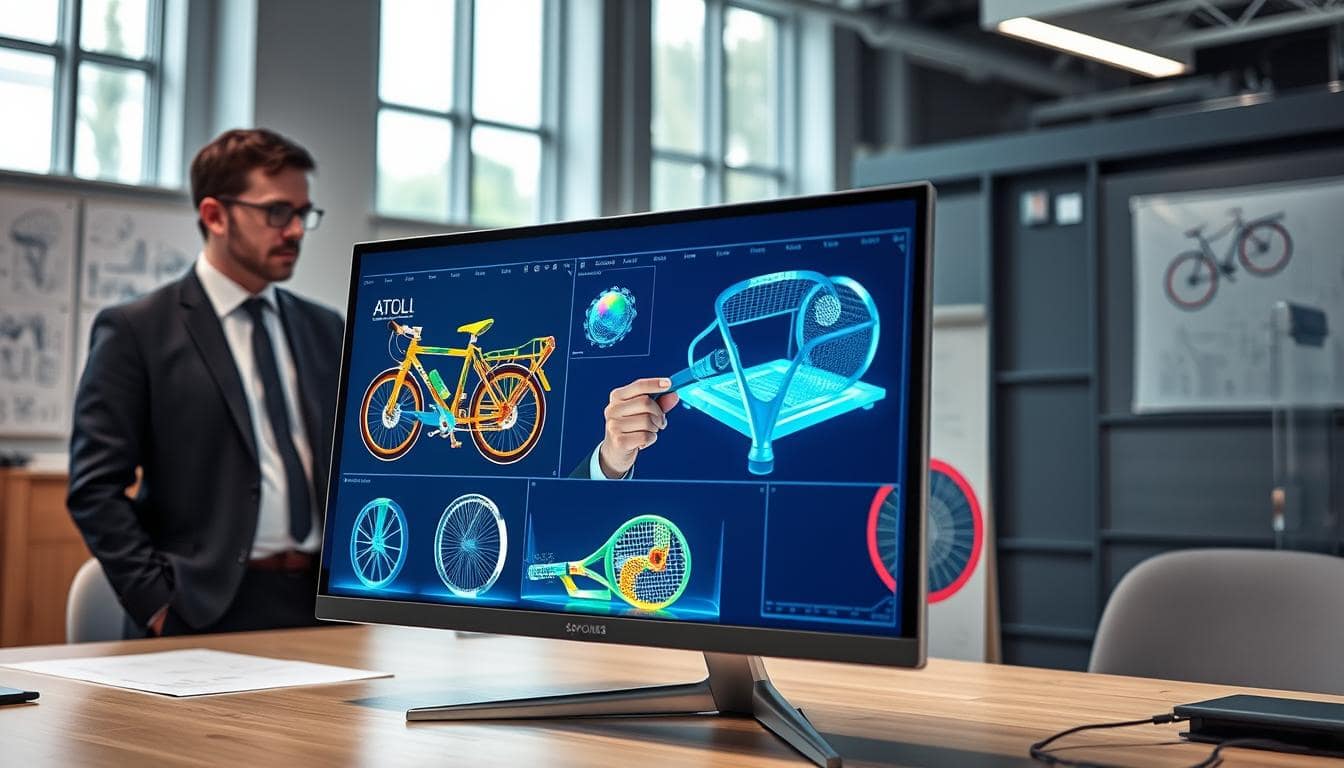
Remember drafting tables? T-squares and eraser shavings? Those days are long gone. Now, we use pixels and powerful tools.
The shift from paper to digital is huge. It’s not just about better graphics. It’s about bringing designs to life.
Parametric design changed the game. Now, you can change one part without messing up the whole design. Generative modeling takes it further. It lets the software suggest forms that are truly amazing.
Simulation is now a key part of the process. It’s like the suspense in a Hitchcock film. It’s essential.
Take COBRA Golf for example. They use Mastercam to tweak 3D club heads in real-time. No need to wait for new designs. MAJESTY GOLF does something similar with Siemens NX. They create the sound of a driver before it’s even made.
This is what modern engineering is all about. It’s not just about working alone with CAD. It’s about creating amazing sports equipment together. Designers in Boston and machinists in San Diego work together to make a winning putter.
Biomechanical Modeling Tools
Designing a golf club is tough, but designing one for a human is even harder. You can make a club look perfect or feel just right, but it must match the athlete’s natural motion. This is where biomechanical modeling comes in. It’s like a digital dummy for sports, helping engineers understand how athletes move.
It’s all about simulating the human body’s physics in motion. No more guessing. These tools turn an athlete’s effort into data for engineers. The goal is to make the gear feel like a part of the athlete.
So, what tools do we have? There are three main areas changing athletic equipment design:
- Movement Analysis: This tool watches how athletes move, like a golf swing or tennis serve. It finds small issues before they become big problems. This helps design gear that fits with, not against, natural movement.
- Load Calculation: This part deals with the forces athletes face. How much force is on a runner’s knee? Load calculation software shows where gear might fail. It helps make gear strong enough for the job.
- Ergonomic Assessment: This looks at how gear feels. Does the grip fit right? Does the boot flex where it should? Ergonomic software checks how design affects performance and safety.
Let’s say we’re talking about a golfer with a moderate swing speed. Companies like MAJESTY might focus on sound, but the real engineering comes from biomechanical modeling. This ensures the club feels right in the golfer’s hands.
In short, biomechanical modeling connects engineering with human performance. It makes sure a perfect strike isn’t just luck, but a result of careful design.
Material Simulation Capabilities
Material simulation turns guesswork into science. Engineers can test every alloy and composite digitally. It’s like putting materials on trial with physics.
Finite Element Analysis (FEA) is the key witness. It’s like a digital stress test without the prototypes. FEA breaks down a component into tiny elements and tests how they react under different conditions. This gives a detailed map of possible failure before making a prototype.

Stress analysis shows where a part might fail. With sports simulation software, you can see stress in color. Red areas show danger, while blue areas are safe.
Fatigue prediction looks at long-term wear. It simulates repeated use to see when a part might fail. This helps ensure a tennis racket lasts a season.
Impact simulation is like a crash test. It models fast, short events. It shows how a baseball affects a bat or a helmet during a fall. This helps avoid real-world injuries.
MAJESTY GOLF used Simcenter 3D for sound analysis. They predicted the sound of a titanium driver before making it. It’s like composing a song with physics.
COBRA Golf mixed titanium, stainless steel, and tungsten in a clubhead. Simulation helped balance these materials. It ensured the clubhead’s weight was right without breaking the bank.
| Capability | Core Function | Key Output | Sports Equipment Application |
|---|---|---|---|
| Finite Element Analysis (FEA) | Divides a model into small elements to solve complex physics equations. | Detailed displacement, stress, and strain fields across the entire geometry. | Predicting overall structural integrity of a bicycle frame or hockey stick. |
| Stress Analysis | Identifies areas of high stress concentration under specific load conditions. | Visual stress maps (von Mises stress) highlighting possible failure points. | Optimizing the throat of a tennis racket or the joint in a pole vault pole. |
| Fatigue Prediction | Simulates the effect of repeated loading over thousands or millions of cycles. | Predicted lifespan (cycles to failure) and crack initiation locations. | Ensuring a running shoe midsole or a baseball glove webbing won’t wear out too soon. |
| Impact Simulation | Models high-speed, short-duration collision events and dynamic loads. | Deformation, energy absorption, and force transmission data over time. | Designing protective gear like football helmets or testing golf ball durability. |
This suite of tools makes material selection data-driven. It’s not just “Will it work?” but “How and when will it fail?” Advanced material simulation gives confidence to innovate. It’s essential for building the next generation of gear.
Integration Workflows
In the world of sports equipment, design gets all the glory. But without the behind-the-scenes work of integration, nothing would happen. It’s like the plumbing of product development. When it works, you don’t even notice. But when it fails, everything falls apart.
We’re talking about a seamless digital thread. It connects the designer’s vision to the factory floor. The goal is to avoid any misunderstandings. COBRA Golf’s use of Mastercam CAD/CAM software with HAAS CNC milling machines is a perfect example.
The toolpath for a new driver face is created from the digital model. There’s no need for manual reprogramming or file conversion. This efficient link turns ideas into prototypes quickly.
But manufacturing is just the first act. Modern equipment design tools must also integrate testing data and manage revisions. MAJESTY GOLF uses Siemens Teamcenter as their central system. It handles every sketch, simulation result, and material spec throughout the development cycle.
Version control prevents the worst nightmare: machining the wrong revision. A collaborative platform lets experts discuss a digital twin. They don’t fight over a physical, gold-plated paperweight.
This integration creates a “single source of truth.” Every team member has access to the latest data. Change management becomes systematic, not chaotic. The difference between smooth and sloppy often comes down to workflow plumbing.
The table below contrasts disconnected versus integrated approaches. It shows why the latter isn’t just convenient—it’s critical for competitive equipment design tools.
| Workflow Aspect | Disconnected Tools | Integrated Tools | Key Benefit |
|---|---|---|---|
| CAD-to-Manufacturing | Manual file export/import; prone to translation errors | Direct toolpath generation (like COBRA’s Mastercam-to-HAAS) | Eliminates errors, accelerates prototyping |
| Version Control | File naming conventions (v1_final_REALLYFINAL) | Automated revision history with check-in/out | Prevents costly manufacturing of wrong design |
| Data Management | Scattered files across drives and emails | Centralized platform (like MAJESTY’s Teamcenter) | Single source of truth for all project data |
| Collaboration | Email chains and meeting notes | Concurrent access to digital twin with markups | Reduces misinterpretation, speeds decision-making |
| Testing Integration | Separate lab reports manually linked to designs | Simulation results automatically attached to model files | Creates direct feedback loop for optimization |
The real cost of poor integration isn’t just time. It’s innovation itself. Teams waste energy on logistics instead of creativity. They fight data instead of physics. The best equipment design tools are those that make all other tools play nice.
Think of it as digital diplomacy. Your FEA software, your CAD package, your CAM suite—they all need to speak the same language. When they do, the result isn’t just a product. It’s a manufacturable, testable, market-ready piece of sports technology. The integration workflow is the quiet engine of modern equipment design.
Performance Optimization Tools
Forget about just cutting down on weight. True performance optimization means moving mass around in a smart way. Digital algorithms guide this, using the physics of winning to guide us.
The goal is to make things better, faster, lighter, stronger, and cheaper. But this is a tricky path to follow. It’s like chasing a dream that’s hard to reach.
Modern sports engineering software helps navigate this complex world. It looks at many factors at once. It finds the best balance, where improving one thing doesn’t hurt another.

This isn’t about cutting down on grams for the sake of it. It’s about putting them where they count the most. It’s like getting advice on where to place material for the best effect.
MAJESTY GOLF shows how this works. They use software to balance sound, power, and looks. This ensures their clubs feel great and perform well.
So, what are the main tools in this digital toolbox?
- Design Optimization Algorithms: These tweak shapes to reduce drag or increase sweet spots.
- Material Selection Databases: They compare materials to find the best one.
- Strength Analysis under Load: This checks if designs can handle the stress of fast swings.
- Cost-Benefit Modeling: This looks at how much materials cost versus their benefits.
Feedback is key. Optimization doesn’t stop with digital models. COBRA Golf’s Dynamic Motion technology is a great example. It makes manufacturing faster and more precise.
This leads to tools lasting longer and more accurate clubfaces. This data goes back to design, helping create better, more possible designs. It connects the virtual and real worlds.
These tools help engineers avoid guesswork. They aim for the perfect design. It’s not just about specs. It’s about improving your game. The right sports engineering software turns this into a science, not just an art.
Rapid Prototyping Integration
The old way of making athletic equipment is gone. Now, we use rapid prototyping to make changes fast. This new method is much faster than the old way.
With 3D printing and simulation, we can quickly turn ideas into real things. Engineers don’t just make a prototype to test it. They make it to see if their digital plans were right. This change is key to new ideas.
MAJESTY GOLF used to take three months to make a club prototype. Now, it takes about five days. Their first mold is much more likely to be right. This change is huge for them.
COBRA Golf also uses rapid prototyping. They print and mill club designs fast. This makes sure their clubs meet strict standards. It’s a new way of working.
This change is big for athletic equipment design. It lets engineers try new things fast. If something doesn’t work, they can change it quickly. This is a big advantage.
Rapid prototyping makes things happen fast. It turns making prototypes into a quick check. This keeps the whole process moving fast.
User Interface & Usability: Where Your Sports CAD Software Earns Its Keep
Imagine a CNC programmer making changes to a 3D golf club model without needing an engineer. This shows the power of a good user interface. The best tools are easy to use, not hard to figure out.
A steep learning curve is a problem, not a challenge. Deadlines in sports design don’t care about learning curves. They want efficiency.
Great sports CAD software is like a smart digital assistant. It knows what you need before you ask. It lets you customize your workspace for your sport.
Stability is key. Crashing during a simulation is not okay. Good software is reliable when you need it most.
| Feature Category | Tool A: “IntuitiveDrafter” | Tool B: “ProSportCAD” | Key Insight |
|---|---|---|---|
| Ease of Learning | Moderate; context-sensitive help but dense toolbar layout. | High; guided workflows and sport-specific task wizards. | A shorter learning curve directly translates to faster project starts. |
| Workflow Customization | Limited preset workspaces. | Extensive; user-defined macros and fully modular interface. | Customization is king for specialists who repeat complex, sport-specific tasks. |
| Model Editing Agility | Requires full feature tree edits for simple changes. | Direct modeling features (e.g., Push/Pull) allow quick, history-free tweaks. | Agility, as seen with COBRA Golf, breaks departmental bottlenecks. |
| Professional Stability | Can lag with large assembly files. | Optimized for handling complex simulations without crashes. | Stability isn’t a feature; it’s the license to do serious work. |
The best design tools are enablers, not obstacles. They make complex tasks easy. They turn ideas into reality quickly. Your software’s interface is your partner in creating legendary gear. Choose one that feels like a partner, not a puzzle.
Industry-Specific Features
MAJESTY GOLF didn’t just tweak a template when they engineered the sound of impact. They built a new instrument. Their acoustic simulation system, made with Siemens and Digital Process, was created to solve a specific problem. It aimed to capture the precise ‘crack’ of a hollow driver head hitting a ball at 120 mph.
This is what industry-specific features in sports simulation software are all about. General tools are for beginners. Professionals need software that speaks their sport’s language.
Using standard CAD for designing a baseball bat is like using a Swiss Army knife for heart surgery. It might have a sharp thing, but it misses the whole context. Sport-specific tools provide that context. They come with the rulebook, physics, and even the unspoken culture of the game.
What does this look like in practice? It’s software with libraries for golf club face compliance. You can simulate how a millimeter of thickness changes feel and flight. It’s a built-in calculator for a baseball bat’s coefficient of restitution, following strict league rules about the ‘trampoline effect’. It’s helmet impact test protocols, defined by bodies like NOCSAE or ASTM, baked directly into the simulation environment. You don’t just model a hit; you model a certifiable hit.
This specialization creates elite, focused toolkits. Designing for the Olympics requires a different digital playbook than designing for a generic manufacturing line. The software must understand:
- The Sport’s Unique Physics: The aerodynamics of a cycling helmet versus a football helmet are worlds apart. One slices air; the other absorbs brutal, multi-directional force.
- The Regulatory Maze: Compliance isn’t a suggestion. It’s the gate. Good sports simulation software integrates these standards, so you’re designing to pass from the first digital sketch.
- The Athlete’s Sensory Experience: It’s not just about stress points. It’s about the sound of a perfect putt, the vibration feedback in a hockey stick, the ‘pop’ of a tennis racket. These are qualitative metrics that win championships.
- Established Testing Protocols: Why export data to another program? The best tools let you run virtual ASTM F1446 or EN 1078 tests inside the same environment where you design.
Let’s get concrete. The table below shows the stark contrast between a generic simulation package and a sport-optimized one.
| Feature | General-Purpose Simulation Software | Sport-Specific Simulation Toolkit |
|---|---|---|
| Material Libraries | Generic metals, plastics, composites | Pre-defined profiles for carbon fiber layups in bike frames, urethane blends for golf balls, approved foam densities for protective gear |
| Analysis Protocols | Basic stress, thermal, flow | Sport-specific impact simulations, bat/ball collision models, aerodynamic drag studies for speed sports |
| Regulatory Framework | Manual input of standards | Pre-loaded testing protocols (e.g., FIFA Quality Pro for soccer balls, USGA rules for golf equipment) |
| Output Metrics | Displacement, factor of safety | Player-perceived ‘feel’, acoustic signature, sport-specific performance coefficients (e.g., moment of inertia for skis) |
The result? A radically compressed development cycle. Engineers spend less time translating sport problems into generic software terms and more time actually solving them. When your digital tool embodies the essence of the game, you’re not just designing a thing. You’re designing a winning thing. You move from asking, “Will it break?” to asking the more profound question: “Will it make the athlete better?”
In the end, this shift toward specialization is a natural evolution. As sports engineering pushes the boundaries of human performance, the tools must keep pace. The future belongs to sports simulation software that doesn’t just simulate materials, but simulates victory. Because in the arena, the margin between gold and silver is often measured in the specificity of your digital toolbox.
Collaboration & Project Management: The Conductor’s Baton for Equipment Design Tools
Modern sports equipment is a result of teamwork, not solo work. Designers focus on looks, engineers on strength, sound experts on acoustics, and craftsmen on making things. Agreeing on a final product is the big challenge. Here, collaboration tools and project management systems help.
Without a leader, a team is just noise. Without good team workflows, experts talk past each other. Designers and engineers might disagree on shapes. Equipment design tools help everyone speak the same language.
Design reviews are intense. It’s like a courtroom where every detail is questioned. Good equipment design tools make this process smoother. They offer real-time feedback and version tracking.
Change management is key. Why did a design change? Who asked for it? A good system keeps track of these changes. It prevents old mistakes from coming back.
Documentation and quality control are essential. They turn one-off successes into repeatable processes. Every detail is stored and controlled. This is how companies like MAJESTY GOLF succeed with platforms like Teamcenter.
Brands like COBRA Golf show the power of teamwork. It’s not magic. It’s the result of tools that make communication easy in the project management cycle.
| Design Phase | The Chaotic Reality (Without Tools) | The Orchestrated Outcome (With Tools) |
|---|---|---|
| Concept Ideation | Scattered sketches, lost emails, conflicting ideas in separate silos. | Centralized mood boards, linked requirements, and live brainstorming feeds integrated into the project. |
| Design Review | Endless meetings with vague feedback. “Make it pop” is considered actionable input. | Structured review cycles with 3D markups, assigned action items, and clear approval workflows. |
| Change Implementation | The “Tuesday Hotfix” breaks the “Wednesday Prototype.” Blame is assigned, not causes. | Tracked change orders with full history. Impact analysis shows what a modification affects before it’s made. |
| Documentation | A final mad scramble to find specs for compliance. Folders named “Final_Final_v2_OLD”. | Automated report generation, live links between drawings and specs, and revision-controlled manuals. |
| Final Sign-Off | A nervous handshake and a hope that manufacturing received the right files. | A digital audit trail with all approvals, versions, and data packages locked and released as one. |
The goal is simple yet deep: to turn a group of experts into a team. Great products come from teamwork, not just genius. The right tools help teams create amazing things. They don’t just manage projects; they make champions.
Future Technology Integration
The future of sports engineering software is already growing. It’s like a seedling pushing through the soil. We’re moving from prediction to recognition, with systems that think.
Imagine AI that creates new designs, not just tweaks them. It could come up with club head shapes that are so advanced, they make today’s look old-fashioned. Virtual reality will let you feel the weight of a driver without it being real. This isn’t just fancy. It’s the next step in advanced biomechanical modeling, putting the human body simulation in the designer’s hands.
Cloud computing makes every garage startup a supercomputer user. The hard work of analysis moves off your desk. This makes power more accessible. It boosts sustainability too. We can simulate perfectly, using less of valuable materials like MAJESTY GOLF’s titanium.
The line between engineer, athlete, and gear is fading. This leads to equipment made with incredible precision. The best sports engineering software will soon be like a co-pilot. The game is changing again.