
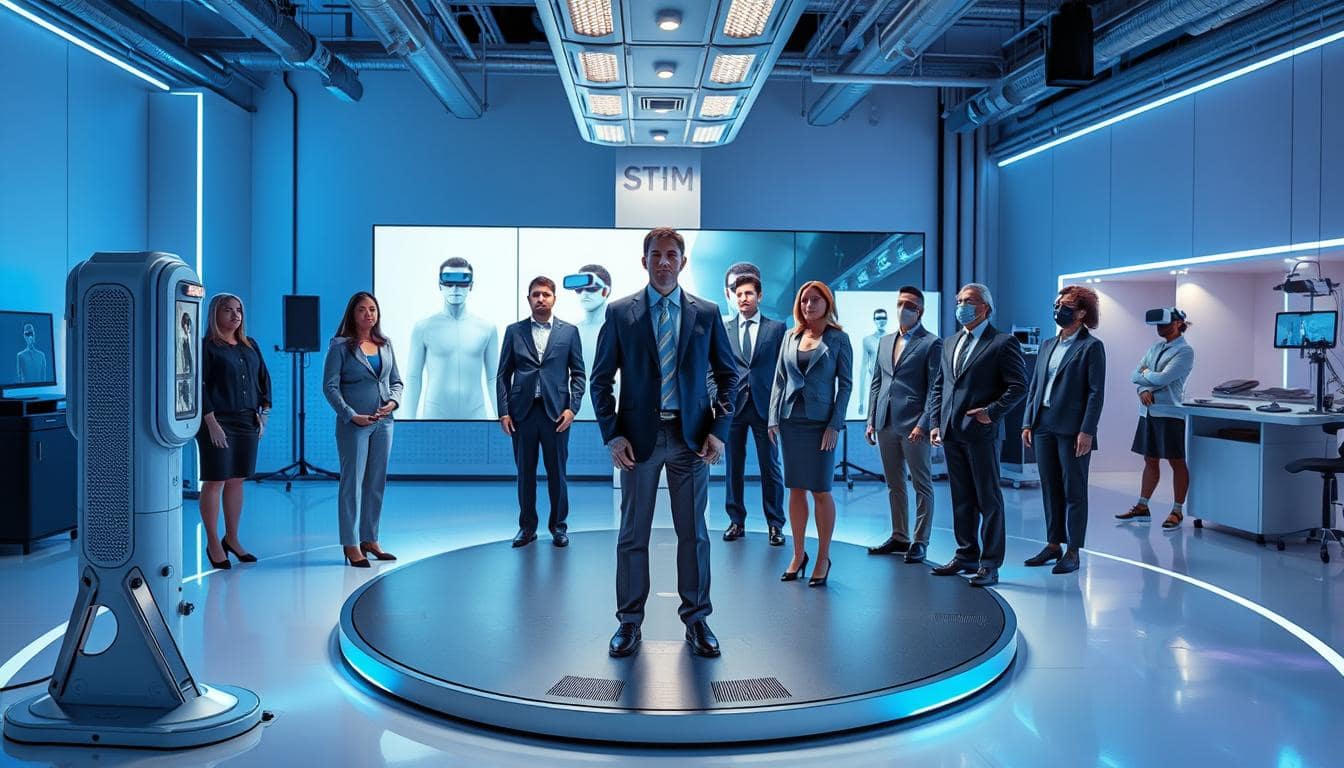
Let’s get real. A helmet that pinches or skates that blister aren’t just minor annoyances. They’re major performance killers and injury risks. Using a generic size chart for your gear is like using a flip phone for stock trading. It’s a guess, and in sports, guesses can be deadly.
The scale of this guessing game is huge. In fashion e-commerce, a whopping 56% of items are returned because of poor fit. Imagine this in sports gear, where the stakes are even higher. The environmental damage from all this waste is huge, causing 2-8% of global greenhouse gas emissions. But the real tragedy is the human cost of poor performance and injuries.
This is where precision engineering meets human physiology. Enter the new gold standard: 3D body scanning with a sub-2% margin of error. It’s not your grandma’s tape measure. It captures every detail of an athlete’s body to create a perfect digital model.
Think of it as the difference between describing a mountain and having a detailed topographical map. The first step in any serious digital workflow is accepting that this level of precision is essential. It’s not a luxury, but a must for safety and peak performance.
This precise digital twin is what powers the next stage: situative digital imaging. It allows for “adaptive images” and creates a bridge to true AR fit testing. The old way of buying blind is now outdated.
Capture pipelines: lidar, photogrammetry, structured light
Creating a digital copy of your gear is no longer science fiction. It’s now a choice between lasers, cameras, and light patterns. This step is key in any serious virtual prototyping process. You need a precise model of the head for a helmet to fit right.
So, which technology do you choose? Each method has its own way of capturing your body’s shape.
Lidar is like a sniper, using laser points to measure distances with great accuracy. It creates a detailed “point cloud” map of your body. It’s perfect for capturing complex areas, like the curve of a cyclist’s sit bones.
Photogrammetry works by combining many 2D photos to create a 3D model. It’s like the tech behind Ikea Place, letting you see a virtual couch in your room. For 3D body scanning, it’s fast and accessible, capturing over 85 body measurements from just two photos.
Structured Light projects patterns onto your body and measures how they change. It’s a balance between accuracy and cost, often better than photogrammetry but cheaper than lidar.
The real challenge isn’t choosing one method. It’s understanding the trade-offs. The right choice depends on your needs, whether for pro sports gear or direct-to-consumer apparel. The goal is a good digital twin, captured quickly and affordably.
| Technology | How It Works | Best For | Speed | Relative Cost |
|---|---|---|---|---|
| Lidar | Measures distance with laser pulses to create a point cloud. | High-accuracy engineering; complex joint & contact point mapping. | Slow to Fast (varies by system) | High |
| Photogrammetry | Extracts 3D data from multiple 2D photographs via triangulation. | Accessible consumer scans; texture-rich models for visualization. | Very Fast (can use phone) | Low to Medium |
| Structured Light | Projects light patterns and analyzes their deformation on the subject. | Balanced clinical or fit studies; good detail at moderate cost. | Medium | Medium |
In practice, the best systems often combine these methods. Start with a quick photogrammetry scan, then add lidar detail to key areas. This hybrid approach gives you clean data for the next step: virtual prototyping where your digital model becomes your next piece of equipment.
Avatar creation and anthropometric databases
Forget the frozen statue of a 3D body scanning snapshot—what we’re building now is a digital doppelgänger with a heartbeat of data. A scan is a moment in time. An avatar is a continuously updated, sensor-fed data construct. This is the critical leap from a static mesh to a parametric digital human driven by biomechanics, motion capture inputs, and fit analytics.
For a deeper look at how these dynamic models integrate with simulation environments, see our digital twin technology in sports equipment guide
We’re not just storing a shape. We’re constructing an exhaustive anthropometric profile. Think segment lengths, girths, joint rotation centers, and even muscle insertion points. It’s a blueprint of human mechanics, often comprising over 100 distinct data points.
Why does this matter? For decades, the gear industry has worshipped at the altar of the “average” body. This has created a tyranny of the average, a one-size-fits-none paradigm that fails spectacularly for nearly anyone outside a narrow statistical band. Did you know the average waist size can swing dramatically across ethnicities? Traditional sizing grids ignore this reality, leaving a staggering 50% of women—and countless athletes of all genders—struggling with gear that simply doesn’t fit their form.
An avatar-based system shatters that outdated model. It is the ultimate antidote. By capturing true diversity—variations across ethnicity, age, and lifestyle—we move beyond catering to a mythical “standard” body.
But the real power isn’t in a single avatar. It’s in the crowd. When you aggregate thousands of these precise digital twins into a searchable, relational database, patterns emerge that were previously invisible. This database becomes a Rosetta Stone for human proportion.
- What are the common femur-to-torso ratios for elite female cyclists?
- How does shoulder-to-hip scaling differ between swimmers and rock climbers?
- Where do pressure points predictably form for a marathon runner’s foot shape?
This isn’t just data collection. It’s diversity, quantified and operationalized. This rich anthropometric database fuels advanced ergonomic simulation. Engineers can now predict chafing, restricted range of motion, and pressure distribution long before a single piece of physical gear is prototyped or cut.
The fashion world gets this, using “virtual models” for campaigns. For performance equipment, the stakes are higher. It’s not about looking good in a render. It’s about how the gear functions with the unique machine of an athlete’s body. A proper avatar system turns 3D body scanning from a measurement tool into a predictive engine.
We’re now building gear that fits the human spectrum, not just a statistical ghost. That’s the promise of moving from scan to avatar: turning human diversity into a design parameter, not a problem to be ignored.
CAD integration and parametric sizing systems
Exporting the perfect .OBJ file is like giving a master key to a locksmith. It opens every door in the digital factory. We insert this key into Computer-Aided Design (CAD) software. Suddenly, our athlete’s avatar is more than just a visual twin. It becomes a living, breathing model for virtual prototyping.
This is where art meets science. Instead of making a helmet for a generic “size Medium,” we design for a specific head shape. CAD software uses the avatar to ensure perfect fits and optimize every surface. It’s like having a custom GPS route instead of a generic map.
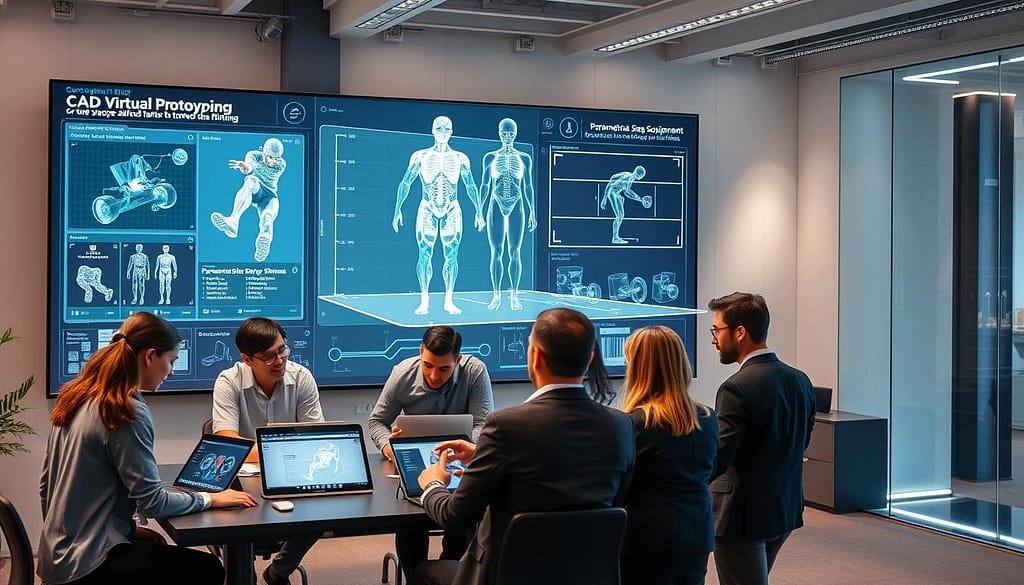
This integration changes the game for apparel and soft goods, too. The .OBJ file fits right into pattern design and 3D fashion software. Designers can now try out digital fabrics on the exact athlete’s form. They can play with tension, stretch, and layering without cutting any physical material. It turns guesswork into a precise ergonomic simulation.
But the real magic is in parametric sizing. It’s like a video game character creator for sports equipment. We’re moving away from the old S, M, L sizes.
- Need a longer lever on a rowing rigger? Just slide a virtual slider. The whole thing adjusts smartly.
- Require a wider toe box on a ski boot? The parametric model changes the entire last, keeping the boot strong.
- Designing a jersey for a unique shoulder-to-hip ratio? The algorithm scales the pattern for any body type.
This isn’t just customization. It’s on-demand, precise manufacturing based on data. The parametric system holds the genius of a master fitter, encoded. It connects the raw body scan with the simulated performance of the gear.
The result? We shift from a one-off, bespoke process to a system that can make perfect fits for thousands. Each one is unique. That’s the power of true CAD integration. It makes perfect fit not just possible, but also very efficient.
Virtual tryouts and physics approximations
The magic of modern virtual tryouts comes from Hollywood’s soundstages. Think of “The Volume” from *The Mandalorian*. It’s a massive LED wall that shows virtual scenes in real-time. Now, imagine an athlete in a VR headset, moving through a world that reacts to them.
This is the future of fitting rooms. It’s not just a pretty view. AR fit testing gets analytical here. The software uses physics approximations to test gear before it’s made.
Will a new backpack strain your back on long walks? Does a bike frame make you ride awkwardly? The system checks forces and airflow. It’s not perfect, but it finds big problems before they cost a lot to fix.
This method turns guesses into facts. Athletes can feel the balance of a virtual paddle. Cyclists can see how a helmet affects their speed. It’s not just looking at a model; it’s a real test.
This stage is a digital filter. It saves money by finding problems early. Virtual tryouts let you test ideas without spending a lot.
To understand these simulations, let’s look at what they cover:
| Aspect Simulated | Virtual Tryout Method | Real-World Equivalent | Primary Insight Gained |
|---|---|---|---|
| Visual Immersion & Scale | StageCraft-style environment rendering with parallax. | Being on the actual slope, court, or track. | User comfort and spatial awareness within the gear. |
| Load Distribution | Real-time physics approximation of weight and forces. | Wearing a loaded backpack or holding a heavy tool. | Predicts muscle fatigue and points of excessive strain. |
| Aerodynamic Profile | Approximated fluid dynamics based on avatar posture and gear shape. | Wind tunnel testing. | Identifies postures or designs that create drag. |
| Material Stress & Flex | Basic deformation simulation under applied force. | Physically bending a ski or flexing a shoe sole. | Highlights possible failure points or unwanted flexibility. |
| Ergonomic Pressure Points | Pressure mapping on the virtual avatar’s skin surface. | Wear-testing with pressure sensors. | Pinpoints exact locations of discomfort or hot spots. |
This isn’t science fiction. It’s the next step in ergonomic simulation. By mixing movie magic with real physics, we check if something works before making it. The goal is to combine human and machine perfectly, tested in digital space first.
Haptics and perception thresholds
We’ve mastered the visual illusion, but the body’s tactile truth remains the final boss in virtual prototyping. Your mind can be dazzled by a perfect 3D render, but your hands, feet, and skin are brutally honest critics. This is where haptics—the science of touch feedback—enters the chat.
Think of it like top-tier VR therapy for a fear of heights. Its power isn’t just the vertigo-inducing visuals. It’s the perfect, sinister sync between the scenario, the sensors, and your own sensomotorics. It tricks your entire nervous system into a genuine sweat. For equipment fit, we need that same level of visceral buy-in.
So, what does this mean for a climbing shoe or a racing bike? An advanced haptic glove can simulate the gritty pressure of a shoe on rock. A suit can replicate the constricting hug of a harness or the micro-vibrations thrumming through a handlebar. This isn’t about graphics. It’s about convincing your proprioception—your body’s internal map.
The million-dollar question is the perception threshold. What’s the minimum feedback needed for an athlete’s “feel” feedback to be valid? Is it a simple vibration pattern? A precise temperature change? The force resistance of a flexing ski boot? Nailing this is the difference between a neat demo and a credible ergonomic simulation.
Cross this threshold, and you collapse the uncanny valley of feel. The athlete isn’t just looking at a prototype; they’re experiencing it. Their feedback on pressure points, balance, and flex becomes actionable data, not a guess. This haptic layer is the secret sauce that transforms a speculative model into a testable product.
Ultimately, virtual prototyping without sophisticated haptics is like a concert with the bass turned off. You get the melody, but you miss the physical punch that makes it real. Integrating this tactile dimension is what turns a clever visual into a believable, biomechanically sound ergonomic simulation.
Remote collaboration and athlete feedback loops
Imagine a ski boot designer in Milan, a biomechanist in Boulder, and an athlete in Chamonix all working together in real-time. They’re all doing it from their desks, without leaving. This isn’t science fiction; it’s today’s reality.
The old way of having a fit specialist fly to a training camp is now outdated. It’s like the fax machine, headed for the museum. Today, we work remotely, asynchronously, and in perfect sync.
An athlete in Colorado uses their smartphone for a 3D body scanning session. No need for a specialist or a studio. Tools like Mobile Tailor make this easy. The scan is uploaded to the cloud in seconds.
Now, a designer in Italy can try out a virtual prototype on the athlete’s digital twin. An engineer in Oregon can run tests. They’re all working on the same thing, but from different places.

The real magic happens in the feedback loop. It’s like advanced sports analytics, but for the equipment. Athletes can mark issues with AR glasses, like a pressure point.
This feedback is instant for the team. They can see it all in real-time. It’s like they’re all around a physical prototype, discussing it live.
This process makes custom fitting more accessible. Athletes everywhere can get top-notch gear, no matter where they are. The feedback loop is precise and rich, turning vague descriptions into clear data.
| Aspect | Traditional Fitting Workflow | Remote AR/VR Collaboration |
|---|---|---|
| Geography | Requires co-location of athlete and expert. Travel is mandatory. | Global team. Participation is location-agnostic. |
| Iteration Speed | Weeks or months due to shipping and scheduling physical prototypes. | Hours or days. Changes are digital and instantly shared. |
| Feedback Quality | Relies on memory and verbal description. Often imprecise. | Visual, annotated, and attached directly to the 3D model. Highly precise. |
| Cost & Access | High cost of travel and logistics. Limits access to top-tier athletes. | Dramatically lower overhead. Democratizes custom fitting. |
| Collaboration Mode | Linear and sequential. One expert works, then passes it on. | Simultaneous and integrated. Multiple experts collaborate in parallel. |
The table above shows how we’ve moved beyond old ways. This change is thanks to cloud technology and real-time data sharing. It’s like how coaches use advanced analytics, but for the athlete’s gear.
This leads to faster innovation and better gear. The athlete’s needs are directly built into the product. The feedback loop is now global.
Data privacy and consent management
Knowing your coffee preference is one thing. But a 3D body scan is another. It feels like giving away your personal data. We’re moving past just cookies and browsing history. This is your actual blueprint.
An athlete’s biomechanical data from an AR fit testing session is unique. It’s valuable for performance and safety. But it’s also valuable to others you might not want to have it.
Think about it. Your virtual prototyping data could be used for ads. Ads for orthopedic surgery or weight-loss supplements. This isn’t a sci-fi story. It’s a real risk if we don’t set rules from the start.
A good workflow isn’t just about tech. It’s about ethics too. Privacy-by-design is key. Every step must answer big questions.
- Who owns the avatar? Is it the athlete, the team, or the software provider? This must be clear.
- Where does the raw scan data live? Is it on a secure server or a cloud with bad access controls?
- How is data anonymized for research? Can it be used to improve sizing without revealing identities?
Consent management is like a lock on your data. It’s more than a form checkbox. It’s a clear agreement. Athletes need to know what they’re agreeing to, for how long, and why.
Getting this right changes everything. It turns virtual prototyping into a trusted partnership. Building trust isn’t just about following the law. It’s the only way this tech will be accepted.
Without trust, even the best fit feels wrong. The data is too personal, and the risks are too high. The goal is a perfect fit, in every way.
KPIs: fit error, time-to-fit, return rate
Let’s talk about what really matters in tech: hard numbers. Key Performance Indicators (KPIs) are the tough critics in tech. They show if a tool is truly useful, not just cool.
For digital fitting, three KPIs are key. They move us from “cool” to “essential.”
You can’t manage what you can’t measure. So, what are we measuring?
- Fit Error: The Delta of Discomfort
- Time-to-Fit: The Clock is Ticking
- Return Rate: The Tax on Guesswork
Fit Error is the difference between digital and real-world feel. We aim for a 2% margin. This is like the difference between a glove that feels like skin and one that feels like a mitt.
3D body scanning and modeling make this precision possible. They turn fit into a science.
Time-to-Fit used to be slow. Athletes would wait months for the right fit. Now, AR fit testing makes it fast. Virtual tryouts let us test and improve quickly.
This speed is a big improvement in manufacturing efficiency. It makes design and delivery faster.
The KPI that gets CFOs excited is Return Rate. Ill-fitting clothes are a big problem. For sports equipment, returns are costly.
In uniform fitting, digital processes have cut costs by 24%. This means big savings for sports equipment. Every return avoided is profit saved.
These KPIs are connected. Better fit means fewer returns. Faster fit means athletes get what they need sooner. It’s a cycle of improvement.
The experience of virtual try-ons is cool. But the value is about making things better and saving money. It shows that 3D body scanning and AR fit testing are smart investments. Now, how do you start measuring for yourself?
Pilot plan and tool stack options
So, the blueprint is clear. The question shifts from ‘if’ to ‘how’. You start without betting the farm. You run a pilot.
Pick a contained use case. Fit new recruits for team helmets. Offer a premium custom option for direct-to-consumer cycling shoes. This is your sandbox for virtual prototyping.
Your tool stack is a mix-and-match affair. For scanning, begin with accessible mobile photogrammetry. Companies like 3DLOOK offer a model here. For CAD and ergonomic simulation, leverage your existing software. Use Clo3D for soft goods or Autodesk Fusion 360 for hard goods.
For the immersive tryout, commercial-grade headsets like the Meta Quest Pro or Varjo are your window. Pair them with haptic development kits from HaptX. You are building a modular pipeline.
Consider the data point from Mobile Tailor’s 7-day trial. It hints at the endgame. A body scan at a retail kiosk sends data directly to a robotic sewing cell. The item is made on-demand.
Your pilot proves this concept. It measures the key performance indicators from section nine. It builds the undeniable case for scaling. The future of fit is not a size on a tag.
It is a dataset, a precise ergonomic simulation, and a perfect, personalized piece of gear created through advanced virtual prototyping. Your pilot is the first step.