
Let’s be honest: our gear faces a lot of abuse, like a Greek tragedy. It goes from being a high-performance item to a breeding ground for sweat microbes. It loses its strength quickly.
We’re talking about nano-scale superheroes that change this story. It’s not just a quick fix. It’s a real material science breakthrough.
Think of it as a tech upgrade for your gear’s health and protection. These coatings fight off bacteria, fix scratches, and ignore water. The key is self-healing polymers and superhydrophobic finishes.
We’ll dive into the science behind it. We’ll also show you the tests that prove it works. And we’ll see how it affects your gear and your budget.
Performance and hygiene drivers
The push for advanced coatings in sports isn’t about sci-fi fantasies. It’s a direct response to two very real problems: stench and waste. We’re not just protecting gear from the elements anymore. We’re protecting it from ourselves—our sweat, our friction, and our relentless pursuit of the next personal best.
Let’s start with the ick factor. Post-workout odor isn’t just a social faux pas. It’s biological evidence. Sweat is a nutrient-rich broth for bacteria and fungi, turning your favorite running shirt into a petri dish. This microbial party doesn’t just smell bad. It actively degrades synthetic fibers and natural materials, breaking them down from the inside out.
This is where antimicrobial coatings for sports gear become a must-have. They act as a permanent bouncer, denying entry to the microbes that cause odor and material decay. The result? Your gear doesn’t just smell fresher; it genuinely lasts longer because it’s not being digested by your own biome.
Then there’s the brute force of durability. Abrasion is the silent killer of jackets, backpacks, and shoes. It’s a death by a thousand scuffs against rocks, gym floors, and backpacks. Without protection, your gear’s lifespan is measured in seasons, not years.
Modern coatings change that equation entirely. Consider the data: some advanced hydrophobic finishes can withstand over 5,000 cycles of abrasive damage without losing their water-shedding magic. That’s the equivalent of a lifetime of trail runs or gym sessions. On the laundry front, certain coatings survive 120 cycles of home washing. That’s years of sweat and soap without the performance washing away.
This durability is the financial driver. It’s an investment against the planned obsolescence built into so much consumer gear. Why buy a new hiking shell every fall when your current one, properly shielded, looks and performs like new? The move towards PFAS-free durable chemistries makes this longevity sustainable, not just for your wallet but for the environment.
The performance driver, in short, is longevity. It’s about transforming gear from disposable consumables into reliable tools. This pursuit of smarter, longer-lasting equipment is a key trend in the latest sports tech aimed at boosting true performance. The goal isn’t just to make gear that survives. It’s to make gear you never have to think about replacing.
Chemistry overview: silver/copper, quats, photocatalytic TiO2, microcapsules, vitrimers
The secret to lasting gear isn’t magic. It’s a mix of chemicals, each with a special role. Think of it like a team of experts working together.
First, we have silver and copper ions for fighting microbes. They’re like ancient warriors with a modern twist. Next, we have quats, which work by breaking down cell walls. It’s a clean and efficient way to kill microbes.
Then, there are self-healing polymers. These coatings use microcapsules that burst to fix scratches. It’s like a bandage for your gear.
Vitrimers are the real game-changers. They can change shape when heated, fixing themselves over and over. This is thanks to special bonds that make them strong and durable.
For keeping water away, we use a clever trick. We create a surface that traps air and has a slick top layer. This makes water bead up and roll off easily.
PDMS is the key binder here, known for its stability and adhesion. It holds the surface together, making it water-repellent.
Photocatalytic titanium dioxide (TiO2) is the overachiever. It breaks down dirt and odors when exposed to light. It’s like a cleaner and protector all in one.
So, it’s like building with Legos. Silver ions are the assassins, vitrimers are the medics, and PDMS-ODA creates superhydrophobic finishes. TiO2 is the multi-tasking janitor. Together, they make a surface that’s smarter, tougher, and more resilient.
Application methods: dip, spray, PVD, sol–gel
You’ve mixed the perfect coating. Now, how do you apply it to your carbon fiber frame without a mess? The right method is key. Pick the wrong one, and your solution won’t work as planned. Choose correctly, and you’ll see the chemistry’s full power.
Dip-coating is a simple, yet effective method. Just dip the part, pull it out, and let it dry. It’s great for complex shapes. But, it can be messy and hard to control the film’s thickness.
Spray-coating offers more control. It’s like using an airbrush on your gear. You can apply the coating precisely and create gradients. But, it requires skill to avoid making a mess.
Physical Vapor Deposition (PVD) is a high-tech option. It’s not painting; it’s building with atoms. The result is a thin, strong film. But, you need a vacuum chamber for this method.
The sol-gel process is my favorite for its elegance. It starts as a liquid and turns into a solid on the surface. This method creates uniform, glass-like films. It’s perfect for photocatalytic and superhydrophobic finishes.
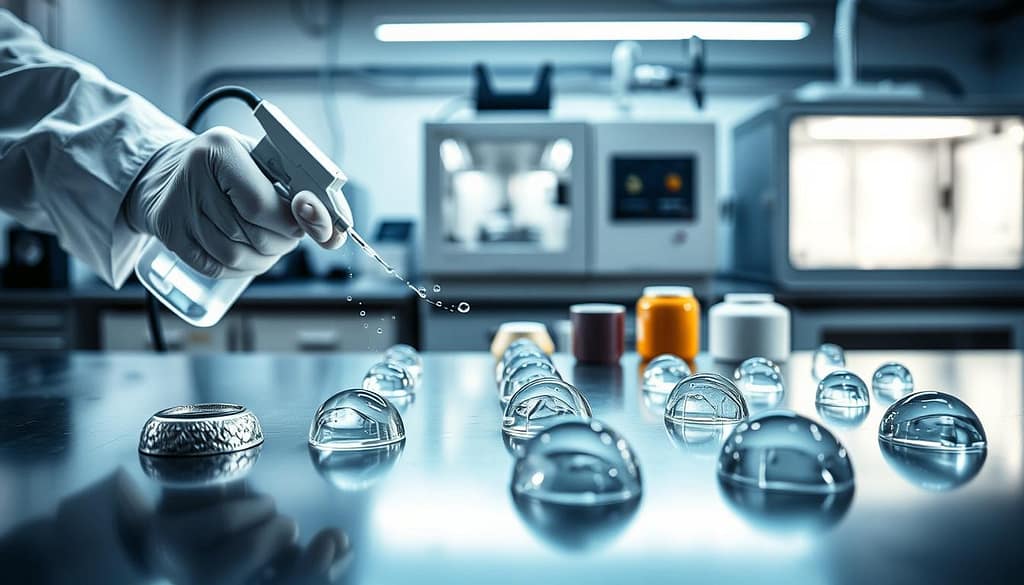
The range of fabrication techniques is wide. Choosing the right method depends on your budget, the material, and the desired outcome. It’s like choosing the right tool for the job.
| Method | Cost & Complexity | Precision & Control | Ideal For | Major Limitation |
|---|---|---|---|---|
| Dip-Coating | Low cost, simple setup | Low. Uniformity varies. | Porous materials, internal surfaces, high-volume simple parts. | High material waste, difficult thickness control. |
| Spray-Coating | Moderate. Needs equipment & skill. | High. Allows gradients and masking. | Large or fixed items, targeted areas, prototyping. | Overspray, environmental controls needed, operator-dependent. |
| PVD | Very high. Capital-intensive. | Extremely High. Atomic-level accuracy. | Hard surfaces (metals, ceramics), where extreme adhesion and thinness are critical. | Line-of-sight process, requires vacuum, not for all polymers. |
| Sol-Gel | Moderate to High. Chemical process control. | Very High. Molecular film uniformity. | Optical coatings, functional surfaces (photocatalytic, superhydrophobic), hybrid organic-inorganic films. | Can be brittle, often requires thermal curing (heat). |
The right application method is key to turning a lab discovery into a real-world feature. That perfect, water-repelling superhydrophobic finish on your lens? It likely needed sol-gel or PVD. The method is often overlooked but always critical.
Surface prep and adhesion on polymers, metals, composites
Forget the chemistry for a moment. The real magic happens before a single drop of coating is applied, on the microscopic battlefield of the substrate’s surface.
Here’s the industry’s dirty little secret: up to 90% of all coating failures trace back to poor adhesion. It’s the plot twist in every infomercial where the miracle product slides right off. You can have a coating that fights microbes, repairs scratches, and repels water like a duck’s back. But if it’s just sitting there like a layer of dust, it’s a very expensive, very useless veneer.
The goal is to move beyond weak, casual handshake bonds—the van der Waals forces. We need covalent bonds. Think of them as the molecular equivalent of superglue. These bonds form when atoms share electrons, creating a connection that can survive flexing, impact, and thermal cycling. For a self-healing polymer coating to perform its reparative magic, it must be fundamentally locked into the gear’s surface, not just perched on top.
Different materials demand different boot camps. Polymers—like the nylon in a backpack or polycarbonate in a goggles lens—often have inert surfaces. Plasma treatment is the go-to. It bombards the surface with energized gas, doing two things: it roughens it microscopically (creating more “grip”) and creates active chemical binding sites.
Metals and alloys are a different story. They might need chemical etching. This process uses acids or other agents to selectively dissolve parts of the surface, again increasing roughness and reactivity. For glass, ceramics, and synthetic fabrics, the challenge is similar. Their smooth, non-porous surfaces offer few natural hooks, so chemical or plasma pretreatment is non-negotiable.
Skip this step, and you’ve built a castle on sand. The fancy chemistry—the antimicrobial silver, the photocatalytic TiO2—becomes decorative. Even the most advanced self-healing polymers are rendered impotent if they can’t maintain intimate contact with the substrate they’re meant to protect.
| Substrate Type | Key Adhesion Challenge | Recommended Prep Method | Target Bond Strength |
|---|---|---|---|
| Polymers (Nylon, PC, PU) | Low surface energy, chemically inert | Plasma treatment, Corona discharge | Covalent bonding via created active sites. Critical for self-healing polymer adhesion. |
| Metals (Aluminum, Steel) | Oxide layer, surface smoothness | Chemical etching, Abrasive blasting | Mechanical interlock + chemical bonding |
| Composites (Carbon Fiber) | Resin-rich slick surface | Light abrasion + specialized silane primers | Covalent siloxane bonds to fiber/resin |
| Glass & Ceramics | Extremely hard, smooth surface | Acid etching, Silane coupling agents | Strong covalent siloxane (Si-O-Si) networks |
| Synthetic Fabrics | Fibrous, flexible, often coated | Low-pressure plasma, Chemical grafting | Permanent grafting onto polymer chains |
So, before you get dazzled by a coating’s promised superpowers, ask about its origin story. What grueling molecular boot camp did the substrate endure? This unglamorous, backstage work is the foundation. It transforms a superficial treatment into an integral part of the gear itself. Your entire investment in self-healing polymers and high-tech coatings depends on this first, critical step.
Durability testing: abrasion, sweat, UV, salt fog
Durability is not just a suggestion; it’s a series of tests to see if something is real. For antimicrobial coatings sports gear, we need facts, not just words. So, how do we know a finish will last?
We test it hard. The rules come from groups like ASTM and ISO. They make sure every claim is fair to compare.
Think of it as four trials by fire. A coating must pass all to be in your gym bag.
- Abrasion: The Sandpaper Marathon. It simulates years of wear and tear. ASTM D4060 tests a sample for thousands of cycles. Top PFAS-free finishes can last over 5,000 cycles.
- Sweat & Chemical Resistance: The Acid Bath. It tests against a mix of salts, acids, and oils. Coatings are tested for damage. This is key for PFAS-free ones, which must not break down in sweat. They must also survive 120 wash cycles.
- UV Testing: The Decade in a Box. It uses UV light to mimic a decade of sun damage in weeks. This test checks for damage like yellowing or breakdown. It’s vital for gear that’s always in the sun.
- Salt Fog: The Coastal Assault. It’s for gear used near the ocean or in harsh winters. A salt spray chamber tests for corrosion. It asks if the finish will protect against damage.
Passing these tests is a big deal. It shows a coating is tough. When a study says a coating can handle 5,000 abrasions and 120 washes, that’s proof. For antimicrobial coatings for sports gear, this data is essential. It turns promises into real results.
Regulatory and safety: skin contact, biocide rules, PFAS restrictions
Forget about how well your gear works for a moment. The real challenge is in the lab, not on the field. Here, skin safety, biocide laws, and chemical rules battle it out. They decide what antimicrobial coatings sports gear can use. This isn’t just about filling out forms; it’s a key part of design.
First off, skin contact is a big deal. If it touches an athlete, it’s seen as a medical device. Regulators look at ISO 10993 for biocompatibility. It’s like a background check for chemicals, making sure they’re safe for humans.
Then, there’s the twist. That cool antimicrobial agent? In the U.S. and EU, it’s treated like a pesticide. Yes, you read that right. It’s not just a feature; it’s a substance meant to kill. This means you need to prove its safety and effectiveness.
PFAS, or “forever chemicals,” are now a big problem. Global rules are getting stricter. Using them for water or oil repellency is seen as a bad choice. Going PFAS-free is smart and forward-thinking. It means using safer chemistry that works well without harming the environment.
Beyond these main points, there are other rules like REACH and RoHS. They limit heavy metals and other harmful substances. Following these rules shows you care about the environment. A coating that doesn’t comply is not just non-compliant; it’s risky.
| Aspect | Key Regulation/Framework | Primary Region | What It Means For You |
|---|---|---|---|
| Skin Safety & Biocompatibility | ISO 10993 | Global | Mandatory testing for any coating with skin contact. No irritation, no toxicity. |
| Antimicrobial Agent Registration | EPA (US), BPR (EU) | USA, European Union | Treats antimicrobials as pesticides. Requires proof of safety and efficacy for the intended use. |
| Chemical Substance Restrictions | PFAS Bans, REACH, RoHS | Global (varying laws) | Forces a move to alternative, safer chemistry. A PFAS-free formulation is increasingly critical. |
Is this all just red tape? No way. This maze is there for a reason. A coating that makes it through isn’t just legal; it’s safer for everyone. That’s a goal worth striving for.
Effects on friction, feel, acoustics
A superhydrophobic finish does more than just repel water. By creating a micro- and nano-structured surface that traps a thin layer of air (the Cassie–Baxter state), it alters tactile friction, acoustic response, and contamination resistance. This is where surface chemistry transitions from laboratory theory to measurable field performance.
For a deeper look at durability strategies in advanced materials, see our protective coating technologies for sports gear guide
The air layer is key. It makes the fabric sit on a cushion of air, like mercury on glass. This isn’t just about being waterproof; it’s about being air-tight.
But what does this air gap feel like? For swimmers, it’s a big win, making them swim faster. For hikers or tool users, it’s different. The slick surface might make it harder to hold onto things.
It’s all about feel. A treatment should not leave a slimy feel. A coating should keep leather feeling like leather, not cardboard. The goal is to protect without changing how things feel.
Sound is also important. The sound of a rain jacket or a soccer ball hitting the ground changes with texture. A superhydrophobic finish can make fabrics quiet, while thicker coatings might sound different.
Choosing the right coating is tricky. It’s like a balancing act. The table below shows how different coatings affect us:
| Coating Type | Primary Mechanism | Effect on Friction | Effect on Feel | Effect on Acoustics |
|---|---|---|---|---|
| Superhydrophobic | Cassie-state air layer | Greatly reduces liquid drag; may reduce dry grip | Often feels smoother, less tactile | Can dampen fabric rustle |
| Antimicrobial (e.g., Silver) | Ion release at surface | Usually minimal change | Must avoid slimy or gritty residue | Negligible change |
| Self-Healing Polymer | Microcapsules or vitrimers | Can be slightly tackier initially | May feel slightly softer, more compliant | Potentially more dampening |
| Hard Durable (e.g., Sol-Gel) | Cross-linked ceramic/organic matrix | Increases abrasion resistance; can be slick | Often adds a slight stiffness or crispness | Can create a sharper, harder sound on impact |
The best coating does it all. It repels water, kills microbes, and heals scratches without feeling alien or sounding wrong. The best finishes are like silent partners, working hard so you can enjoy the moment.
Cleaning, maintenance, re-application cycles
After the science fades, the coating’s true value shows in cleaning, care, and reapplication. It’s like a new car. The shine is one thing, but how it handles daily use is the real test.
The core promise of self-healing polymers is an extended maintenance interval. A minor scratch can heal over time. This isn’t magic; it’s chemistry. The coating fixes itself from the inside out.
Cleaning is surprisingly easy. A superhydrophobic surface repels water and dirt. Just a rinse can make them roll off. It’s like your gear has a non-stick coating.
But, these coatings aren’t invincible. Harsh chemicals and constant abuse can damage them. Think industrial-strength solvents or using your coated backpack as a sled on concrete.
This raises the question: is this a lifetime treatment or like waxing a car? Knowing when to reapply is key. Some coatings last forever, while others need a refresh every few years.
Research shows these coatings can recover. A worn, superhydrophobic fabric can regain its water-repelling ability after 72 hours at room temperature. This hints at a product that can bounce back from damage.
To care for this technology, use gentle cleaning. Lukewarm water and mild soap are best. Avoid harsh brushes and store gear in cool, shaded areas. This maximizes your investment’s lifespan.
In the end, the coating needs a smart owner. You provide basic care, and the self-healing polymers do the rest. It’s a partnership where you’re the manager and the science is your star player.
Decision matrix and validation plan
So you’ve waded through the science. Now what? Time to choose. The market is a noisy bazaar of promises. Your job is to cut through the hype.
Build a simple decision matrix. Weight your needs. Is killing germs the top priority? Then focus on proven antimicrobial coatings sports gear. Is your brand going green? Make PFAS-free a non-negotiable column.
Does your gear get scraped on rocks? Self-healing polymers might be your hero. Battling mud and rain? Superhydrophobic finishes deserve a heavy score.
Validation is where theory meets your grimy reality. Don’t just trust a glossy datasheet. Demand test reports against real standards like ASTM E2149 or ISO 22196.
Ask for samples. Does the coating survive your weekend warrior ritual? Does it feel wrong or change the gear’s performance?
Industry benchmarks are emerging. They set minimum thresholds for clarity, recovery time, and durability cycles. Use them. Your validation plan is a shield against buyer’s remorse.
The best coating isn’t the fanciest. It’s the one that solves your problem, for the longest time, without new headaches. That’s how you win.