
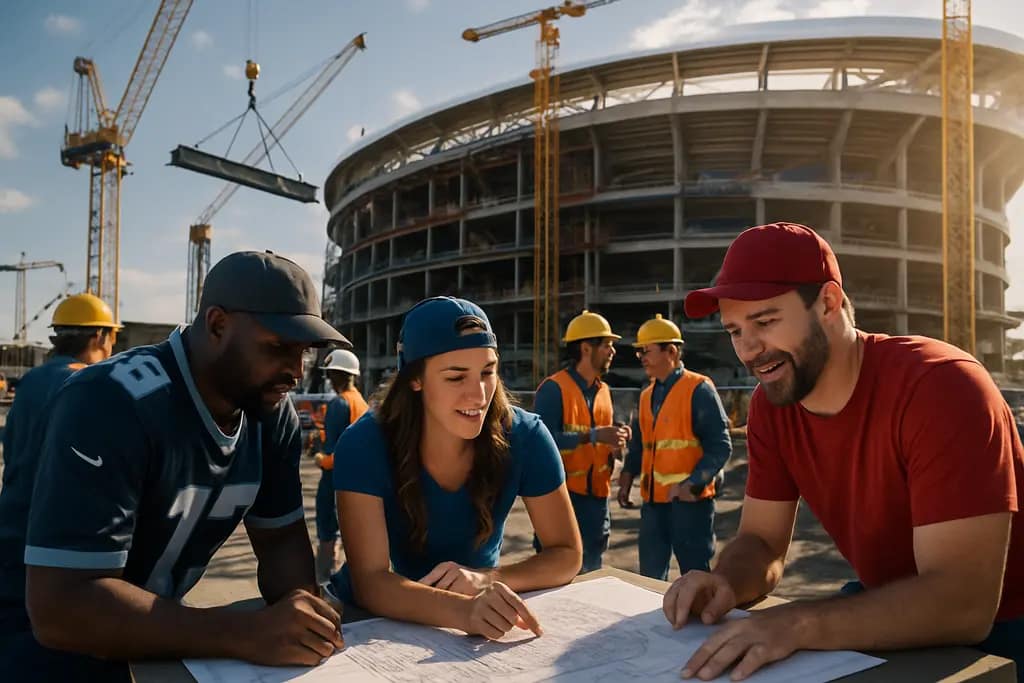
Philadelphia arena development is no longer just a venue story. It is a sports-business test for South Philadelphia: can a privately funded arena plan add jobs and event capacity while reducing some of the travel pressure around one of the country’s busiest sports districts?
The answer is not settled. The available public record supports some clear points: the Sports Complex already produces major event traffic, a state and city traffic plan was announced on May 28, 2026, and project backers have described the arena as a long-term economic driver. What is less clear is how much of the promised economic activity would be new, how construction disruptions would be managed, and whether the finished building would set measurable standards for lower-impact sports operations.
Philadelphia Arena Development And The Sports Economy
The proposed South Philadelphia arena sits inside an existing event district rather than a new entertainment district. That matters. The Sports Complex already draws large crowds for basketball, hockey, baseball, football, concerts, and other live events. Pennsylvania’s May 2026 announcement said the complex hosts more than 300 events per year, draws more than 8 million attendees annually, generates about $2.3 billion in economic activity for Philadelphia, and supports about 15,000 jobs according to the Commonwealth of Pennsylvania.
Those figures set a high baseline. A new arena would not be starting from zero; it would be inserted into an area that already carries heavy game-day and concert-day demand. That gives the plan advantages, including existing sports identity, nearby venue operations, and a fan base used to traveling to South Philadelphia. It also raises the bar for proof. If the district already supports thousands of jobs, the key policy question is not whether sports events create work. They do. The sharper question is whether the arena adds durable local employment, improves event flow, and avoids shifting costs to residents and public agencies.
Philadelphia Arena Development Job Claims
Project materials cited in the research say the proposed arena is expected to generate nearly $6 billion in economic activity over ten years and create about 15,000 jobs across construction, operations, and related economic activity. Those are large claims, and they should be read as projections rather than results. Arena job totals often combine short-term construction roles, permanent venue positions, supplier work, and induced spending. Each category has a different value for workers and for the city budget.
Construction work can provide a significant, time-limited employment burst. Permanent arena operations may include event staffing, security, maintenance, food service, ticketing, hospitality, and building management. Related economic activity may flow to nearby restaurants, hotels, transport providers, and event vendors. The most useful public reporting, once work begins, would separate full-time, part-time, union, nonunion, local, and temporary jobs. Without that breakdown, the headline total is informative but incomplete.
Why The Existing District Changes The Math
A Center City arena proposal was abandoned in January 2025 in favor of the South Philadelphia plan, according to the research record supplied for this article. That shift changes the economic debate. In Center City, supporters and opponents argued over the potential to stimulate Market East while raising concerns about neighborhood impacts. In South Philadelphia, the plan is tied to an established sports node, which may reduce some land-use friction but concentrates even more event demand in one district.
For teams and venue operators, co-location can be efficient. Shared parking fields, event staffing experience, and venue-adjacent services can reduce some operational friction. For sustainability-minded planners, though, efficiency is not the same as lower impact. If most fans still arrive by car, the district’s carbon and congestion burden could remain significant. The arena’s real performance story will depend as much on access design as on the building itself.
Infrastructure, Traffic, And Fan Access
The strongest publicly sourced sustainability-relevant detail is the transportation plan around the Sports Complex. On May 28, 2026, Governor Josh Shapiro, Mayor Cherelle Parker, Philadelphia sports teams, and regional partners announced a roughly $30 million initiative intended to reduce traffic, improve safety, and support economic growth around the complex. The plan included a new westbound I-76 entrance ramp from 7th Street, upgraded traffic operations, improved signage, and new traffic signals as outlined by Pennsylvania DCED.
That matters because the environmental footprint of an arena is not limited to concrete, steel, lighting, refrigeration, or scoreboards. Fan travel can be a major part of event impact. A venue with efficient operations but unmanaged car queues can still impose fuel use, delay, air-quality concerns, and safety risks. Better ramps and signals may reduce idling and conflict points, but they can also make driving more convenient. The policy balance is delicate: improve safety without locking the district into car-first event growth.
Traffic Relief Is Not The Same As Sustainability
The announced road and signal work should be judged by measured outcomes: travel times, crash data, pedestrian safety, transit reliability, parking search time, and crowd dispersal after games. A smoother exit from a Sixers or Flyers game is meaningful for fans and workers. It is not, by itself, evidence that the arena is sustainable.
For the Philadelphia arena development plan to make a stronger environmental case, public reporting would need to show how fans and workers will reach the site with lower-impact options. The research supplied here does not establish firm commitments on transit mode share, bike access, electric vehicle charging, building energy targets, waste diversion, or low-carbon materials. Those may appear in later filings, but they should not be assumed.
What Fans And Workers Need From Access Planning
Sports venues are judged on event days by the least glamorous details: the postgame merge, the crosswalk, the late-night train connection, the staff entrance, the loading dock, and the rideshare queue. The South Philadelphia district hosts overlapping event calendars, so a new arena could intensify scheduling pressure if two or more venues draw major crowds on the same date.
From a performance standpoint, poor access can affect more than fan patience. It can shape athlete routines, broadcast logistics, emergency response, staffing reliability, and arena operating costs. From a sustainability standpoint, access planning is where climate goals meet behavior. If the easiest option remains a single-occupancy car, the venue will struggle to cut event-day travel impacts.
Private Funding, Public Risk, And Community Value

Research materials describe the arena as fully privately funded, with an estimated project cost of $1.5 billion and ownership shared by Harris Blitzer Sports & Entertainment and Comcast Spectacor. Private funding reduces one major public concern: direct taxpayer exposure for construction. It does not remove every public issue. Streets, policing, transit coordination, permitting, utility work, and traffic management can still involve public agencies.
The Community Benefits Agreement tied to the current South Philadelphia arena includes $50 million in commitments for adjacent communities and shared economic opportunity, according to the research notes. That is a meaningful figure, but its value depends on governance, timing, eligibility, and public reporting. Community benefits work best when residents can see where money goes, who receives contracts, which training programs lead to jobs, and whether commitments are enforceable.
How To Read The Economic Activity Figure
The nearly $6 billion projection over ten years should be treated as a planning claim, not a scoreboard result. Economic activity can include spending that circulates through a region, but it does not automatically equal net new wealth for the city. Some spending may be displaced from other local entertainment, dining, or sports options. Some wages may go to workers outside the immediate neighborhoods. Some vendor revenue may leave the region depending on ownership and supply chains.
That does not mean the claim is wrong. It means the best analysis should track actual outcomes over time. For Philadelphia arena development, useful measures would include net new tax revenue, local hiring, small-business contracting, minority- and women-owned business participation, wage quality, apprenticeship pathways, and year-round job retention after construction ends.
Sustainability Metrics Should Be Public
The arena’s design renderings and job projections may shape public attention, but the next layer should be performance data. A sports venue that wants credibility on sustainability can report energy intensity, water use, waste diversion, refrigerant management, renewable electricity procurement, and construction material impacts. Without those figures, fans and policymakers are left with promises rather than evidence.
There is also a competitive angle. Modern arenas compete for concerts, college events, women’s sports, sponsorships, premium seating, and regional tourism. Sponsors increasingly ask about environmental claims. Teams that can document lower-impact operations may have a stronger business case with partners that face their own reporting pressure. For readers comparing sports, culture, and community coverage across the same publishing network, Banat Zayed offers a related editorial reference point.
The Arena’s Sports Performance Test
The proposed venue is expected to serve the 76ers, Flyers, and Philadelphia’s upcoming WNBA team, with a targeted 2030 opening based on the research provided. That timing gives the project several years to clarify design, approvals, construction sequencing, access planning, and community reporting. It also gives fans time to ask better questions than whether a new building looks impressive.
The strongest case for the project is operational: a modern shared arena in an established sports district could support three major basketball and hockey tenants, concerts, and other events while maintaining South Philadelphia as the city’s main sports address. The strongest caution is also operational: placing more event demand in the same district could strain roads, transit, workers, and nearby communities unless access and scheduling are managed with evidence.
For Philadelphia arena development, the jobs story and the sustainability story should not be separated. A venue can create work while still producing avoidable congestion. It can be privately financed while still relying on public systems. It can host elite sports while still needing transparent environmental metrics. The project’s credibility will depend on whether its backers report results in plain terms: who got hired, what was built, how fans arrived, how traffic changed, how much energy the building used, and whether nearby communities saw measurable gains.