
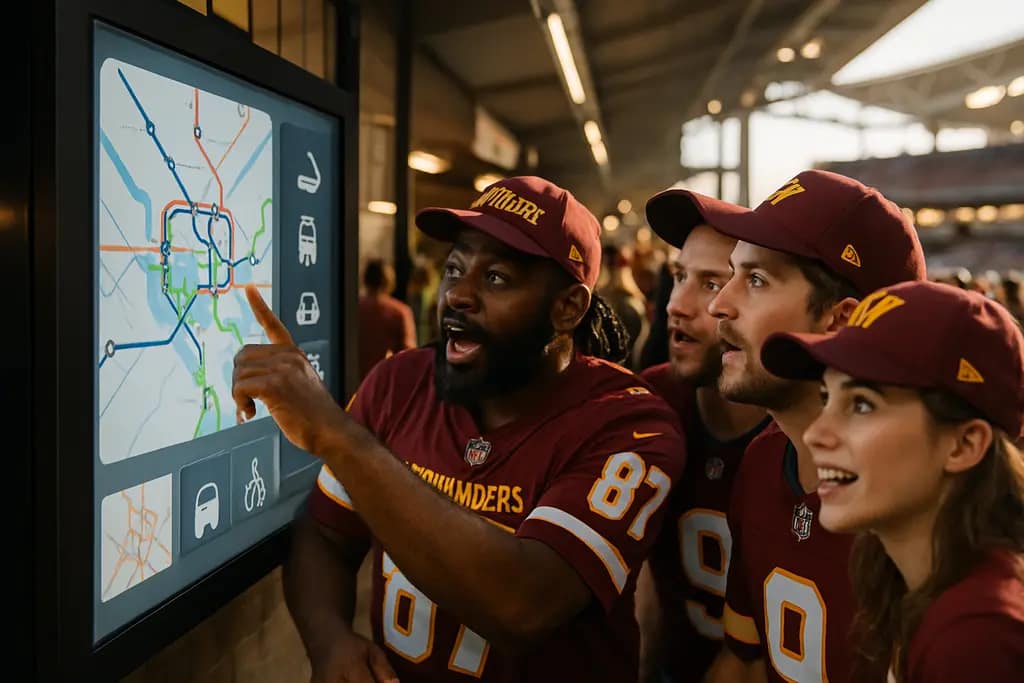
Fan Mobility is the central performance test for the planned Washington Commanders stadium at the RFK Stadium site, not a side benefit. The project has been framed around a roofed, enclosed 65,000-seat venue designed to open for the 2030 NFL season, but the more difficult question is how tens of thousands of people will reach and leave the campus without recreating a car-first event pattern. For a sustainability-focused sports project, that question matters as much as seating, premium areas, or field presentation.
The available record points to a clear shift: fewer parking spaces, more dependence on Metro and buses, and a larger mixed-use district around the stadium. That direction is consistent with lower car reliance, but the result is not guaranteed. Transit-first stadiums need capacity, wayfinding, accessible routes, postgame crowd control, and operating discipline. If those pieces arrive late or underperform, fans feel it immediately.
Fan Mobility As The Project’s Core Test
What Fan Mobility Means At RFK
The RFK plan is not simply a stadium replacement. It sits on a 180-acre campus where about 90 acres are slated for development, including housing, retail, restaurants, and entertainment, with remaining areas preserved as open or green space. That mix changes the mobility challenge. The site must work on NFL game days, but it also has to function on non-event days for residents, workers, visitors, cyclists, and pedestrians.
The most concrete financial signal is the District’s earmark of $600 million for transportation improvements tied to the stadium project, including Metro and other transit upgrades, as reported by The Washington Post. That level of public investment sets a high bar for measurable public value. It also means mobility should be judged by delivery dates, capacity gains, accessibility improvements, and reduced friction for fans who do not drive.
The Fan Mobility claim will face its sternest test after games, when 65,000 spectators do not leave in a smooth trickle. Stadium plans can look persuasive on paper, but the most valuable evidence will be operational: platform crowding, bus headways, pedestrian clearance times, and whether fans with mobility needs can move through the site without long detours.
Metro, BRT, And The First-Day Plan
Stadium-Armory Station Is The Pressure Point
The Stadium-Armory Metro Station is the obvious pressure point because it is expected to absorb a large share of event-day movement. Plans described in the project submission included physical and operational improvements such as elevators and a new mezzanine intended to improve post-event capacity and accessibility. As of August 2026, the station work and BRT connection designs were still at the 30 percent design phase, which means the concept had advanced but major construction and final delivery risks remained.
The “Day One Transportation Plan” described direct walking routes from Stadium-Armory’s southern portal, enhanced bus service on Benning Road, and a transit plaza at the northern end of the RFK campus with dedicated transit access, according to the NCPC submission materials. For Fan Mobility, this is the right set of categories: rail access, bus capacity, walking routes, and a clear transit hub. The open question is whether these pieces will be built and operated at a level that matches NFL peak demand.
The Gold Line Concept Needs Operating Proof
The planned Bus Rapid Transit connection between RFK and Union Station, known as the Gold Line in the research record, is a significant part of the project’s transit-first pitch. Dedicated lanes and signal priority are intended to make service faster and more reliable than standard mixed-traffic buses. That matters because Union Station could act as a regional gateway for fans arriving by rail, local transit, or connecting services.
Still, BRT labels can vary widely in practice. A route with dedicated lanes, enforced priority, intuitive boarding, and enough vehicles can move crowds with confidence. A route delayed by traffic conflicts or weak event-day staffing can quickly become a bottleneck. The sustainability case depends less on the branding and more on the final operating plan.
Parking Reduction And Sustainability Trade-Offs
Less Parking Changes Fan Behavior
The plan marks a major shift from the current car-heavy model. Northwest Stadium has about 22,000 parking spaces, while the new RFK stadium plan reduces that figure to about 8,000 spaces, eventually placed in garages. That is one of the strongest signals that the project is moving away from tailgate-led access and toward transit, walking, biking, and shared arrivals.
From a sustainability standpoint, reduced parking can support lower car dependence, but only if alternatives are credible. Fans do not stop driving because a planning document says they should. They change behavior when train frequency, bus reliability, walking safety, bike access, and post-event queue management make the non-car option less stressful than driving. If that does not happen, the pressure may shift into nearby neighborhoods through spillover parking and ride-hail congestion.
The trade-off is cultural as well as logistical. Tailgating has long been part of many NFL fan routines, and the reduction in parking will likely reduce that experience at RFK. The question for the Commanders and the District is whether plazas, food areas, and pregame public spaces can provide a lower-car version of gathering without simply pushing fans into premium indoor zones.
Technology, Access, And District Design

AI Can Help, But It Cannot Replace Infrastructure
In June 2026, the Commanders issued a Request for Information to explore how artificial intelligence and emerging technologies might support infrastructure, fan flow, efficiency, and sustainability across the stadium and mixed-use district. That is worth watching, particularly for crowd monitoring, gate loading, transit information, and energy management. But AI cannot solve Fan Mobility if trains, buses, sidewalks, elevators, and crossings are undersized.
The most credible use of technology would be practical and restrained: real-time transit updates, crowd routing alerts, accessible route information, and staffing decisions based on observed flow. The least useful version would be a marketing layer placed over unresolved physical constraints. In sports venues, fans judge systems by missed trains, long ramps, stalled platforms, and unclear exits, not by procurement language.
This is where the RFK project connects to a wider venue trend. Stadiums and arenas are being asked to prove public benefits beyond the scoreboard, from emissions-related choices to safer pedestrian patterns. For those interested in exploring different venue settings, the nearby Copeland Hills Golf highlights the contrasting arrival patterns found at golf courses compared to those at a bustling NFL stadium. For a closer stadium-specific comparison within this network, the RFK campus impact analysis raises related questions about public value, land use, and sustainability.
Commanders Stadium Fan Mobility Trade-Offs
The Commanders’ RFK plan has the right sustainability logic on paper: a smaller parking supply, a Metro station expansion, a planned BRT link, direct walking routes, a transit plaza, and a mixed-use campus that should not sit idle between games. Those choices align with a less car-dependent sports venue model. Yet the project remains in a delivery phase where caution is warranted.
The clearest near-term indicators will be design advancement beyond the 30 percent phase, construction sequencing for Stadium-Armory improvements, final details on BRT operations, and public reporting on how event-day passenger volumes will be handled. A 65,000-seat stadium can claim a transit-first identity only if the first mile and last mile work for ordinary fans, not just planners and renderings.
If the District and the team deliver the promised mobility systems by the 2030 season, RFK could become an instructive case in how NFL venues reduce car dependence while protecting fan experience. If delivery slips, the reduced parking strategy could expose fans and nearby neighborhoods to avoidable strain. The project’s sustainability value will be decided in that gap between ambition and verified performance.