
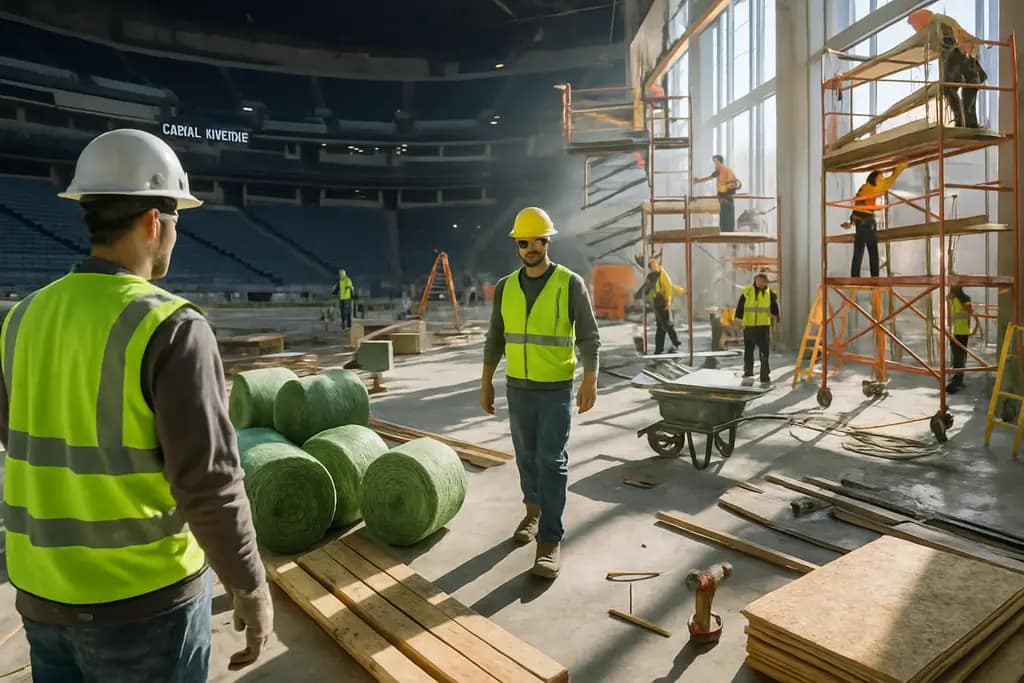
The Ball Arena Renovation is framed as a $135 million fan-experience project, but its sustainability value depends less on headline spending and more on what can be measured after Nuggets and Avalanche crowds move through the building. Based on the available research, the strongest evidence sits in beverage packaging, recycling infrastructure, and the broader district plan around the Denver venue. The weaker area is public detail on how each fan-facing upgrade will cut energy use, water use, or material waste inside the arena itself.
Ball Arena Renovation And Fan Experience
Ball Arena Renovation Scope
Arenas rarely get judged by sustainability language on planning documents. They get judged by the line at concessions, the bottle or cup in a fan’s hand, restroom throughput, seating comfort, and whether crowds can leave without long delays. That is the practical test for this project. If the renovation improves those basics while reducing disposable plastic, cutting operating waste, and preparing the site for lower-carbon district systems, it deserves credit. If the experience improves mainly through more premium consumption, larger concourses, and higher material demand, the sustainability case becomes thinner.
The available facts point to a mixed but promising picture. Ball Arena already has a waste-reduction program with a long operating record, and the research describes broader redevelopment ideas that would push future buildings toward electrification, passive design, water efficiency, green space, and mixed mobility. Those are meaningful themes for a venue that hosts high-attendance basketball, hockey, concerts, and other events. Still, the public evidence provided here does not confirm verified carbon savings from the $135 million work, nor does it provide a full life-cycle account for materials used in construction.
Comfort Without Extra Waste
For an equipment specialist, the fan-experience angle starts with use patterns. A reusable or recyclable product only works if it survives contact with real crowds. Aluminum cups and bottles can be a cleaner option than single-use plastic if collection points are visible, contamination is low, and the recovered material stays in a valuable recycling stream. That is not just a concessions issue. It affects staffing, signage, back-of-house sorting, vendor training, and the speed at which fans can make sustainable choices without feeling punished for doing so.
Venue districts also shape the pregame and postgame footprint through food, hospitality, and travel choices. To explore related developments and how sports-adjacent settings compare, visit Bass Lake Roadhouse, a site within the same network. The Denver case is larger and more urban, but the principle is similar: venue spending does not stop at the turnstile.
Recycling Performance Inside The Arena
Aluminum Cups And Collection Discipline
The strongest documented sustainability gain at Ball Arena is the shift toward aluminum beverage packaging. Ball Corporation reported that Ball Arena recycled about 3 million aluminum cups, cans, and bottles during the 2024–2025 Denver Nuggets and Colorado Avalanche seasons through its partnership with Kroenke Sports & Entertainment, a useful data point because it reflects event-season behavior rather than a design promise Ball filing. That figure does not, by itself, prove a closed-loop system. It does show that the venue has already handled recovery at a scale relevant to major-league sports crowds.
The venue’s “Play Clean” program started in 2008 with single-stream recycling for plastic cups, bottles, and clean paper. In October 2019, Ball Arena became the first major professional sports venue to scale up the use of infinitely recyclable aluminum cups as part of concession sales, according to the venue’s program description Play Clean program. That timeline matters. A sustainability claim attached to a renovation carries more weight when it builds on an operating program rather than appearing as a marketing label after construction has started.
Where The Evidence Is Still Incomplete
The research notes that Ball and KSE aimed for all venue concessions to use aluminum beverage packaging and set a goal for a closed-loop system by 2022. A cautious review should separate the goal from verified performance. The 3 million recycled items in the 2024–2025 seasons are encouraging, but the evidence supplied here does not state the capture rate, contamination rate, percentage remade into new beverage packaging, or emissions reduction compared with the prior mix of plastics and other containers.
That distinction is not nitpicking. A fan may see aluminum and assume the work is done. In practice, the sustainability result depends on whether cups are collected, sorted, and reprocessed at high quality. The arena can improve the fan experience by making that process easy: consistent bin placement, plain-language signs, vendor scripts, and fast post-event cleaning routes. Those measures are not as visible as a new scoreboard or premium club, but they can decide whether the Ball Arena Renovation produces measurable waste benefits.
- Useful proof: seasonal counts of aluminum items recovered and recycled.
- Missing proof: public capture rates and contamination rates by event type.
- Useful proof: clear concession packaging standards across vendors.
- Missing proof: full life-cycle data for renovation materials and operations.
District Systems And Event-Night Impacts
Energy And Building Design
The broader redevelopment around Ball Arena appears to be where some of the deeper sustainability moves sit. The research describes provisions for fossil fuel free buildings that prioritize electricity, including for thermal and hot-water needs, in line with Xcel Energy’s stated path toward carbon-free electricity by 2050. It also describes passive design strategies such as facade orientation, building massing, insulation, and infiltration control to limit energy loads.
Those measures are more relevant to long-term climate performance than many one-time fan amenities. If new buildings around the arena reduce heating and cooling demand before mechanical systems are specified, the district can lower operating energy needs without depending only on future offsets. The same applies to a planned energy loop that could share thermal energy across buildings. In sports terms, that is a systems play rather than a single highlight. It may not be visible to a fan entering through the plaza, but it can affect the emissions profile of the full arena district for decades.
Water, Heat, And Mobility
The research also points to water efficiency measures for buildings and landscaping, including possible greywater reuse for irrigation or toilet flushing. That matters in Denver, where venue districts need to account for both crowd demand and regional water stress. Landscaping can become a liability if it increases irrigation demand, but it can become an asset if designed with efficient water systems, shade, and habitat value.
Green spaces, courtyards, habitat areas, and heat-island reduction features are part of the master-plan material described in the research. So are mixed-mobility elements such as walkability and bike infrastructure. Those features touch fan experience directly. Shade changes how a plaza feels before a summer concert. Safe bike access can reduce parking pressure. Walkable edges can spread arrivals and departures across more routes. For a related example of how venue upgrades can be tested against environmental claims, CadCamNet’s review of National Tennis Center upgrades shows why lighting, waste, and water data need to be assessed with care.
What Evidence Should Be Tracked Next

Fan Metrics Need Environmental Context
The Ball Arena Renovation should not be evaluated only through attendance, concession revenue, or premium-seat demand. Those measures matter to the operator, but they do not show whether the building is becoming cleaner to run. A better scorecard would pair fan metrics with environmental data: average waste per attendee, percentage of beverage containers captured, water use per event, energy use per event, and transit or bike mode share on major event nights.
Construction impacts also deserve scrutiny. Renovations can avoid some emissions associated with building a replacement venue, but they still require steel, concrete, finishes, lighting, electronics, seating components, and transport. Without published material quantities or embodied-carbon estimates, any claim that the project is clearly low-carbon would be premature. The responsible view is narrower: Ball Arena has a documented recycling program and a district plan with credible sustainability concepts, while the renovation’s full carbon and resource profile remains unproven from the supplied evidence.
Questions For Operators And Fans
Operators can help by publishing annual performance data in plain categories. Fans can help by using the systems correctly, but the burden should not fall only on fans. Good design makes the lower-waste choice obvious. If a fan has to search for a recycling bin after the final horn, the system has already lost ground.
The most useful public updates would include whether aluminum packaging has reached the intended share of concessions, whether closed-loop processing has been verified, how much single-use plastic remains, and how district energy and water systems are being phased. Specific event-type reporting would be valuable too, because a sold-out playoff game, a concert, and a weekday event can have different waste and mobility patterns.
Ball Arena Renovation Sustainability Scorecard
A Cautious Grade From Available Facts
Based on the evidence supplied, the Ball Arena Renovation earns a cautious positive mark for building on an existing aluminum and recycling program rather than starting from scratch. The approximately 3 million aluminum items recycled during the 2024–2025 Nuggets and Avalanche seasons is the clearest performance signal. The Play Clean history gives the venue a longer baseline than many arenas making fresh sustainability claims.
The unanswered questions are just as real. The research does not provide a verified emissions-reduction total, a renovation material inventory, a public energy-use baseline, or confirmed post-renovation operating targets. The broader district plan includes strong concepts: electrified buildings, passive design, water efficiency, a possible energy loop, green space, and mobility improvements. Those ideas could make the arena district more resilient and less resource-intensive, but they need project-level reporting as work advances.
For fans, the practical read is this: the renovation can improve comfort and still support sustainability if the operator treats waste, water, energy, and mobility as operating metrics, not side notes. The project’s best sustainability evidence is already in the cup stream. The next test is whether the $135 million fan-experience push turns that foundation into verified gains across the building and the surrounding district.