

Welcome to the digital playing field where compliance is key. The sports analytics market is growing fast, from $5.79 billion to $24 billion by 2032. Now, three-quarters of professional teams use real-time analytics. This growth makes compliance a big challenge.
Enter GDPR – Europe’s digital referee. It doesn’t tolerate foul play. Many organizations see GDPR like that awkward relative at family gatherings. They know they should engage but prefer to avoid it.
This isn’t just paperwork. It’s about scoring big with proper information handling or facing penalties. The GDPR framework demands our attention, whether we’re ready or not.
It’s like herding cats while juggling flaming torches. The cats have lawyers, and the torches are huge fines. Let’s figure out how to turn regulatory challenges into advantages.
Team/league/school contexts
Imagine the NFL’s Digital Athlete technology across all 32 clubs and your local high school using basic smart sensors. The data privacy field is not even – it’s like a pro stadium versus a sandlot. The CCPA doesn’t care about your league’s budget. It treats everyone the same, like they’re all playing in the same regulatory Super Bowl.
Professional leagues handle data like Fortune 500 companies. The NBA’s METIC system for injury prediction uses more data points than some small countries. They have big compliance teams, bigger than some teams’ coaching staffs. Schools, on the other hand, are like amateur clubs trying to keep up with major league analytics.
Organizations treat youth sports data with professional-level rigor. It’s like using a Formula 1 car for a grocery run. The stakes are different. Pro teams risk big CCPA fines. Schools face parental outrage and trust erosion that can shut down programs.
The regulatory context changes fast, like a wide receiver changing direction. What works for the NFL might not work for schools. The California Consumer Privacy Act is now the new baseline for everyone, no matter their league’s revenue.
| Organization Type | Data Volume | Compliance Resources | Primary CCPA Risk |
|---|---|---|---|
| Professional Leagues | Massive (TB+ daily) | Dedicated teams + legal | Multimillion-dollar fines |
| College Athletics | Significant (GB daily) | IT + compliance officers | Reputational damage + fines |
| High School Programs | Moderate (MB daily) | Coaches + admin staff | Parental trust erosion |
| Youth Leagues | Minimal (KB daily) | Volunteers only | Program termination risk |
The table shows the harsh truth about data privacy compliance. Big organizations can handle CCPA requirements. Smaller programs often don’t even know what they don’t know. Yet, the regulation applies to all the same.
This isn’t about fair play – it’s about smart play. Knowing your organization’s context is key to credible compliance. In the game of data privacy, everyone plays by California’s rules now.
Threat Modeling
Welcome to the digital chess match where your opponent already knows your next move. Those sleek wearables athletes swear by? They’re not just performance trackers – they’re treasure troves for anyone with malicious intent.
I’ve seen systems where consent management was treated like asking for permission after you’ve already taken the car for a cross-country joyride. Catapult Sports vests, STATSports GPS, and WHOOP bands don’t just collect numbers – they gather intimate health insights that could make or break careers.
Proper threat modeling means recognizing these devices create multiple vulnerability points. It’s not just about statistics anymore. We’re talking about personal health information that demands sophisticated protection strategies.
True consent management isn’t an afterthought – it’s the foundation of ethical sports analytics. Because in this game, the stakes are higher than just winning or losing.
Device, app, cloud risks
Welcome to the digital locker room where your fitness tracker knows more about your heart rate than your cardiologist. Modern sports technology has created a triple threat scenario that would make even the most seasoned coach sweat.
Let’s start with the hardware – those sleek wearables that athletes strap on like digital tattoos. WHOOP bands monitor physiological data with the precision of a NASA mission control. Intel’s 3D Athlete Tracking system captures movement biomechanics with enough detail to make a Hollywood motion capture studio jealous.
But here’s the rub: these devices can disappear faster than a rookie’s signing bonus. Lost wearables become treasure troves of biometric data. Hacked sensors? That’s like giving opponents your playbook wrapped in a bow.
Then we have the apps – the digital coaches living in athletes’ pockets. Swing Vision analyzes tennis strokes with 97% accuracy, which is both impressive and slightly terrifying. These applications often have more vulnerabilities than a minor league defense line.
Cloud platforms represent the third pillar of this risk trifecta. AWS hosting the NFL’s Digital Athlete platform is like building a virtual stadium – except sometimes the digital gates get left unlocked overnight. These storage solutions can become data free-for-alls if not properly secured.
The real magic trick in this circus is de-identification. I’ve seen systems where stripping personal data was treated like putting a name tag on someone’s back and calling it anonymity. Proper de-identification requires more sophistication than simply removing visible identifiers.
Each technology category presents unique challenges:
- Devices: Physical loss, unauthorized access, sensor manipulation
- Apps: Data leakage, insecure APIs, permission overreach
- Cloud: Breach vulnerabilities, multi-tenant risks, jurisdiction issues
Effective de-identification strategies must account for all three risk vectors. It’s not enough to secure the cloud if the app on an athlete’s phone is leaking data like a sieve. True protection requires a defense that’s tighter than a championship game in overtime.
The solution isn’t abandoning technology – that would be like going back to leather helmets. It’s about implementing robust de-identification protocols that actually work, not just looking good on a compliance checklist.
Design Patterns
Ever notice how some fitness platforms feel like a trusted coach while others feel like a surveillance state? That’s where design patterns make a big difference.
Platforms like Strava and Garmin Connect get it right. They make their interfaces so easy to use, it’s like having a personal coach. The key? Differential privacy – a math trick that lets systems learn without sharing personal details.
It’s like having a shield for your personal info. These designs know people want to get better, not be watched. They share info if it’s useful, but stand up for privacy if they feel exposed.
The best patterns blend great UX with solid math. Differential privacy isn’t just theory – it’s what makes privacy work in real life.
Consent UX, privacy dashboards, minimization
Digital consent in sports tech is a big deal. Athletes often click “I agree” without reading the fine print. This is because they’re sharing important data like heart rate and sleep patterns.
The current state of consent UX in sports apps is confusing. It’s like trying to find the bathroom in a new stadium. Privacy dashboards are often hidden, making it hard to find them.
Athletes share more than just their email addresses. They give away biometric data that affects their careers. This is a big deal, like a game-winning field goal attempt.
The Three Pillars of Ethical Data Collection
Good sports tech platforms follow three key rules:
- Transparent consent UX that explains what’s collected in plain language
- Accessible privacy dashboards that athletes actually use
- Genuine data minimization practices that respect athlete privacy
The minimization principle is often ignored. Teams collect too much data, not just what they need. It’s like digital hoarding.
What Great Consent Experiences Look Like
The best systems have ongoing conversations about consent. They make data minimization a feature, not a limitation. Athletes know what’s collected and why it matters.
Think of it like a playbook. You don’t need every play, just the ones that work. The same goes for data collection in sports tech.
| Feature | Poor Implementation | Excellent Implementation | Impact on Athletes |
|---|---|---|---|
| Consent UX | Endless scroll of legal text | Visual, step-by-step explanations | Understanding vs. confusion |
| Privacy Dashboards | Buried in settings menu | Front and center access | Control vs. frustration |
| Data Minimization | Collect everything possible | Only essential performance metrics | Trust vs. skepticism |
| Ongoing Consent | One-time agreement | Regular check-ins and updates | Engagement vs. abandonment |
Personalized training apps and fan engagement platforms show why clear consent matters. When done right, athletes feel respected. They understand how their data is used.
Good consent UX is about respect, not just following rules. It’s like explaining why you need a pass to your teammate. The best sports tech platforms respect this, making data collection a partnership.
The goal is simple: collect less, explain better, and empower athletes. Trust is the ultimate performance metric in sports tech.
Technical Controls
Welcome to the digital locker room where analytics meets alchemy. This is where sports science transforms raw numbers into championship strategies.
The real magic happens when systems like METIC’s injury prediction use transformer technology. This is the same stuff that powers language processing. Apparently, analyzing basketball injuries and understanding human speech aren’t that different.
Then there’s Zone7’s AI algorithms processing movement metrics to predict Achilles tendon ruptures before they happen. They’re like fortune tellers with math degrees.
The smartest approach I’ve seen? Federated learning systems that let teams train models without centralizing sensitive information. It’s like having your analytics cake and eating it too – without compromising athlete welfare.
These technical controls work like great defensive strategies: invisible when working properly but absolutely critical for preventing catastrophic failures.
Encryption, DP, FL, access logging
Welcome to the digital locker room where encryption meets athletic performance. It’s the most secure huddle you’ve ever seen. This isn’t just about protecting data. It’s about building trust ecosystems where athletes can share their most sensitive metrics without second-guessing the security behind them.
Let’s break down the all-star team of technical controls that make modern sports analytics both powerful and private.
Encryption That Would Make James Bond Blush
We’re talking enterprise-grade encryption that treats athlete data like state secrets. The AWS and NFL collaboration for their Digital Athlete platform demonstrates this perfectly. Your sleep patterns, heart rate variability, and recovery metrics get the same protection level as classified government documents.
This isn’t your basic password protection. We’re discussing end-to-end encryption where data gets scrambled from the wearable device to the cloud storage and back again. Only authorized personnel with the right cryptographic keys can access the raw information.
Differential privacy represents the genius solution to a classic sports analytics dilemma. How do we gain team insights without exposing individual athlete data? This mathematical approach adds just enough statistical noise to protect personal information while maintaining aggregate accuracy.
Think of it like this: coaches can see that the offensive line’s average fatigue level increased 23% in the fourth quarter, but they can’t tell which specific player was struggling most. It’s pattern recognition without personal exposure.
Federated Learning: Global Insights from Local Data
Federated learning keeps data local but shares intelligence globally. Instead of moving sensitive athlete information to a central server, the algorithm travels to where the data lives. The model learns from local patterns then shares only the insights – not the raw data.
Tata Consultancy Services’ digital heart modeling uses this approach beautifully. Their system can identify cardiac patterns across entire leagues without ever centralizing individual heart rate data. It’s like having a scout who learns from every team but only reports back the strategic insights.
Access Logging: The Digital Breadcrumb Trail
Access logging creates an audit trail more detailed than a coach’s play-by-play notes. We’re talking timestamped records that show exactly who accessed what data, when, and from where. I’ve seen systems that could tell us which assistant coach checked a player’s sleep data at 2:37 AM (usually correlating with their own coffee consumption patterns).
This isn’t about surveillance – it’s about accountability and trust. When athletes know their data access is meticulously tracked, they’re more comfortable sharing the information that drives performance improvements.
| Security Technology | Primary Benefit | Implementation Complexity | Real-world Example |
|---|---|---|---|
| Enterprise Encryption | Data protection at rest and in transit | High (requires key management) | AWS-NFL Digital Athlete platform |
| Differential Privacy | Aggregate insights without individual exposure | Medium (statistical expertise needed) | Team performance trend analysis |
| Federated Learning | Local data processing with global learning | High (distributed system architecture) | Tata Consultancy cardiac modeling |
| Access Logging | Complete audit trails and accountability | Medium (logging infrastructure required) | Coach access pattern tracking |
These technical controls work together like a well-coached team. Each plays their position while supporting the overall defensive strategy. The result? Athletes get to focus on performance, knowing their data is protected like the playbook before the championship game.
The beauty of this approach lies in its layered protection. Even if one security measure gets beaten (which is rare with proper implementation), the others stand ready to prevent any data breach touchdown.
Data Governance
Imagine your company’s data security is like a pickup basketball game. Everyone makes up rules as they go. I’ve seen cases where the janitor has the same access as the head coach. It’s either very democratic or very risky.
The sports analytics market is growing fast, aiming for $24 billion by 2032. Setting up a team can cost $1-5 million. It’s clear that data governance can’t be ignored.
The team doctor needs different access than the marketing intern. Historical data has different needs than real-time analytics. European player info is handled differently than American athlete data.
Proper RBAC implementation creates a framework that’s organized but flexible. It’s where security meets strategy in the digital world.
Retention, audits, DPIAs, vendor risk
Ever notice how sports organizations treat data like championship trophies? They keep everything forever, creating digital museums of athlete info. This is more than the Library of Congress could handle.
This “keep everything forever” approach works great for memorabilia but terribly for privacy. It’s like saving every grocery receipt from 1998 just in case you need to prove you bought milk that one Tuesday.
Data retention policies need more discipline than a playoff-bound team. You can’t just stockpile biometric data because nobody wants to make the deletion call. That’s where proper audits come in – they’re the referees of your data governance game.
I’ve conducted audits that revealed shocking data hoarding practices. Teams storing heart rate data from training sessions a decade ago? That’s not analytics – that’s digital hoarding with better technology.
The real game-changer? DPIAs (Data Protection Impact Assessments). These become critical when dealing with advanced analytics. It’s the difference between smart analytics and playing with ethical fire.
Now let’s talk about the elephant in the locker room: vendor risk. Professional teams’ vendor ecosystems are complex. Catapult Sports vests, STATSports analytics, AWS cloud platforms, and various AI providers create a supply chain that needs more monitoring than a rookie’s diet plan.
Each vendor represents a risk. The best organizations audit them more thoroughly than a referee reviewing a controversial touchdown call. Because when your data lives in someone else’s cloud, their security becomes your problem.
| Vendor Type | Risk Level | Audit Frequency | Data Access |
|---|---|---|---|
| Biometric Sensors | High | Quarterly | Full athlete data |
| Cloud Storage | Medium-High | Bi-annual | All organizational data |
| Analytics Platforms | Medium | Annual | Processed data only |
| AI/ML Providers | High | Quarterly | Training data sets |
Managing this vendor risk landscape requires more strategy than a fourth-quarter comeback. You need clear contracts, regular security assessments, and exit strategies that don’t leave your data stranded like a player without a ride home.
Remember: your data’s security is only as strong as your weakest vendor. And in today’s sports tech landscape, that’s saying something.
Special Populations
Welcome to the world where tracking meets teens. Do we really need to monitor their sleep like it’s the Olympics?

The line between professional and amateur tracking is getting fuzzy. Pros give up rights with contracts. But amateurs just want to play without being watched.
Medical privacy is often ignored. Using advanced tech on high school athletes is like using a nuclear bomb in a water balloon fight.
Different games need different rules. The weekend athlete’s data should be more private than a pro’s. It’s about fairness in tracking people’s lives.
Youth athletes, medical boundaries
Imagine a high school soccer team tracking sleep like they track goals. Welcome to the world of youth sports analytics, where WHOOP bands are as common as water bottles. Privacy awareness is like reality TV contestants and open diaries.
Professional sports technology has reached amateur levels, creating big ethical issues. We’re talking about young bodies, minds, and parents who might not understand data collection’s long-term effects. It’s like giving kids sports cars before they learn traffic laws.
Medical data becomes tricky when injury prediction could affect college chances. A hamstring strain is more than a medical issue; it’s a data point that could change athletic futures.
Handling youth athlete data like protected health information is key. It’s just as important, but in cleats and jerseys instead of hospital gowns.
Essential Safeguards for Youth Sports Data
Protecting young athletes needs more than good intentions. It requires specific strategies that balance performance and privacy. Here’s what makes responsible programs different from data miners:
| Risk Area | Common Pitfalls | Protection Strategies | Compliance Considerations |
|---|---|---|---|
| Medical Data Collection | Over-collection without purpose limitation | Data minimization principles | HIPAA analog protections |
| Parental Consent | Boilerplate agreements lacking specificity | Granular opt-in mechanisms | COPPA compliance requirements |
| Long-term Data Use | Unlimited retention periods | Automatic deletion timelines | Right to be forgotten protocols |
| Third-party Sharing | Hidden data sharing with recruiters | Transparent disclosure policies | Vendor risk assessments |
These safeguards make sure performance tracking helps athletes, not turns them into data. It’s about giving kids analytics benefits without making them products.
Top programs use “privacy by design” for youth sports. They build protection into their data practices, not as an afterthought. This way, young athletes get both top-notch insights and strong privacy protections.
As these technologies grow, the industry must set standards to protect young athletes. Nothing should take away from a child’s right to grow their skills and keep their privacy. For more on this, check out federated learning models for privacy and insights.
Playbook
Ever watch a championship team execute their game plan? That’s what a proper digital protection playbook looks like. It’s coordinated, strategic, and beautiful when done right.
The NFL’s Digital Athlete program shows how pros handle this. They don’t just wing it like your uncle’s fantasy football draft. Instead, they create systematic protocols that work.
Good playbooks know that different groups need different strategies. A college athletic department isn’t the same as an NBA team, which isn’t like a youth sports group. They create living documents that change fast, like Taylor Swift’s dating history.
Want to see a real protection playbook in action? It’s not about strict rules. It’s about smart, adaptable frameworks that work in real life.
The best organizations treat this like offensive coordination. They constantly update, practice, and execute with precision. In today’s digital world, your defense must be as sharp as your offense.
Policies, templates, checklists
Let’s face it—talking about policy documents can be a real buzzkill. They’re like the vitamins of data privacy: needed but not exciting. Without them, your athlete data protection plan is like a long shot with no time left.
I’ve seen policies that are so broad, they could cover anything from collecting biometric data to managing hot dog vendors. The best ones are clear, easy to follow, and work in real life.
Professional leagues have developed great tools quietly. Their templates come from years of learning what works. They know what triggers checks, what coaches do, and how to avoid data breach talks after games.
Why do checklists matter so much? Because in the heat of a big game, privacy can slip away fast. These tools make complex rules simple and doable.
Here are key parts for your playbook:
- Data Handling Protocols: Who handles data and when
- Vendor Assessment Templates: To check if third-party apps are safe
- Compliance Checklists: For quick checks to make sure everything’s okay
The best part is when these documents are easy to understand. They help trainers, coaches, and admins focus on winning, not just privacy.
Great templates aren’t just about making more paperwork. They’re about setting up safety nets for athletes. This way, the team can focus on what it does best: compete.
Case Snapshot
Welcome to the big leagues of biometric innovation. Here, theory meets reality quickly, like a rookie’s first contract negotiation.
The NFL’s Digital Athlete rollout across all 32 teams is impressive. It’s either a masterclass in federated learning or a cautionary tale about moving too fast. I’ve watched this deployment with the fascination of a Monday Night Football analyst.
The NBA’s METIC implementation uses transformer technology. It sounds like sci-fi but it’s real. This system analyzes game sequences and injury patterns with terrifying accuracy.
These real-world deployments prove something important. The most advanced AI means nothing without trust. Successful implementations balance cutting-edge analytics with robust protections, creating win-win situations for everyone involved.
Privacy and performance aren’t opposing goals here. They’re complementary strategies executed at championship level.
League rollout with federated models
Watching a league-wide federated models rollout is like seeing a championship team play perfectly. Every player knows their role, and the results are amazing. The NFL’s use of Digital Athlete technology across all 32 teams on AWS is a top example of sports data privacy.
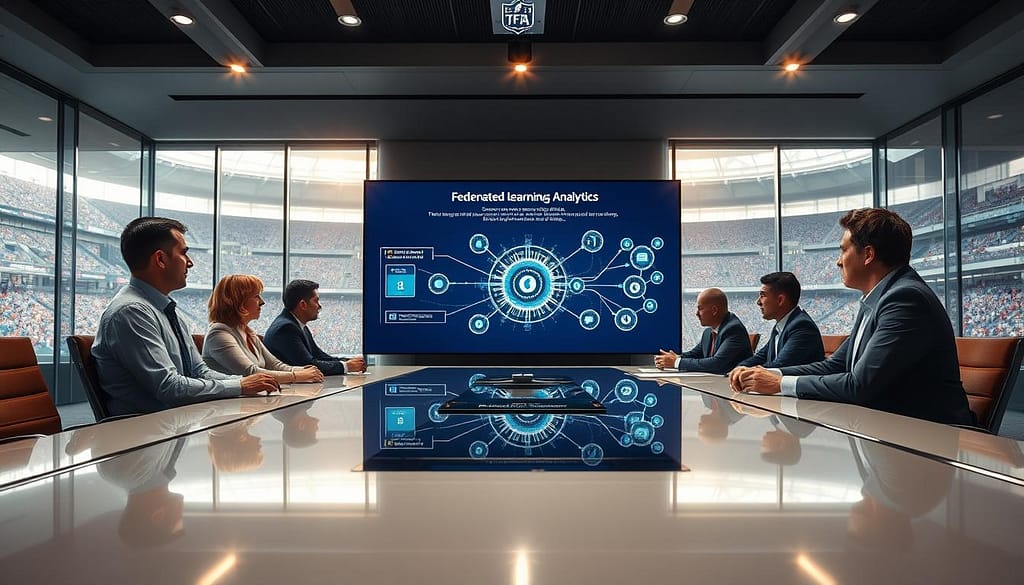
Federated learning lets each team keep their data safe while sharing insights with the league. It’s like having your cake and eating it too. Teams keep their secrets while gaining valuable information.
The tech behind these systems is impressive, but the real challenge is getting everyone on board. I’ve seen cases where the tech worked great, but coaches didn’t understand it. Getting trainers, athletes, and staff to accept new technology takes amazing communication skills.
Federated models work well in sports because they respect team boundaries. Teams can work together without sharing their secrets. This includes training methods, player development, and game plans.
The NFL’s league rollout shows the power and challenges of scale. With 32 teams, every detail counts. The communication plan must be as detailed as the technology, explaining data privacy at every level.
Trust is key for successful adoption. Athletes must feel their data is safe. Coaches need to trust the insights will help them win. And owners must see a return on their investment.
Well-executed federated learning systems help everyone. When teams share and benefit from collective intelligence, the sport grows. It’s a form of competitive collaboration that leads to success.
The Final Whistle on Athlete Data Privacy
We’ve reached the end of our journey into athlete data privacy. The sports analytics market has grown to $24 billion. Now, 75% of pro teams use real-time data. The rules are getting stricter, like a tight defense in the fourth quarter.
Some teams just see it as a rule to follow. But the smart ones know it’s a way to get ahead. They’re not just collecting data; they’re building trust. This trust is key for real innovation in how they analyze performance.
The future isn’t just about more sensors or faster computers. It’s about handling data better, protecting it more, and making systems athletes can trust. The ones who win will make privacy a key part of their plan.
Are you ready to turn your athlete data into your biggest asset? Let’s create analytics programs that athletes trust, regulators respect, and competitors wish they had.