

Think about your favorite running jacket. It has a special membrane and zippers that move smoothly. Now, imagine where it goes when you’re done with it. Most of us just throw it away, sending it to a landfill.
The sports tech world has focused on making clothes that last, like those for Everest. But, we haven’t thought about what happens to them after we wear them out. Closed-loop manufacturing changes this. It turns old clothes into new products, like turning old tights into a yoga mat.
Only about 1% of clothes get recycled back into new fibers. With the industry expected to reach $430 billion by 2025, this is a huge problem. It’s not just bad for the planet; it’s also a waste of resources. This article explores how new systems are making the industry take responsibility and recycle more.
What is a Closed-Loop Process?
Let’s explore the world of closed-loop processes, where waste is just a myth. Unlike the old linear model, circular manufacturing is a new way. It lets us design products that can be used over and over, turning waste into something valuable.
In the old model, 73% of clothes go to landfills every year. This happens because we use resources, make products, and then throw them away. But in a closed-loop process, we see waste as a sign of not thinking hard enough. Products are made to last long, be fixed, and recycled.
Key principles of circular design include:
- Design for Longevity: Products should last 2–3 times longer than fast fashion items.
- Material Selection: Use recycled or biodegradable materials that have a clear end-of-life plan.
- Modular Construction: Build products that can be easily disassembled for repair or recycling.
- Repair Services: Offer services that encourage consumers to fix instead of throw away.
- Resale Options: Make it easy for people to sell their products, extending their life.
These strategies help the planet and make manufacturing better. Companies using circular methods save up to 50% water and 30% energy during production. So, the real question is, why did we ever settle for anything less?
Key Steps: Collection, Reprocessing, Repurposing
If closed-loop manufacturing were a heist movie, the collection step would be the unsung hero. It quietly gathers materials while the flashy action unfolds elsewhere. This foundational phase is where the magic begins.
Think of it as convincing consumers that their worn-out gym shorts can have a second life. Without a robust take-back infrastructure, like Adidas’ “Made To Be Remade” programs or convenient in-store drop-off bins, the loop breaks before it even forms.
Next up is the Reprocessing phase, where the real sci-fi magic happens. We’re talking about AI-driven sorting systems that can differentiate between nylon-6 and nylon-6,6 faster than a sommelier can identify a fine Bordeaux. Robotic separation, coupled with blockchain tracking, slashes reverse logistics costs by 31% while boosting recovery rates from a dismal 54% to a respectable 78%.
Yet, it’s not all smooth sailing; fiber blending and dye contamination remain the party crashers nobody invited. That stretchy elastane blend that makes your yoga pants so comfortable? It also complicates recycling.
Lastly, we arrive at the Repurposing phase—the victory lap. This is where recovered materials transform into new products that perform as well as or even better than their virgin counterparts. Imagine recycled polyester from plastic bottles that wick sweat like a champ, or recycled nylon that can withstand the rigors of the trail.
Yet, the sobering reality is that even with all this innovation, fabric recycling rates are projected to crawl to just 43% by 2050. The technology exists, the will is forming, but now we just need the execution to match the ambition.
| Step | Description | Challenges | Innovations |
|---|---|---|---|
| Collection | Gathering used materials from consumers | Consumer awareness | Take-back programs |
| Reprocessing | Sorting and separating materials | Fiber blending, dye contamination | AI sorting, blockchain tracking |
| Repurposing | Transforming materials into new products | Low recycling rates | Innovative fabric technologies |
Leading Industry Examples
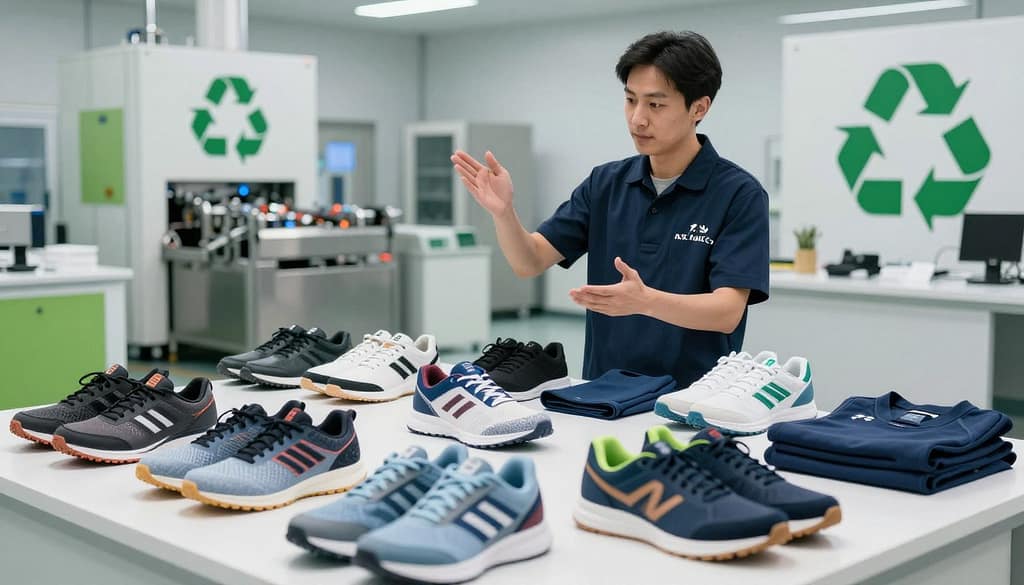
In a world where sustainability is often just a buzzword, some brands are actually making a difference. Let’s look at the leaders in circular manufacturing who are turning waste into new opportunities in the sports gear industry.
Adidas is leading the way with its “Made To Be Remade” program. They invite customers to return worn-out gear, which they then break down to make new products. It’s like a phoenix rising from the ashes, but with three stripes. While it’s hard to scale such programs globally, their effort is truly commendable.
Patagonia is another brand known for its commitment to sustainability. They’ve been working on circular principles for years. Their repair services and resale markets are not just ideas; they’re strong business models that fight against throwaway culture.
Closed Loop Partners made headlines with a $5 million loan to Supersede. This company turns recycled industrial plastic waste into marine-grade building panels. These panels are better than traditional plywood, being 100% waterproof, rot-proof, and mold-proof. And yes, they can be fully recycled!
Also, Closed Loop Partners’ acquisition of Sutter Metals shows the importance of keeping metals like aluminum and copper in use. Circular manufacturing is not just about trendy yoga pants; it covers many industries.
The market is responding well to these efforts. The sustainable athleisure market is expected to grow from $88.75 billion to $176.05 billion by 2030. Over 60% of this growth will come from mass-market products. This shows that sustainable fashion is no longer just for eco-warriors with deep pockets. Mainstream consumers are now buying into it, and brands that started early will lead the market.
| Brand | Initiative | Impact |
|---|---|---|
| Adidas | Made To Be Remade | Recycling worn-out gear into new products |
| Patagonia | Repair and Resale Services | Promoting longevity and reducing waste |
| Supersede | Marine-Grade Panels from Recycled Plastic | High-performance, fully recyclable building materials |
Economic & Environmental Benefits
Closed-loop systems in sports are more than just a trend. They mark a big change in how we make and use things. The global circular economy market is expected to grow from $656 billion to $2.3 trillion by 2030. This growth is real and even the most skeptical business leaders can’t ignore it.
Using recycled materials can save 15% to 35% on raw material costs. This means businesses and consumers can save a lot of money. For example, saving $2.8 million for every $100 million in revenue by using recycled materials. Brands that adopt circular practices see their profits increase by 23% in just three years. This is a huge change.
The environmental benefits are also significant. Closed-loop systems can cut carbon footprints by up to eight times compared to old methods. Recycling aluminum, for example, uses only 5% of the energy needed to make it from scratch. The circular fashion market is expected to grow from $7.63 billion to $13.94 billion by 2032, making up 23% of the global fashion market by 2030.
In Europe, closed-loop systems could unlock $560 billion in economic value and create 700,000 jobs by 2030. It’s not a question of whether closed-loop systems make sense economically; it’s why brands sticking to old ways think they can survive. To learn more about these practices, check out this insightful article.