
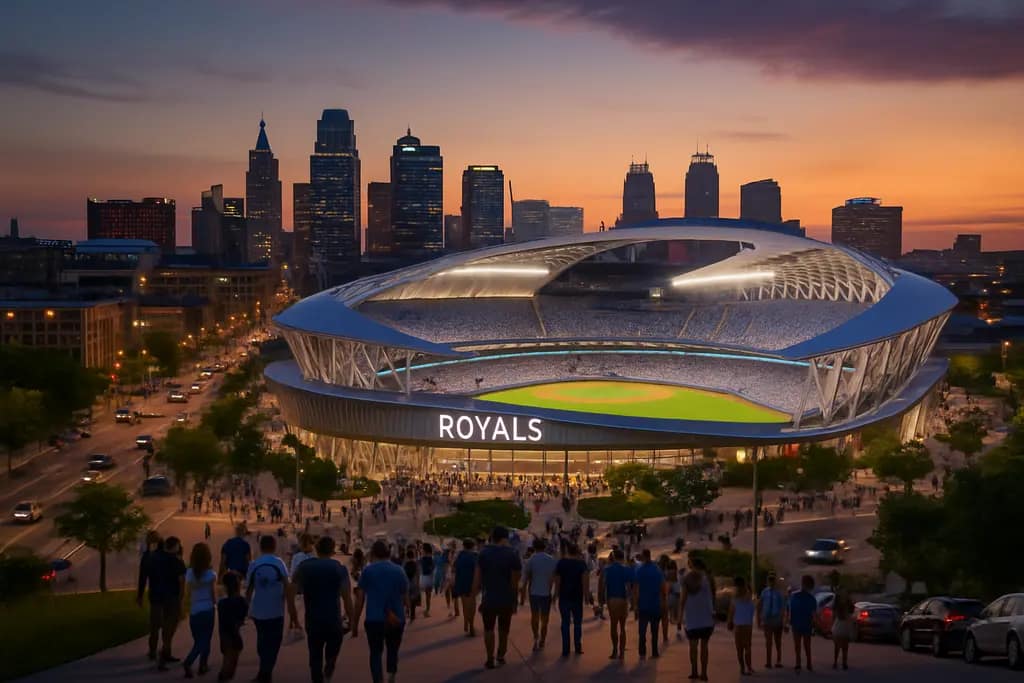
The Royals stadium impact debate has moved from theory to a specific downtown plan. On April 22, 2026, the Kansas City Royals and Hallmark Cards announced a proposal for a new ballpark and surrounding Baseball District at Crown Center and Washington Square Park, describing an 85-acre, roughly $3 billion public-private development according to MLB.com. That date matters because, as of September 1, 2026, this is no longer a loose stadium search. It is a named site with economic promises, civic tradeoffs, and sustainability questions that need public testing before a targeted 2030 opening.
For sports cities, a downtown ballpark can be more than a venue. It can shift travel patterns, land values, small-business traffic, union labor demand, park access, and the daily use of streets around a team’s home schedule. Yet stadium projects often carry two competing truths: they can concentrate investment, and they can move public costs onto residents who may not share equally in the benefits.
This analysis treats the Royals plan as a sports infrastructure proposal first, not as a civic branding exercise. The question is not whether a ballpark looks attractive in renderings. The question is whether Kansas City can measure the jobs, public funding, access, environmental performance, and neighborhood effects with enough clarity to know what it is buying.
What Royals Stadium Impact Means Downtown
Royals Stadium Impact On Jobs And Public Value
The city’s public account of the agreement said the project is expected to generate 20,000 construction jobs and support 1,000 union jobs on game days per Kansas City’s official release. Those are significant figures, particularly in a construction market where large public-private projects can shape labor demand for years.
The cautious reading is that job counts alone do not settle the value question. Construction jobs are temporary by design. Game-day jobs vary by event schedule, operating model, subcontracting terms, and seasonality. A stronger public review would separate full-time-equivalent positions from head counts, define wage floors, track local hiring, and publish the share of contracts going to minority-, women-, and veteran-owned businesses if those commitments are written into the final framework.
The Royals stadium impact on downtown will also depend on whether spending is new to the region or shifted from other Kansas City entertainment districts. Baseball creates 81 regular-season home dates in a normal MLB season, plus possible postseason games and non-baseball events if booked. That is enough activity to matter, but it is not the same as a seven-day-a-week employment engine unless the surrounding district brings daily uses that survive outside first pitch.
Why Location Changes The Sustainability Math
Crown Center and Washington Square Park place the proposed ballpark near existing urban assets rather than on the edge of the metro area. That can reduce some infrastructure duplication if transit, utilities, sidewalks, and public space are integrated well. It can also intensify pressure on streets, parking, stormwater systems, parkland, and nearby residents if the design leans too heavily on car access.
For sustainability, density is only a starting point. A downtown location becomes environmentally stronger when fans can arrive by walking, cycling, bus, streetcar, or rail connections without long delays or unsafe crossings. It weakens when a ballpark pulls in large volumes of single-occupancy vehicle trips and requires new parking fields that sit underused on non-event days.
Community Benefits And Labor Commitments
What The Public Should Be Able To Track
The research record for the project includes community-benefit elements such as arts funding, youth sports support, backing for the Negro Leagues Baseball Museum, homelessness services, affordable housing stipulations, public open space, and workforce provisions. Those concepts align with what modern stadium agreements often promise. The public test is whether they become enforceable, timed, measurable obligations.
A strong agreement would answer several practical questions:
- Who receives the funding: named program categories are useful, but audited distributions matter more.
- When payments are made: front-loaded commitments carry different value than back-loaded lease-term promises.
- How housing rules are enforced: affordability needs income targets, unit counts, duration, and compliance reviews.
- How park access is protected: free public access to Washington Square Park should be clear on event and non-event days.
- How labor standards are measured: prevailing-wage language should be matched with reporting on hours, contractors, and workforce demographics.
Community benefits are not charity if public land, public financing, or public infrastructure support the development. They are part of the exchange. That is why the Royals stadium impact should be judged against delivered outcomes, not only against the size of the construction budget.
Sustainability Questions Still Unanswered
From Kauffman Practices To A New Ballpark Standard
The Royals’ current sustainability practices cited in the research record include LED lighting, solar panels, water refill stations, recycling programs, and gardens connected to food donation. Those are relevant signals, but they are not yet a full environmental plan for a new stadium district.
A downtown ballpark built for a 2030 opening should face a higher bar. Kansas City should ask for an energy model, estimated operational emissions, embodied-carbon accounting for major materials, water reuse targets, shade and heat-island planning, stormwater design, waste-diversion targets, and public reporting after opening. Without those figures, “sustainability” risks becoming a design label rather than a performance standard.
There is also a sports-specific issue: baseball venues are used unevenly. A ballpark has heavy peaks on game days and quieter periods outside the season. That makes district planning critical. Restaurants, housing, offices, public space, and transit access can spread energy and mobility demand across more hours. Poorly integrated districts, by contrast, can produce event surges with little civic value between games.
Other cities are wrestling with similar stadium questions. Our analysis of the Commanders stadium impact at the RFK campus raised comparable issues around infrastructure, community benefits, housing, and environmental accountability. Baseball and football have different schedules, but the public-policy test is similar: public participation should rise with public exposure.
How The Baseball District Could Affect Fans
Access, Affordability, And The Game-Day Footprint
For Royals fans, the move from the Truman Sports Complex to downtown would change the act of attending a game. Kauffman Stadium is built around regional driving access and surface parking. Crown Center would put the team closer to hotels, offices, Union Station, entertainment uses, and potential transit connections. That shift could make some trips shorter and others more complicated.
The fan experience should be judged by travel time, cost, accessibility for disabled fans, safety after night games, shade on walking routes, and the price effects of district development. A downtown stadium that works only for premium spenders would miss a core part of baseball’s civic value. Youth sports groups, families, older fans, and budget-conscious supporters need predictable access too.
The Royals stadium impact on nearby businesses is also uncertain. Some bars, restaurants, and hotels may gain from game-day crowds. Other businesses may face rent pressure, disruption during construction, or access problems during major events. Kansas City should publish construction phasing and small-business mitigation plans early enough for local operators to plan staffing, deliveries, and lease decisions.
Readers looking for extensive insights on outdoor recreation and sports planning might find valuable resources at Texas Sportsmen, a related site in our network that caters to community interests.
Royals Stadium Impact And Kansas City’s Next Test
The strongest case for the downtown ballpark is that it could concentrate investment near existing urban infrastructure, support union work, activate public space, and tie Major League Baseball more directly to Kansas City’s central civic assets. The weakest case is that public money could support private value without enough proof on emissions, housing, displacement risk, long-term maintenance costs, or equitable access.
That is why the next phase should be data-heavy. Before major commitments are locked, Kansas City should seek public documents that spell out the financing structure, public repayment exposure, infrastructure obligations, environmental targets, lease protections, construction schedule, community-benefit enforcement, and reporting requirements after opening. Renderings invite optimism; contracts decide outcomes.
As of September 1, 2026, the targeted 2030 season gives the city time to do that work. The Royals stadium impact will not be defined by a single announcement or a single vote. It will be defined by whether Kansas City turns a major sports project into a measurable civic asset, with sustainability treated as a requirement rather than a slogan.