
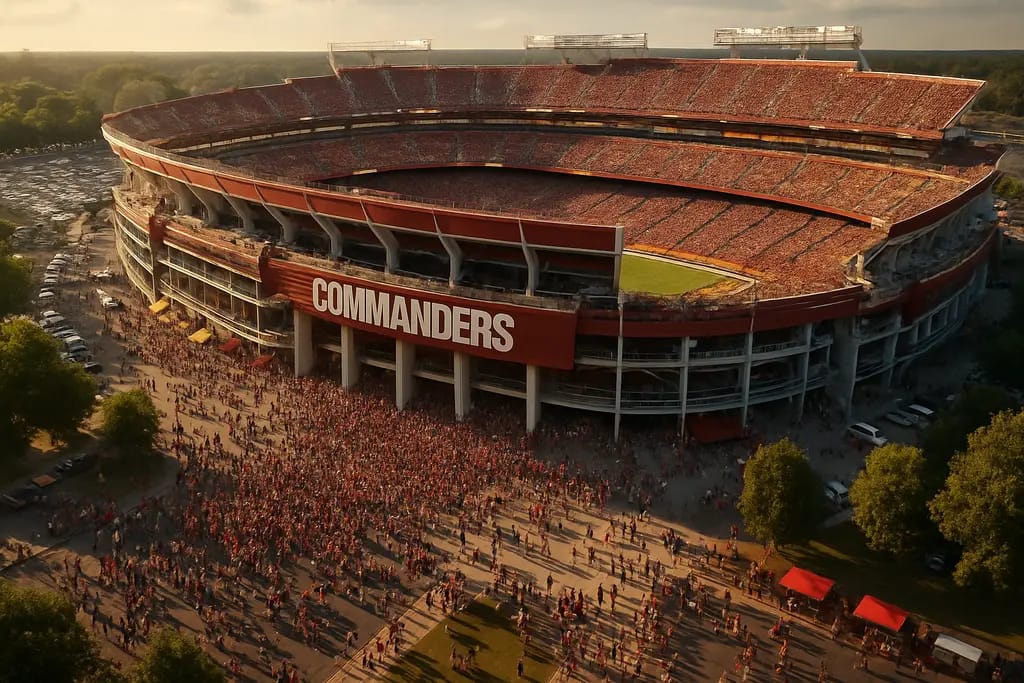
Commanders Stadium Impact is now a test of how Washington, D.C. weighs pro football ambition against public cost, neighborhood benefit, and climate-aware infrastructure. As of September 19, 2026, the RFK campus plan remained a future development, not a finished venue: vertical stadium construction was expected to begin in spring 2027, with full completion scheduled for the second quarter of 2030.
The proposal matters beyond one NFL building. The RFK campus covers 180 acres, and the stadium itself is planned to occupy about 11% of that site, leaving the wider argument centered on housing, transportation, public finance, green space, and long-term use between event days. The roofed stadium is expected to seat roughly 65,000 and support year-round events, but the public test is not only whether the Commanders return to D.C.; it is whether the full campus produces measurable civic value.
Commanders Stadium Impact And The Public Balance Sheet
The financial frame is large by any local sports-infrastructure standard. The Commanders’ planned private investment was listed at $2.7 billion for the roofed stadium and related improvements. Public participation was also significant: research notes described $500 million for stadium horizontal and non-vertical costs, $175 million through revenue bonds for parking, and $202 million for utilities, roadways, and transit studies. That mix makes risk allocation the central question for residents, not a side issue.
Commanders Stadium Impact On Stadium Revenues
The District’s fiscal analysis forecasted that stadium operations in 2030, the expected opening year, would generate $1.3 billion in gross stadium revenue, with 57% projected to be net new to D.C. The same analysis estimated $800.3 million in direct spending and $1.1 billion in total output for that year, according to the D.C. OCFO tax analysis. These are projections, not audited results, so they should be read as a planning case rather than a guarantee.
That distinction matters in sports economics. A roofed NFL venue can attract concerts, college games, international soccer, and other large events, but each event has a different spending profile. Some money is new to the District; some is shifted from restaurants, hotels, and entertainment spending that would have happened elsewhere in the city. That is where Commanders Stadium Impact should be judged with annual reporting after opening, not only with pre-construction modeling.
Public Funding And Risk Allocation
Public funding can be defensible when infrastructure has broad use, but the deal needs clear guardrails. Roads, utilities, transit connections, and structured parking can serve more than football, yet their value depends on whether the mixed-use district arrives on schedule and functions outside game windows. If housing, retail, and public spaces lag behind the stadium, the public share may look less like campus investment and more like event-support spending.
For readers comparing prior coverage, our related analysis of RFK stadium funding analysis raised the same caution: the project’s strongest case rests on the whole district, not the stadium alone.
Jobs Housing And Mixed-Use Promises
The broader RFK plan is projected to include about 8.1 million square feet of mixed-use development across housing, office, retail, hotels, structured parking, a sportsplex, infrastructure, and green space over a seven-year build-out horizon, according to the CSL RFK economic impact analysis. That scale is why the community debate is larger than Sunday football.
Housing Commitments Need Delivery Tests
The research record described 5,000 to 6,500 housing units, with at least 30% designated as affordable housing. On paper, that is one of the more meaningful community elements of the plan. In practice, residents should ask how affordability will be defined, how long the restrictions will last, which income bands will be served, and whether the units will be built near the stadium or delayed into later phases.
A stadium district can improve access to amenities, but it can also place pressure on nearby rents and small businesses if benefits are not structured with care. The available research does not provide enough detail to confirm displacement outcomes, so the cautious position is to treat housing commitments as targets that need enforcement, published milestones, and public reporting.
Jobs Forecasts Are Not Community Outcomes
The project is expected to create 14,000 construction-phase jobs and 2,000 permanent jobs, with $3.9 billion in personal earnings during the construction period. Those figures are substantial, but job totals alone do not answer who gets hired, whether local workers gain durable career paths, or how many permanent jobs pay family-supporting wages.
A stronger community-benefit structure would track apprenticeship slots, local hiring, minority-owned and local business participation, and retention after construction. Sports developments often receive public support because they promise identity and economic activity. For that promise to hold, the benefits need to be visible in payroll records and neighborhood outcomes, not only in ribbon-cutting language.
Sustainability Questions For A Roofed RFK Venue
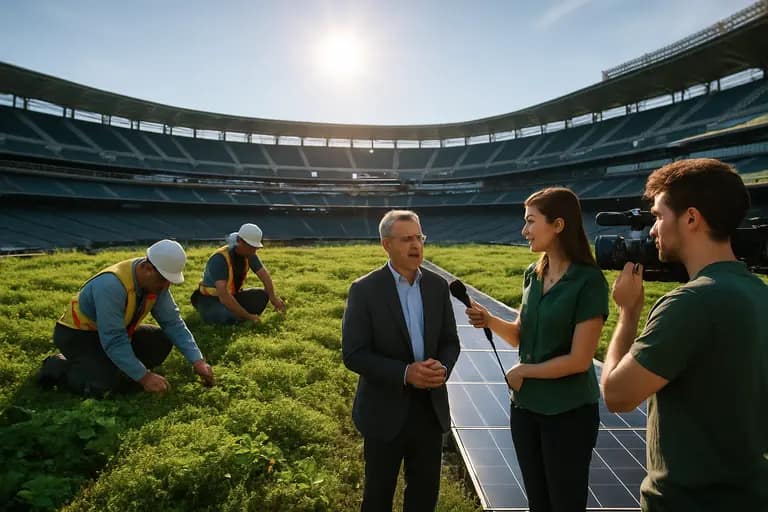
From a sustainability lens, the planned roof is both an asset and a question. It may improve event reliability and broaden the venue calendar, which helps the revenue case. It may also increase material use and energy demand compared with a simpler open-air building. The research notes do not establish a carbon budget, renewable-energy target, water plan, or third-party green-building certification, so no one should treat the project as environmentally proven at this stage.
Year-Round Events And Energy Demand
A roofed stadium can host events in more weather conditions, but event frequency is not the same as climate performance. The sustainability case depends on building systems, power sourcing, waste management, refrigerants, low-carbon materials, and how the venue operates on non-event days. Without published performance targets, Commanders Stadium Impact remains an open environmental question.
This is where sports venues are entering a harder accountability period. Fans increasingly understand that a modern stadium is not sustainable because it includes trees in renderings or bike racks near an entrance. The better standard is measurable: energy intensity, transit mode share, stormwater performance, embodied carbon, and waste diversion reported after opening.
Transit Land Use And Fan Travel
Fan travel is often one of the largest practical sustainability tests for a stadium district. The RFK site has the advantage of being inside the District rather than on an isolated suburban parcel, but public outcomes will depend on transit studies, pedestrian routes, bike access, parking pricing, and event-day crowd management. If most fans arrive by car, the campus will carry more traffic and emissions pressure than the planning story suggests.
International football venues offer a useful comparison because many operate in dense urban settings where transit access shapes matchday behavior. Readers who follow broader football culture through the website World Football Idol will recognize that stadium location can influence not just atmosphere, but also how supporters move through a city.
- Financial test: compare projected tax revenue with actual public costs, debt service, and maintenance obligations.
- Community test: publish housing, hiring, and small-business outcomes by phase.
- Sustainability test: disclose energy, travel, water, waste, and embodied-carbon metrics before and after opening.
Commanders Stadium Development Plans And Public Value
The fairest reading of the RFK proposal is neither reflexive praise nor automatic rejection. The private investment is large, the housing target is meaningful, and the site plan leaves room for a district that could serve more than eight or nine NFL dates. The fiscal projections also suggest major activity if the stadium and surrounding development perform as modeled.
The risk is that the stadium opens first while the broader public benefits move more slowly. That would weaken the public-value argument, especially given the scale of District funding tied to infrastructure, parking, and site preparation. The most useful public conversation before spring 2027 is not whether Washington is a football city; that answer is already clear. The harder question is whether the deal turns scarce public capacity into lasting neighborhood value.
For that reason, Commanders Stadium Impact should be tracked through milestones: financing terms, construction timing, affordable housing delivery, local hiring, transit decisions, and environmental reporting. If those measures are published and enforced, the RFK campus has a clearer path to becoming a sports-anchored district with civic value. If they remain vague, the project will be remembered less for returning the Commanders to D.C. and more for the public risks carried along the way.