
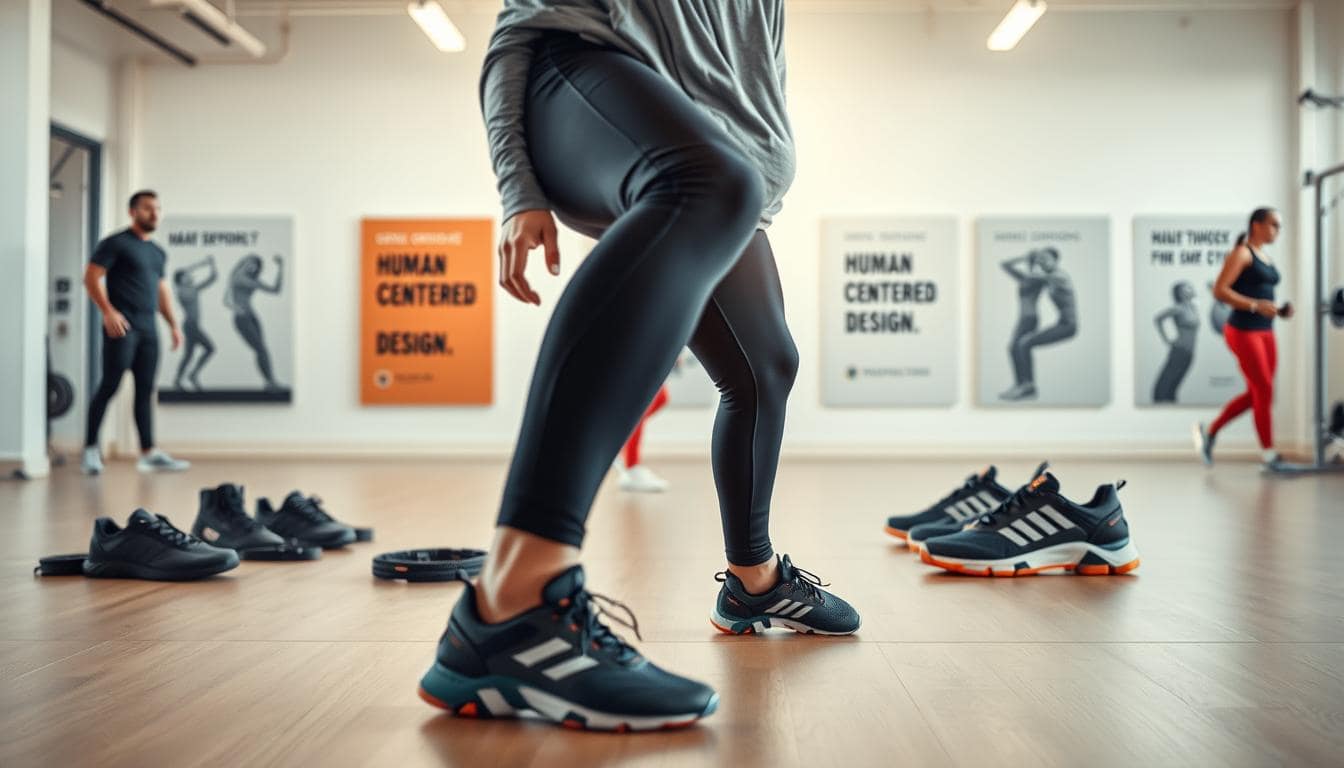
Most athletic gear is made for people who look like Lego minifigures. It’s a one-size-fits-all approach that doesn’t work for many.
This isn’t just about selling better stuff. It’s about a smarter way of thinking. We’re talking about human-centered design. It’s about making tools that work with the athlete’s body.
The goal is deep: to make the athlete and their gear work together perfectly. It means starting fresh with new ideas.
True success comes from key principles. Think about anthropometric considerations—because people are different. And think about biomechanical alignment—your joints are more complex than simple hinges.
The goal is a three-part harmony: comfort, optimization, and peak performance. When we succeed, the gear becomes invisible. The athlete and their tool become one.
But if we fail? That’s when you might need a physical therapist. The difference is huge—it’s between your best performance and a big disappointment.
Material Science Applications
Forget recycled cardboard shoes—today’s biomechanical equipment design is a masterclass in applying advanced material science to the athlete’s form. This is where physics and physiology shake hands, often over a polymer composite. The right materials don’t just cover the body; they actively participate in the performance. They reduce load, manage energy, and extend endurance. It’s a silent, technical dialogue between the athlete and their gear.
Selecting a material is a high-stakes compromise. You’re constantly balancing weight against strength, cushioning against responsiveness, and flexibility against support. Get it wrong, and you have equipment that fails under pressure or, worse, hinders the very motion it’s meant to enhance. Modern solutions pull from a wild portfolio: memory foams that learn your shape, carbon nanotubes for insane strength, and aerogels that defy conventional physics.
Lightweight Materials: The Need for Speed (and Efficiency)
Lightweight construction in sports gear isn’t just about shaving grams for the sake of speed. It’s about reducing metabolic cost. Think of it as cutting the bloat from a software update—your body runs smoother with less junk code. Every ounce saved in a running shoe or a hockey helmet is energy the athlete doesn’t have to expend moving the gear itself.
This principle is central to intelligent biomechanical equipment design. Materials like carbon fiber composites, titanium alloys, and advanced polymers provide incredible strength-to-weight ratios. A carbon fiber bike frame is stiff and responsive yet feather-light. The goal is to make the equipment feel like a natural extension of the body, not a burden it must carry.
Shock Absorption: The Art of the Controlled Crash
Shock absorption isn’t just cushioning. It’s a strategic negotiation between impact force and energy return. When your foot strikes the ground or a hockey puck slams into padding, the material must do two things: dissipate harmful energy and return useful energy. It’s a controlled crash.
Technologies like memory foam, viscoelastic polymers, and air-bladder systems excel here. They deform under impact, spreading the force over a larger area and a longer time period. This dramatically reduces peak stress on bones and joints. In protective gear, this isn’t a luxury; it’s a non-negotiable pillar of safety and long-term athlete health.
Flexibility Requirements: Beyond the Wet Noodle
Flexibility in gear must allow for natural human movement without sacrificing structural integrity. A running shoe needs to bend at the ball of the foot, not in the middle. A goalie pad must allow for a full butterfly drop without buckling like a wet noodle. This requires engineered zones of flexibility.
Materials are often layered or patterned to achieve this. Stretch-woven fabrics, segmented plates, and strategic perforations create articulated systems. The best biomechanical equipment design maps material properties directly to the body’s hinge points and ranges of motion. It provides freedom where you need it and firm guidance where you don’t.
Durability Standards: Outlasting Your Resolution
Durability is the unglamorous hero. It ensures your $200 running shoes or $800 helmet last longer than your New Year’s resolution. But it’s more than just being tough. Durability standards in sports equipment fight against specific enemies: abrasion, UV degradation, moisture, and repetitive stress fatigue.
Modern synthetics like high-denier Cordura nylon, thermoplastic polyurethane (TPU), and cross-linked polyethylene are built for this war. They resist tearing, don’t break down in sunlight, and maintain their properties through thousands of cycles. This is critical for both consumer value and consistent performance. Gear that breaks down changes its characteristics, undermining the precise biomechanical equipment design it started with.
To see how these material properties translate into real-world gear, consider the following comparison. It highlights the trade-offs and specializations inherent in modern sports equipment.
| Material Type | Key Property | Primary Sport Application | Notable Trade-off |
|---|---|---|---|
| Carbon Fiber Composite | High Stiffness, Low Weight | Bicycle Frames, Pole Vault Poles | Can be brittle; poor impact resistance |
| Memory Foam (Viscoelastic) | Customized Shock Absorption | Football Helmets, Running Shoe Insoles | Slower energy return; can retain heat |
| Thermoplastic Polyurethane (TPU) | Abrasion Resistance, Flexibility | Snowboard Boots, Protective Hard Shells | Often heavier than comparable plastics |
| Dyneema/Spectra Fabric | Extreme Cut/Puncture Resistance | Cut-Resistant Socks (Hockey), Sailing Gloves | Limited stretch; can be challenging to sew |
| EVA Foam (Ethylene-Vinyl Acetate) | Lightweight Cushioning | Midsole of Athletic Shoes, Yoga Mats | Compresses over time, losing cushion |
So, the next time you lace up or strap on, remember you’re not just wearing gear. You’re harnessing a carefully selected portfolio of material science. Each element, from the featherweight frame to the energy-managing foam, works in concert. This is biomechanical equipment design at its finest: turning advanced physics into a tangible performance advantage.
3D Body Scanning Integration
Forget the mall sneaker rack. The future of athletic gear starts with a digital blueprint of your body. This is where mass-production convenience meets its match. Performance isn’t about averages. It’s about your unique topography.
3D body scanning turns guesswork into geometry. It captures every curve, pressure point, and biomechanical signature. This is the core of a true athlete-centered design philosophy.

Custom Fit Protocols
The old protocol was a Brannock Device and a hope. The new one is a laser scan and a plan. Custom fit begins the moment an athlete steps onto the scanner. The system doesn’t just measure length and width.
It maps dynamic posture, weight distribution, and even soft tissue compression. The goal is a bespoke interface between body and equipment. This process, as outlined in research on 3D Scanning & Customization, compiles anthropometric and biomechanical data to create a unique profile. No two scans are identical.
Anthropometric Databases
Imagine a database that makes Facebook’s data collection look quaint. These repositories aren’t storing your vacation photos. They’re archiving the physical architecture of human performance.
From elite marathoners to weekend warriors, each scan adds to a collective intelligence. This data reveals patterns we’d never see with a tape measure. It allows designers to create for real human variance, not just statistical norms.
Manufacturing Scalability
Here’s the trillion-dollar question. How do you translate a one-of-a-kind scan into a replicable, cost-effective product? You can’t craft each item by hand. The trick lies in flexible manufacturing.
Digital files drive automated cutting, molding, and assembly. The production line adjusts on the fly for each unique order. This is the holy grail: mass customization. It brings true athlete-centered design to a scalable market.
Precision Engineering
A perfect digital model is useless if the physical product misses the mark. This is where precision engineering takes the baton. Tolerances shift from millimeters to microns.
Materials are selected and layered based on the exact stress maps from the scan. Every stitch and seam has a calculated purpose. This integration of data and fabrication, supported by advanced sensor and manufacturing landscapes, ensures the digital promise becomes a wearable reality. The fit isn’t just good. It’s engineered.
This entire ecosystem—scan, database, scalable build, precision execution—defines the new frontier. It’s athlete-centered design from the ground up, literally.
Biomechanical Load Distribution
Biomechanical load distribution makes physics work with your body, not against it. It’s like a partnership between your goals and your joints. If not done right, it can cause stress in one area.
Good sports equipment ergonomics helps share forces evenly. This makes muscles work together better, saves energy, and boosts performance. Without it, you might feel like a human pogo stick, losing power with every jump.
Pressure Mapping
Pressure mapping is like a truth-telling mirror for sports. It shows where your body and gear disagree. Thin, sensor-filled mats or insoles create a heatmap of pressure points.
These maps highlight friction points before they turn into blisters or sores. For cyclists, it might show too much pressure on the sit bones. For runners, it could point out too much heel strike impact. The goal is to make the heatmap look like a sunset, not a volcano.
Force distribution analysis shows “why” and “how much” of the pressure. It’s like solving a math problem. It tracks how forces move through equipment into the body during movement.
Advanced systems track vectors in real-time. They might show a tennis racket sending shock waves up the arm. Or a football helmet focusing impact on the skull. The fix? Redistribute forces to safer areas.
Research into biomechanical alignment shows that proper force pathways can cut injury risk by over 30%. It’s about directing load to shock absorbers in your body.
Contact Surface Optimization
Contact surface optimization is about the touchpoints between you and your gear. A bad grip, saddle, or footbed can cause nerve issues or numbness.
The goal is simple: maximize surface area, match contours to your body, and use materials that adapt. Memory foam insoles, ergonomic grips, and contoured gloves are examples. The best designs feel like an extension of you, not a foreign object.
| Equipment Type | Traditional Issue | Optimized Design Solution | Key Ergonomics Benefit |
|---|---|---|---|
| Cycling Saddle | Pressure on soft tissue, causing numbness | Channeled center with rearward support | Redirects load to sit bones, preserves blood flow |
| Running Shoe Insole | Flat surface, poor arch support | 3D-molded arch with variable density foam | Distributes impact across entire foot surface |
| Baseball Bat Grip | Cylindrical shape, uniform pressure | Contoured, tapered handle with tacky zones | Reduces grip force needed, minimizes vibration |
| Football Helmet Liner | Single-density foam, hard impacts | Multi-layer system with fluid-filled pads | Spreads impact over time and larger area |
Stress Reduction
The ultimate goal of all this engineering isn’t a gold medal. It’s being able to train tomorrow. Stress reduction in sports equipment ergonomics means avoiding overuse injuries. Tendonitis, stress fractures, and joint degeneration often start with poor load distribution.
Effective stress reduction starts with eliminating pressure points. Then, redistribute the remaining force. Lastly, dampen what’s left. Modern materials like viscoelastic polymers and gradient foams are great at this. They absorb and dissipate energy, protecting bones and connective tissues.
A study on optimized weight distribution shows that smart load management can delay fatigue onset. When your equipment handles the physics, you can focus on performance. That’s the real win in sports equipment ergonomics—playing longer, and stronger.
User Interface Design
User interface design in sports equipment is where cognitive ergonomics meets the brutal reality of physical performance. It’s not about adding more pixels or touch gestures. It’s about stripping away friction between thought and action.
When an athlete’s heart is pounding at 180 BPM, their brain is managing a complex algorithm of strategy, form, and survival. The interface must serve, not distract. This is the core promise of user-centered sports tech: to make the complex feel simple, and the technical feel natural.
Control Placement: Thumb Zones and Muscle Memory
Ever fumbled for a stopwatch button while sprinting? That’s a design failure, not a user error. Control placement is a sacred geometry. It maps directly to the athlete’s natural “thumb zone” and ingrained muscle memory.
Should a bike shifter be where your hand rests during a climb, or where it looks sleek in a catalog? The answer determines whether you shift gears or lose your lead.
Usability testing here is non-negotiable. It’s not done in a sterile office but in conditions mimicking fatigue, sweat, and gloves. The principle of minimizing cognitive load is key. Buttons, toggles, and dials must be distinguishable by touch alone.
If you have to look, you’ve already wasted a second you can’t get back.
Feedback Systems: Cutting Through the Adrenaline Fog
In the middle of a race, your senses are overloaded. A gentle beep is useless. Feedback systems—haptic, auditory, visual—must be designed to penetrate this fog.
A smartwatch that vibrates a specific pattern for a split-time alert is using haptics effectively. A head-up display in a ski goggle that flashes a subtle color for heart rate zones leverages visual cues without obscuring vision.
The key is signal versus noise. Feedback must be immediate, unambiguous, and actionable. It should confirm an action (gear shifted) or warn of a state (low hydration). Poor feedback creates doubt; good feedback builds instinct.
Intuitive Operation: When the Equipment Disappears
The pinnacle of interface design is intuitive operation. The gear becomes an extension of your intent. Think of a rock climber’s chalk bag. They don’t think about the clasp; their hand finds it, opens it, and chalks up almost subconsciously.
This means leveraging universal metaphors. A swipe down to refresh data feels natural. A long press for advanced options is learned quickly. The menu structure should be shallow, not a deep dive.
If you need a PhD to operate your heart rate monitor mid-race, you’ve already lost. The technology should recede, leaving the athlete and the sport in sharp focus.
Accessibility Considerations: Lowering the Entry Fee
Performance innovation shouldn’t have a high entry fee. Accessibility considerations ensure that adaptive athletes and those with varying physical abilities aren’t locked out. This can mean voice-command options for a cyclist with limited hand mobility, or high-contrast, large-font displays for a coach with visual impairments.
It’s not charity; it’s smart design. Solving for edge cases often improves the mainstream product. A button that’s easy to press with a gloved hand is also easier for someone with arthritis. This ethos is central to true user-centered sports tech.
Universal Design Principles: Building for Everyone, Benefits for All
Universal design principles take accessibility a step further. They advocate for creating products usable by all people, to the greatest extent possible, without the need for adaptation. A heart rate monitor strap with a magnetic clasp is easier for everyone to put on, not just those with fine motor challenges.
Audio description for a training app’s video menu aids the visually impaired and the athlete driving to the gym.
Applying these principles often reveals elegant solutions. It forces designers to question assumptions. Why *should* a control be a tiny button? Why *can’t* feedback be multi-modal? This line of thinking doesn’t just make equipment more inclusive; it makes it fundamentally better, more robust, and more intuitive for every user.
| Feedback Type | Best For | Sport Example | Design Pitfall to Avoid |
|---|---|---|---|
| Haptic (Vibration) | Confirming actions without visual attention | Swimming pace alerts on a waterproof watch | Patterns too subtle to feel during high vibration (e.g., running) |
| Auditory (Sound) | Urgent alerts over distance | Finish line beep for a blind sprinter | Generic beeps that blend into crowd noise |
| Visual (Light/Display) | Conveying complex data quickly | Cycling power meter data on a head-unit | Cluttered screens requiring focus to decipher |
Ultimately, user interface design is the silent partner in performance. It’s the difference between technology that fights you and technology that flows with you. By prioritizing control placement, crafting clear feedback, striving for intuition, and embracing accessibility and universal design, we create tools that unlock human performance, not hinder it. That’s the real win in user-centered sports tech.
Testing & Validation Methodologies
The design studio is where dreams start. But the testing lab is where they face reality. Here, beautiful ideas meet the harsh world of sports.
It’s not about what looks good on paper. It’s about what works when you’re tired and need to make quick decisions.
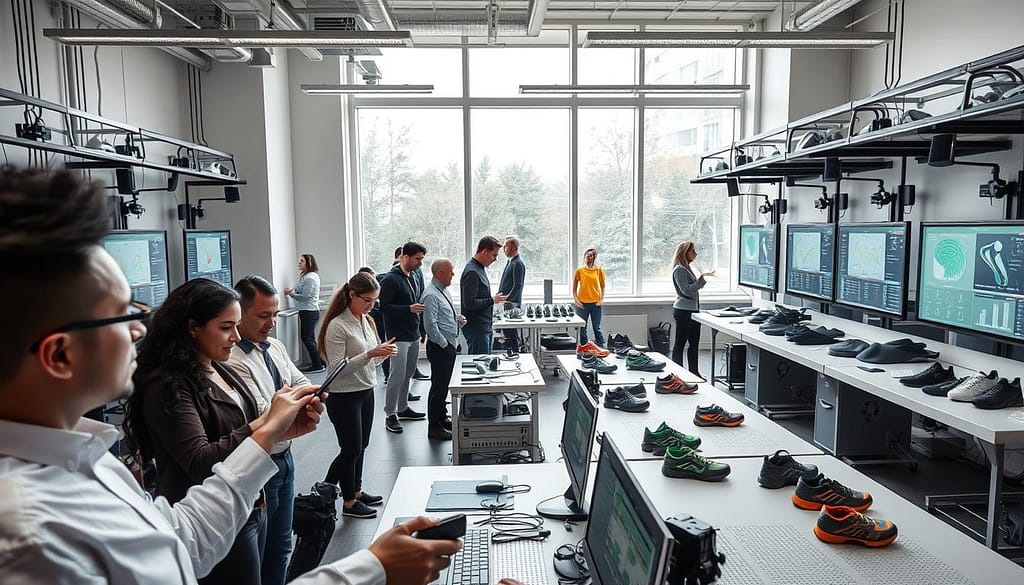
We turn ideas into real evidence here. This process is key to making sure our gear really helps athletes, not just looks good.
Human Factors Testing
Here, we ask if a design works with a human. It’s like usability testing, but for high-pressure situations. We check if athletes can use it easily, even when they’re stressed.
- Can the athlete operate it without looking? Muscle memory is key.
- Does the feedback system communicate clearly under duress? A confused athlete is a slow athlete.
- Does the design reduce mental fatigue? The gear should solve problems, not create new ones.
Biomechanical Analysis
We use cool tech like motion capture and force plates here. We want to make sure our design helps athletes move well and safely. We look for the truth, even if it’s hard to hear.
Biomechanical analysis gives us the facts. It shows if our gear helps or hurts athletes’ movements.
Comfort Assessment
Comfort is very important. Athletes who are uncomfortable are not performing their best. We check how comfortable our gear is.
We use special tools and listen to what athletes say. If they feel uncomfortable, we change it. In top performance equipment design, comfort is key.
Long-Term Wear Trials
This is the final test. Anyone can make gear that feels good for a short time. But the real challenge is making it last for a long time.
Long-term trials show if our gear can handle daily use. It’s about durability and how well it works over time.
This whole process turns ideas into real gear. It’s how we make sure our gear is reliable and helps athletes achieve their goals.
Manufacturing Considerations
You can sketch the world’s most ergonomic helmet on a napkin. But can you make it at scale without losing its essence? This is where the CAD file meets the injection mold. The journey from a perfect prototype to a viable product is full of hard choices.
It’s the eternal tug-of-war between athlete-centered design and the messy reality of factories, margins, and supply chains.
Think of it as the difference between a custom-tailored Savile Row suit and something off the rack. Both cover your body, but one feels like a second skin. The challenge is making that bespoke feeling available without the Savile Row price tag. Let’s pull back the curtain on the factory floor.
Cost-Effective Production: The Art of the Possible
Cost-effective production isn’t about being cheap. It’s about being smart. It’s the alchemy of turning expensive materials and complex processes into something you can actually sell. This is where iterative refinement for mass production happens.
The goal is to build a bridge between the ideal and the affordable. This often means compromise, but the smart kind. Can you achieve 95% of the performance benefit with 50% of the material cost? Can a simpler molding process yield nearly identical results?
The economics force a brutal but necessary focus. True athlete-centered design in manufacturing means protecting the core performance benefits while shaving away everything else.
Quality Control: Your Reputation on the Line, Every Time
Quality control is the silent guardian of your brand. It’s the promise that the ten-thousandth unit rolling off the line performs exactly like the first one you fell in love with. This isn’t just about spotting defects. It’s a systemic philosophy.
Modern QC uses everything from AI-powered visual inspection to randomized destructive testing. It means pressure-mapping every tenth shoe sole and stress-testing every fiftieth helmet. The data from “Final Production” phases feeds directly back to design.
A flaw in the field isn’t a failure; it’s the most valuable feedback loop you’ll ever get. Consistent quality is what transforms a cool product into a trusted one.
Customization Capabilities: The Holy Grail (With a Catch)
Customization is the ultimate expression of athlete-centered design. It’s the promise of gear that fits you, not the average. Thanks to 3D scanning and digital inventories, we can now capture an athlete’s unique morphology with stunning precision.
The dream is a world of one-off perfect fits. But here’s the catch: customization is the arch-nemesis of traditional manufacturing logic. Assembly lines love repetition. They thrive on doing the same thing, perfectly, a million times.
Introducing variables—different sizes, shapes, materials—slows everything down. It’s like asking a symphony orchestra to improvise a jazz solo. The capability exists, but the cost can be symphonic.
Scalability Challenges: Bespoke vs. Box Store
This is the grand, central tension. Scalability is the challenge of taking something beautiful and making it ubiquitous. How do you maintain the integrity of a custom-fit protocol when you need to produce for a global market?
The answer often lies in modular or platform-based design. Think of it as a “Lego” approach. You create a core, scalable platform—the base shoe, the standard helmet shell. Then, you offer a range of customizable components—insoles, liners, padding sets—that allow for personalization.
This hybrid model tries to have it both ways. It’s the only practical path to making athlete-centered design accessible beyond the elite professional. Navigating this clash between bespoke tailoring and assembly-line efficiency is what separates a flash-in-the-pan prototype from a legacy brand.
In the end, manufacturing is where philosophy gets a reality check. The most brilliant design is a museum piece if it can’t be built reliably, affordably, and at volume. Mastering this balance is the final, and most critical, stage of putting the athlete truly at the center.
Sport-Specific Applications
Designing gear for sports is not one-size-fits-all. It’s a world of different needs for each sport. For example, a marathon runner’s gear is very different from a downhill mountain biker’s. This is where performance equipment design gets really interesting and very specific.
We’re going to explore the different types of gear. We’ll look at their unique needs and how they change from sport to sport. Safety standards also play a big role, as they vary greatly between sports.
Equipment Categories
We can group sports equipment into four main categories. Each category has its own set of needs.
- Footwear & Apparel: Running shoes, soccer cleats, swimsuits. They help us interact with the ground, water, or air.
- Wheeled Conveyances: Bicycles, skateboards, skis. These help us move around.
- Implements & Striking Tools: Tennis rackets, golf clubs, baseball bats. They help us control and direct force.
- Protective Armor: Helmets, pads, gloves. They keep us safe without getting in the way.
Designing a bike frame is different from making a running shoe. Each category has its own design philosophy.
Unique Requirements
Every category has its own set of must-haves. These are based on physics and how our bodies work.
A running shoe needs to return energy and help with your stride. It must handle the impact of your foot hitting the ground and help you push off with your toes. A road bike, on the other hand, focuses on being fast and efficient. Every part of it is designed to cut through the air and transfer power.
A tennis racket needs to dampen vibrations and have the right weight for your swing. It’s all about controlling a fast-moving ball. Protective gear, like a hockey helmet, must absorb impact while keeping your vision clear. Each sport has its own set of requirements for design.
Performance Priorities
What we aim for changes with each sport. Sometimes it’s about going as fast as possible. Other times, it’s about being precise.
For cyclists, it’s all about speed and using less energy. How can we make this human engine more aerodynamic and reduce energy waste? For tennis players, it’s about hitting the ball accurately. The performance equipment design focuses on the racket’s stability and how it responds to strings.
For marathon runners, it’s about lasting the distance and saving energy. For weightlifters, it’s about stability and transferring force from the ground to the bar. This is why a sprinter’s shoe and a hiker’s boot are so different.
Safety Standards
Safety is a must, and it varies greatly between sports. A helmet standard for one sport is not the same for another.
A climbing helmet is designed to protect against falling rocks and minor impacts. A downhill mountain bike helmet is built to withstand high-speed impacts on rough terrain. They are not interchangeable.
Bicycle frames have ISO standards for durability and stress. Football shoulder pads have NOCSAE certifications for impact management. These standards shape the performance equipment design, affecting material choices and safety features. Ignoring them is not an option; it’s a risk.
So, when you’re getting ready to play, remember: you’re using gear designed for your sport’s specific needs. That’s the magic—and the challenge—of getting it right.
Regulatory Compliance
Ergonomic design is more than just about comfort and performance. It also involves meeting strict regulations. This is the final test for any sports equipment ergonomics idea.
Creating a handle or pad that feels great is just the start. Without the right approvals, it’s just a fancy paperweight. Compliance ensures your design is safe for everyone.
Safety Standards: The Rulebook
Safety standards are based on past mistakes. Groups like ASTM International and the U.S. Consumer Product Safety Commission write these rules. They cover everything from how products handle impacts to what materials are safe.
For sports equipment ergonomics, these standards focus on preventing injuries and ensuring products don’t fail under stress. A helmet must meet the ASTM F1447 standard for impact protection. It’s about making sure comfort and safety go hand in hand.
| Organization | Region / Scope | Key Focus Areas | Typical Certification Path |
|---|---|---|---|
| ASTM International | Global (Voluntary Consensus) | Material performance, test methods, safety specifications | Third-party lab testing against published standard |
| U.S. CPSC | United States (Mandatory) | Consumer product safety, defect reporting, bans on hazardous products | Self-certification (with testing) & mandatory reporting |
| EN (European Norms) | European Economic Area | Essential health & safety requirements for CE marking | Notified Body assessment & factory production control |
| ISO (International Org.) | International | Quality management systems, process standardization | Audit by accredited certification body |
Certification Requirements
Certification is the key to getting your product on the market. It involves third-party testing in labs. Products are tested to simulate years of use in just days.
The goal is to show your design is safe and reliable. Without certification, your product can’t be sold. It’s that simple.
International Regulations
Selling worldwide means dealing with many rules. A soccer cleat might need different approvals for Europe, the U.S., and Asia. These rules can sometimes conflict.
One area might focus on chemical safety, while another looks at mechanical failure. Navigating these rules is a big challenge for manufacturers.
Liability Considerations
Liability laws ask if the manufacturer could have seen the risk. A good ergonomic design process and following safety standards are key. They show you took the necessary steps to ensure safety.
In a world where lawsuits can be costly, proving your design is safe is essential. Compliance is like an insurance policy for your product.
Regulatory compliance turns a good idea into a safe, market-ready product. It’s the bridge between a lab and the field. It’s not just about rules; it’s about making sure your product is trusted by everyone.
Innovation Opportunities
Now that we’ve mapped the current state of ergonomic principles, we look ahead. The future of biomechanical equipment design is not just a small step. It’s a big leap into a world where gear can think for itself.
Emerging Technologies Reshape the Field
Artificial intelligence and virtual reality are now real. AI can create designs we never thought possible, like Autodesk’s generative design. VR lets us test ideas in a digital space, cutting down on development time. These technologies are changing the game in advanced biomechanical equipment design.
Unmet Needs: The Athlete’s Whisper
Listen to what athletes say after a game. Their complaints can lead to big innovations. Issues like chafing and limited mobility in knee braces are just waiting for a solution.
Spotting the Market Gaps
Big players often miss out on niche sports or gear for different body types. There’s a huge gap between pro and amateur equipment. Someone will fill this gap.
The Trajectory of Design Trends
Personalization and sustainability are leading trends. The future of biomechanical equipment will be as unique as a fingerprint. It will use recycled materials without losing performance.
Future Applications: The Smart Equipment Era
Imagine a running shoe that adjusts its support as you run. Picture a helmet that tracks impact forces in real time. The next step is adaptive equipment that responds to your needs like a co-pilot.
The goal is not just to make gear lighter or stronger. It’s to make it smarter. The best design will listen to your body’s signals and adapt. That’s the next big step in human-centered performance.