
Smart stadium connectivity is no longer a luxury feature added after seats, scoreboards, suites, and concessions are already finished. In 2026, it has become part of the operating system for U.S. sports venues. The FIFA World Cup across the United States, Canada, and Mexico showed how high-capacity Wi-Fi, 5G, fiber, private networks, broadcast routing, security systems, and real-time data flows now shape the way a stadium performs under match-day pressure. Even outside the venue itself, connected sports audiences move through team apps, broadcast platforms, fan forums, ticketing systems, travel tools, and betting-adjacent research pages such as a BetOnline sportsbook review, which shows why digital behavior around sports now extends far beyond the seat bowl.
For cadcamnet.com, the sports story is not simply that fans want faster phones. The stronger angle is that connectivity now supports ticketing, concessions, media delivery, officiating technology, accessibility services, fan safety, team analysis, and venue operations. FIFA’s World Cup technology report said more than 100,000 miles of fiber were deployed, 13 petabytes of data moved across tournament and broadcast networks, 4,000 network devices supported operations and venue connectivity, and a private 5G network across all 16 stadiums powered referee camera services.
That is the new stadium standard. A venue is no longer judged only by capacity, sightlines, premium seating, scoreboard size, or architectural identity. It is judged by whether tens of thousands of fans, officials, broadcasters, players, staff, emergency teams, vendors, and data systems can function at once without the building breaking digitally before the event breaks competitively.
Why Connectivity Has Become Stadium Infrastructure
The old model treated stadium internet as a fan amenity. A venue could promote free Wi-Fi, faster mobile service, or better social sharing and leave the deeper operational network in the background. That model no longer fits major sports.
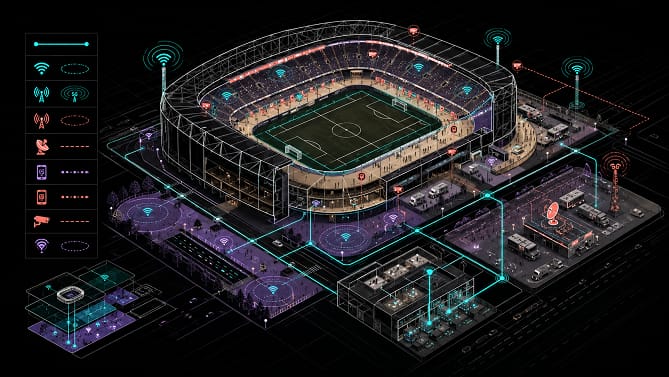
At a World Cup match, a stadium network has to carry fan uploads, mobile tickets, concession payments, operational radios, security feeds, media files, broadcast signals, referee technology, accessibility services, hospitality systems, and team data at the same time. The pressure is not only download speed. Upload capacity, latency, signal reliability, cybersecurity, device density, and network segmentation can decide whether the building performs smoothly.
Verizon said before the tournament that spectators were expected to use more than 50 terabytes of data inside a stadium for each match. The company also said it added spectrum capacity across host venues, installed thousands of under-seat antennas, and used targeted 4G and 5G coverage for higher sections through its World Cup network upgrades.
The useful comparison is not a home internet plan. It is an airport, command center, media facility, retail corridor, emergency response hub, and packed arena operating inside one footprint. Fans may notice whether a video uploads. Venue operators notice whether access gates, emergency messages, payment terminals, cameras, and field-level technology remain stable under peak load.
That is why U.S. venues preparing for global events are investing in layered systems: Wi-Fi 6 or Wi-Fi 6E for dense fan areas, distributed antenna systems for carrier coverage, fiber backbones for broadcast and operations, and private 5G for controlled low-latency applications. The result is a building that can respond to sports, media, safety, and commercial pressure at the same time.
How The World Cup Turned Network Scale Into A Sports Operations Story
The 2026 World Cup gave U.S. sports venues a real-time test. FIFA expanded the event to 48 teams and 104 matches, spreading games across 16 stadiums in three countries. That format created a larger operational challenge than a single championship game or a normal league season.
The network numbers explain the difference. FIFA reported 10,000 video distribution endpoints delivering live content across venues, 5,000 radios deployed, and 2,600 spectrum requests approved and activated during the tournament’s operational phase. Those are not fan-experience extras. They are hidden systems that let referees communicate, broadcasters move feeds, accessibility services function, and venue staff coordinate inside packed buildings.
The same trend appeared in telecom performance after the tournament. Data Center Dynamics reported on July 21, 2026, that Verizon’s network carried nearly 500 terabytes of data across U.S. stadiums hosting World Cup matches, including 29.2 terabytes during the July 19 final at MetLife Stadium in East Rutherford, New Jersey, where Spain beat Argentina 1-0. That kind of data load shows why stadium connectivity has to be engineered for predictable surges, not average use.
| Connectivity Layer | Stadium Function | Why It Matters On Match Day |
|---|---|---|
| Fiber Backbone | Broadcast, media, operations, data routing | Moves high-volume video, audio, and match data reliably |
| Public 5G And DAS | Fan phones, uploads, mobile apps | Handles dense crowds across seating bowls and concourses |
| Wi-Fi 6 / Wi-Fi 6E | High-density user traffic | Supports fan use where mobile networks face crowd strain |
| Private 5G | Referee cameras, field systems, controlled operations | Gives low-latency bandwidth to priority applications |
| Spectrum Coordination | Radios, broadcast, venue systems | Reduces interference across many wireless users |
| Cybersecurity Systems | Access control, data, payments, communications | Protects the event from digital disruption |
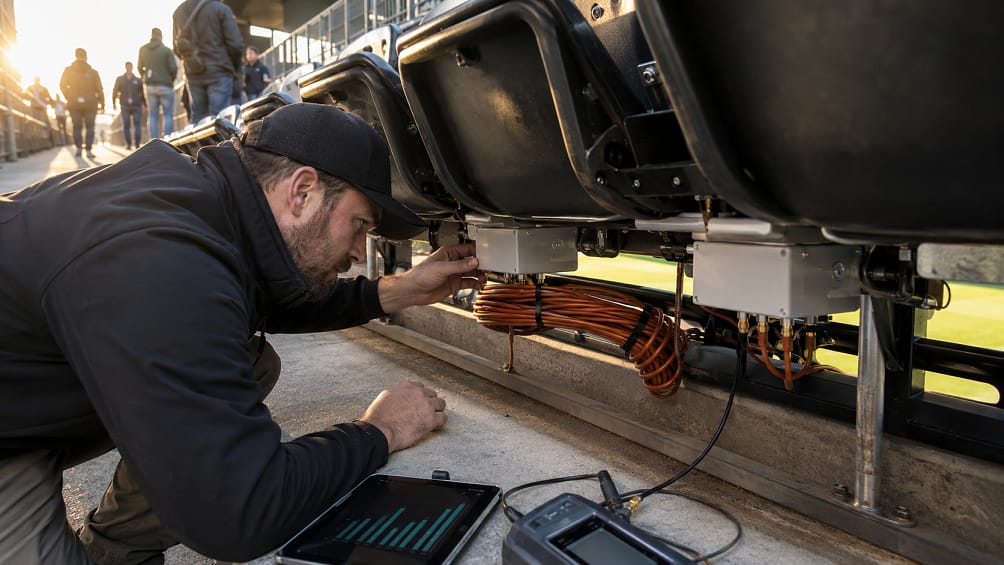
This is where sports venue design now intersects with technical planning. A stadium cannot simply add antennas in the final stage and expect match-day reliability. Network equipment, cable routes, mounting locations, equipment rooms, under-seat installations, broadcast compounds, and emergency access all need to be coordinated with architecture, event flow, and construction sequencing.
For U.S. venues, that means future renovations will increasingly treat connectivity as a design discipline. The digital layer has to be planned beside seating, concourses, kitchens, suites, locker rooms, camera positions, security zones, and public plazas.
Why Wi-Fi And 5G Need To Work Together
The World Cup made 5G highly visible, but smart stadium connectivity is not a one-network story. The best venues use Wi-Fi, cellular, fiber, and private wireless systems together since each layer solves a different problem.
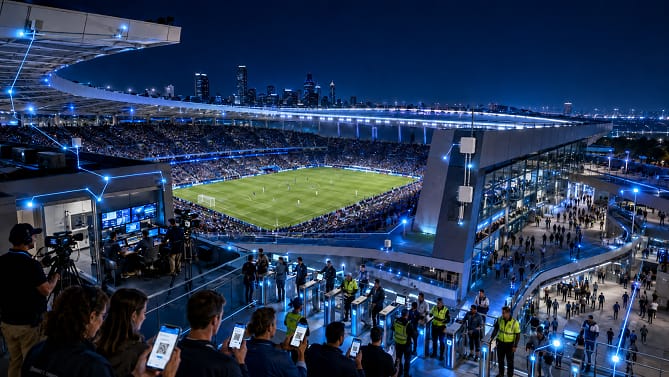
Levi’s Stadium in Santa Clara, California, offers a clear example. The 49ers and Levi’s Stadium announced new venue features in 2024 that included Cisco Wi-Fi 6 infrastructure with 1,300 access points and a new 5G Distributed Antenna System built with America Fujikura Ltd. The venue tied those upgrades to 49ers games, Super Bowl 60, FIFA World Cup matches, concerts, and other major events through its Levi’s Stadium fan experience upgrades.
The reason this matters is practical. Dense crowds stress networks differently than normal buildings. A stadium bowl can put 60,000 to 80,000 people in a tight environment, with thousands trying to upload video, send photos, check scores, open mobile tickets, order food, or stream highlights at the same time. Cellular systems can deliver strong peak speed in lower-density conditions, yet game-day uplink traffic can become a pressure point.
A July 2026 research paper on dense stadium deployments at Notre Dame Stadium studied app-based performance across cellular and Wi-Fi systems in a football venue with 77,622 spectators. The researchers found that crowd loads heavily strained cellular uplink and latency performance, while dense stadium Wi-Fi delivered stronger resilience for uplink and latency under game-day conditions in the stadium network performance study.
That finding matters for venue planners since fans do not only download anymore. They upload. They post video. They send images. They join group chats. They open cloud-based apps. Media members move content. Staff rely on tablets and handheld systems. The stadium network has to support traffic in both directions.
The practical takeaway is that 5G and Wi-Fi are not rivals inside major venues. They are complementary systems. Public 5G helps with mobility, carrier continuity, and broad coverage. Wi-Fi can absorb dense indoor and seating-bowl traffic. Private 5G can reserve performance for mission-specific uses. Fiber ties the entire system together.
How Smart Connectivity Changes Fan Experience And Revenue
Fans often think about connectivity in personal terms: Can I get through the gate? Can I open my ticket? Can I send a video? Can I order food? Can I find my friends? Can I check another match? Those questions now shape the business model of major sports venues.
A connected stadium can support mobile entry, app-based wayfinding, real-time parking information, mobile concessions, cashierless checkout, seat upgrades, loyalty programs, and targeted service messages. Those systems only work if the venue network stays reliable under crowd load. When the network fails, the failure is not abstract. Lines grow. Payments slow. Fans miss action. Staff lose coordination. Security messages reach fewer people.
Foley & Lardner’s June 23, 2026 analysis of stadium technology described modern arenas as live networks, with connectivity, data collection, and new operating models reshaping the stadium experience. The analysis pointed to World Cup host venues prioritizing network upgrades and noted that teams and venue operators increasingly view network investment as a revenue, safety, and operations tool through the stadium technology in 2026 discussion.
That is the financial side of the infrastructure story. Connectivity lets a venue understand where fans move, where lines form, which entrances overload, which concessions need staffing, which messages get engagement, and which spaces are underused. The risk is that data collection also creates privacy, security, and governance questions that operators have to handle carefully. A smarter venue is not automatically a better venue if the data model is poorly explained or poorly protected.
For sports readers, the fan impact is more direct. A connected stadium reduces friction. It helps people move through the building, buy what they need, receive event alerts, follow live content, and stay connected to the event even when they leave their seat. For operators, every one of those interactions becomes part of the venue’s performance profile.
Smart connectivity changes the stadium from a static building into a live service environment. That is why the backbone matters.
Why Private Networks Are Becoming Critical For Referees, Teams, And Broadcast Crews
The most important connectivity inside a stadium is not always public. Some of the most sensitive sports systems need controlled bandwidth, low latency, and protection from fan traffic. That is where private networks become central.
FIFA said its private 5G network across all 16 World Cup stadiums powered referee camera services. Verizon’s business materials described private 5G across the tournament venues as a way to provide dedicated bandwidth and ultra-low latency for on-field applications, along with high-capacity fiber for centralized broadcast operations through the World Cup connectivity platform.
That matters because the future of sports broadcast and officiating depends on stable in-venue wireless systems. Referee cameras, semi-automated offside technology, team analysis tools, real-time video feeds, wearable devices, sideline tablets, broadcast effects, and security operations cannot fight with thousands of fan uploads for the same performance layer.
FIFA’s June 3, 2026 innovation briefing said the tournament would use advanced semi-automated offside technology, improved images from referee body cameras, and Football AI Pro match-analysis access for all 48 participating teams. FIFA Director of Innovation Johannes Holzmüller outlined those systems from the International Broadcast Centre in Dallas through the official World Cup innovation briefing.
That is a major shift. Sports technology used to sit mostly in replay booths, broadcast trucks, and team offices. Now it is on the field, in the official’s headset, in the camera feed, in the performance database, and inside live tactical workflows. The stadium network has to treat those systems as priority traffic.
This also affects how venues are designed. Camera positions, wireless transmission paths, interference zones, equipment rooms, media compounds, and field-level network access need to be part of the physical plan. A stadium cannot serve next-generation officiating and broadcast tools with patchwork coverage.
How Connectivity Is Changing U.S. Venue Design
Smart stadiums need more than antennas. They need network-aware architecture. That includes under-seat access point placement, distributed antenna locations, cabling paths, equipment rooms, power redundancy, cooling for network hardware, secure access zones, broadcast routing, and physical protection for critical systems.
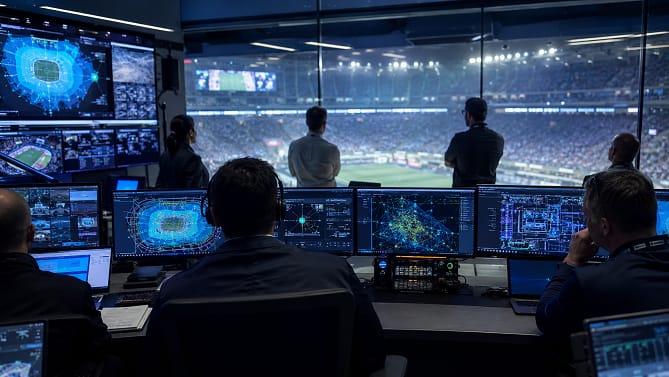
The design challenge is harder in multipurpose venues. U.S. stadiums host NFL games, college football, soccer, concerts, international tournaments, fan festivals, corporate events, and mixed-use district activity around the venue. A network that works for a 1 p.m. football game must also support a night concert, an international soccer match, a media-heavy tournament, or a packed fan zone outside the stadium.
Hollywood Park and SoFi Stadium show how mixed-use sports campuses are stretching the definition of venue connectivity. Stadium Tech Report’s June 15, 2026 case study described Hollywood Park as a roughly 300-acre sports and entertainment development where stadium, retail, hospitality, entertainment, and public gathering spaces create demand for scalable wireless infrastructure. The report focused on a venue-owned neutral host distributed antenna system designed to increase capacity and performance before major 2026 and 2028 events through next-generation connectivity at Hollywood Park.
That model points toward the next phase of U.S. venue design. The stadium is no longer an isolated bowl. It is part of a district. Fans may arrive through parking areas, transit points, fan festivals, retail corridors, plazas, hotels, and entertainment zones before they ever scan a ticket. Connectivity has to follow that journey.
For architects, engineers, and sports operations teams, this makes digital infrastructure part of spatial planning. Where do fans gather? Where do they queue? Where do they need signal? Where do cameras need bandwidth? Where do emergency teams need reliable communications? Where does the network need to prioritize operations over entertainment?
Those are design questions now.
What U.S. Sports Venues Should Build For Next
The 2026 World Cup made one lesson clear: the future stadium is a connected operations platform. The venues that treat network infrastructure as a late-stage technology add-on will struggle as events become more data-heavy, broadcast-heavy, and fan-app dependent.
The strongest U.S. sports venues will build for several realities at once. They will need dense public connectivity for fans, private connectivity for critical systems, fiber depth for broadcast and operations, secure segmentation for payments and access control, and enough flexibility to handle different event formats. A soccer match, a football game, a concert, and a global tournament do not stress the network in identical ways.
That does not mean every stadium needs the same solution. A historic college stadium, an NFL dome, a soccer-specific venue, and a mixed-use entertainment campus have different physical layouts and business needs. The common standard is not identical hardware. The common standard is planning connectivity as infrastructure.
For teams, that planning affects revenue and fan loyalty. For venue operators, it affects safety, staffing, security, and crowd flow. For broadcasters, it affects the quality and reliability of live content. For officials and leagues, it affects the use of real-time technology. For fans, it affects whether the building feels modern or broken.
The next generation of stadium design will be measured by what spectators can see and what they never notice. The best network is often invisible: the ticket opens, the camera works, the payment clears, the radio connects, the security message sends, the replay feed arrives, and the crowd keeps moving.
That is why smart stadium connectivity is becoming the backbone of U.S. sports venues. It is the layer that lets the building behave like a modern sports system.