
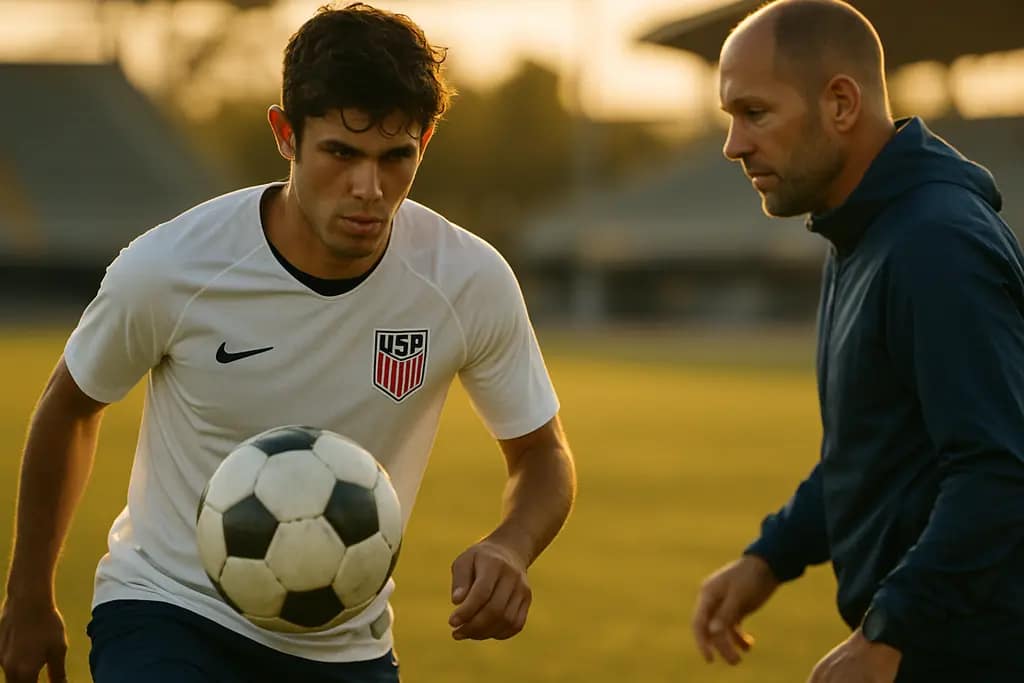
USMNT Youth Infusion is the clearest label for Mauricio Pochettino’s Fall 2026 camp, but the phrase needs a careful reading. A young roster can signal ambition, better scouting, and useful performance stress. It can also create workload, access, and expectation problems if the system treats early senior exposure as a shortcut rather than one step in a longer development plan.
The camp arrived after Pochettino signed a new contract in summer 2026 that runs through 2030. U.S. Soccer listed a 28-player roster with 13 uncapped players and an average age of 22 years, 9 months, making it one of the least experienced senior men’s camps in recent U.S. history, according to U.S. Soccer’s fall camp release. That is not a small sample of prospects tucked onto the edge of a veteran group. It is a major stress test of the senior environment itself.
As of September 28, 2026, the timing also matters. The Peru match on September 26 had already been played, while Chile on September 29, Mexico on October 3, and Canada on October 6 remained on the schedule. Hindustan Times reported the camp slate and highlighted the presence of 16-year-old Cavan Sullivan, who would become the second-youngest player to appear for the USMNT if he played in one of those September-October friendlies, behind Freddy Adu, per Hindustan Times’ camp report.
USMNT Youth Infusion And Development Signals
USMNT Youth Infusion In The Roster
The first performance takeaway is simple: the staff created a camp where first impressions could be made at senior speed. Thirteen uncapped players in a 28-player group changes the normal camp balance. Training sessions are not only about tactical installation; they become live evaluations of decision speed, recovery habits, positional discipline, and how quickly players absorb instruction under national-team scrutiny.
The age profile sharpens that point. The research notes show that the uncapped group included eight teenagers, with an average age of 19 years, 6 months. That is young enough to raise the value of long-range development planning, not just match-day selection. For a federation trying to build toward future cycles, USMNT Youth Infusion can be useful only if it gives coaches better information without asking teenagers to carry senior-team narratives too soon.
Several names made the development link visible. Cavan Sullivan was the youngest player called in at 16. Julian Hall, also 16, entered camp with 10 goals and four assists in 26 MLS games, plus three goals in the U.S. Open Cup. Justin Ellis, 19, received his first senior call-up after entering the season with three goals and 11 assists in all competitions for Orlando City SC. These are performance markers, not guarantees. The more careful interpretation is that club minutes and production made the players worth testing, while the national team still needs to judge how those traits transfer.
Academy Links And Senior Readiness
The Philadelphia Union thread is one of the more interesting parts of the roster. Sullivan, Neil Pierre, and Frankie Westfield all came through the Union academy system. Pierre, a defender, had scored four goals in 10 MLS appearances in the season noted in the research, setting a club record for a Union defender in a single campaign. That kind of academy cluster can help chemistry, but it should not be overstated. Club familiarity may reduce some social friction in camp; it does not automatically solve the jump from MLS or youth international play to senior international tempo.
A number of young players in the camp had been connected with U-17, U-19, and U-20 national programs. That matters for continuity. If terminology, standards, and role expectations carry across age groups, a player’s first senior camp can feel less random. The related question is whether talent identification remains broad enough. A useful companion read on that point is youth talent ID in U.S. soccer, because a larger scouting net has value only if access and evaluation quality keep pace.
What The Roster Shows About Performance Readiness
First Caps As A Measurement Tool
The Peru opener on September 26 offered an early read on the camp design. The research notes report that the USMNT beat Peru 4-1 in Orlando and that 11 of the 13 uncapped players earned first caps in that match, with teenagers Justin Ellis and Julian Hall scoring and Malik Tillman also on the scoresheet. Since that match had already happened by September 28, it belongs in the record as an early camp result, not as a preview point.
First caps can be powerful, but they are a limited measurement tool. A goal on debut can show composure and timing; it does not settle whether a player is ready for repeated senior minutes against stronger opponents, different tactical plans, and travel demands. The value of this camp is likely to be found in the staff’s internal grading: pressing triggers, defensive recovery, ball security, communication, and how players respond when the match state changes.
Brian Schwake presents a different development case. At 25, he was the only uncapped player in the research notes with no youth national team experience. His MLS form included 12 clean sheets and a 0.81 goals-against average, and he had played his way into the Nashville SC starting role. For a goalkeeper, that profile shows why the senior pool should not be limited to youth-program graduates. Late or non-linear development is still development.
- Positive signal: The roster created senior exposure for players who had already shown club or youth-national-team progress.
- Performance caution: Early goals and first caps should be tracked over multiple camps, not treated as permanent status changes.
- Development caution: Teenagers need workloads, media pressure, and expectations managed with care.
Sustainability Questions In Player Development

Workload Is A Sustainability Issue
In soccer, sustainability is not only about recycled shirts or lower-impact travel plans. It also includes whether a development system can produce players without burning through bodies, family resources, or equipment cycles. The USMNT Youth Infusion raises that issue because many players in the camp are still early in their professional careers. Their training loads are shaped by clubs, youth national teams, senior camps, and, for some, tournament exposure.
The research does not provide GPS loads, recovery data, or travel emissions for this camp, so those points should not be invented. What can be said is narrower: a camp heavy on teenagers requires a disciplined approach to minutes, monitoring, and communication with clubs. Sustainable player development means asking whether the same player is being asked to prove himself too often in too many settings.
Equipment and data practices sit inside that same discussion. Wearables, boots, recovery tools, and training apparel can help performance staff read trends, but they also create cost and waste if programs chase every new product cycle. A responsible camp model would use technology where it answers a clear coaching or medical question, then avoid turning youth evaluation into a gear race. That matters for equity as much as for environmental impact.
Access, Cost, And The Player Pool
A young national-team roster can look like proof that the development pipeline is working. It can also hide the players who never reached those checkpoints because travel, club fees, geography, or scouting blind spots kept them out. The presence of academy products, youth internationals, and MLS contributors is encouraging, but it does not remove the need to ask who was missing from the funnel.
For readers interested in similar paradigms in other sports, basketball grapples with comparable issues around early professional exposure and player development structures, with insightful analysis available at NBA Playbook. The shared lesson is that youth does not equal depth unless the system keeps producing options across positions, backgrounds, and maturation timelines.
USMNT Youth Infusion After The Peru Opener
The best reading of USMNT Youth Infusion after the Peru match is cautiously positive. The roster gave Pochettino and his staff a larger evidence base, and the opening result supplied real senior minutes for many players who had not yet crossed that line. The next scheduled matches against Chile, Mexico, and Canada were set to give the staff different tests after September 28, 2026, with the Mexico and Canada fixtures especially useful for measuring speed, duels, and emotional control.
The development risk is the temptation to turn a camp story into a settled hierarchy. A 16-year-old call-up is significant. A teenage goal is significant. A goalkeeper arriving through a less traditional route is significant. None of those facts should become a fixed conclusion about 2030 readiness. Player development is rarely that neat.
For performance staff, the practical question is whether the camp produces better next steps: clearer role definitions, smarter minutes plans, stronger club-federation communication, and a wider view of who can handle senior pressure. If those pieces follow, this camp can support a more sustainable national-team model. If not, the roster will be remembered more as a dramatic age profile than as a lasting development gain.