
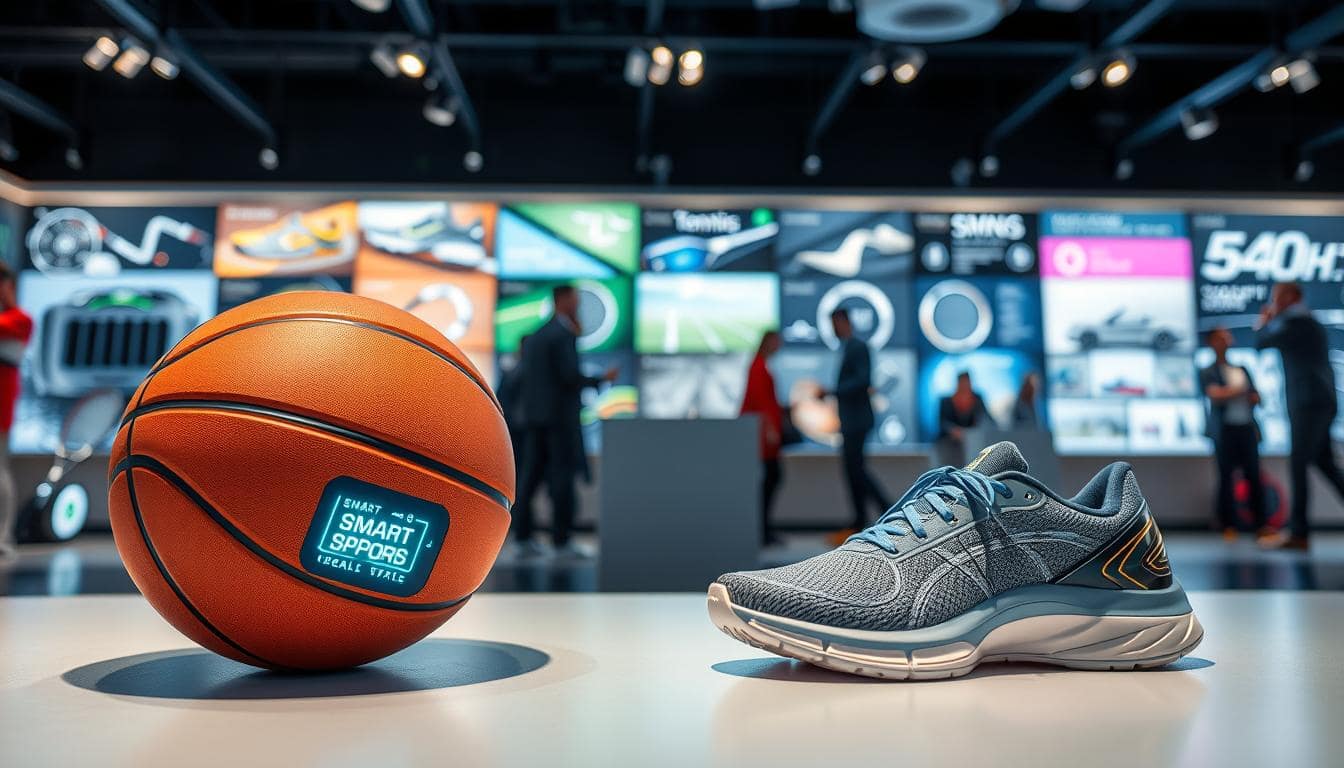
Imagine trying to solve a Rubik’s Cube while riding a roller coaster. That’s the fast pace of innovation in equipment design today. It’s not just about making gear lighter or stronger anymore. The new game is about making it smarter.
In 2024, the sports tech sector saw a staggering $86 billion in deals, a 70% surge. Wearable tech alone became a multi-billion dollar frontier. The old playbook is obsolete. The new smart equipment doesn’t just protect or perform; it communicates, analyzes, and adapts in real-time.
This isn’t about small tweaks. This is a big change in how equipment works with athletes. We’re moving from passive gear to active, data-driven partners. This shift isn’t just a product upgrade—it’s a fundamental shift in how performance and safety are engineered.
We’re going to look at the trends, the new business models, and the technology stacks powering this quiet revolution. The smart equipment on the field today is less like a piece of gear and more like a co-pilot.
Winning Themes: The New Playbook for Smart Gear
Forget the old, dumb equipment. Today, winning startups are making cybernetic second skins. They combine advanced materials, smart energy systems, and dynamic fit for a new kind of gear.
Materials are now alive. They change temperature and adjust to needs. It’s not just a helmet; it’s a smart, reactive shell. This is the base of today’s athletic gear.
Energy management is key now. It’s not just about saving power. It’s about using and directing it. Imagine a cleat that captures energy from a player’s sprint to power embedded sensors.
This isn’t just a dream. It’s the next step. A basketball player’s jump could power their shoes’ micro-LEDs for a game-winning shot. It’s a self-sustaining system.
The fit is also changing. A smart shoe that doesn’t fit is useless. The new fit system uses embedded sensors and adaptive materials. It adjusts mid-stride, like a running shoe tightening its laces.
At the heart of this are embedded sensors. They don’t just measure; they interpret. They turn athletic performance data into useful information. This is the real value: gear that coaches and learns.
This is the startup’s new strategy: sell a data-driven performance layer, not just a product. The winners will master the blend of these themes. They’re not just making better gear; they’re creating a new interface between humans and the digital world.
Testing Standards Deep Dive (NOCSAE, drop/rotational rigs)
Forget the crash test dummies in car commercials. In sports equipment, NOCSAE standards are the real heroes. They ensure safety, but without the glamour. This science is key to preventing injuries.
Testing rigs are at the heart of this process. Imagine a helmet being dropped onto an anvil. This is how helmets are tested for impact. But, we now know that many injuries come from twisting forces.
The rotational rig is where things get complex. It simulates the impacts seen in real games. It tests how well a helmet handles twisting forces.
The old certification process is slow. But D2C innovation changes this. Startups can now test and improve their products quickly. They sell directly to athletes, getting feedback fast.
This creates a dynamic where D2C startups can innovate quickly. They use real data to improve their products. This is different from the slow process of traditional certification.
So, when you see a new helmet, remember its journey. It has been tested and improved many times. The D2C model is leading the way in athlete safety.
Data Translation: Lab to On-Field Relevance
Ever felt like lab results are amazing, but they don’t work in real games? This is the big translation problem. Safety ratings from labs are impressive in theory but useless without real-world use. The real magic happens when we turn those perfect lab results into the messy, real-life game.
Mass customization is more than just a buzzword. It’s the key to making lab data fit each athlete perfectly. It’s like the difference between a generic suit and one made just for you. We need to make lab data speak the language of real game moments.
From Lab Coats to Shoulder Pads: The Translation Protocol
So, how do we make lab data work in the stadium? It’s a mix of hardware, software, and feedback loops. This process is like something NASA engineers would be proud of.
The Wearable Tech Tango
Today’s athletes wear sensors that track everything. Systems like Catapult and Zebra give us a lot of data. But it’s how we use this data that’s really new. We’re not just tracking hits; we’re creating detailed player profiles.
This is where mass customization gets really personal. AI can process this data quickly, comparing lab results to real game forces. It’s about knowing exactly how a player’s gear holds up in a game.
The AI Tailor: Stitching Data to the Athlete
The heart of the mass customization revolution is making gear for each athlete. AI uses a player’s history, position, and physiology to suggest gear changes. It’s like having a personal shopper for your safety.
The table below shows the big difference between lab results and real games.
| Lab Metric | Field Reality | Translation Challenge | Customization Solution |
|---|---|---|---|
| Linear Impact Force (Lab) | Multi-vector, rotational impacts in a scrum | Lab tests single-direction force; games have chaos | Multi-sensor arrays to map real-world impact angles |
| Perfect Fit (Lab Dummy) | Constantly shifting fit due to sweat, movement, gear | Static lab dummies vs. dynamic, sweating athletes | 3D scanning for bespoke, form-fitting gear |
| Controlled Temperature | Freezing cold, pouring rain, 100°F heat | Material performance varies wildly with temp | Smart materials that adapt to temperature changes |
| Single-Impact Test | Repeated sub-concussive hits over a game | Fatigue and cumulative damage are invisible in a lab | Embedded sensors that track micro-damage in real-time |
The magic of mass customization turns these problems into a playbook. Lab data is no longer just a static certificate. It’s a dynamic dataset that matches the chaos of the field. The ‘Customization Solution’ is AI-driven, adjusting gear in real-time.
The On-Field Proof: From Data to Durable Advantage
This isn’t just theory. Teams using mass customization are seeing big changes. Linemen get shoulder pads that fit their blocking style. Receivers have helmet liners that match their impact risks. It’s not just about safety; it’s about performance.
The final result? It’s not just about preventing injuries. It’s about unlocking performance. When gear fits perfectly, the line between athlete and equipment blurs. Lab data is the music, and on-field performance is the symphony. We’re learning to conduct it.
IP, Funding & Post-Award Commercialization Paths
Turning a great idea into a product is tough. It’s like running through a financial and legal maze. In sports tech, your intellectual property is key. You must protect it first.
Why is IP so important? Without it, your product can be copied easily. A strong patent portfolio makes your startup attractive to investors. Smart founders protect not just the product but also the process and materials used.

Finding money for a hardware startup is hard. Venture capitalists are cautious about investing in products that cost a lot to make. You need a mix of funding to get from a grant to a Series A round.
The Funding Buffet: A Comparative Spread
Finding the right funding is like making a layered dish. It’s not just about one thing.
| Source | Best For | Pros | Watch Out For |
|---|---|---|---|
| SBIR/STTR Grants | Early-stage R&D, de-risking tech | Non-dilutive, validates tech for future investors | Slow, bureaucratic, milestone-driven |
| Venture Capital | Scaling production, market expansion | Large capital, strategic connections | Significant equity loss, growth pressure |
| Strategic Corporate Partner | Co-development, market access | Industry expertise, distribution channels | Can limit future options, IP sharing complexities |
| Government Programs | Pre-commercial R&D, prototyping | Non-dilutive, supports high-risk R&D | Stringent reporting, use of funds restrictions |
After winning funding, the real work starts. It’s not just about getting a grant or a customer. It’s about turning your idea into a product.
This is where the real work begins. You’re no longer just an inventor. You’re a project manager, a compliance officer, and a supply chain manager. You must navigate pathways to commercialization that often involve regulatory hurdles, scaling manufacturing, and building a sales pipeline. It’s the unglamorous, gritty work of turning a one-off prototype into a scalable, shippable product. Additive manufacturing shines here, too, enabling on-demand production of custom parts or small batches without the need for expensive tooling, smoothing the transition from prototype to production.
The journey from idea to product is a marathon of small, calculated steps. It requires a founder to be equal parts inventor, legal strategist, and fundraiser. In the high-stakes game of sports tech, your additive manufacturing process isn’t just a production method—it’s a strategic asset that accelerates iteration, protects IP, and proves your scalability to the investors and partners who will help you cross the finish line.
Adjacent Challenges (Rugby, Hockey, Soccer) and Takeaways
Ever tried explaining the offside rule to someone new? It’s a challenge. The same goes for making protective gear for sports like rugby, hockey, and soccer. Each sport has its own way of dealing with collisions, and a single solution doesn’t work for all.
Rugby is all about controlled force, like a physics experiment. Hockey checks are fast and hard, with little friction. Soccer players face constant running and heading the ball, which can be tough on their heads. The protective gear for each sport is as unique as the game itself.
Now, wearables and AI fit are changing the game. Tech startups, mainly in soccer, use AI to analyze player data. They’re not just tracking steps; they’re predicting them. Imagine a rugby scrum cap that adjusts to impact in real-time, thanks to AI fit.
The growth of wearables in sports is huge. Football tech startups are using AI for performance analysis. This isn’t just tracking; it’s about predicting and preventing injuries. For hockey players, AI fit shoulder pads could stiffen up before a hit, thanks to AI.
The future of sports equipment is changing. It’s moving from passive to predictive and adaptive. The AI fit doesn’t just protect; it learns from the athlete. This creates a system where the gear evolves with the player. That’s the real game-changer.
Collaboration with Leagues, Labs, and Cert Bodies
Creating top-notch sports equipment is a team effort. Leagues, testing labs, and certifying bodies are key partners. They help your startup go from a prototype to professional gear. Without them, you’re playing the wrong game.
Leagues like the NFL or FIFA are the ultimate end-users and rule-makers. They set the problems that need solving. Testing labs, like those following NOCSAE standards, test your gear rigorously. Certifying bodies then give the final approval, ensuring your gear is safe.
Cloud analytics has changed the game. It’s not just about storing data. It’s about creating a real-time, shared system. Imagine a lab in Boston testing a helmet, and the data instantly reaches teams in San Francisco and New York.

This isn’t just data sharing; it’s a continuous conversation. A lab in Europe can compare a new cleat’s traction data with historical metrics. This is the power of cloud analytics—it makes the slow certification process fast and collaborative.
| Collaborator | Their Role in Your Success | How Cloud Analytics Unlocks Value |
|---|---|---|
| Leagues (NFL, FIFA, etc.) | Set the rules of the game. They define the performance and safety problems that need solving. A partnership here isn’t just for a logo; it’s access to real-world testing grounds and data. | Provides real-time, on-field performance data (e.g., concussion metrics, equipment failure points) that can be fed directly into R&D, creating a closed-loop system for product evolution. |
| Testing Labs (NOCSAE, etc.) | The objective, third-party validators. They provide the unbiased, repeatable data that proves your gear meets or exceeds the baseline standards. | Labs can upload and compare test results in a shared cloud environment, allowing for trend analysis and faster iteration on failed parameters. |
| Certifying Bodies | The final arbiters who grant the official stamp of approval. They ensure the lab’s data meets the letter of the law for safety and performance standards. | Cloud platforms can streamline the certification audit trail, making the submission and review of terabytes of test data instantaneous and transparent. |
The goal is to move from a slow, linear process to a fluid, integrated system. When leagues, labs, and cert bodies are connected through a shared cloud analytics platform, the feedback loop tightens. A lab anomaly in a helmet test can be cross-referenced with on-field impact data from the league, and the certification body can review the integrated dataset in real-time. This collaboration, powered by shared data, doesn’t just get your product to market. It ensures that the gear that hits the field is safer, smarter, and has already proven itself in a continuous loop of real-world feedback.
Case Snapshots: Prototypes to Market Adoption
Every sports tech startup starts with a spark in a garage, dorm room, or lab. But turning that spark into a must-have item is a big challenge. It’s not just about having a better product. It’s about getting it to the right people.
Your product might be the next big thing in sports tech. But if it’s stuck in your warehouse, it’s just a cool idea. Your channel strategy is key. It’s the plan that turns your product into a must-have for athletes.
Think of your channel strategy as your path to market. Will you sell online and keep the customer close? Or will you partner with big sports retailers? Or maybe sell to teams directly?
Most startups use a mix of these approaches. For example, a smart insole company might sell to elite athletes, use online platforms, and partner with running stores. This way, they reach more people.
Your channel strategy is your game plan. It’s what turns a garage project into a global brand. It’s not just about getting your product out there. It’s about building trust and confidence with your customers.
| Startup | Product | Primary Channel | Channel Strategy Insight |
|---|---|---|---|
| Fanalysis | Smart Football Analytics | Direct B2B Sales to College/Pro Teams | Built credibility with top programs, then expanded to high schools. |
| PlayerSnap | Recruiting & Scouting Platform | Hybrid: Freemium B2C, Premium B2B | Used grassroots (athletes, parents) to create demand that pulled in institutional buyers. |
| Catapult Sports | Wearable Performance Trackers | Enterprise B2B (Teams, Leagues) | Started with elite pro teams to build brand, then expanded down-market. |
| Whoop | Fitness & Recovery Wearable | Hybrid D2C (Online) & Strategic Partnerships (Pro Leagues) | Leveraged pro-athlete endorsements and social proof to drive D2C sales. |
Hudl started filming high school games from the bleachers. Their channel strategy focused on the coaching community. They sold a solution to a common problem, not just software.
Catapult, a leader in athlete monitoring, first targeted elite teams. This built their reputation before they expanded to more markets.
The best companies start with a focused channel. They dominate a niche, like smart mouthguards for college lacrosse teams. This focus proves the product and the model.
Your product might start in a garage, but success comes from the market. The right channel strategy drives adoption. It’s the difference between a great idea and a game-changer.
Playbook: Preparing Submissions and Test Evidence
You’ve made a better helmet. You’ve passed the lab tests. Now, you face the final challenge: the certification body. This is where engineering meets persuasion. Your submission is like a thesis defense for your product.
Your submission packet should shine, not be a pile of papers. Passing NOCSAE or other standards is just the start. You need to tell a story with your data. Show how your helmet is innovative and safe.
Think about every question a skeptical engineer might ask. Your submission should answer them before they’re even asked. Make lab data relevant to real games. Explain what a graph from a rotational rig means for a running back.
This playbook is a mindset, not a checklist. Your submission is your product’s last test. It must show not just safety, but a leap forward. It’s about proving your gear is the future.