
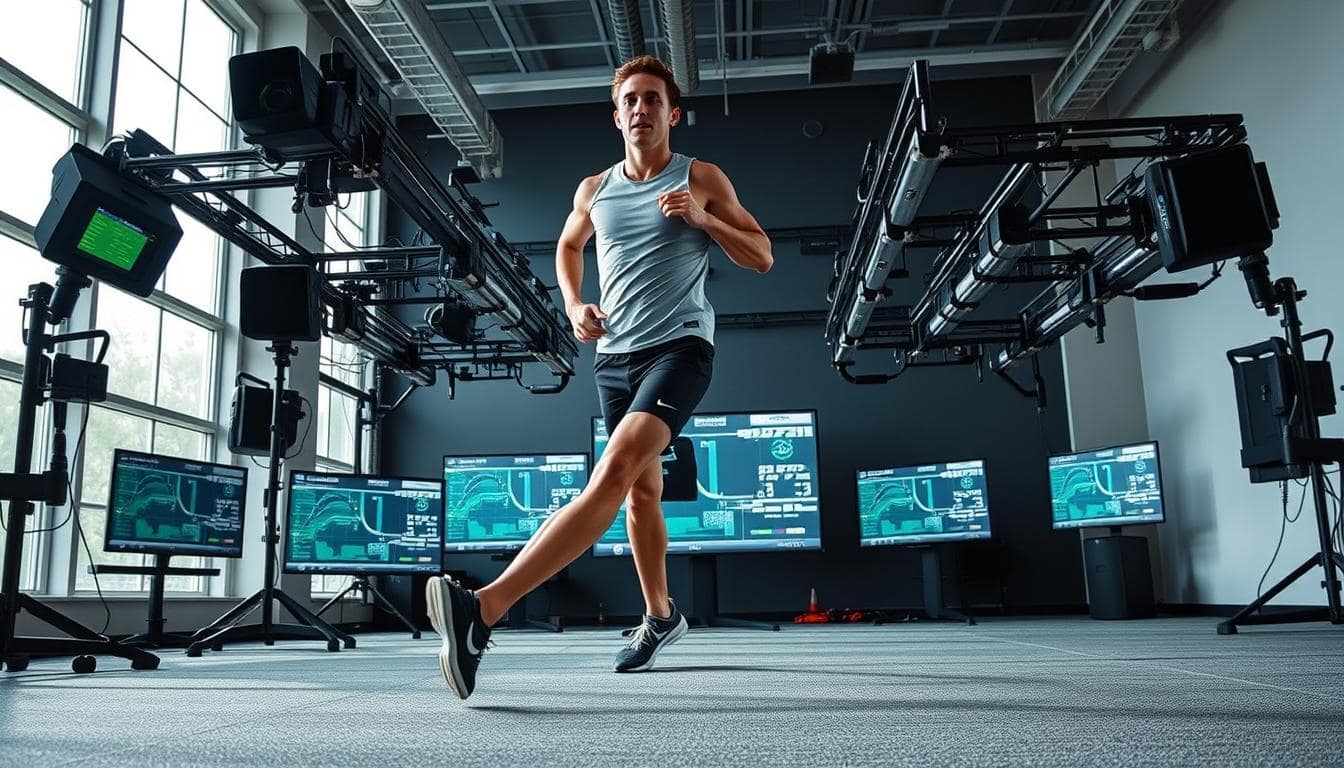
Coaching by gut instinct is old news. Today, we have data to guide us. Guessing an athlete’s form is like using starlight when GPS is available.
This shift is more than an update; it’s a game-changer. We’re leaving behind the “looks good to me” days. Now, every detail of movement is measured.
Modern performance motion systems offer clear insights into how athletes move. They track things like joint angles and coordination, far beyond what the eye can see. It’s not about replacing a coach’s eye. It’s about making it better.
The data shows us what we can’t see with our eyes. It’s like giving your team a tool to see the unseen. It’s like Sherlock Holmes’ magnifying glass for human movement.
With this analysis, making improvements is clear. The aim is to boost performance, cut down on injuries, and make athletes more efficient. The days of guessing are over.
Motion Capture Technology Overview
Choosing a motion capture system for 3D motion capture sports is more than a purchase. It’s a partnership with a specific technology approach. We’ll help match your athletic program with the right technology.
Today, three main philosophies dominate the field. Each converts human movement into data, but in different ways.
The Lab Aristocrat is about optical marker-based systems. Think Vicon or Qualisys. These systems are super accurate, but only work indoors. They’re perfect for clean, controlled environments.
The Nomadic Scout uses Inertial Measurement Unit (IMU) systems like Xsens. It’s all about portability. Athletes can move freely, but there’s a small error margin over time.
The Silent Observer is all about markerless computer vision. It uses AI to analyze video. No sensors needed. It’s the most scalable option, but relies on AI.
So, who wins? Your choice shows what your program values most:
- Optical Systems: You want the most precise data.
- Inertial Sensors: You need something that works in real-world settings.
- Markerless Tracking: You want something easy to use and scalable.
Then there are emerging hybrids. They mix different technologies to get the best of all worlds. This area is constantly evolving.
There’s no single “best” technology for 3D motion capture sports. Each system offers a unique view. Your task is to find the one that best captures your athletes’ performance.
System Architecture Design: Building the Nerve Center
A motion capture system’s architecture is like a cyborg athlete’s nervous system. Every connection must be perfect, or the whole thing fails. It’s not about fancy software. It’s about the solid, behind-the-scenes work that turns movement into reliable data. If you get this wrong, you’re wasting money and creating a beautifully rendered fantasy.
Many great ideas fail because of a bad setup. The magic is in the machinery. A strong movement tracking technology architecture has five key parts:
- Camera Networks & Sensor Placement: The system’s physical eyes and feelers.
- Data Synchronization: The digital choreography that keeps everything in sync.
- Processing Pipelines: The factory that refines raw data into useful insights.
- Storage Solutions: The library for your growing motion data.
- Calibration Protocols: The rituals that turn science into fact.
The Ballet of Cameras and Sensors
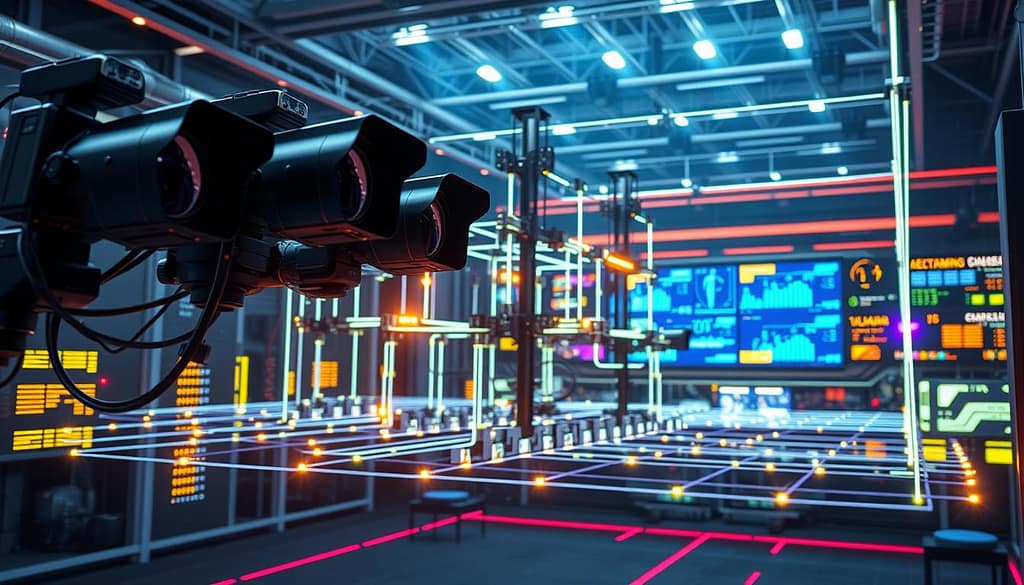
Optical systems need more than cameras; they need a constellation of them. A dense network is essential, with no blind spots. For a standard lab, you might use 42 OptiTrack cameras in a 135 m³ space. Each camera must be placed with sniper-like precision, with their views overlapping like a solved Venn diagram.
Inertial systems use body-worn sensors instead of cameras. But placing these sensors is just as critical. A small mistake, like a centimeter off on a shin, can ruin your data. Understanding the comprehensive sensor landscape is essential. Markerless tech offers freedom but requires complex algorithms or smart single-camera software.
Taming the Ghost in the Machine: Synchronization
Time is a harsh reality for cameras and sensors. If they’re not perfectly in sync, your data is useless. A small delay can ruin a sprinter’s form, turning it into digital noise.
Synchronization is a major challenge for DIY systems. Wired networks fight latency but create a mess of cables. Wireless systems offer freedom but face signal interference and clock drift. Solving this is key to credible movement tracking technology.
From Firehose to Fountain: Pipelines and Storage
Once you’ve captured synced raw data, the real work starts. A high-fidelity optical system can produce terabytes per session. You need a processing pipeline to turn this data into useful 3D coordinates and velocities.
This pipeline is where edge computing shines. It reduces latency, enabling real-time feedback. But then you must store it. You need scalable, cloud-backed solutions to handle the data flood of a sports team’s season. Your architecture must plan for this from the start, or you’ll be overwhelmed by your own success.
In the end, a sleek analysis interface means nothing without a solid foundation. It’s the difference between a Rube Goldberg machine and a precision watch. In the high-stakes game of athletic performance, you can’t afford to be a cartoon.
Real-Time Processing Capabilities
The quest for real-time feedback in sports is not about speed. It’s about being immediate. We turn huge amounts of movement data into coaching tips in seconds. Feedback that’s late is feedback that’s lost—it misses the chance to fix a mistake before it becomes a habit.
So, what does “real-time” mean in sports tech? It’s not like watching TV. It’s a high-tech balancing act. The system must quickly capture movement, process lots of data, and give clear insights fast. That’s the ultimate goal.
Low-latency analysis is key. Latency is bad. A delay of just a few hundred milliseconds can make feedback useless. Modern systems work hard to cut down on this delay, from capturing data to showing it on a coach’s tablet.
Edge computing is a hero in this fight. It doesn’t send all data to a cloud server, which adds delay. Instead, it processes data locally. It’s like having a supercomputer right where the action is.
The results are amazing. Coaches can see streaming data like live velocity and joint angles on a screen. They can say, “Your plant foot is 3 degrees off,” right before the next try. This feedback makes training sessions more effective.
Not all methods are the same, though. The choice between cloud, edge, or a mix depends on the sport and how fast insights are needed.
| Processing Approach | Typical Latency | Data Volume Handled | Ideal Use Case |
|---|---|---|---|
| Cloud Processing | Seconds to Minutes | Very High | Post-session deep analysis, long-term trend tracking |
| Edge Computing | Milliseconds | Moderate to High | In-session technique correction, immediate biomechanical feedback |
| Hybrid (Edge + Cloud) | Milliseconds (edge) & Seconds (cloud) | Extremely High | Comprehensive programs needing both instant cues and archival analysis |
| On-Device (Sensor) Processing | Near-instantaneous | Low to Moderate | Wearable tech for basic form monitoring, individual athlete metrics |
The table shows a clear choice. For quick, game-changing feedback, edge computing is the best. It’s the difference between making a change now or tomorrow.
This changes how coaches work. They don’t rely on memory or slow-motion anymore. They have real-time data to guide them. They can see if a pitcher’s arm is dropping or a sprinter’s leg is off balance right away.
Advanced athletic motion analysis systems change everything. They don’t just measure athletes; they start a conversation. The data flows, the coach interprets, and the athlete adjusts. It’s like giving coaches X-ray vision into how athletes move, one millisecond at a time.
Accuracy & Precision Requirements
Let’s talk about the unsung hero of any credible motion lab: the meticulous, often obsessive, pursuit of accuracy. In biomechanical tracking, precision isn’t a luxury feature. It’s the bedrock. Without it, you’re not analyzing an athlete. You’re interpreting expensive noise.
Think of it this way. Would you trust a stock tip from a fortune cookie? Of course not. Yet, some performance systems peddle accuracy claims with similar vagueness. Real validation is a brutal, numbers-driven sport of its own.
So, what do the numbers actually say? Optical motion capture systems set the gold standard. They boast sub-millimeter accuracy for static measurements. In dynamic, real-world scenarios, the error typically stays under 2 millimeters. That’s like detecting the thickness of two sheets of paper on a sprinting wide receiver.
Inertial Measurement Units (IMUs) tell a more complex story. Their Root Mean Square Error (RMSE) for joint angles can range from a respectable ~3 degrees to a catastrophic 100-plus degrees. The variance depends heavily on the movement plane and the specific task. A controlled lab squat is one thing. A chaotic soccer tackle is another.
Markerless systems, the cool new kids on the block, are promising but yet maturing. They often report RMSE between 3 and 15 degrees for movements in the sagittal plane (think forward/backward). Venture into rotational, transverse plane movements, and that error can balloon to a concerning 3–57 degrees. That’s the difference between diagnosing a flawless pitching motion and missing a potentially injurious flaw.
This is where measurement validation moves from checkbox to crusade. A published accuracy claim is meaningless without context. Was it validated on a static mannequin or a live athlete? In a sterile lab or on a rain-slicked field? You must ask these questions.
Calibration protocols are your first and best defense against garbage data. They are the pre-flight checklist for your multi-camera or multi-sensor array. Skip a step, rush the process, and you’ve just compromised every data point you’ll collect for the next hour. It’s a silent failure.
Understanding error sources is like being a forensic accountant for movement. You must audit the budget. Where does inaccuracy creep in?
- Occlusion: A camera’s view is blocked, or a limb hides a sensor. It’s the oldest trick in the book.
- Sensor Drift: Inertial sensors slowly lose their reference point over time, like a watch that falls behind by seconds each day.
- Magnetic Interference: The invisible enemy. Gym equipment, reinforced concrete, or even a laptop can distort an IMU’s sense of direction.
Every system has its error profile. The goal isn’t perfection—that’s a fantasy. The goal is to know your error, quantify it, and account for it in your analysis. This rigorous error analysis is what separates a diagnostic tool from a random number generator with a fancy GUI.
Repeatability is the final exam. Can your system produce the same precise measurements tomorrow, under the same conditions, that it did today? If the answer is “maybe,” you have a problem. True precision is boringly consistent.
In the end, investing in rigorous accuracy protocols isn’t about nerdy details. It’s about trust. It’s the foundation upon which every subsequent coaching decision, training adjustment, and performance prediction is built. Or, as we’ve seen, where it all collapses. Your data is only as strong as its most fragile measurement.
Multi-Sport Applications: From Pool to Pitch
Motion capture is like a Swiss Army knife. It adapts for swimming and soccer. Athletic departments need a wide range of tools for different sports.
In the pool, sports video analysis gets wet. IMUs track a swimmer’s stroke. They look for ways to improve performance.
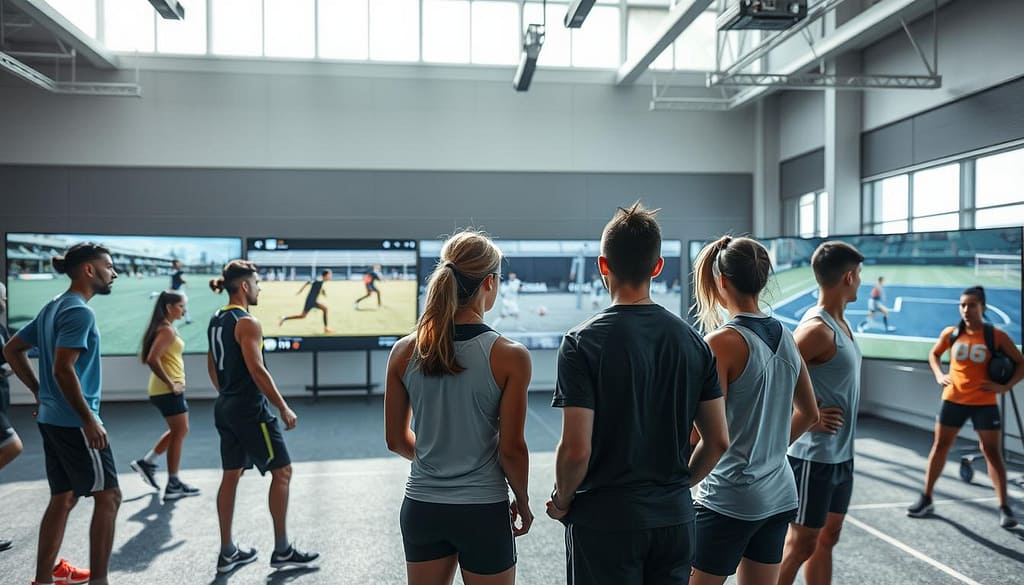
On the court, volleyball needs explosive jumps. Motion systems analyze these jumps. They look at arm swings and knee flexion.
Baseball is about precise pitching. Motion capture tracks every detail of a pitch. It helps prevent injuries.
On the track, sprint starts are fast. Systems measure force and timing. A small difference can mean a lot.
Soccer is all about constant motion. Sports video analysis tracks player movements. It helps prevent injuries.
Each sport has its own challenges. Water and sun affect technology. Large fields need many cameras.
Tools vary by sport. Swim teams use IMUs, while football teams need real-time tracking. The right tool depends on the sport.
The real magic is in sport-specific analysis. It tells the story behind the data. This is where motion analysis becomes meaningful.
It’s about asking the right questions. Not just “what happened?” but “what does it mean for this athlete, in this sport, tomorrow?” Modern sports video analysis offers this insight.
Data Analysis Algorithms
Imagine the raw data from a motion capture system: a mix of XYZ coordinates and sensor readings. This data is like a digital storm that means nothing on its own. But, with the help of data analysis algorithms, this chaos turns into a meaningful story.
Without these algorithms, the data is just a map without street names. They are like urban planners and linguists. They turn raw data into the language of performance, making biomechanical tracking meaningful.
Decoding Movement: Joint Angle Calculation
How do we turn points into a precise knee valgus angle? Inverse kinematics is the key. It’s like a detective working backwards. It figures out the most likely joint positions from the data.
For IMUs, it’s about combining data from accelerometers, gyroscopes, and magnetometers. For markerless systems, it’s fitting a digital skeleton to the data. This gives us a clear, accurate record of joint angles, the basics of movement analysis.
The Calculus of Performance: Velocity & Acceleration Profiles
Knowing an ankle’s position is one thing. But knowing its speed and how it’s changing is more interesting. This is where derivatives come in. They help us find velocity profiles.
The second derivative gives us acceleration patterns. These patterns show the dynamic nature of movement. A sprinter’s explosive start and a pitcher’s fastball are all in these curves.
The Symphony of Motion: Coordination Metrics
Now, we look at how body parts work together. Coordination metrics analyze this teamwork. Techniques like segment coupling study the pelvis and thorax during a golf swing. Phase analysis checks if limbs are in sync.
These metrics help us understand efficiency, skill, and risk. They show if a runner’s arm swing matches their leg drive or if fatigue might lead to injury. This is the top level of insight in biomechanical tracking.
In short, these algorithms are silent translators. They make the data speak, telling us about joint angles, velocity, and coordination. They turn movement into a story about performance.
Integration Challenges
Integration is where your high-tech motion analysis dreams meet the old equipment in your facility. You’ve got the new 3D motion capture sports system. Now, you face the hard part: making it work with everything else. It’s like a tech merger, full of culture clashes and communication problems.
The first challenge is hardware. Your lab’s old force plates and EMG sensors need to work with the new system. It’s like trying to get old friends to get along with new ones.
Software interfaces are another big problem. Your new MoCap software might use a special format. But your team uses Visual3D or MATLAB. This means your data gets stuck, needing manual translation. It’s like having an interpreter who only speaks Klingon.
Workflow integration is also tricky. A system that slows down a coach’s routine is doomed. It must fit into the existing rhythm of training. If it disrupts the flow, it will be ignored.
Lastly, there’s the human factor. The most common problem isn’t the camera. It’s the person using it. Training coaches and sports scientists is essential for good data. A study on biomechanical methods shows that following protocols is key for reliable results.
To overcome these challenges, you need a structured approach. The table below outlines the main issues and how to solve them.
| Challenge Area | Common Pain Point | Primary Risk | Mitigation Strategy |
|---|---|---|---|
| Equipment Compatibility | Legacy force plates & EMG units with outdated communication protocols. | Data synchronization failures, creating gaps in the biomechanical profile. | Invest in universal hardware interfaces or middleware; budget for phased hardware refresh. |
| Software & Data Formats | Proprietary export formats from the new MoCap system. | Creation of data silos, hindering combined analysis and slowing down feedback. | Demand open standards (like C3D) or custom API access from your vendor during procurement. |
| Workflow Integration | Adding complex setup/calibration steps to a time-crunched training session. | Coach resistance and inconsistent system use, rendering the investment useless. | Co-design the implementation with coaching staff; automate calibration where possible. |
| User Training & Adoption | Assuming tech-savvy staff will “figure it out” without formal training. | Operator error becomes the largest variable, corrupting data and eroding trust. | Implement tiered certification for users; create quick-reference guides and video libraries. |
The goal is more than just adding a 3D motion capture sports tool. It’s to create a connected biomechanics system. Building a bridge between new and old tech requires planning, open standards, and respect for human workflow. Ignore this, and your expensive system becomes a decoration.
Professional Implementation
The best athletic motion analysis system is useless if it doesn’t change how athletes move. It’s all about making sure the data from the lab makes it to the field. This means creating tools that fit a coach’s instincts and give athletes feedback they can use right away.
It’s like building a bridge between science and coaching. The goal is to help coaches see more clearly, not to turn them into data scientists.
Coaching Tools: Dashboards That Don’t Cause Dashboard Confusion
Forget about spreadsheets that look like they were made by an accountant having a nightmare. A coach’s dashboard should be simple and clear, like a pilot’s cockpit. It should show the most important metrics for the session right away.
Tools like Catapult Sports or VALD Performance dashboards work well because they fit right into a coach’s workflow. They answer the question fast: Is what we’re doing working? The best software doesn’t make coaches learn a new language. It translates athletic motion analysis into terms of wins and losses.
Athlete Feedback: From Data Dumps to Lightbulb Moments
Handing an athlete a 20-page PDF on their gait cycle is a waste. Feedback needs to be quick, easy to see, and simple to understand. This is where markerless tracking and real-time processing really shine.
Imagine a swimmer seeing a ghostly avatar of their ideal stroke on their video feed. Or a sprinter seeing a simple red/yellow/green light on their block start angle. This kind of feedback speaks directly to movement, not just numbers. It turns complex biomechanical adjustments into simple cues.
Training Protocols: Baking Data into the Recipe
Data should be a daily part of training, not just a quarterly check-up. Effective implementation means adding athletic motion analysis checks into the training plan. If the overload phase is causing movement imbalances, the data will flag it before the athlete feels it.
This turns training into a dynamic, responsive process. Protocols evolve based on real data, not just how the athlete feels. It’s like having a live GPS with traffic updates, not just a map.
Performance Tracking: The Longitudinal Conversation
The real power is in the trend line, not just individual data points. Longitudinal tracking turns snapshots into a detailed story of an athlete’s movement. It shows if chronic imbalances are improving and if new cues are working.
This creates a continuous conversation about performance. It moves from “How did you feel today?” to “Here’s how your body actually performed today, and here’s the trend over the last six weeks.” It’s objective, trackable, and cuts through the noise.
To sum up, here’s how different feedback modalities stack up in a professional setting:
| Feedback Modality | Best For | Coach Overhead | Athlete Comprehension |
|---|---|---|---|
| Real-Time Avatar Overlay | Technique refinement (e.g., golf swing, pitching) | Low (automated) | Very High (visual & immediate) |
| Traffic Light System | Simple cueing (e.g., jump height, start angle) | Very Low (pre-set thresholds) | Instant |
| Biomechanical Summary Report | In-depth injury rehab analysis | High (requires interpretation) | Low (requires explanation) |
| Video Sync with Data Graphs | Post-session coach-athlete review | Medium (requires syncing) | Medium (coach-guided) |
The table shows that there’s no one-size-fits-all solution. It’s about having the right tool for the right conversation. The ultimate goal is to make biomechanical insight as routine as checking the weather before practice. When data flows smoothly into daily training, that’s when you start building excellence, rep by rep.
Innovation Opportunities
Today’s advanced motion analysis seems like science fiction, but we’re just starting. We’re barely at the beginning. The future is full of exciting possibilities.
Artificial intelligence is set to become the ultimate coach’s assistant. Future systems won’t just track movements. They’ll predict injuries and warn athletes before they happen. This will change how analysts work, making them key strategists.
Automated analysis will quickly review hours of footage, spotting small issues. This includes a pitcher’s arm position or a runner’s uneven gait. The aim is to prevent injuries, not just diagnose them after they happen.
Cloud processing is changing how we work. Imagine a global database for biomechanics. It uses data from thousands of athletes to improve training for everyone. This makes teamwork the new way to win.
And let’s not forget your smartphone. It’s already a motion capture device. Apps are making biomechanics accessible to everyone. While it’s not as precise as lab systems yet, the gap is narrowing. Soon, this tech will be in every pocket, changing everything.