
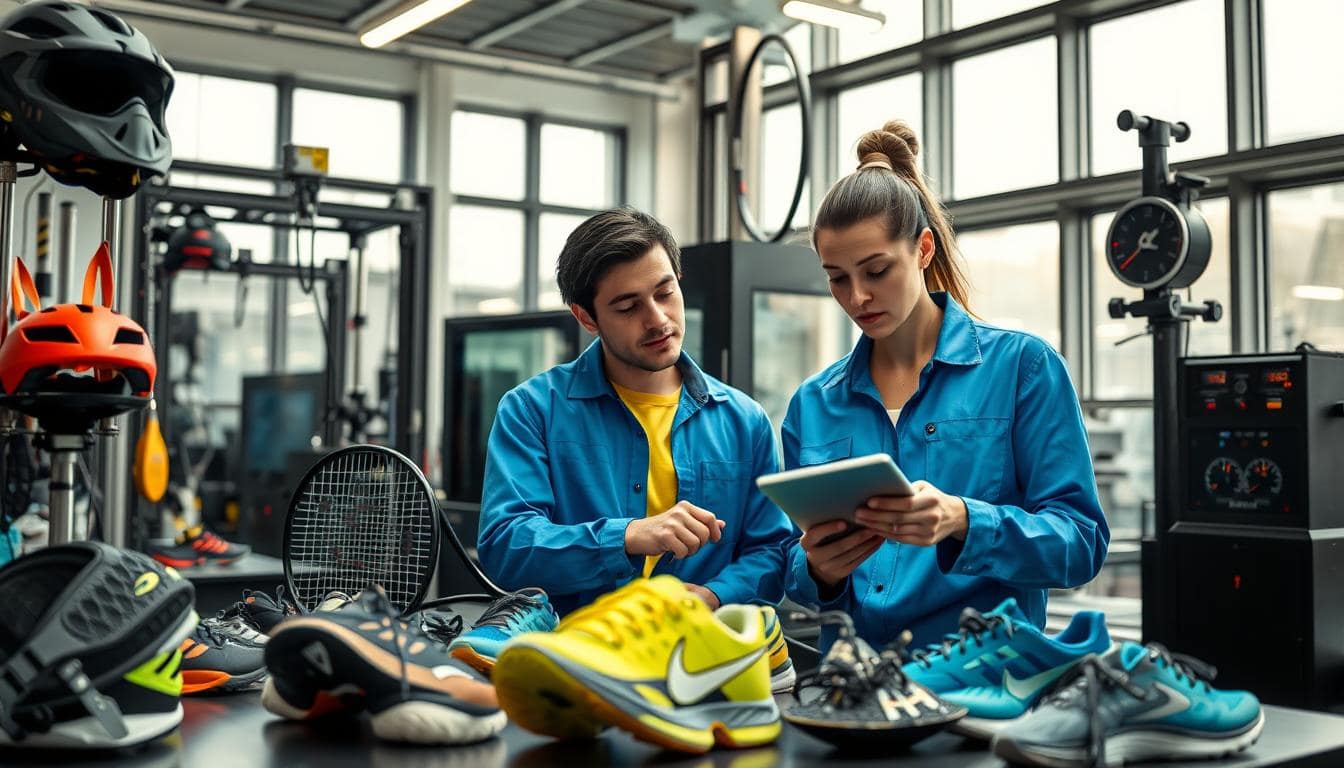
Forget the podium for a second. The difference between a gold medal and a catastrophic failure often hangs on a few grams of carbon fiber or a polymer’s secret recipe. I’m here to pull back the curtain on the unglamorous, yet utterly vital, world where champions’ gear is born.
The real drama doesn’t happen in the stadium. It unfolds in the lab, where prototypes are tortured, analyzed, and validated to within an inch of their life. This is the brutal science that ensures your gear won’t betray you when the pressure is absolute. It’s not just about compliance; it’s engineering excellence as a moral imperative.
How do we get there? Through simulation software so advanced it’s already shaping victories at the Summer Games. Think cycling, sailing, and rowing. This digital proving ground redefines what’s possible, marrying peak performance with fundamental safety.
This relentless pursuit is the bedrock of modern athletic equipment standards. It’s the unsung hero of every triumph, a rulebook for the gladiatorial arena written in data and enforced by science. Understanding this process isn’t just technical—it’s a glimpse into the integrity behind the spectacle.
So, before you marvel at the physical feat, consider the silent partner: rigorous equipment certification. It’s where trust is forged, long before the first cheer echoes.
Testing Standard Framework
Before any athlete takes a hit, the equipment must pass a series of rules. These rules are written in a way that’s hard to understand. They are the constitutional document for equipment integrity. Think of it as the playbook that every piece of gear must memorize before it’s allowed on the field.
So, what’s in this playbook? It’s a mix of international agreement and sport-specific knowledge. The ISO standard for a general helmet is a good start, but it’s not enough for a hockey goalie. They need different ingredients.
This framework answers the question that keeps engineers and lawyers up at night: “What does ‘good enough’ actually mean when a human life or career is on the line?” The answer is never simple, and it’s always evolving.
ISO standards are like the Esperanto of sports equipment testing. They provide a common language for safety and quality across borders. A manufacturer in Vietnam and a testing lab in Germany can argue product integrity using the same metrics.
These standards cover everything from basic mechanical properties to labeling requirements. They are the foundational layer. But here’s the catch: they are designed to be broad. A bicycle helmet standard (ISO 10256) ensures it can survive a certain impact. It doesn’t ensure it’s aerodynamic enough for a Tour de France contender.
Sport-Specific Dogma: Where Rules Get Personal
This is where the framework gets interesting. Every major sport has its own governing body, and each has a bible of equipment rules. The NFL’s strict guidelines on helmet composition are born from a century of colliding giants. World Archery’s specifications for bow rigidity come from millennia of refinement.
The sport-specific requirement is what separates a safe product from a competitive one. It’s the difference between a “bike path” bike and a “race-winning” bike. Manufacturers use advanced simulation software precisely to navigate this gap. They model a product against the ISO baseline, then tweak it endlessly to meet the niche demands of a specific sport’s culture and physics.
Safety Regulations: The Shield and the Sword
Safety regulations are the law. They are as much about preventing injury as they are about managing liability. In the U.S., bodies like the Consumer Product Safety Commission (CPSC) set mandatory rules. An ASTM standard for football helmets can become a de facto legal requirement.
This layer of the framework is non-negotiable. It’s the minimum viable product for not getting sued. Smart manufacturers see compliance not as a cost, but as a key market advantage. A “CPSC Certified” label is a powerful signal to parents and leagues.
Performance Benchmarks: The Pursuit of “Better”
Performance benchmarks are set by the elite—professional teams, Olympic committees, or leading athletes. If a safety standard says “won’t break,” a performance benchmark says “will make you faster.”
This is where the testing framework meets the real world. Does a new running shoe material actually improve energy return by 4%? Does a lighter baseball bat compromise its durability? Long-term field studies and athlete feedback feed directly back into the design software, creating a loop of continuous improvement.
| Framework Layer | Primary Scope | Key Driver | Real-World Example |
|---|---|---|---|
| ISO Standards | International Baseline Safety | Global Trade & Consensus | ISO 10256: Protective gear for ice hockey |
| Sport-Specific Rules | Competitive Integrity & Nuanced Safety | Governing Bodies (FIFA, NFL, etc.) | NBA’s official ball size and pressure specifications |
| Government Safety Regulations | Consumer Protection & Legal Liability | National Agencies (CPSC, EU Directives) | CPSC mandatory standard for bicycle helmets |
| Performance Benchmarks | Elite Athletic Advantage | Professional Teams & Athletes | Nike’s “Breaking2” project shoe energy-return metrics |
This table isn’t just academic. It’s the battlefield map for modern sports equipment testing. A manufacturer must navigate all four layers simultaneously. They use smart development strategies to build products that are legal, safe for the sport, and superior to the competition.
So, the next time you lace up your shoes or strap on a helmet, remember the invisible framework that holds it all together. It’s the unglamorous grammar that makes the poetry of sport possible.
Material Testing Protocols: The Interrogation Room for Athletic Gear
We don’t just test materials; we put them through harsh tests. This is the heart of safety testing protocols. It’s like a check-up for equipment before it hits the field. This way, we catch problems early and avoid failures later.
Modern tech acts like a crystal ball, spotting design flaws early. It saves money and prevents big failures. Your gear will last longer, giving you more confidence.
Deconstructing the Material Personality
Every material has its own traits. Some are strong but break easily, while others are flexible but weak. We test these traits to understand each material better.
It’s not just about being strong. It’s about finding the right balance for the job. For example, a climbing rope needs strength and flexibility. A hockey stick needs stiffness but also some give.
The Grind: Fatigue, Environment, Age, and Failure
After understanding a material’s basic traits, we test it in tough conditions. This is where safety testing protocols really shine.
- Fatigue Testing: We bend a paperclip back and forth until it breaks. Then, we do that to a bike frame 100,000 times. It’s like a week of use in just a few days.
- Environmental Durability: We test how a tennis racket or soccer ball holds up in extreme conditions. We use UV light, humidity, and chemicals to mimic real-world use.
- Aging Simulation: We speed up aging by using heat and oxygen. This shows how materials degrade over time. It’s like a mid-life crisis test.
- Failure Analysis: We push materials until they break to understand how and why. It’s like a lesson in not breaking the same way twice.
The table below shows how we test materials. It’s like a report card for their strength.
| Test Protocol | Simulated Condition | Key Metric Measured | Primary Safety Outcome |
|---|---|---|---|
| Tensile & Compression | Maximum pulling/stretching and crushing forces. | Ultimate Strength (MPa), Yield Point | Prevents sudden snapping or collapse under load. |
| Cyclic Fatigue | Repeated bending, twisting, or impact (e.g., 500,000 cycles). | Cycles to Failure, Crack Initiation Point | Ensures durability over product lifespan, not just first use. |
| UV & Humidity Exposure | Accelerated sun and moisture exposure (e.g., 1000 hrs of UV). | Color Fade, Material Embrittlement, % Strength Loss | Guards against degradation from outdoor storage and use. |
| Thermal Aging | High-temperature oxidation over compressed time. | Change in Flexibility, Hardness, Chemical Structure | Predicts shelf-life and ensures safety of old stock. |
| Failure Mode Analysis | Controlled overload to destruction. | Fracture Pattern, Energy Absorption, Failure Point | Informs redesign to eliminate catastrophic failure modes. |
This set of tests turns guesswork into certainty. We simulate a product’s whole life to build gear athletes can trust. It’s not just about making something strong. It’s about knowing exactly when and how it will fail, and designing it so that moment never comes.
Impact Testing Systems
Forget crash test dummies; in sports gear, impact testing is where physics meets fear. It’s the final exam for any piece of equipment claiming to protect a human body. It’s not about if something will hit the fan, but how the gear performs when it does.
Modern simulation tests provide real-time feedback. They turn a catastrophic moment into a teachable one. This improves product safety and athlete protection.
Drop Testing: The Heartbreak Simulator
Drop testing is like your worst day. It simulates the moment a helmet meets asphalt or a knee pad hits concrete. The equipment is mounted on a guided assembly and released from precise heights onto standardized anvils.
Accelerometers and force sensors capture the event in milliseconds. It’s not just about recording a big number. It’s about understanding the impulse—the force over time—that travels to the athlete’s body. A softer, longer impulse is often better than a sharp, sudden spike.
Ballistic Testing: For the Freak Accidents
While drop tests cover gravity’s cruelty, ballistic testing prepares for projectile pandemonium. Think of a 100-mph fastball, a slap shot, or a rogue piece of debris. This method uses air cannons or pendulum systems to fire standardized projectiles at protective equipment.
The goal is to measure the equipment’s ability to manage localized, high-velocity energy. It answers the question we hate to ask: “What happens when the unexpected becomes the impact?” This data is vital for sports with high-speed puck or ball play, turning freak accidents into calculated risks.
Energy Absorption: The Kinetic Thief
The hero of any impact story is energy absorption. This isn’t about stopping force dead; it’s about stealing its kinetic oomph. Materials like expanded polystyrene (EPS) foam or specialized polymers are engineered to crush, deform, or flex in a controlled manner.
By doing so, they convert dangerous kinetic energy into harmless heat or other forms of energy dissipation. Evaluating this absorption is a cornerstone of advanced performance testing methods, quantifying how much punishment the gear takes so the athlete doesn’t have to.
Deformation Analysis: The Post-Mortem Story
After the impact, the equipment tells a story. Deformation analysis is the forensic read. Permanent dent, crack propagation, or layer delamination—each flaw is a data point. High-speed cameras and 3D scanning map the damage with microscopic detail.
This analysis reveals if the material rebounded (elastic deformation) or stayed crushed (plastic deformation). It tells engineers not just if the gear “survived,” but how it survived. This feedback directly informs material selection and design geometry, closing the loop on safety performance testing methods.
Safety Threshold: The Line in the Sand
All this data converges on one non-negotiable: the safety threshold. This is the engineering line between a “good story” and a “call an ambulance.” Thresholds are often defined by peak acceleration (measured in G-forces) or head injury criteria (HIC) scores that correlate to injury risk.
Establishing this threshold is an act of empathy disguised as math. It forces a binary question: does this design keep the athlete below the known danger zone? Passing this test isn’t about winning a prize; it’s about earning the right to be on the field. It’s the ultimate validation that the simulation’s real-time data has successfully been translated into real-world protection.
Biomechanical Testing Integration
Forget about lab rats; the ultimate test subject for sports gear is a human athlete in motion. This is where our pristine engineering specs collide with the glorious, unpredictable chaos of biology. Biomechanical testing integration is the final, critical step in sports gear validation. It asks the fundamental question: does this equipment work with the human body, or against it?
You can have a helmet that passes every impact test but gives the wearer a neckache. A shoe with perfect material durability might throw off a runner’s gait. This phase plugs the warm, sweaty, beautifully complex human directly into the machine’s data stream.
The Human Factor and Ergonomic Assessment
Is that new running vest an extension of your body or a medieval torture device? Ergonomic assessment moves beyond guesswork. We now use wearable sensor technology to get hard numbers on comfort and fit.
Studies in sports physiotherapy provide specific metrics. For instance, monitoring joint angles during activity might show a mean flexion of 112.3 degrees. Muscle activation sensors can reveal a mean engagement of 43.2% in key stabilizers. This data tells us if gear is forcing the body into inefficient or stressful positions.
Performance Impact and Injury Prevention
This isn’t just about comfort—it’s about results and safety. Does this gear make you faster, stronger, and more resilient? More importantly, can it stop you from getting hurt?
By analyzing patterns in stress, strain, and motion, we can predict failure points in the athlete before they become injuries. This is proactive healthcare disguised as equipment testing. Advanced algorithms integrate these biomechanical metrics for real-time monitoring. Machine learning models then suggest adaptive interventions, shifting gear design from generic sizing to truly personalized protection.
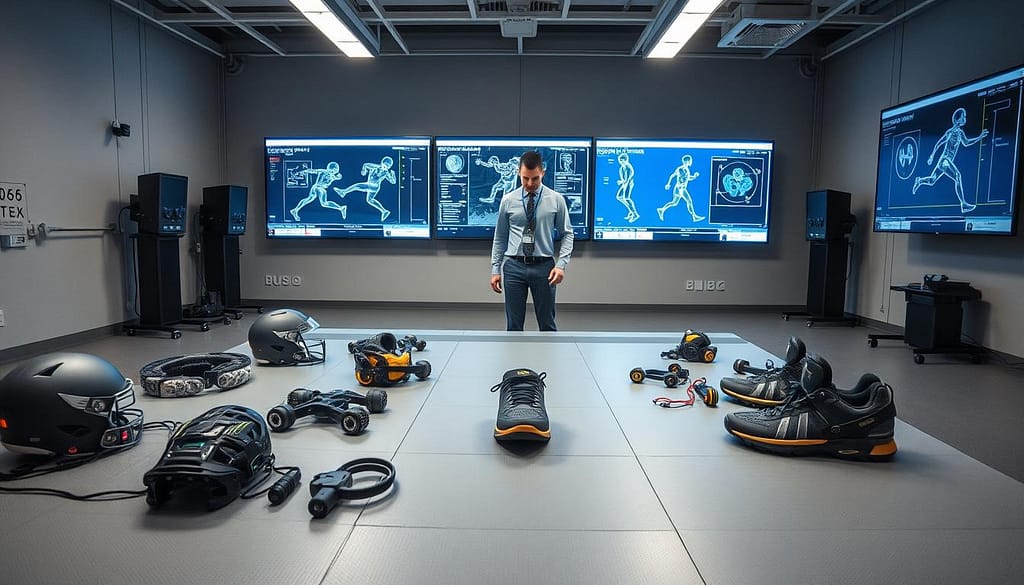
To make sense of the data flood, we break down key biomechanical metrics. The table below shows how specific measurements directly inform the sports gear validation process.
| Biomechanical Metric | Typical Value / Focus | What It Measures | Impact on Gear Design |
|---|---|---|---|
| Joint Angle Range | Mean ~112.3° (e.g., knee flexion) | Freedom and natural range of motion during activity. | Informs flexibility of materials and placement of seams or pads to avoid restriction. |
| Muscle Activation | Mean ~43.2% in primary stabilizers | How hard specific muscles work to maintain form or stability. | Guides support structure placement; over-activation can signal inefficiency caused by gear. |
| Impact Force Attenuation | Peak G-force reduction | How well equipment absorbs and disperses shock from ground contact or collisions. | Directly drives material selection and cushioning system geometry for injury prevention. |
| Kinematic Sequencing | Order and timing of body segment movement | The fluidity and coordination of an athlete’s motion pattern. | Reveals if gear disrupts natural kinetics, leading to redesigns for better dynamic fit. |
The goal is clear. We’re moving past asking if gear survives the machine. Now we ask if it helps the athlete thrive. This integrated, data-driven approach is the future of creating equipment that feels invisible and performs brilliantly.
Environmental Testing Requirements
Environmental testing is where athletic gear meets its maker—or its breaker. We’re not just simulating a game; we’re simulating a world tour of worst-case scenarios. It’s like Survivor, but with less voting and more data logging. The goal is to ensure that a helmet, shoe, or piece of padding won’t quit when the weather does.
This rigorous process is a non-negotiable pillar of credible equipment certification and a core component of modern safety testing protocols.
Passing these trials isn’t just about bragging rights for durability. It’s a sustainability play. A product that survives harsh conditions gets replaced less often. That means less waste.
So, while we’re torturing gear in the lab, we’re also quietly designing for a longer, greener life cycle. Mother Nature, it turns out, is the ultimate quality assurance manager.
The Thermal Rollercoaster: Temperature Cycling
Your gear needs to perform in Arizona in August and Norway in February. Temperature cycling tests that. We slam equipment between Saharan heat and Arctic chill in rapid succession.
This isn’t just about comfort. It’s about material integrity. Polymers become brittle in the cold and pliable in the heat. Seals can fail. Glues can soften. A failure here isn’t a minor defect; it’s a safety crisis waiting for the wrong climatic extreme.
The Slow Soak: Humidity Exposure
Forget a quick rain shower. Humidity exposure is the slow, corrosive embrace of a perpetually damp locker room or a tropical regatta. It’s a test of patience and resistance.
Moisture seeps into everything. It can cause metals to corrode, fabrics to mildew, and composites to delaminate. If your equipment can’t handle the muggy aftermath of a team sweat session, it won’t last a season.
UV Degradation: The Silent Killer
The sun is a relentless foe. UV degradation testing simulates years of stadium sunshine in a matter of weeks. UV rays don’t just fade colors; they break down molecular bonds in plastics, rubbers, and textiles.
This leads to embrittlement, cracking, and a catastrophic loss of strength. A sun-bleached helmet might look vintage, but its protective capabilities are likely compromised. We test to ensure materials have the internal sunscreen to fight back.
Chemical Resistance: The Stain of Victory
Athletics is messy. Chemical resistance testing prepares gear for everything from chlorine and sweat to grass stains and spilled energy drinks. These substances can be surprisingly aggressive.
They can degrade surfaces, weaken fibers, and cause unexpected material interactions. A safety testing protocol that ignores chemical exposure is ignoring the very reality of sports.
To make sense of this gauntlet, here’s how these tests break down in the lab:
| Test Type | Simulated Condition | Primary Risk | Key Metric Measured |
|---|---|---|---|
| Temperature Cycling | Extreme hot/cold transitions | Material cracking, seal failure | Thermal expansion coefficient |
| Humidity Exposure | Constant high moisture | Corrosion, mold growth | Moisture absorption rate |
| UV Degradation | Prolonged sunlight exposure | Polymer breakdown, fading | Tensile strength retention |
| Chemical Resistance | Contact with acids, bases, salts | Surface degradation, staining | Change in mass & hardness |
Ultimately, conquering these environmental hurdles is what separates a prototype from a certified product. It provides the hard data that justifies equipment certification. When you see that stamp of approval, you’re not just seeing a pass on impact tests.
You’re seeing proof that the gear has already weathered a storm—literally—and lived to tell the tale.
Quality Control Systems: The Conductor’s Baton
Imagine a symphony where every violin is perfectly tuned. That’s what quality control systems do in a factory. They make sure every part works perfectly, every time. This isn’t about creativity. It’s about ruthless, data-driven repetition.
Today, quality control uses digital tools like automation and digital twins. These tools help make sure products are made right, meeting athletic equipment standards without fail.
Statistical Process Control & Batch Testing: The Math of Consistency
Quality control starts with math, not feelings. Statistical Process Control (SPC) finds small problems before they become big ones. It’s like a math detective.
Batch testing is like a random check on the production line. If a few units pass, the whole batch is good. But if they fail, the whole line stops. This method keeps quality high across many units.
Continuous Monitoring & Defect Detection: The Always-On Nervous System
The factory has a live nervous system thanks to continuous monitoring. It uses sensors and digital models to watch production in real-time. It’s like a Fitbit for the factory.
Automated defect detection is the final check. It uses cameras and AI to find small problems that humans might miss. This double-check ensures products are top-notch.
A strong quality control system does more than just find errors. It builds a culture of excellence. It means every product is reliable, no matter how many are made.
Performance Validation Methods
If the lab is like a rehearsal studio, performance validation is like opening night on Broadway. It’s live, with no safety net, and critics watching. This is where our simulations meet the real world of sports. It’s the ultimate sports gear validation, asking if it works in real life.
Field Testing: The Empirical Crucible
You can practice a mountain descent many times, but only the real thing tells you if it works. Field testing is key to moving from theory to reality. We take the prototype out of its safe space and test it in the wild.
This isn’t just a quick test. True validation needs long-term studies. We check how the helmet holds up after many tackles. We see if the shoe’s midsole changes over long runs. This data is priceless, showing things lab tests can’t.
The Human Algorithm: Athlete Feedback
While sensors measure forces, the athlete’s feelings are priceless. A pro saying the gear feels off or too stiff is giving us unique data. This feedback is the heart of performance testing methods.
Structured feedback sessions turn feelings into useful insights. It’s like medical tech validation, checking if the gear is truly useful. Does it boost confidence or ease the mind? That’s what no simulation can fully capture.
Closing the Loop: Analysis and Effectiveness
The final step is a tough comparison. Comparative analysis puts your gear against the best in the market. It’s not about being different; it’s about being better under tough conditions.
Then, we check effectiveness. Did our design really protect the knee? Did the fabric keep athletes cool for 90 minutes? This shows if our product is truly validated.
Regulatory Compliance
Getting a certification isn’t just a logo on a box. It’s a promise of safety backed by lots of paperwork. It’s about following the law and making sure your product is safe and reliable.
This process builds trust with customers. Nothing hurts a brand’s reputation more than a recall or lawsuit.

Think of it as the final exam for your gear. You’ve passed the science and impact tests. But can you pass a lawyer’s or inspector’s scrutiny?
This section isn’t about red tape. It’s about making your product safe and reliable.
The Gatekeepers and Their Gauntlet
Certification bodies are like the industry’s bouncers. They decide who gets in. The Safety Equipment Institute (SEI) for helmets, FIFA for soccer balls, and ASTM International for materials each have their own rules.
Getting their seal is a detailed process. It starts with a formal application and submitting prototypes that have passed internal sports equipment testing. Then, an independent audit is done by the certifying body’s labs.
After that, a review committee checks all the data. They decide if your product gets their mark or not.
| Certification Body | Primary Sport/Focus | Key Standard | Typical Approval Process Steps |
|---|---|---|---|
| Safety Equipment Institute (SEI) | Cycling, Equestrian Helmets | ASTM F1447 | Application, lab testing audit, quality manual review, ongoing surveillance. |
| FIFA | Soccer Balls | FIFA Quality Programme | Batch sample submission, circumference/weight/rebound tests, durability chamber assessment. |
| ASTM International | General Materials & Performance | Various (e.g., F1937 for faceguards) | Design to published standard, third-party lab verification, self-certification with test data. |
| World Rugby | Rugby Headgear, Posts | World Rugby Regulation 12 | Laboratory testing for impact attenuation, submission of full technical dossier, licensing agreement. |
Documentation Requirements: The CYA Library
Documentation is key. It’s your “Cover Your Assets” library. You need technical files, risk assessments, test reports, and quality records.
This paper trail proves your case to the gatekeepers. It also shows you’ve done your homework. Using data from the advanced sensor landscape in these reports is smart. It shows you understand how your product works in real life.
Liability Considerations: The Legal Shield
Liability is a big deal. A strong compliance file is your legal shield. It shows you followed standards and acted responsibly.
This builds trust with customers. Trusted brands face fewer lawsuits. Your compliance documents prove your product is safe.
So, regulatory compliance isn’t just about following rules. It’s about making a product safe and reliable. It’s the ultimate quality control, both on the factory floor and in public promise and legal accountability.
Advanced Testing Technologies
Testing athletic gear used to be slow and manual, like reading a phone book. Now, labs are like mission control for Mars rovers. We’ve moved from clipboards to a world where robots and algorithms lead the way. This change is not just an upgrade; it’s a revolution in safety and performance.
The new guard includes automation and artificial intelligence. They don’t just run tests. They think about them.
Automated Testing Systems: The Robotic Workhorse
Forget the technician dropping a weight on a helmet over and over. Modern automated testing systems are relentless, precise, and never need a break. Robotic arms do complex impact sequences, and machines apply force with incredible accuracy. Vision systems also scan for defects that human eyes might miss.
This results in amazing consistency. Every product in a batch gets the same rigorous test. This means no human error in safety. Plus, what took weeks now happens in days, speeding up innovation and getting safer gear to athletes faster.
| Testing Aspect | Old Manual Method | Modern Automated System |
|---|---|---|
| Precision & Repeatability | Subject to human fatigue and slight variations. | Robotic execution ensures identical test conditions every single time. |
| Throughput & Speed | Slow, limits batch size and innovation pace. | High-speed, 24/7 operation dramatically reduces time-to-results. |
| Data Collection | Manual recording, prone to gaps or errors. | Integrated sensors capture vast, precise datasets automatically. |
AI-Enhanced Analysis: From Data to Wisdom
All those robots generate a lot of data. This is where AI-enhanced analysis comes in, like a brilliant detective. Machine learning algorithms look through millions of data points from stress tests and more. They find patterns and correlations that humans can’t see.
For example, an AI might find a link between a fabric weave and wear. This changes testing from a simple gatekeeper to a predictive partner in design. Engineers get feedback that helps them improve their designs.
Real-time Monitoring and Predictive Analytics
The story doesn’t end in the lab. The next step is putting the lab on the athlete. Embedded sensors in equipment, like smart helmets, create a continuous real-time monitoring stream. This live data tells us what’s happening during actual use, not just in tests.
With predictive analytics, we have a crystal ball for maintenance and safety. Algorithms analyze real-time stress data against historical failure models. They can predict when gear is likely to fail, leading to smarter maintenance.
Together, these technologies create a feedback loop of unmatched intelligence. We’re not just building tougher equipment; we’re building *smarter* equipment that almost understands the game it’s playing.
Innovation in Testing Methods
The old build-break-repeat cycle is over. Today, we use virtual prototypes and digital foresight for engineering excellence.
Virtual testing and simulation, like Siemens’ Simcenter, let us test many digital versions before making one real one. This way, we can test for years in just days. It gives us a complete view, changing how we test for safety and performance.
AI helps us understand more. Machine learning, like in M_adaptive for physiotherapy, finds patterns we can’t see. It helps us monitor and predict in real-time. This leads to better data processing for testing, making insights from numbers.
This new approach is faster, cheaper, and smarter. It’s a shift where the toughest tests happen in computers, before athletes use the gear.