
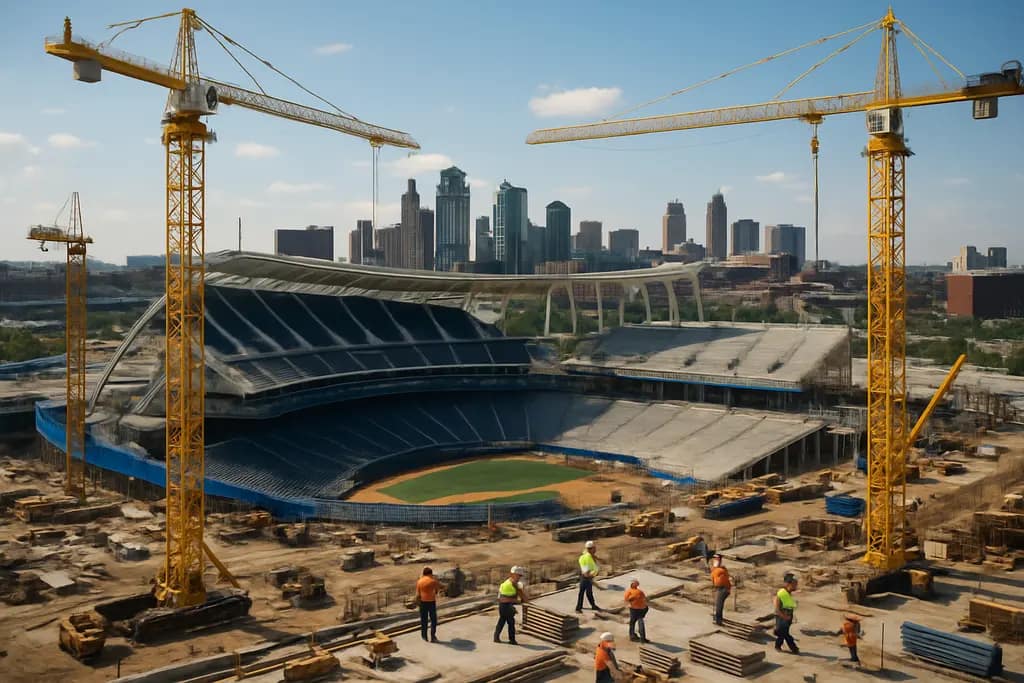
As of September 24, 2026, Royals stadium funding rested on a public-private model that carried clear sports-business ambition and equally clear public exposure. The proposed Kansas City Royals ballpark and supporting Crown Center development were estimated at about $1.9 billion, with public sources covering roughly 60% and the Royals plus private partners covering roughly 40%, according to the published funding breakdown from KSHB. For a baseball club seeking a new venue before the Kauffman Stadium lease expires, the project offered a path toward a different game-day district. For taxpayers, it asked a harder question: how much public risk is acceptable if the promised economic activity depends on district performance over three decades?
My lens here is not anti-stadium. Modern venues can change fan movement, athlete facilities, broadcast operations, sponsor inventory and neighborhood foot traffic. Yet public finance in sports needs the same discipline teams apply to player performance data. A projection is not a result. A district forecast is not cash in hand. A sustainability claim is not settled unless it includes measurable energy, water, transport, construction and maintenance standards.
Royals Stadium Funding By The Numbers
Royals Stadium Funding Split
The headline split framed the entire deal. The total stadium and supporting development cost was estimated at roughly $1.9 billion. Public funding was expected to cover about $1.14 billion, while the Royals and private partners were expected to contribute about $760 million. The City of Kansas City’s commitment was described as $600 million: $510 million through bonds for the stadium and related facilities, plus $90 million for infrastructure tied to the project.
State support was also part of the model. The research notes identify expected help through Missouri’s Show-Me Sports Investment Act, including at least about $15.3 million annually over 30 years, or roughly $459 million total, to help repay debt service. The notes also cite up to $148 million in infrastructure funding and tax credits. That structure matters because the public share is not a single check. It is a layered finance package built from bonds, state support, district tax growth, infrastructure commitments and new stadium-related revenue.
Timeline And Lease Structure
The plan targeted groundbreaking in May 2027 and opening for games in March 2030. Those dates placed the project before the end of the current Kauffman Stadium lease. Under the terms described in the research, the city would own the stadium, while the Royals would lease it for 30 years, with potential two-year extensions. The rent figure was $1 per year. The team would assume maintenance and insurance costs, though the notes state that in the final five years of the term, if the lease was not renewed, maintenance obligations could fall to 50% of average annual maintenance costs.
For sports operators, maintenance terms can be as significant as construction headlines. A baseball facility is not static. Scoreboards age, club spaces need refreshes, seating systems require work, player development spaces change and safety systems need replacement. If public ownership remains in place, Kansas City’s risk assessment should include not only bond repayment but also asset condition near the back end of the lease.
Public Risk And Revenue Assumptions
Bond Repayment Exposure
The central public risk in Royals stadium funding is not hard to locate. Kansas City planned to issue tax-exempt bonds for its $600 million share, and the Royals were not obligated to repay those bonds. The research states that shortfalls in bond payments would fall on the city. Bonds were expected to be supported by city appropriations, tax revenues from the Tax Increment Financing district, a proposed new 1% sales tax on stadium sales such as food and merchandise, and incremental growth tied to the project.
That means the model leans heavily on the district doing what the model says it will do. If stadium sales are weaker than expected, if office development lags, if event activity outside Royals games underperforms, or if incremental tax growth comes in below forecast, the public sector has the backstop role. That is a common tension in stadium finance: the private tenant gains a modern venue and related commercial upside, while the public owner carries repayment exposure if projected activity does not arrive on schedule.
Economic Output Versus Fiscal Return
The economic case was substantial on paper. MLB.com reported projections of at least 2,000 construction jobs, about $1.4 billion in labor income and $2.8 billion in economic output during construction; year-one operations were projected at about $185 million in local economic output, including $117 million from game days and events and $68 million from out-of-town visitor spending, with longer-term district operations projected to support about 2,200 new office jobs, roughly $200 million in annual labor income and about $500 million in annual economic output through the Royals’ released data and renderings on MLB.com.
Those figures are useful, but they are not the same as net public return. Economic output measures activity. It does not automatically show whether city revenues exceed city costs, whether activity is new to the region rather than shifted from another Kansas City entertainment district, or whether the timing of tax receipts matches debt service requirements. A careful assessment should separate three questions: what construction activity occurs, what recurring activity is truly incremental, and what cash is available to pay public obligations.
- Public upside: new tax activity, infrastructure upgrades, visitor spending and a denser sports district if demand meets projections.
- Public exposure: bond repayment shortfalls, slower-than-expected district growth and long-term asset risk under city ownership.
- Private upside: a new MLB venue, lease stability, adjacent development value and modernized fan revenue opportunities.
Sustainability And Community Tests

What The Community Package Covers
The community commitments in the research notes totaled at least $55 million over 30 years. The cited allocations included $5 million each to the Negro Leagues Baseball Museum and Housing Gateway, $14 million to One Percent for the Arts, and about $1 million per year for broader neighborhood connectivity and benefits. Those commitments are material, but their long duration requires reporting discipline. A 30-year pledge should be tracked by annual payment, recipient, project status and public outcome, not treated as a one-time headline.
The local stakes also extend beyond baseball. Stadium districts affect traffic flows, small business patterns, housing pressure, public space and worker access. Related venue-finance analysis on the impact of the Royals stadium on downtown Kansas City has raised similar questions about jobs, public costs and downtown land use. For readers interested in recreational facilities, more topics are covered within the same network, including detailed exploration of facility features at Copeland Hills Golf.
Where Sustainability Evidence Is Still Thin
From a sustainability standpoint, the available research supports a cautious reading. The plan included infrastructure spending, community benefits and district development assumptions. The notes did not provide verified data on building energy targets, embodied carbon, material reuse, water systems, transit mode share, waste diversion, heat mitigation or construction emissions. Without those measures, any claim that the project advances sports sustainability remains incomplete.
A stadium can reduce environmental pressure if it shifts more trips to transit and walking, uses lower-carbon materials, cuts operational energy, manages stormwater well and avoids waste-heavy construction practices. It can also increase pressure if it induces car travel, consumes large volumes of concrete and steel, or shifts public investment away from more efficient neighborhood infrastructure. The difference is not branding; it is measured performance. For a project of this scale, Kansas City and the Royals should be expected to publish targets before construction and results after opening.
Royals Stadium Funding Accountability
Metrics That Should Be Public
The fairest test of Royals stadium funding will come from disclosures that compare actual results with the original model. The public should be able to see annual bond repayment sources, TIF revenue, 1% stadium-sales-tax collections, infrastructure spending, team maintenance spending, event counts and district vacancy data. Community-benefit payments should be reported in plain categories. Sustainability reporting should include energy use, water use, waste diversion, transport mode share and construction material data.
That kind of reporting would not settle every policy dispute. Some residents may object to a 60% public share on principle. Others may support the project if it keeps the Royals anchored in Kansas City and produces a stronger downtown sports district. But transparent measurement would reduce the fog around the deal and make it harder for either side to overstate the evidence.
The financial model is ambitious, but it is not risk-free. The Royals receive a long-term stadium solution with low rent and no obligation to cover bond shortfalls. The city receives ownership of a major sports asset and a chance at district growth, while accepting repayment exposure if assumptions miss. That trade is the core issue. If the stadium opens in March 2030 as planned, the early fan experience will matter. The larger test will be whether the public balance sheet, neighborhood commitments and sustainability metrics still look sound five, 10 and 30 years later.