
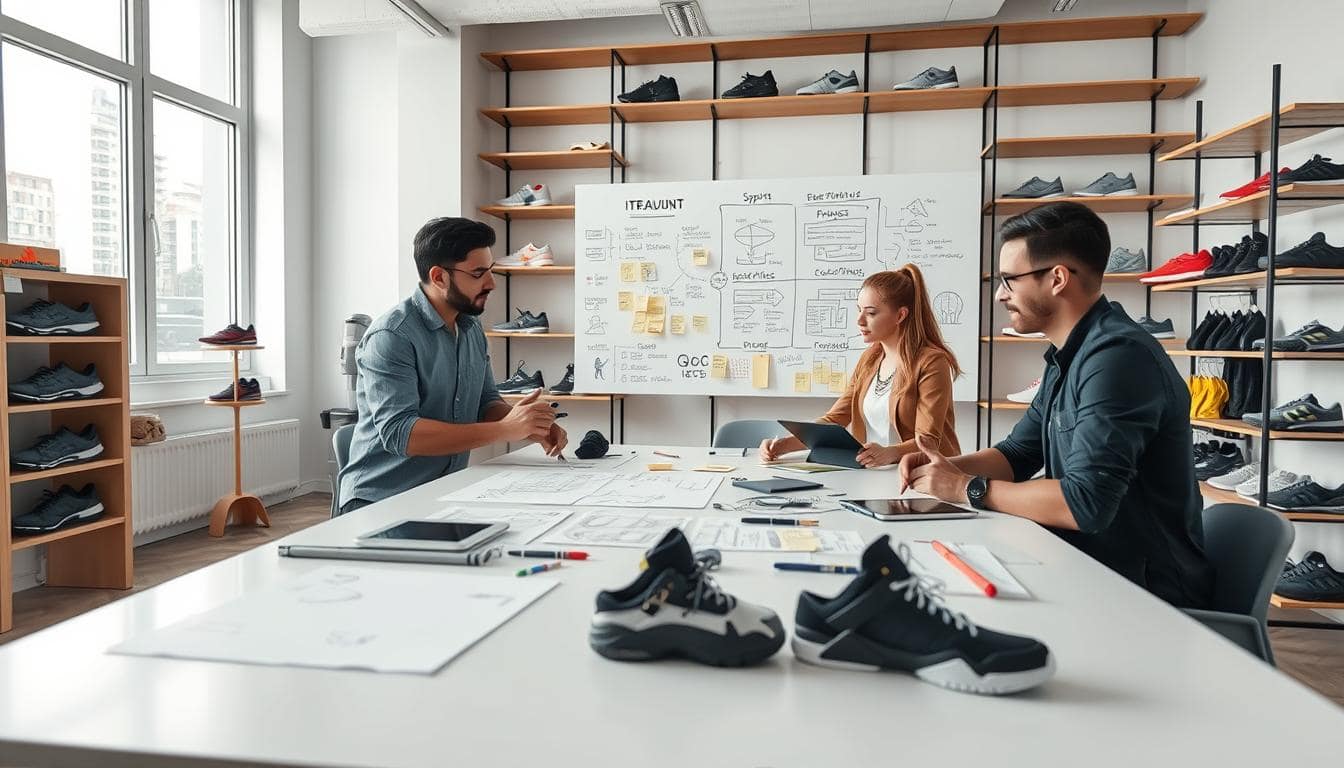
When people hear “design thinking,” they often imagine a brainstorming session in Silicon Valley. There are too many Post-it notes and a kombucha tap. But in sports product development, it’s all about speed, not just vibes.
The global sports technology market is expected to hit USD 140 billion by 2030. The numbers are clear.
In the last decade, 65,700 sports-related inventions have been patented. This growth is 7.6% each year. From golf to swimming, innovation is everywhere. New materials and sensors are changing how we perform.
Design thinking frameworks guide us. They help turn ideas into real products. We go from “what if?” to “what’s next?”
These frameworks ask deeper questions. Not just “can we make this lighter?” but “should we, and for whom?” This section will show how these ideas become market-ready products.
User-centered design principles
What if I told you that the future of sports gear hinges not on flashy designs but on the very athletes who use them? User-centered design is more than a buzzword; it’s a philosophy that can transform the sports technology landscape. It emphasizes a truth: we must listen to the athletes who will actually sweat in our gear.
In a world where performance tracking and monitoring devices account for a staggering 33% of football patents, the stakes are high. Wearable technologies, like GPS trackers and biometric monitors, are no longer just cool gadgets. They are essential tools that provide insights into an athlete’s performance and health. But let’s not forget the para-athletes, whose needs are just as vital. Adaptive technologies—think custom prosthetics, sport-specific wheelchairs, and assistive robotics—are not merely innovations; they are lifelines that expand participation and enhance performance.
Here’s a radical thought: the athlete is not just a crash-test dummy with a sponsorship deal. User-centered design means we actually talk to these athletes and, brace yourself, we listen. Too often, we see “innovations” that look stunning in a pitch deck but fail miserably in real-world applications. Remember that smart insole that couldn’t survive a puddle? Exactly.
Empathy maps and athlete personas are as critical as CAD software in this design thinking process. We need to understand the physical and emotional landscapes athletes navigate daily. Whether it’s a footballer whose every sprint is tracked or a para-athlete requiring specialized equipment, the principle remains the same: design with, not for.
Ultimately, a product that doesn’t solve a real problem is just expensive landfill. By embracing user-centered design principles, we can create equipment that not only meets the athletes’ needs but also enhances their performance and experience.
Rapid prototyping techniques
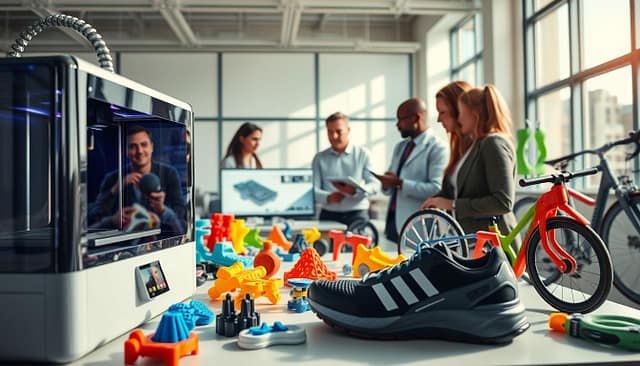
Imagine being able to test and refine sports equipment in the blink of an eye—welcome to rapid prototyping. This technique is changing how we innovate in sports technology. We’re moving away from slow, old methods to a fast world where ideas are tested and improved in days.
Hawk-Eye Innovations is a great example. What began as a cricket ball-tracking system has grown into a platform for multiple sports. This happened thanks to quick changes. In the time it takes to debate a VAR call, a team could have 3D-printed several new shin guard designs. This is sports innovation at its fastest!
The key is to fail fast and learn even faster. With methods like additive manufacturing and virtual simulation, we can test many ideas quickly. Watching a golf club head break at 150 mph is a harsh lesson. It shows speed is about beating your own doubts, not just others.
| Prototyping Technique | Benefits | Typical Applications |
|---|---|---|
| Additive Manufacturing | Quick production of complex designs | Custom sports gear, protective equipment |
| Virtual Simulation | Real-time testing and feedback | Equipment performance analysis |
| 3D Printing | Rapid iteration and low-cost prototypes | Footwear, helmets, and accessories |
In conclusion, rapid prototyping is more than a trend; it’s a major change in sports equipment design. It lets us keep up with athletes’ and coaches’ needs. So, the next time you see new sports gear, remember it might have come from a week of trial and error, fueled by lots of coffee!
Material innovation and testing
From golf clubs to swimsuits, material innovation is key in sports product development. Golf equipment makes up 57% of golf patents. This is because golfers are always looking for the perfect ball.
It’s not just about looks; it’s about how well the ball performs. In swimming, 19% of patents focus on fabrics that cut through water better. These fabrics are inspired by shark skin, showing how nature helps us create better products.
Racket sports also see a lot of innovation, with 49% of patents for equipment. New strings are made to give players more power and control. Engineers test these materials to make sure they can handle the game.
So, what makes a new material stand out? It’s all about testing. We need to know if it really helps you perform better. In sports, where time is everything, feeling fast isn’t enough. It has to be proven by science.
In the end, the mix of polymers, alloys, and smart textiles is changing sports. Each new material not only improves performance but also shows the competitive spirit. Next time you use a golf club or wear a swimsuit, think about the science behind it.
Performance validation methodologies
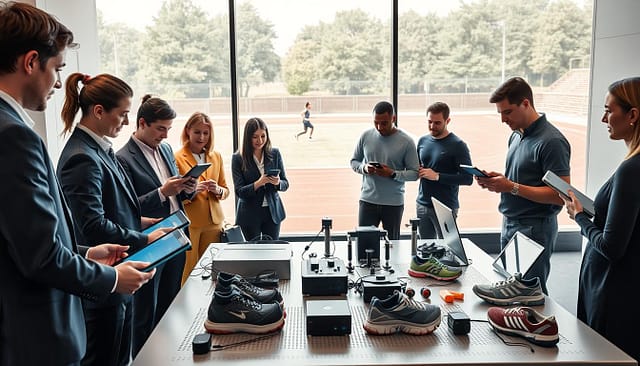
Performance validation is more than just a buzzword; it’s the core of trustworthy sports technology. Without it, how can we be sure that your new tennis racket is truly better?
Think about this: a huge 37% of swimming patents are about monitoring systems, like underwater cameras and sensors. In racket sports, 35% of patents are for analytics that guess what opponents will do. This shows how important design thinking is in making products.
Performance validation is the essential step that makes the difference between real science and fake promises. Companies that ignore this step often face ridicule online. How do we know our claims of “faster” are true? The answer is in thorough testing methods.
- Biometrics: These metrics give us insights into how well we perform, making sure our claims are supported by data.
- Motion Capture: This tech tracks movements to check if our technique has improved.
- Statistics: Numbers show us the real effect of a product on our performance.
For example, in football, VAR and goal-line systems have changed how games are officiated, adding fairness. This same strict approach is used to check if a running shoe really returns more energy. In sports tech, data doesn’t care about your marketing budget; it only looks at results.
In conclusion, performance validation is about making sure our claims are not just empty words but are proven by solid evidence. It’s the Moneyball moment for sports equipment—where every claim is supported by data, not just hope.
Intellectual property considerations
In sports tech, intellectual property is key, not just a legal formality. Over the last decade, 65,700 sports inventions have been patented. There are also 1.25 million trademarks and 70,300 designs. It’s a race where your patents protect you.
Startups often overlook provisional patents, losing their unique ideas. A new golf club face can be worth millions. The real battle is in the patent office, not on the field.
Now, let’s explore the types of intellectual property that protect your innovations:
| Type of IP | Description | Examples |
|---|---|---|
| Utility Patents | Protects new inventions or functional improvements. | Sensor algorithms, unique equipment designs |
| Design Patents | Covers the ornamental design of a functional item. | The swoosh on athletic gear |
| Trademarks | Protects brand identifiers, like logos and slogans. | Brand names, logos on apparel |
Gengee’s CEO says, “We protect our core innovations to transform every touch into a data-driven language.” Hawk-Eye’s CEO adds, “IP is central to protecting our unique computer vision.” These views show that IP is vital for a sports tech business.
In a world of constant innovation, knowing your IP is key. A trademark is more than a logo; it’s a promise of quality. So, as you enter sports tech, protect your innovations with all your might.
Market research and user feedback
Market research is the unsung hero of sports product development. Without it, we risk creating products that might as well be designed for a different planet. It’s just as important to know what athletes want as it is to know how to make the product. After all, what good is a cutting-edge sports product if no one wants it?
Over the past decade, sports trademarks have seen a remarkable 6.1% annual growth. This growth is largely driven by apparel and footwear, which are not just functional but also a statement of identity. The global sports market is currently valued at $417 billion and is expected to soar past $600 billion by 2030. Clearly, the stakes are high.
Smart companies use various methods to tap into the minds of their users. Here are some key strategies:
- Social Listening: Monitoring social media platforms to gauge athlete sentiments and preferences.
- Sweat-Testing Panels: Engaging athletes in real-world testing to gather genuine feedback.
- Focus Groups: Bringing together target users to dissect and critique product designs.
Each click and comment on digital platforms transforms into valuable market research data. This information helps shape product development, ensuring that companies are not just creating for the sake of innovation but are responding to real needs. Your next great idea is probably already being complained about on Twitter.
In conclusion, market research and user feedback are not just optional steps in sports product development; they are essential. They keep us grounded and focused on what truly matters—the athletes and their experiences. For a deeper dive into how these insights can be harnessed, check out this resource.
Sustainability in sports tech design
Sustainability in sports tech is more than just a trend; it’s essential for our planet. In the UK, 90% of sports gear ends up in landfills. Globally, 7,000 tonnes of sports equipment reach the end of their life each year. The 2022 FIFA World Cup alone produced 3.6 million tonnes of CO₂ emissions. This is not just a carbon footprint; it’s a massive carbon impact.
So, how do we solve this problem? Design thinking is a powerful method that makes sports tech more sustainable. Here are some key strategies:
- Smart Venue Systems: These innovations cut down on waste and energy use, making events both green and exciting.
- Automated Irrigation: This tech saves water and makes sports fields more sustainable.
- Circular Material Strategies: Using materials that can be recycled or reused at the end of their life cycle reduces landfill waste.
Extreme E and Formula 1 are racing towards net-zero emissions. These efforts are not just about racing. They show a shift towards more responsible practices in the industry. The truth is, performance and planet often conflict. But with smart design, we can make sustainability a competitive edge.
It’s time to innovate without harming the planet. By exploring better materials and end-of-life programs, we can create a future where winning doesn’t harm the environment. Let’s make sustainability a core value in sports tech design.
For more on how innovation in sports can promote inclusion and sustainability, read this informative article.
Collaboration with athletes and coaches
The idea that one person can invent everything is a myth in sports tech. Athletes and engineers working together is key. They turn ideas into real game-changers. Imagine a Paralympian improving a prosthetic or a coach fixing a swimsuit issue.
Federations, clubs, and sponsors team up, creating a great place for innovation. Groups like UNESCO and Laureus Sport for Good are leading the way. They focus on making sports tech better for everyone, like prosthetics and adaptive gear.
From top training camps to local programs, the work is diverse. Athletes and coaches talking is essential. The whole sports world, including TV and government, helps or hinders this teamwork. So, talking with coaches is vital for good design. For more on sports tech, see this resource.