
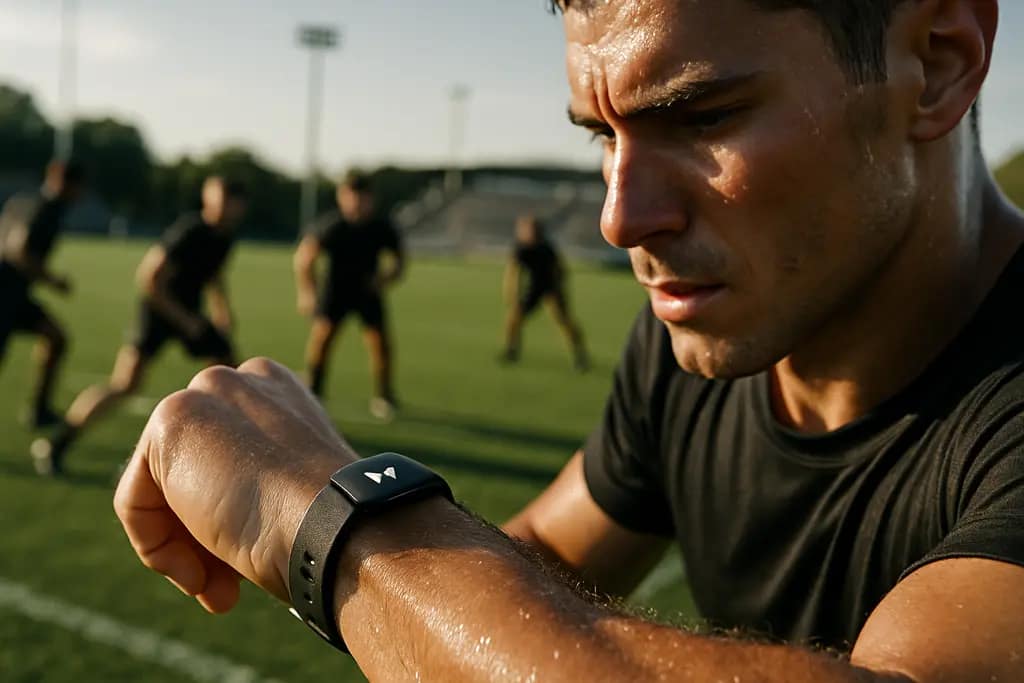
Training camp wearables moved closer to the center of player development in 2026, especially in football, where workload, speed, acceleration, and recovery signals are being read alongside film and coaching evaluation. The shift is useful, but it should not be treated as a perfect scouting lens. Data can sharpen questions about readiness and fatigue; it cannot replace position coaching, medical review, or context from practice design.
The strongest public evidence comes from football. The NFL said its Digital Athlete launched in January 2026 and gives all 32 clubs tools that combine video and wearable data from training, practice, and games to support injury-risk prediction and workload monitoring through the league’s Digital Athlete program. That matters during camp because roster decisions often depend on small differences: whether a rookie handles repeated high-intensity reps, whether a veteran needs a reduced workload, and whether a position group is accumulating too much exposure before games count.
What Training Camp Wearables Actually Measure
From Shoulder Pads To Workload Signals
The most visible football system is not a wrist device. NFL performance tracking uses Next Gen Stats, with RFID tags in players’ shoulder pads and ultra-wideband receivers in stadiums. The system captures player location, speed, and acceleration 10 times per second on every play, according to NFL Football Operations. During camp, those signals can help staff compare practice demands against the movements a player will face in games.
For a wide receiver, the useful question is not just top speed. It is how often he reaches high-speed running, how he decelerates, and whether he can repeat those bursts across team periods. For an offensive lineman, location and acceleration data may be interpreted differently, with attention to short-area load, repeated contact periods, and changes in movement across practice blocks. Public league sources do not provide team-by-team camp thresholds, so any claim that one number decides a roster spot would be unsupported.
Why Per-Snap Context Matters
A July 28, 2026 study in the Journal of Sports Sciences tracked external training loads in Division I NCAA football using wearable devices across 232 players, 10 seasons, and 4,084 player-game observations. The study found that total load increased with game exposure, while per-snap loads decreased as exposure rose. That finding is relevant to camp evaluation because a player taking more reps may show a higher total load without necessarily showing higher intensity on each rep.
This distinction can protect player development from lazy readings of dashboards. A rookie who takes 50 snaps in a practice may have a higher total number than a veteran on 25 snaps, but the per-rep demand could tell a different story. Coaches and performance staff need both views: total exposure to manage accumulation, and intensity measures to judge how a player responds to football-specific work.
Training Camp Wearables And Development Decisions
Training Camp Wearables In The Meeting Room
Training camp wearables are most useful when their data enters a disciplined review process. A strength staff may see a spike in acceleration load. A position coach may know the player was covering a difficult route tree or taking extra special-teams reps. A medical staff may know the athlete reported poor sleep or soreness. The number gains value only when those groups compare notes without turning a single metric into a verdict.
The research base outside football also points toward cautious use. A Frontiers in Physiology paper published on February 18, 2026 collected 12 weeks of data from 48 university soccer players across 536 training sessions and 24 matches. The researchers used GPS, heart-rate monitors, and self-reports, and reported that an XGBoost model predicted fatigue with an ROC AUC of 0.895. That result is promising, but it came from university soccer, not an NFL camp. Translation across sports, ages, and competitive environments needs care.
In team settings, analytics can support player development in three grounded ways:
- Workload comparison: Staff can compare a player’s camp volume against his own prior sessions and against position demands.
- Readiness review: Sleep, heart-rate variability, and subjective fatigue can be paired with field data where teams use platforms that collect those measures.
- Practice adjustment: Coaches can reduce or redistribute reps when accumulated load appears out of line with the day’s objective.
As of February 9, 2026, Garmin’s Firstbeat Sports platform allowed NBA, NFL, and NHL teams to integrate sleep duration, sleep scores, and heart-rate variability from Garmin wearables into performance dashboards. That does not mean every team uses the same system or values the same markers. It does show that recovery data is moving closer to football and other pro training environments, where the old camp model of simply surviving volume is being challenged by more measured planning.
For readers who want the broader analytics angle, our related piece on smart analytics platforms covers how performance dashboards can shape training decisions without pretending that software is a coach.
Safety, Privacy, And Sustainability Checks
Player Safety Is Not Just A Dashboard
The NFL’s Digital Athlete gives clubs daily training volume and injury-risk information, according to the league’s January 2026 materials. That is a meaningful development for camp safety because coaches can see whether a player’s workload is rising faster than planned. Still, the phrase “injury-risk information” should be read carefully. Public sources do not show the exact model features, thresholds, or team-specific interventions. A risk flag is a signal for review, not a diagnosis.
The same caution applies to youth and transition cases. A case study of an 18-year-old Major League Soccer fullback moving from youth to senior competition found large variability in external load during preseason and in-season phases. Because it was a case study, it is useful as a reminder, not a universal rule. Young players may face uneven exposure as they move between squads, training roles, and match availability. That is exactly where athlete monitoring can help staff notice patterns that are hard to see from memory alone.
The Sustainability Test For Sports Tech
Wearable systems can support sustainability only if teams ask practical questions. If better workload planning reduces unnecessary extra sessions, travel between facilities, or redundant testing, there may be resource benefits. Public research in the supplied record does not quantify those environmental savings, so they should not be overstated. The clearer sustainability issue is procurement: sensors, tags, batteries, chargers, tablets, and data infrastructure all have material and energy costs.
Teams should ask vendors how devices are repaired, reused, recycled, and retired. They should also ask whether data storage policies keep information longer than needed. Sports technology is often judged by competitive value first, but sustainability requires a life-cycle view. A club that buys new devices every camp without a recovery plan is shifting waste downstream. A club that extends device life, standardizes charging equipment, and limits unnecessary data retention is at least applying pressure in the right places.
That lens is not limited to football. Golf facilities, youth academies, and multisport venues face the same tension between better measurement and more equipment. A related sports property such as Copeland Hills Golf illustrates why venue operators across sports need to connect performance services with practical resource management.
Training Camp Wearables In 2026 Player Development
By August 21, 2026, the public record supported a measured view: training camp wearables help teams monitor workload, speed, acceleration, recovery markers, and fatigue risk, but they do not remove uncertainty from player development. The best use case is not replacing coaches. It is helping coaches see whether practice exposure matches the development plan.
For roster evaluation, the fair question is not “What does the device say?” It is “Does the data match what the staff saw on film, heard from the athlete, and planned for that practice?” If the answer is yes, the data can confirm a trend. If the answer is no, the disagreement may be the most useful part of the process. That is where a staff can revisit drill design, rep counts, recovery, or the player’s technical execution.
The next pressure point is governance. Players need to know what is collected, who can see it, how long it is stored, and whether it can affect contract or roster decisions. The February 2, 2026 review of professional soccer research noted benefits such as performance improvement, better decision-making, and transparency, while also flagging concerns around emotion, data privacy, and stress. Those concerns belong in football camp conversations too. Data that helps a player train better can also feel intrusive if the boundaries are unclear.
The strongest 2026 camp programs will likely be the ones that keep the system human: limited metrics, clear consent practices, shared interpretation, and a sustainability plan for the devices themselves. Wearables can make development more visible. They should also make teams more accountable for how they train, protect, and equip athletes.